




G6PD Deficiency: Symptoms, Causes, Diagnosis, Treatment & Prevention
By Dr. Vishesh Bharucha +2 more

Medically reviewed by Dr. Vishesh Bharucha
Last updated: Sep 10, 2026 Published on: Jul 29, 2026


Get,

to manage your symptom
Get your,

4 Cr+ families
benefitted

OTP sent to 9988776655



You’ve successfully subscribed to receive
doctor-approved tips on
Whatsapp

Get ready to feel your best.


Register to Avail the Offer
Send OTPBy continuing, you agree with our Privacy Policy and Terms and Conditions
Hi There,
Sign up on PharmEasy now!!


Trusted by 4 crore+ families

OTP sent to 9988776655
You have unlocked 25% off on medicines


Code: NU25

By Dr. Vishesh Bharucha +2 more
Table of Contents
Some inherited conditions can remain unnoticed for years, even when they have been present since birth. Glucose-6-phosphate dehydrogenase (G6PD) deficiency is among the most common inherited enzyme disorders worldwide. Many people discover it only after certain medicines, foods, or infections trigger symptoms1,2.
Most people with G6PD deficiency live healthy, normal lives, but recognising triggers is important for preventing complications. This blog covers the symptoms, causes, diagnosis, treatment, and practical tips for understanding and managing G6PD deficiency.

G6PD deficiency is an inherited genetic condition in which the body does not produce enough of the G6PD enzyme, or the enzyme has reduced activity1. When people with G6PD deficiency are exposed to certain triggers (such as specific medicines, infections, or foods like fava beans), their red blood cells (RBCs) can break down faster than the body can replace them. This process (called haemolysis) can lead to haemolytic anaemia (a condition in which the body does not have enough healthy RBCs to carry oxygen effectively)1.
Did You Know?
G6PD helps the body produce a molecule called NADPH (nicotinamide adenine dinucleotide phosphate) through the pentose phosphate pathway. NADPH keeps glutathione, the main antioxidant in RBCs, in its active form. This antioxidant protects RBCs from oxidative stress damage and prevents them from breaking down too early1,6.
Unlike most other cells, mature RBCs cannot make new proteins or generate additional G6PD because they lack a nucleus and other cell structures. As a result, they rely entirely on the G6PD enzyme already present to defend against oxidative stress7. When G6PD activity is too low, exposure to substances that cause oxidative stress, such as certain medications, infections, chemicals, or foods, can damage RBCs and cause them to break down prematurely (haemolysis). This may lead to haemolytic anaemia, reducing the blood’s ability to carry oxygen throughout the body1.
G6PD deficiency is caused by inherited changes (mutations) in the G6PD gene, which provides instructions for making the G6PD enzyme. G6PD deficiency is caused by mutations in the G6PD gene, resulting in reduced or absent G6PD enzyme activity1.
This mutation is triggered by certain factors such as:
Note: More than 400 genetic variants of G6PD deficiency have been identified. These variants differ in the amount of enzyme activity they produce, which is why some individuals never develop symptoms, while others experience severe episodes of haemolysis8.
Most people with G6PD deficiency do not have symptoms unless they are exposed to a trigger. When RBCs undergo haemolysis, symptoms can develop suddenly and range from mild to severe. Common G6PD deficiency symptoms include1,9:
Some babies with G6PD deficiency may develop symptoms shortly after birth, including1:
Rarely, untreated severe jaundice in babies can lead to kernicterus, characterised by permanent brain damage1.
Diagnosis typically involves blood tests that measure G6PD enzyme activity. Based on your symptoms, the doctor may rely on1,10:
Note: G6PD test results may appear normal during or soon after a haemolytic episode because the tested sample could contain more of younger RBCs with higher G6PD activity and a lower proportion of older RBCs with low G6PD levels11. If G6PD deficiency is still suspected despite a normal test result, your doctor may recommend repeating the test after recovery, usually about 3 months later, for a more accurate diagnosis.
Important: Babies with unexplained or severe jaundice may be tested for G6PD deficiency, especially if they have a family history or belong to a high-risk population1,9.
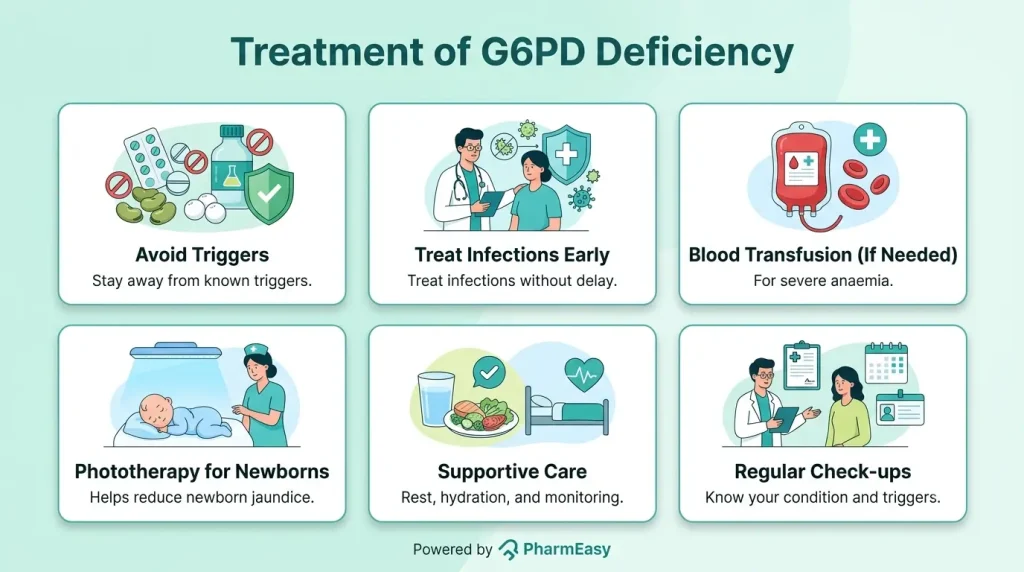
There is no cure for G6PD deficiency. Management mainly focuses on avoiding triggers and treating haemolysis if it occurs. Management options for G6PD deficiency include1,12.
Most people with G6PD deficiency remain healthy if they avoid known triggers. However, repeated or severe episodes of RBC breakdown can lead to complications, including1,4,9:
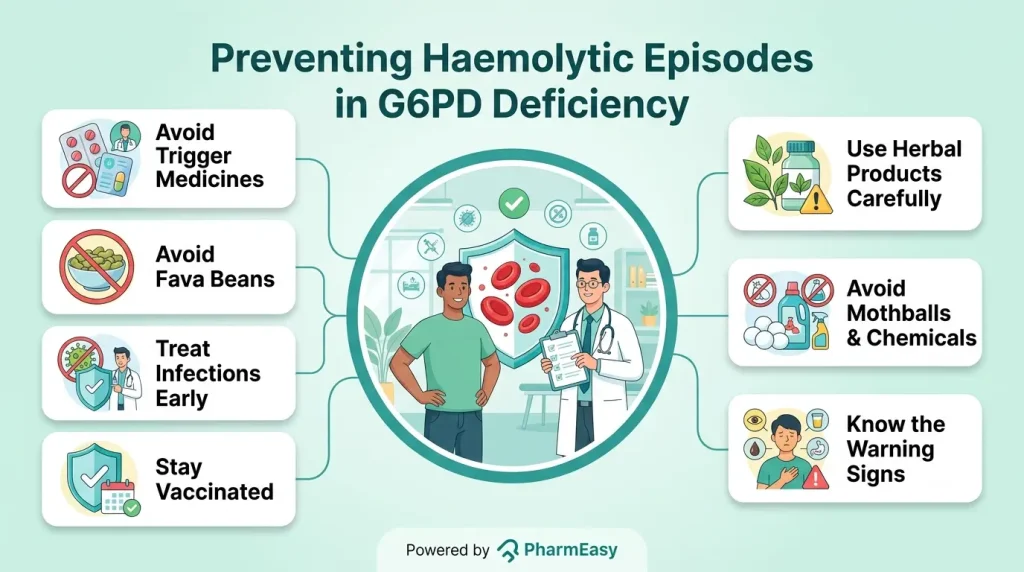
G6PD deficiency itself cannot be prevented because it is an inherited genetic condition. However, episodes of haemolysis can often be prevented by avoiding known triggers9:
Also Read: High Creatinine: Symptoms, Causes, Diagnosis & Treatment
Seek medical attention immediately if you (or your child) have G6PD deficiency and develop signs of haemolysis, especially after exposure to a known trigger. You should see a doctor if you experience9:
Note: For newborns, seek urgent medical care if your baby develops jaundice within the first 24 hours of life, has difficulty feeding, or appears unusually sleepy. Jaundice that develops after the first 24 hours should also be evaluated by a healthcare provider, as early diagnosis and treatment can help prevent complications1,9,13.
Also Read: Low Alkaline Phosphatase (ALP): Symptoms, Causes, Diagnosis & Treatment
G6PD deficiency is a common inherited condition that often remains unnoticed until exposure to certain triggers causes RBC breakdown. Although there is no cure, most people with G6PD deficiency can lead healthy, normal lives by recognising triggers, avoiding high-risk medications and foods, and seeking timely medical care when symptoms occur.
Yes, G6PD deficiency is an inherited genetic condition caused by mutations in the G6PD gene. It is passed down in an X-linked pattern, which is why it is more common in males than females1.
No, G6PD deficiency is a lifelong condition and does not go away with age9,14. However, many people remain symptom-free throughout their lives if they avoid known triggers.
The main danger of G6PD deficiency is acute haemolytic anaemia, in which RBCs break down rapidly after exposure to certain medications, infections, or foods such as fava beans. Severe cases can lead to jaundice, kidney injury, or, in newborns, serious complications such as kernicterus, if left unaddressed1,9.
1. Mak GK, Shah M. Glucose-6-Phosphate Dehydrogenase Deficiency. In: StatPearls. StatPearls Publishing; 2026. Accessed July 15, 2026. http://www.ncbi.nlm.nih.gov/books/NBK470315/
2. Bubp J, Jen M, Matuszewski K. Caring for Glucose-6-Phosphate Dehydrogenase (G6PD)–Deficient Patients: Implications for Pharmacy. Pharm Ther. 2015;40(9):572-574. Accessed July 15, 2026. https://pmc.ncbi.nlm.nih.gov/articles/PMC4571844/
3. Cappellini MD, Fiorelli G. Glucose-6-phosphate dehydrogenase deficiency. Lancet. 2008;371(9606):64-74. doi:10.1016/S0140-6736(08)60073-2 https://medlineplus.gov/genetics/condition/glucose-6-phosphate-dehydrogenase-deficiency/
4. Koromina M, Pandi MT, van der Spek PJ, Patrinos GP, Lauschke VM. The ethnogeographic variability of genetic factors underlying G6PD deficiency. Pharmacol Res. 2021;173:105904. doi:10.1016/j.phrs.2021.105904 https://pubmed.ncbi.nlm.nih.gov/34551338/
5. Awab GR, Aaram F, Jamornthanyawat N, et al. Protective effect of Mediterranean-type glucose-6-phosphate dehydrogenase deficiency against Plasmodium vivax malaria. eLife. 10:e62448. doi:10.7554/eLife.62448 https://pubmed.ncbi.nlm.nih.gov/33543710/
6. Stanton RC. Glucose-6-Phosphate Dehydrogenase, NADPH, and Cell Survival. Iubmb Life. 2012;64(5):362-369. doi:10.1002/iub.1017 https://pubmed.ncbi.nlm.nih.gov/22431005/
7. Karafin MS, Francis RO. Impact of G6PD status on red cell storage and transfusion outcomes. Blood Transfus. 2019;17(4):289-295. doi:10.2450/2019.0092-19 https://pmc.ncbi.nlm.nih.gov/articles/PMC6683872/
8. McDonagh EM, Thorn CF, Bautista JM, Youngster I, Altman RB, Klein TE. PharmGKB summary: very important pharmacogene information for G6PD. Pharmacogenet Genomics. 2012;22(3):219-228. doi:10.1097/FPC.0b013e32834eb313 https://pmc.ncbi.nlm.nih.gov/articles/PMC6683872/
9. Favism. Healthdirect. February 5, 2026. Accessed July 15, 2026. https://www.healthdirect.gov.au/G6PD-deficiency
10. G6PD Test. MedlinePlus Medical Test. Accessed July 15, 2026. https://medlineplus.gov/lab-tests/g6pd-test/
11. Arese P, Gallo V, Pantaleo A, Turrini F. Life and Death of Glucose-6-Phosphate Dehydrogenase (G6PD) Deficient Erythrocytes – Role of Redox Stress and Band 3 Modifications. Transfus Med Hemotherapy. 2012;39(5):328-334. doi:10.1159/000343123 https://pmc.ncbi.nlm.nih.gov/articles/PMC3678266/
12. Garcia AA, Koperniku A, Ferreira JCB, Mochly-Rosen D. Treatment Strategies for Glucose-6-Phosphate Dehydrogenase Deficiency: Past and Future Perspectives. Trends Pharmacol Sci. 2021;42(10):829-844. doi:10.1016/j.tips.2021.07.002 https://pubmed.ncbi.nlm.nih.gov/34389161/
13. Ansong-Assoku B, Adnan M, Daley SF, Ankola PA. Neonatal Jaundice. In: StatPearls. StatPearls Publishing; 2026. Accessed July 20, 2026. http://www.ncbi.nlm.nih.gov/books/NBK532930/
14. Israel A, Schäffer AA, Berkovitch M, et al. Glucose-6-Phosphate Dehydrogenase (G6PD) Deficiency and Long-Term Risk of Immune-Related diseases. medRxiv. Published online March 24, 2023:2023.03.23.23287616. doi:10.1101/2023.03.23.23287616 https://pubmed.ncbi.nlm.nih.gov/37753082/
Disclaimer: The information provided here is for educational/awareness purposes only and is not intended to be a substitute for medical treatment by a healthcare professional and should not be relied upon to diagnose or treat any medical condition. The reader should consult a registered medical practitioner to determine the appropriateness of the information and before consuming any medication. PharmEasy does not provide any guarantee or warranty (express or implied) regarding the accuracy, adequacy, completeness, legality, reliability or usefulness of the information; and disclaims any liability arising thereof.
Links and product recommendations in the information provided here are advertisements of third-party products available on the website. PharmEasy does not make any representation on the accuracy or suitability of such products/services. Advertisements do not influence the editorial decisions or content. The information in this blog is subject to change without notice. The authors and administrators reserve the right to modify, add, or remove content without notification. It is your responsibility to review this disclaimer regularly for any changes.


Comments

Leave your comment...
You may also like
























Comments