




Is Food Poisoning Contagious: The Definitive Research-Based Guide
By Dr. Nayana Shetty +2 more

Medically reviewed by Dr. Nayana Shetty
Last updated: Sep 24, 2026 Published on: Jul 3, 2024


Get,

to manage your symptom
Get your,

4 Cr+ families
benefitted

OTP sent to 9988776655



You’ve successfully subscribed to receive
doctor-approved tips on
Whatsapp

Get ready to feel your best.


Register to Avail the Offer
Send OTPBy continuing, you agree with our Privacy Policy and Terms and Conditions
Hi There,
Sign up on PharmEasy now!!


Trusted by 4 crore+ families

OTP sent to 9988776655
You have unlocked 25% off on medicines


Code: NU25

By Dr. Nayana Shetty +2 more
Table of Contents
Food poisoning is a very common infection that most individuals have had at least once in their lifetime. It is usually acquired when food is not handled hygienically. In this article, we will discuss if food poisoning is contagious, what causes food poisoning, how it is transmitted, and how to avoid its spread. Lastly, we will answer some frequently asked questions regarding this topic.
Pathogens That Cause Food Poisoning:
Bacteria are minuscule single celled organisms. They grow fast under the right conditions. They induce food poisoning in several ways, toxin production is one. Another way is by infecting the cells that form the gut lining.
Common bacterial sources1
Viruses are tinier than bacteria. They need a host cell to reproduce. They cause inflammation of the gut lining cells and damage them when they strike, causing symptoms like diarrhoea and vomiting.
Common viral sources1
Parasites live on or in other creatures known as hosts. There they feed off the host without giving anything good in return. Some parasites can lead to foodborne illness. They enter the body via tainted food or water.
Common parasitic sources1
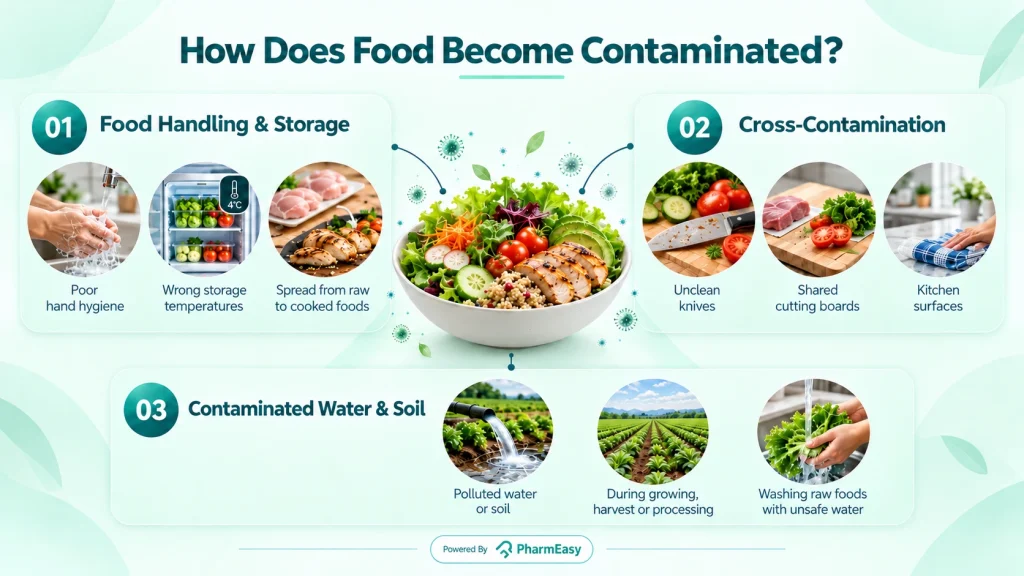
There are many routes through which food can become contaminated, causing food poisoning. Some include2:
It’s a lesser-known fact that scombroid poisoning is also a type of food poisoning. It occurs from eating spoiled fish like tuna or mackerel, where bacteria turn histidine into histamine. This causes symptoms like flushing, headache, and hives. Fish should be properly refrigerated to avoid it.
Dr. Nayana Shetty, MBBS, MD
Food poisoning commonly begins with exposure to contaminated food or water. But some of the pathogens that cause food poisoning can also spread from person to person. The way food poisoning spreads depends on the microorganism involved.
Most bacterial food poisoning don’t spread directly from person to person. Food poisoning is commonly caused by toxins produced by the bacteria within the food items eaten by a person, in which case it does not transfer from one person to another. But, some that are directly caused by the bacteria can spread if contact with infected faeces, shared food, or dirty objects occurs3.

Viral food poisoning typically passes from person to person via faecal-oral transmission. An infected person may handle food without washing their hands after using the bathroom. Or another person may touch a dirty surface and then touch their mouth or food, causing transfer of infection.

Parasitic food poisoning can also spread between individuals, but this is less common. Consuming contaminated food or water, contact with infected faeces, or direct contact with an infected person or animal can spread the parasites that cause sickness.
For proper management and recovery, it’s important to recognise food poisoning symptoms and know when to see a doctor.
The symptoms of food poisoning can vary. They depend on the type of bacteria, virus, or parasite causing the illness. But, they usually include the following2:
Knowing dehydration and malnutrition signs can help you decide when to look for medical help. Signs of dehydration include the following4,5:
For children, signs may include dry mouths, no wet diapers for three hours, weakness, irritability, and crying without tears.
Most cases of food poisoning can be diagnosed based on the given symptoms. For severe or long-lasting cases, doctors may ask for more tests.
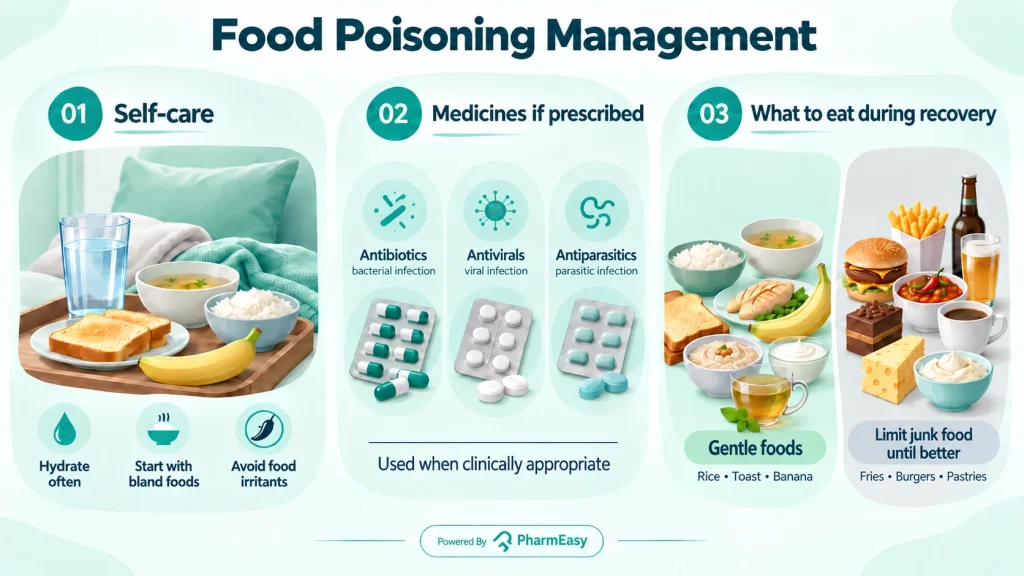
Food poisoning can be truly uncomfortable. However, the focus of management is managing the symptoms and avoiding other health issues. It isn’t usually centred on managing the cause of the illness.
The main goal of home remedies for food poisoning is rest and hydration. Here are some ways to do it.
In some cases, a doctor may prescribe drugs. These can help manage food poisoning symptoms or manage the underlying cause.
Also Read: What To Eat During Food Poisoning?
A few steps you take can help avoid food poisoning. These can make meals safer.
Following certain general food safety rules may reduce the risk of food poisoning.
People with a higher risk of food poisoning, like pregnant woman, infants, young children and elderly people, should be extra careful:
New studies suggest that isolating lactic acid bacteria (LAB) from raw camel’s milk might help in combatting food poisoning. LABs such as Leuconostoc and Lactobacillus might help in stopping the growth of bacteria that cause food poisoning. Including such probiotics in your diet may help prevent or reduce food poisoning symptoms, however further studies are required on the topic.
Dr. Nayana Shetty, MBBS, MD
Also Read: How Does Junk Food Damage Your Body?
Food poisoning can vary a lot in severity and duration. Some people have a higher risk of complications than others.
Dehydration is a common symptom of food poisoning. It can occur from too much vomiting and diarrhoea. Severe dehydration may need hospital management. Other possible dangers of food poisoning include:
There are several factors that can affect the likelihood of getting food poisoning, which are as follows.
It’s vital to know when to consult a doctor if you suspect food poisoning.
Also Read: 10 Nutritious Health Benefits of Sweet Lime
In conclusion, food poisoning can be highly discomforting and even risky. But understanding how it starts, what it feels like, and how to manage it may help you deal with the sickness and recover swiftly. While some types of food poisoning can spread, good food handling and hygiene may reduce the chance of passing on the pathogen. Your chances of getting food poisoning may be kept minimal by following this guide’s food safety tips. Also, always seek medical help when needed.
Usually, food poisoning lasts just a few days. However, how long it lasts may depend on the cause and the person’s overall health.
Food poisoning can be due to bacteria, viruses, or parasites that develop by ingestion of contaminated food. While stomach virus or flu is a virus that attacks the digestive tract, the symptoms look alike. In food poisoning the symptoms develop faster when compared to stomach virus. For correct diagnosis seek medical help.
Good food handling, storage, and cooking can help stop food poisoning. Also, being careful when traveling or eating in places you don’t know well may also reduce the risk.
Rest, stay hydrated, and slowly start eating bland foods again as you recover from food poisoning. Stay away from fatty, spicy, or high-sugar foods, and limit caffeine and alcohol intake until you’ve fully recovered.
Things usually go well for individuals with food poisoning. Most people completely recover in a few days, even without management. But it’s vital to know about serious cases and look for medical help when needed to stop complications and get better soon.
1. Bintsis T. Foodborne pathogens. AIMS Microbiol. 2017;3(3):529-563. doi:10.3934/microbiol.2017.3.529 https://pubmed.ncbi.nlm.nih.gov/31294175/
2. Food poisoning. NHA. November 21, 2017. Accessed September 11, 2026. https://www.nhs.uk/conditions/food-poisoning/
3. E. coli. WHO. Accessed September 16, 2026. https://www.who.int/news-room/fact-sheets/detail/e-coli
4. Symptoms & Causes of Food Poisoning. NIDDK. Accessed September 11, 2026. https://www.niddk.nih.gov/health-information/digestive-diseases/food-poisoning/symptoms-causes
5. Food Poisoning Symptoms. Food Safety. CDC. November 24, 2025. Accessed September 11, 2026. https://www.cdc.gov/food-safety/signs-symptoms/index.html
6. Diagnosis of Food Poisoning. NIDDK. Accessed September 11, 2026. https://www.niddk.nih.gov/health-information/digestive-diseases/food-poisoning/diagnosis
7. Treatment for Food Poisoning. NIDDK. Accessed September 11, 2026. https://www.niddk.nih.gov/health-information/digestive-diseases/food-poisoning/treatment
8. Vardanyan R, Hruby V. Antiviral Drugs. Synthesis of Best-Seller Drugs. 2016;687-736. doi:10.1016/B978-0-12-411492-0.00034-1 https://pmc.ncbi.nlm.nih.gov/articles/PMC7149618/
9. Campbell S, Soman-Faulkner K. Antiparasitic Drugs. StatPearls Publishing. Accessed September 11, 2026. Available from: https://www.ncbi.nlm.nih.gov/books/NBK544251/
10. Eating, Diet, & Nutrition for Food Poisoning. NIDDK. Accessed September 11, 2026. https://www.niddk.nih.gov/health-information/digestive-diseases/food-poisoning/eating-diet-nutrition
11. Program HF. Food Safety Booklet for Pregnant Women, Their Unborn Babies, and Children Under Five. FDA. Published online September 5, 2024. Accessed September 16, 2026. https://www.fda.gov/food/people-risk-foodborne-illness/food-safety-booklet-pregnant-women-their-unborn-babies-and-children-under-five
12. Pogreba-Brown K, Austhof E, Armstrong A, et al. Chronic Gastrointestinal and Joint-Related Sequelae Associated with Common Foodborne Illnesses: A Scoping Review. Foodborne Pathog Dis. 2020;17(2):67-86. doi:10.1089/fpd.2019.2692 https://pubmed.ncbi.nlm.nih.gov/31589475/
13. Batz MB, Henke E, Kowalcyk B. Long-Term Consequences of Foodborne Infections. Infect Dis Clin North Am. 2013;27(3):599-616. doi:10.1016/j.idc.2013.05.003 https://pubmed.ncbi.nlm.nih.gov/24011832/
Disclaimer: The information provided here is for educational/awareness purposes only and is not intended to be a substitute for medical treatment by a healthcare professional and should not be relied upon to diagnose or treat any medical condition. The reader should consult a registered medical practitioner to determine the appropriateness of the information and before consuming any medication. PharmEasy does not provide any guarantee or warranty (express or implied) regarding the accuracy, adequacy, completeness, legality, reliability or usefulness of the information; and disclaims any liability arising thereof.
Links and product recommendations in the information provided here are advertisements of third-party products available on the website. PharmEasy does not make any representation on the accuracy or suitability of such products/services. Advertisements do not influence the editorial decisions or content. The information in this blog is subject to change without notice. The authors and administrators reserve the right to modify, add, or remove content without notification. It is your responsibility to review this disclaimer regularly for any changes.


Comments

Leave your comment...
You may also like






















Comments