




Influenza B: What is It, Causes, Symptoms, Treatment & Prevention
By Dr. Vishesh Bharucha +2 more

Medically reviewed by Dr. Avinav Gupta
Last updated: Sep 15, 2026 Published on: Jun 18, 2025


Get,

to manage your symptom
Get your,

4 Cr+ families
benefitted

OTP sent to 9988776655



You’ve successfully subscribed to receive
doctor-approved tips on
Whatsapp

Get ready to feel your best.


Register to Avail the Offer
Send OTPBy continuing, you agree with our Privacy Policy and Terms and Conditions
Hi There,
Sign up on PharmEasy now!!


Trusted by 4 crore+ families

OTP sent to 9988776655
You have unlocked 25% off on medicines


Code: NU25

By Dr. Vishesh Bharucha +2 more
Table of Contents
Influenza B is one of the primary types of influenza viruses responsible for seasonal flu outbreaks across the globe1. Among the estimated 1 billion cases of influenza that occur annually, influenza B contributes significantly, more commonly in children and adolescents, however, it can affect all age groups1,2.

Although less prevalent than influenza A, influenza B virus can co-circulate with it and have varying global impact based on season and region3. Therefore, understanding what influenza B is, its symptoms and its management strategies is essential for effective prevention and treatment, especially during peak flu seasons.
Influenza B is caused by the influenza B virus, a member of the Orthomyxoviridae family4. This virus is divided into two genetically and antigenically distinct lineages4:
The influenza B virus spreads easily from person to person through respiratory droplets released when an infected individual coughs or sneezes, making close contact a key factor in transmission. It can also spread by touching contaminated surfaces and then touching your face without washing your hands2.
While influenza B typically leads to mild to moderate respiratory illness, particularly in otherwise healthy children, it can sometimes result in more severe disease. This is especially true for individuals with underlying chronic medical conditions, weakened immune systems, or other health vulnerabilities. In rare cases, it can even be fatal4.
The B/Victoria lineage is one of the two major lineages of Influenza B that have historically circulated in humans. It causes seasonal outbreaks that often impact younger demographics, particularly school-aged children.
Post-COVID: Following the pandemic, B/Victoria is currently the only Influenza B lineage known to be circulating widely in humans. Because it continues to spread actively across both hemispheres, international health agencies like the WHO and CDC have designated it as the exclusive Influenza B component included in the updated trivalent flu shots.
The B/Yamagata lineage historically evolved at a slower rate and tended to strike older populations. Compared to other seasonal strains, it was naturally less transmissible, making its long-term survival highly dependent on steady, uninterrupted human-to-human chains of transmission19.
Post-COVID: The widespread pandemic has effectively broken those chains, and global health networks have not detected a single confirmed case of B/Yamagata since March 2020. Classified by experts as probably extinct or no longer circulating in humans, regulatory bodies have recommended removing the B/Yamagata component from current trivalent influenza vaccines because the lineage has not been detected in sustained circulation since 202019.
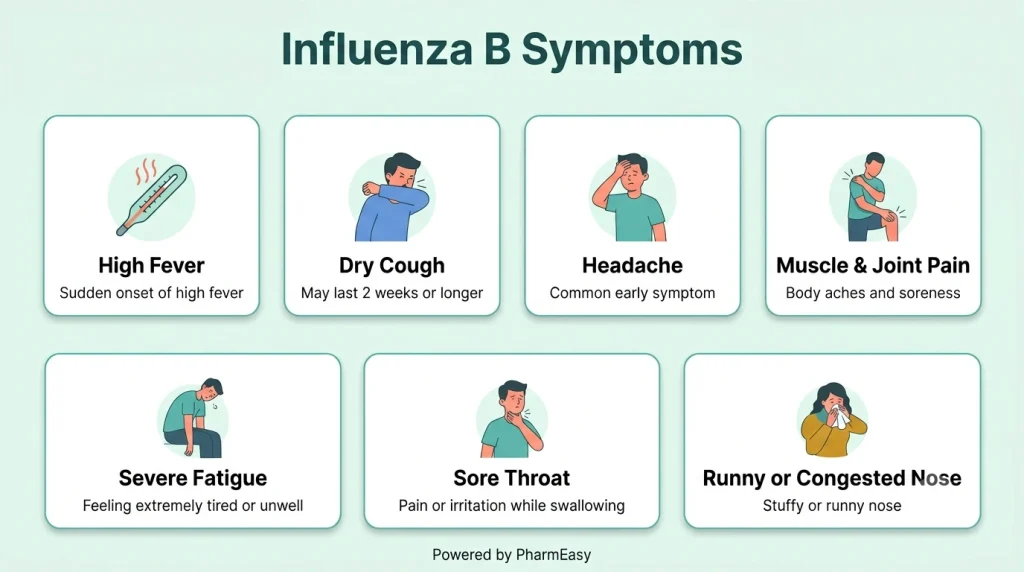
Influenza B symptoms usually begin within 1 to 4 days after infection and can include2,6:
Note: Children (especially those under 5 years of age) may experience vomiting, abdominal pain and diarrhoea. However, these symptoms are not prevalent in adults7.
Since influenza B and the common cold are both respiratory viruses, their early signs can look incredibly similar. However, their intensity, how fast they develop, and their overall recovery timeline look very different.
The breakdown below highlights how to spot the difference between the two.
| Feature | Common Cold | Influenza B |
| Onset Speed | Symptoms usually develop gradually | Symptoms often develop suddenly within a |
| Fever | below 100°F (except in toddlers) | 100°F–102°F+, lasting 3 to 4 days. |
| Body Aches | Mild | Severe |
| Fatigue & Weakness | Mild | Moderate to severe |
| Cough Type | Often produces mucus or phlegm as it develops. | A persistent, hacking cough that can feel painful. |
| Headache | Rare | Prominent |
| Congestion & Sneezing | Very common | May occur but are usually less prominent. |
| Recovery Timeline | 7 to 10 Days | 1 to 2 Weeks |
Influenza B differs from types A and C in several important ways, including its virus structure, who it primarily affects, and the severity of the illness it causes:
Virus Strains:
Who It Affects:
Severity:
Outbreaks:
BIO-FIRE Pneumonia Panel, the BF-PP has reliable analytical performance and provides a high rate and rapid detection of microorganisms in respiratory specimens, offering advantages over cultures for detection of Influenza18.
Dr. Vishesh Bharucha, MBBS, MD
Also Read: Influenza A: What is It, Causes, Symptoms, Treatment & Prevention
While influenza B can affect anybody, certain groups are at a greater risk of complications. These include:
Note: While Influenza A often gets the most attention, Influenza B is actually a primary driver of flu illness in children, making early protection vital. Because kids’ immune systems are still learning how to fight off bugs, this strain can sometimes hit them harder, leading to faster complications like severe croup or pneumonia.
Diagnosing influenza B typically starts with a clinical evaluation, where doctors review the patient’s symptoms and medical history10. To confirm the infection, several diagnostic tests may be used but the common ones are:
Other laboratory tests include immunofluorescence and serological assays to detect virus-specific antigens/antibodies. However, molecular tests have largely replaced these now11.
High-risk individuals should be especially vigilant for influenza B complications such as13
Most cases of influenza B can be managed at home with supportive care, but antiviral medications may be recommended in some situations, especially for those at high risk of complications. Common influenza B treatment options include:

These drugs are especially recommended for all hospitalised patients, those with severe or progressive illness, and high-risk individuals (e.g., elderly, pregnant women, people with chronic conditions, etc.), regardless of how long symptoms have been present10,11,12.

Adequate rest helps the body recover and conserve energy to fight the infection2.

Drinking plenty of fluids prevents dehydration, especially if fever is present2.

Fever and pain-relieving medications, when taken under medical supervision, can help relieve fever, headache, and body aches. Common mediactions include:
Note: Do not give aspirin to children as it has been associated with the risk of Reye’s Syndrome15.
To protect yourself and those around you, it’s important to follow these effective prevention measures:
Many patients think Influenza B is just a common cold or that antibiotics will cure it, which leads to delayed treatment. It’s actually a serious viral infection that can cause high fever, body aches, and pneumonia, and it needs timely antiviral care and rest, not antibiotics.
Dr. Vishesh Bharucha, MBBS, MD
The quadrivalent flu vaccine is designed to guard against four distinct viral threats: two influenza A subtypes (H1N1 and H3N2) and two influenza B lineages (Victoria and Yamagata). For over a decade, it served as the global standard to prevent B-lineage mismatch20.
While quadrivalent vaccines may still be available in some settings,some public health authorities have recommended a transition to trivalent influenza vaccines. This is because B/Yamagata viruses have not been detected in global influenza surveillance since March 2020 and are not currently considered to be actively circulating in people.
The updated trivalent vaccine streamlines protection by targeting exactly three actively circulating strains: the H1N1 and H3N2 A-subtypes, and B/Victoria lineage based on current surveillance and vaccine recommendations. This formulation does not include a B/Yamagata component, in line with current public health recommendations and surveillance findings19.
Also Read: Everything To Know About the Influenza Vaccine & Its Importance
Most individuals recover from influenza B within 5 to 14 days, though symptoms like cough may persist for longer than 14 days2,16.
However, in some cases, symptoms may worsen or lead to serious complications. It’s important to consult a doctor immediately if you experience any of the following16:
Also Read: What Is Hantavirus? Symptoms, Causes, & Effective Prevention
Understanding and effectively managing influenza B is crucial for reducing the spread of infection and minimising the risk of complications, especially among vulnerable groups like children, elderly, and those with weakened immune systems.
While often milder than influenza A, influenza B can still lead to a serious illness. Timely diagnosis, appropriate influenza B virus treatment (such as antiviral therapy), preventive measures like vaccination, and awareness of warning signs, all play a vital role in controlling the impact of this seasonal virus. Thus, by staying informed and proactive, individuals and communities can better protect themselves and others during flu season.
Also Read: H1N1 (Swine Flu): Causes, Symptoms, Treatment, and Prevention
No. It’s important to stay home until at least 24 hours after your fever subsides without the use of fever-reducing medications to prevent spreading the virus15.
Antiviral medications work best when started within 48 hours of symptom onset, but they may still be helpful later for high-risk individuals or those with severe illness10.
In India, Influenza B circulates year-round, especially in central and southern regions. In northern areas, it peaks during winter (November to March), often alongside influenza A, with additional mild peaks seen post-monsoon (September to November)17.
The incubation period for influenza B (the time between exposure to the virus and the appearance of symptoms) is typically around 2 days but can range from 1 to 4 days2.
Disclaimer: The information provided here is for educational/awareness purposes only and is not intended to be a substitute for medical treatment by a healthcare professional and should not be relied upon to diagnose or treat any medical condition. The reader should consult a registered medical practitioner to determine the appropriateness of the information and before consuming any medication. PharmEasy does not provide any guarantee or warranty (express or implied) regarding the accuracy, adequacy, completeness, legality, reliability or usefulness of the information; and disclaims any liability arising thereof.


Comments

Leave your comment...
You may also like

























Comments