
एक एएनए (एलिसा) परीक्षण एक खून परीक्षण है जिसका उपयोग खून में एंटीन्यूक्लियर एंटीबॉडी की उपस्थिति का पता लगाने के लिए किया जाता है।
एंटीन्यूक्लियर एंटीबॉडी परीक्षण को सहन करने के लिए एक साधारण खून नमूना या खून सीरम की आवश्यकता होती है। इस टेस्ट के लिए किसी खास तैयारी की जरूरत नहीं है।
यदि आप बार-बार लक्षण पाते हैं या आपके पिछले परीक्षण के परिणाम आपके खून में एंटीन्यूक्लियर एंटीबॉडी की सकारात्मक उपस्थिति दिखाते हैं तो आपका डॉक्टर आपको हर तीन महीने में एएनए टेस्ट दोहराने की सलाह दे सकता है।
यदि पिछले एएनए परीक्षण परिणाम नकारात्मक हैं, तो आप अपने परीक्षण को वार्षिक या आवर्तक लक्षणों के आधार पर दोहरा सकते हैं।
इस ANA टेस्ट में सिर्फ एक ही पैरामीटर शामिल है।
एएनए (एलिसा) परीक्षण खून में एंटीन्यूक्लियर एंटीबॉडी की उपस्थिति को मापता है। एएनए परीक्षण परिणाम जो सकारात्मक या असामान्य हैं, खून या अंगों को विभिन्न तरीकों से प्रभावित कर सकते हैं। यह परीक्षण ऑटोइम्यून बीमारियों का पता लगाने में मदद कर सकता है।
यदि आपके पास ऐसे लक्षण हैं जो शरीर के विभिन्न हिस्सों में शामिल हैं या संबंधित हैं, तो आपका डॉक्टर एएनए (एलिसा) परीक्षण का सुझाव दे सकते हैं :
कुछ लक्षण हैं:
यदि व्यक्ति पहले से ही बीमारियों या विकारों का पता लगा चुका है तो डॉक्टर एएनए (एलिसा) परीक्षण का सुझाव दे सकता है:
ऑटोइम्यून रोग नहीं होने के बावजूद 20% स्वस्थ लोगों में एंटीन्यूक्लियर एंटीबॉडी का पता लगाया जा सकता है।
यह भी पढ़ें: वीडीआरएल टेस्ट (VDRL Test in Hindi): क्या है, खर्च, नॉर्मल रेंज, कैसे होता है, क्यों और कब करना चाहिए
एक गलत सकारात्मक परिणाम के मामले में अधिक होने की संभावना हैः
यदि एएनए (एलिसा) टेस्ट के परिणाम खून में उच्च सकारात्मकता दिखाते हैं, तो किसी भी ऑटोइम्यून रोगों के निदान को उस स्थिति में खारिज करना होगा। आपको एक सलाहकार चिकित्सक, रूमेटोलॉजिस्ट (rheumatologist) , या इम्यूनोलॉजिस्ट द्वारा आगे के उपचार और निगरानी की आवश्यकता है। एक डॉक्टर आपको तीन महीने के लिए दोहराए जाने वाले एएनए टेस्ट की भी सलाह दे सकता है।
यह भी पढ़ें: एएसओ परीक्षण (ASO Test in Hindi): क्या है, खर्च, नॉर्मल रेंज, कैसे होता है, क्यों और कब करना चाहिए?
कई स्वास्थ्य स्थितियां आमतौर पर एक सकारात्मक एएनए परीक्षण का कारण बनती हैं, जिसमें स्क्लेरोडार्मा, सिस्टमिक ल्यूपस एरिथेमेटोसस, संधिशोथ, एसजोग्रेन सिंड्रोम, पॉलीमायोसाइटिस आदि शामिल हैं।
जब उच्च सकारात्मक एएनए पर पता लगाया जाता है, तो परिणाम यह इंगित नहीं करता है कि किसी रोगी को लक्षणों या भौतिक निष्कर्षों की अनुपस्थिति में ऑटोइम्यून बीमारी है या विकसित होगी। जबकि ऑटोइम्यून रोगों के लक्षणों के साथ उच्च सकारात्मक एएनए परीक्षण परिणाम होने पर, स्थिति गंभीर स्वास्थ्य जटिलताओं का कारण बन सकती है।
एक एएनए परीक्षण का उपयोग ल्यूपस, ऑटोइम्यून हेपेटाइटिस जैसे ऑटोइम्यून विकारों का निदान करने या खून में एंटीन्यूक्लियर एंटीबॉडी की उपस्थिति का पता लगाने के लिए किया जाता है।
एएनए परीक्षण पर एक सकारात्मक परिणाम एक डॉक्टर को ऑटोइम्यून विकार का निदान करने में मदद कर सकता है। परीक्षण में परिणाम एएनए की सकारात्मक उपस्थिति के रूप में दिखाई देने के बाद, रोगी को एक और परीक्षा के लिए सिफारिश की जाएगी या निदान के तुरंत बाद एक विशेष ऑटोइम्यून स्थिति के लिए उपचार शुरू करना चाहिए।
तनाव के कारण ल्यूपस या रुमेटीइड गठिया जैसे ऑटोइम्यून रोग हो सकते हैं, जो एक अध्ययन के आधार पर पाया गया कि तनाव से संबंधित विकारों वाले लोगों में ऑटोइम्यून रोगों की अधिक घटनाएं हैं। संयोजी ऊतक रोग (सीटीडी) के रोगियों में तनाव और एएनए प्रतिक्रियाशीलता के बीच एक संबंध पाया गया।
विटामिन डी की कमी प्रतिरक्षा रोग में योगदान कर सकती है, जिसके परिणामस्वरूप एंटीबॉडी, विशेष रूप से एंटीन्यूक्लियर एंटीबॉडी (एएनए) का उत्पादन होता है। एक रैखिक संबंध जिसमें गंभीर विटामिन डी की कमी वाले रोगियों ने एक सकारात्मक एएनए परीक्षण प्राप्त करने की 2.99 वृद्धि की संभावना का प्रदर्शन किया।
आइसोनियाजिड, मेथ्य्लडोपा, क्विनईदिन, मिनोसीक्लीन, सुल्फेडिएज़िन, हाइड्रालज़ीन जैसी दवाएं खून में सकारात्मक एंटीन्यूक्लियर एंटीबॉडी के साथ जुड़ी दवाएं हैं। इसके बाद इस स्थिति को ड्रग प्रेरित ऑटो इम्यून डिजीज कहा जाता है।
Disclaimer: The information provided here is for educational/awareness purposes only and is not intended to be a substitute for medical treatment by a healthcare professional and should not be relied upon to diagnose or treat any medical condition. The reader should consult a registered medical practitioner to determine the appropriateness of the information and before consuming any medication. PharmEasy does not provide any guarantee or warranty (express or implied) regarding the accuracy, adequacy, completeness, legality, reliability or usefulness of the information; and disclaims any liability arising thereof.
Links and product recommendations in the information provided here are advertisements of third-party products available on the website. PharmEasy does not make any representation on the accuracy or suitability of such products/services. Advertisements do not influence the editorial decisions or content. The information in this blog is subject to change without notice. The authors and administrators reserve the right to modify, add, or remove content without notification. It is your responsibility to review this disclaimer regularly for any changes.
 6
6  1
1क्रिएटिनिन टेस्ट का उपयोग हमारे खून में क्रिएटिनिन के स्तर के आकलन के लिए किया जाता है। यह बताता है कि किडनी ठीक से काम कर रही है या नहीं।
आप अपने नियमित स्वास्थ्य जांच के एक हिस्से के रूप में क्रिएटिनिन परीक्षण ले सकते हैं। यदि आपको मधुमेह, उच्च खूनचाप, या / और गुर्दे की क्षति का कोई लक्षण है, तो आपका डॉक्टर आपको यह परीक्षण लिख देगा। इसकी जांच नियमित अंतराल पर की जा सकती है, जिससे किडनी की सेहत पर नजर रखी जा सके। क्रिएटिनिन परीक्षण के परिणाम भी उपचार योजना की प्रभावकारिता को समझने में डॉक्टर की मदद करेंगे।
क्रिएटिनिन टेस्ट के अन्य नाम
टेस्ट इंक्लूजन: क्या पैरामीटर शामिल हैं?
क्रिएटिनिन परीक्षण निम्नलिखित मापदंडों पर विचार करता हैः
क्रिएटिनिन परीक्षण खून में क्रिएटिनिन की मात्रा को मापता है।
क्रिएटिनिन के असामान्य स्तर से संकेत मिलता है कि गुर्दे के साथ कुछ समस्या है। शरीर में गुर्दे की क्षति के लक्षण दिखाई देंगे जैसेः
परामर्श चिकित्सक क्रिएटिनिन परीक्षण निर्धारित करेगा यदि व्यक्ति गुर्दे की क्षति के अन्य लक्षणों के साथ इस तरह के लक्षण दिखाता है या सर्जरी से पहले फिटनेस के स्तर की जांच करता है
कुछ बीमारी की स्थिति जिसके लिए एक क्रिएटिनिन परीक्षण निर्धारित किया जाता हैः
उपरोक्त स्थितियों में, क्रिएटिनिन स्तर को अन्य मापदंडों के साथ मापा जाता है। एक बार जब डॉक्टर किसी निदान पर पहुंचते हैं, तो वे उपचार शुरू कर देते हैं। गुर्दे के स्वास्थ्य और उपचार के प्रभाव का आकलन करने के लिए डॉक्टर नियमित अंतराल पर क्रिएटिनिन परीक्षण लिख सकते हैं।
क्रिएटिनिन परीक्षण भी स्वस्थ वयस्कों में एक नियमित शारीरिक परीक्षण के रूप में निर्धारित किया जाता है। यह बुनियादी चयापचय पैनल में जांच की जाती है। यह टेस्ट किडनी डैमेज होने का पता लगाने में भी जल्दी मदद करता है। इसलिए किडनी की बीमारी की जांच के लिए भी यह निर्धारित किया जाता है।
क्रिएटिनिन टेस्ट सभी पुरुषों और महिलाओं के लिए उपयुक्त है। कुछ दवाएं क्रिएटिनिन परीक्षण परिणामों के परिणामों में हस्तक्षेप कर सकती हैं। अगर आप कोई भी दवा ले रहे हैं तो उसके बारे में अपने डॉक्टर से पूछें।
पुरुषों में 1.3mg / dl के स्तर से ऊपर और महिलाओं में 1.1 mg / dl से ऊपर कुछ भी एक उच्च या खराब क्रिएटिनिन स्तर माना जाता है। यह इंगित करता है कि गुर्दे प्रभावी ढंग से काम नहीं कर रहा है।
सीरम क्रिएटिनिन का उच्च स्तर आमतौर पर अपने आप में हानिकारक नहीं होता है। बल्कि, वे अन्य स्वास्थ्य समस्याओं का एक मार्कर हो सकते हैं। इसके पीछे की वजह जानना जरूरी हो जाता है।
उच्च सीरम क्रिएटिनिन मधुमेह, निर्जलीकरण, उच्च खूनचाप, गुर्दे की पथरी, ऑटोइम्यून स्थितियों, यूटीआई या प्रोस्टेट रोगों के कारण हो सकता है।
क्रिएटिनिन का उच्च स्तर अंतर्निहित गुर्दे विकार का एक मार्कर है। शरीर में मूत्र की मात्रा और आवृत्ति में परिवर्तन, खूनचाप में परिवर्तन, थकान, भूख न लगना, पूरे शरीर में खुजली की सनसनी, पैरों और टखनों पर सूजन और मतली जैसे कई प्रकार के लक्षण दिखाई देते हैं। हालांकि, अलग-अलग लोग अपने शरीर के प्रकार और स्थितियों के आधार पर अलग-अलग लक्षणों का अनुभव कर सकते हैं।
यदि क्रिएटिनिन का उच्च स्तर निर्जलीकरण के कारण होता है, तो पीने का पानी क्रिएटिनिन के स्तर को कम करने में मदद करेगा।
सामान्य क्रिएटिनिन स्तर हैंः
बच्चों के लिए (3 से 18 वर्ष की आयु): 0.5-1.0mg/dL।
वयस्क पुरुष के लिए: 0.9-1.3mg/dL
वयस्क महिला के लिए: 0.6-1.1 एमजी / dL
आपको सोडियम, प्रोटीन, फॉस्फोरस और पोटैशियम से भरपूर खाने से बचना चाहिए। यदि क्रिएटिनिन अधिक है तो बहुत सारे प्रोटीन, लाल मांस और मछली उत्पादों को लेने से बचें।
अपने स्वास्थ्य की स्थिति के अनुसार आहार और जीवन शैली में परिवर्तन करने के लिए डॉक्टर से कंसल्ट करें। उच्च क्रिएटिनिन के अंतर्निहित कारण के लिए उचित दवाएं और उपचार लें।
Disclaimer: The information provided here is for educational/awareness purposes only and is not intended to be a substitute for medical treatment by a healthcare professional and should not be relied upon to diagnose or treat any medical condition. The reader should consult a registered medical practitioner to determine the appropriateness of the information and before consuming any medication. PharmEasy does not provide any guarantee or warranty (express or implied) regarding the accuracy, adequacy, completeness, legality, reliability or usefulness of the information; and disclaims any liability arising thereof.
Links and product recommendations in the information provided here are advertisements of third-party products available on the website. PharmEasy does not make any representation on the accuracy or suitability of such products/services. Advertisements do not influence the editorial decisions or content. The information in this blog is subject to change without notice. The authors and administrators reserve the right to modify, add, or remove content without notification. It is your responsibility to review this disclaimer regularly for any changes.
31
2हेपेटाइटिस सी वायरस (एचसीवी) संक्रमण का निदान इस परीक्षण से किया जाता है। जब प्राथमिक एचसीवी एंटीबॉडी परीक्षण पॉजिटिव आता है, तो यह परीक्षण यह जांचने के लिए किया जाता है कि वायरस अभी भी शरीर में मौजूद है या नहीं।
एचसीवी परीक्षणों के लिए, एक स्वास्थ्य / निदान प्रोफेशनल द्वारा अग्रभूमि (forearm) की नस से रक्त का एक नमूना लिया जाता है।
यदि एचसीवी एंटीबॉडी परीक्षण नकारात्मक आता है, तो आगे की जांच करवाना जरूरी नहीं है। यदि यह सकारात्मक परिणाम दिखाता है, तो एक एचसीवी आरएनए परीक्षण किया जाता है। एक बार एचसीवी एंटीबॉडी परीक्षण सकारात्मक आने के बाद, किसी को इसे फिर से लेने की आवश्यकता नहीं है, क्योंकि परिणाम हमेशा सकारात्मक रहेगा क्योंकि एंटीबॉडी हमेशा रक्त में रहते हैं।
यदि एचसीवी आरएनए (RNA) परीक्षण परिणाम नकारात्मक आता है, तो भी कोई और परीक्षण नहीं किया जाता है। यदि एचसीवी आरएनए परीक्षण सकारात्मक आता है, तो हेपेटाइटिस सी के लिए उपचार शुरू किया जाता है, जो आदर्श रूप से लगभग 8-12 सप्ताह में इलाज में परिणाम देता है। आगे की जांच मेडिकल प्रोफेशनल के सुझावों के अनुसार की जाती है।
एचसीवी एंटीबॉडी परीक्षण को इस रूप में भी जाना जाता हैः
एचसीवी आरएनए परीक्षण में भी कई उपनाम हैं, जैसे कि:
नीचे इस परीक्षण में दिखाए गए पैरामीटर हैंः
एचसीवी परीक्षण व्यक्ति में हेपेटाइटिस सी संक्रमण की उपस्थिति की जांच करने में मदद करते हैं। एंटीबॉडी परीक्षण एंटीबॉडी की उपस्थिति की पहचान करता है जो हाल ही में या पिछले संक्रमण का संकेत देता है। एचसीवी आरएनए परीक्षण शरीर में एचसीवी की उपस्थिति या अनुपस्थिति की पुष्टि करता है और यह दर्शाता है कि संक्रमण तीव्र या पुराना है या नहीं। जीनोटाइप टेस्ट वायरस के प्रकार की पहचान करता है।
एचसीवी परीक्षण आदर्श रूप से उन लोगों के लिए निर्धारित किया जाता है जोः
यह भी पढ़ें: विडाल टेस्ट स्लाइड मेथड (Widal Test Slide Method in Hindi): क्या है, खर्च, नॉर्मल रेंज, कैसे होता है, क्यों और कब
लगभग 80% लोग प्रारंभ में संक्रमित होने पर कोई लक्षण नहीं दिखाते हैं। तीव्र संक्रमण के मामले में, निम्नलिखित लक्षण देखे जाते हैंः
शरीर का तापमान बढ़ना
थकान
मतली और उल्टी
भूख कम होना
पेट में दर्द
डार्क पेशाब
पैल मल (pale faeces)
जोड़ों में दर्द
जौंडिस
क्रोनिक इंफेक्शन के साथ, बहुत, ज्यादातर मामलों में, कोई लक्षण नहीं देखे जाते हैं। देखे गए लक्षणों में जिगर की गंभीर बीमारियों में दिखाई देने वाले लक्षण शामिल हैं, जैसे कि थकान और अवसाद का लगातार महसूस करना।
यदि एचसीवी आरएनए मात्रात्मक (quantitative) परीक्षण> 800,000 आईयू / एल का परिणाम दिखाता है, तो यह एक उच्च वायरल लोड को इंगित करता है। यदि यह <800,000 आईयू / एल दिखाता है, तो इसका अर्थ है कम वायरल लोड। वायरल लोड का अर्थ है एचसीवी आरएनए अंतरराष्ट्रीय इकाइयों (आईयू) प्रति मिलीलीटर रक्त की संख्या। यदि परिणाम <15 आईयू / एल दिखाते हैं, तो यह एचसीवी के बहुत कम स्तर की उपस्थिति का संकेत दे सकता है।
80% मामलों में एचसीवी संक्रमण किसी भी लक्षण के साथ मौजूद नहीं है, विशेष रूप से हाल ही में संक्रमण के साथ। एक पुराना संक्रमण भी, तब तक कोई लक्षण नहीं दिखाता है जब तक कि रोग बड़ी गंभीरता तक नहीं बढ़ जाता है। इस प्रकार, इलाज की संभावना को बढ़ाने के लिए उच्च जोखिम वाले समूहों में इस बीमारी का जल्दी पता लगाना आवश्यक हो जाता है।
एचसीवी अनुपात को सिग्नल-टू-कट-ऑफ (signal-to-cut-off) अनुपात (ratio) कहा जाता है। यह मानक (standard) मूल्य के खिलाफ मापा मूल्यों की तुलना है। यह अनुपात निर्धारित करने में मदद करता है कि एंटी एचसीवी परीक्षा परिणाम सकारात्मक या फॉल्स-सकारात्मक है या नहीं। फॉल्स-सकारात्मक का अर्थ है कि आप संक्रमित नहीं हैं बल्कि सकारात्मक परिणाम प्रदर्शित करते हैं।
अगर एंटी-एचसीवी टेस्ट पॉजिटिव आता है तो आपके शरीर में एंटीबॉडी की मौजूदगी होती है, जो बताता है कि आप अतीत में एचसीवी से संक्रमित हो चुके हैं।
Disclaimer: The information provided here is for educational/awareness purposes only and is not intended to be a substitute for medical treatment by a healthcare professional and should not be relied upon to diagnose or treat any medical condition. The reader should consult a registered medical practitioner to determine the appropriateness of the information and before consuming any medication. PharmEasy does not provide any guarantee or warranty (express or implied) regarding the accuracy, adequacy, completeness, legality, reliability or usefulness of the information; and disclaims any liability arising thereof.
Links and product recommendations in the information provided here are advertisements of third-party products available on the website. PharmEasy does not make any representation on the accuracy or suitability of such products/services. Advertisements do not influence the editorial decisions or content. The information in this blog is subject to change without notice. The authors and administrators reserve the right to modify, add, or remove content without notification. It is your responsibility to review this disclaimer regularly for any changes.
19
3करी पत्ते एक छोटे पर्णपाती सुगंधित झाड़ी का भाग होते हैं, जिसका वैज्ञानिक नाम मुरराया कोएनिगी होता है, जो रूटेशियाई कुल से संबंधित होता है। इसे प्राकृतिक औषधीय पौधा माना जाता है। दक्षिण एशिया इस पौधे का घर है, और यह श्रीलंका, बांग्लादेश, चीन और भारत जैसे देशों में पाया जाता है। भारत में, यह हिमालय के नीचे महाराष्ट्र, तमिलनाडु, केरल और असम जैसे राज्यों में पाया जाता है।1-3
इस पौधे में चमकदार हरे पत्ते होते हैं जो वसंत, ग्रीष्म और मानसून के दौरान वृद्धि करते हैं और ये सर्दियों में गिर जाते हैं। तमिल और कन्नड़ साहित्य में ऐसे संदर्भ हैं जो मुरराय कोएनिगी को ‘करी’ के रूप में वर्णित करते हैं, जिसका अर्थ है सब्जियों के लिए स्वाद एजेंट के रूप में इस्तेमाल किया जाने वाला ‘मसालेदार सॉस’। यह भारत में सबसे लोकप्रिय मसाला और छौंक के रूप में पहचाना जाता है। इसे आमतौर पर हिंदी में कड़ीपत्ता या मीठा नीम, तमिल में करुवेप्पिलई और मलयालम में करिवेप्पिले कहा जाता है।2,3
सूखे और ताज़े दोनों तरह के करी पत्ते में अच्छे पोषक तत्व होते हैं और यह स्वास्थ्य के लिए फ़ायदेमंद होते हैं।
| पोषक तत्वों की मात्रा | ताज़ा करी पत्ते | सूखे करी पत्ते |
| प्रोटीन (ग्राम) | 6 | 12 |
| कार्बोहाइड्रेट्स (ग्राम) | 18.7 | 64.31 |
| फ़ैट (ग्राम) | 1 | 5.4 |
| विटामिन C (मिलीग्राम) | 4 | 4 |
| β-कैरोटीन (माइक्रोग्राम) | 7560 | 5292 |
| कैल्शियम (मिलीग्राम) | 830 | 2040 |
| आयरन (मिलीग्राम) | 0.93 | 12 |
टेबल 1: प्रति 100 ग्राम करी पत्तों के पोषक तत्वों की मात्रा 1,2
आयुर्वेद के अनुसार, करी पत्ते के बहुत से फ़ायदेमंद गुण हो सकते हैं: 1
Curry patte (Curry Leaves) ke sambhavit upyog:
करी पत्तों के संभावित उपयोग अलग-अलग स्वास्थ्य स्थितियों के लिए हो सकते हैं। कई अध्ययनों में करी के पत्तों के फ़ायदे इस प्रकार हैंः
ब्लड शुगर के प्रबंधन में करी पत्तियों की प्रभावशीलता का अध्ययन 2012 में डुसाने एट अल द्वारा एक पशु मॉडल में किया गया था। यह ब्लड शुगर के स्तर में उल्लेखनीय कमी लाता है। पत्तियों के अर्क का यह ब्लड शुगर को कम करने वाला गुण, ब्लड शुगर के स्तर को कम करने में मदद कर सकता है। ये प्रभाव इंसुलिन के जैसे प्रभाव हो सकते हैं, जो ब्लड शुगर को या तो अग्नाशय के इंसुलिन उत्पादन को बढ़ाकर या विशिष्ट एंजाइमों के कारण कोशिकाओं द्वारा ग्लूकोज अप-टेक करके कम कर सकता है। इससे पता चलता है कि करी पत्ता डायबिटीज़ मेलेटस के प्रबंधन में प्रभावी हो सकता है।1,3,4
डायबिटीज़ एक गंभीर बीमारी है और इसका उचित निदान किया जाना चाहिए। दुर्भाग्य से, उपरोक्त जानकारी अपर्याप्त है क्योंकि ये अध्ययन मनुष्यों पर नहीं किए गए हैं। हालांकि, शरीर में ब्लड शुगर के स्तर को नियंत्रित करने पर करी के पत्तों के सकारात्मक प्रभाव को दर्शाने के लिए अभी और अधिक मानव परीक्षणों को करने की आवश्यकता है। इसलिए डॉक्टरों से परामर्श लेना और इसे केवल दवा के रूप में लेना आवश्यक है।
करी पत्तों और उनके असेंशियल ऑइल का फ़ायदा यह है कि वे सूजन कोशिकाओं के खिलाफ कार्य कर सकते हैं। जब यह बाहरी सतही चोटों पर लगाया जाता है जैसे कि त्वचा छिलने, जलने और खरोंच, तो ये घाव भरने वाली गतिविधि दर्शा सकते हैं। पत्तियों से बने असेंशियल ऑइल का उपयोग क्रीम और अन्य योगों में किया जा सकता है जो धूप से सुरक्षा, त्वचा की चमक को बढ़ाने और खुरदरी त्वचा को मॉइस्चराइज़ करने के लिए प्रभावी हो सकते हैं। करी पत्ते का तेल त्वचा की समस्याओं जैसे कि फोड़े, मुहांसे, खुजली, रिंगवर्म, ज़ख़्मी पैर आदि से निपटने में भी सहायक हो सकते हैं।1-3
त्वचा के स्वास्थ्य को बनाए रखने के लिए करी पत्तियों के लाभकारी प्रभावों को विकसित करने के लिए आगे के अध्ययनों की आवश्यकता है। इसलिए लोगों को करी के पत्तों से बने किसी भी हर्बल दवा के सेवन से पहले डॉक्टर से परामर्श करना चाहिए। इसके अतिरिक्त, हम आपको सलाह देते हैं कि डॉक्टर से परामर्श किए बिना आयुर्वेदिक या हर्बल दवा के साथ चल रही दवाओं को बंद या प्रतिस्थापित न करें।
ज़ी एट अल द्वारा 2006 में किए गए एक पशु अध्ययन में करी पत्ते ने कुल कोलेस्ट्रॉल और ट्राइग्लिसराइड (वसा) के स्तर को काफ़ी कम कर दिया। करी पत्ते की यह हाइपोलिपिडेमिक (लिपिड कम करने वाली) कार्य इसके एंटीऑक्सीडेंट गुणों के कारण हो सकती है। यह कोलेस्ट्रॉल और कम डेंसिटी वाले लिपिड (खराब कोलेस्ट्रॉल) को कम करने में मदद कर सकता है; इससे पता चलता है कि कोलेस्ट्रॉल और वसा के मेटाबोलिज़्म को कम करने में इसकी संभावित भूमिका हो सकती है।3,4,6
हालांकि, ये अध्ययन मनुष्यों पर प्रभाव को समझने के लिए पर्याप्त नहीं हैं। हमें मानव शरीर में कोलेस्ट्रॉल के स्तर को प्रबंधित करने में करी पत्ते के फ़ायदों के बारे में ज़्यादा जानकारी की आवश्यकता है। इसलिए, कोलेस्ट्रॉल की जांच के लिए करी पत्ते का उपयोग करने से पहले डॉक्टर से बात करना बेहतर होता है।
देसाई एट अल द्वारा 2012 में पशु मॉडल अध्ययन ने खुलासा किया कि करी पत्ते के रस ने लीवर एंजाइम के कार्य में काफ़ी वृद्धि की जो लीवर में लिपिड के ऑक्सीडैशन में सहायता करता है। रस ने लीवर की रक्षा करने वाले कार्य भी दिखाए जो लीवर की क्षति को रोकते हैं।4
ऊपर दी गई जानकारी अपर्याप्त है क्योंकि ये अध्ययन जानवरों पर किए गए हैं। हालांकि, मानव स्वास्थ्य पर करी पत्ते के फ़ायदों को जानने के लिए मनुष्यों पर और अध्ययन आवश्यक है। इसलिए, अपने संबंधित डॉक्टरों से परामर्श करना महत्वपूर्ण है।
हालांकि, कई स्वास्थ्य स्थितियों में करी पत्ते के फ़ायदों को दर्शाने वाले अध्ययन अपर्याप्त हैं और मानव स्वास्थ्य पर करी पत्ते के फ़ायदों की सही सीमा स्थापित करने के लिए आगे के अध्ययन की आवश्यकता है। इसके अतिरिक्त हर व्यक्ति इन जड़ी-बूटियों के प्रति अलग-अलग प्रतिक्रिया दे सकता है। इसलिए, किसी भी चिकित्सीय स्थिति के लिए करी पत्ते का उपयोग करने से पहले डॉक्टर की सलाह लेना आवश्यक है।
करी पत्तों का इस्तेमाल इन तरीकों से किया जा सकता है:
करी पत्ते से बने किसी भी हर्बल सप्लीमेंट को लेने से पहले लोगों को एक सही डॉक्टर से परामर्श लेना ज़रूरी होता है। हम सलाह देते हैं कि आप किसी आयुर्वेदिक डॉक्टर से परामर्श किए बिना आयुर्वेदिक या हर्बल दवाइयों के साथ अपनी वर्तमान दवाओं को न बदलें या न ही उन्हें बंद करें।
कोई महत्वपूर्ण अध्ययन दर्ज प्रमाण नहीं है जो लोगों में करी पत्ते के लक्षण दिखाता है। वैसे, ज़ी एट अल द्वारा 2006 में कुछ अध्ययन में पशु मॉडल में स्थानीय आंतों में जलन दिखाई दी थी।6
हालांकि, अगर आपको पेट में ऐसी जलन महसूस होती है, तो आपको किसी आयुर्वेदिक डॉक्टर से सलाह लेनी चाहिए और तुरंत इलाज कराना चाहिए।
सामान्य तौर पर, करी पत्ते का उपयोग करना सुरक्षित होता है। हालांकि, किसी भी समस्या से बचने के लिए सामान्य सावधानियां बरतने की ज़रूरत होती है।
आपको नियमित रूप से करी पत्ते का सेवन करते समय अपने डॉक्टर द्वारा दी गई सामान्य सावधानियों और निर्देशों का पालन करना चाहिए और आपको कभी भी प्राकृतिक फलों, सब्जियों और जड़ी-बूटियों के साथ स्वयं औषधि नहीं लेनी चाहिए।
इसलिए, अपने डॉक्टर के साथ अपने चल रहे उपचारों पर चर्चा करना और जड़ी-बूटी की खुराक और रूप पर उनकी सलाह का पालन करना ज़रूरी है। वे आपको आपकी स्थिति के आधार पर करी पत्ता खाने का सबसे अच्छा तरीका सुझाएंगे।
Also Read: चिया सीड्स (Chia Seeds in hindi): उपयोग, लाभ, साइड इफ़ेक्ट, और अन्य जानकारी!
करी पत्ते कड़वे होते हैं और उनमें तेज़, तीखी महक होती है।1
पत्तों को बारीक पीसकर छाछ के साथ लेने से खराब पेट का एक अच्छा घरेलू उपाय हो सकता है।1 हालांकि, लोगों को करी पत्ते का इस्तेमाल स्वयं औषधि के रूप में नहीं करना चाहिए। डॉक्टर से सलाह लेना ज़रूरी है।
करी पत्ते में मौजूद कैल्शियम और ज़िंक खनिज और बायोएक्टिव घटक जैसे फोलिक एसिड, बीटा कैरोटीन और राइबोफ्लेविन मौखिक स्वास्थ्य के लिए अच्छे हो सकते हैं और माउथवॉश को बनाने में उपयोग किए जाते हैं। हालांकि, यह जानकारी पर्याप्त नहीं है।1 मुंह के स्वास्थ्य पर करी पत्ते के फ़ायदों को प्रमाणित करने के लिए अधिक अध्ययन की आवश्यकता है।
करी पत्ते के रस में विटामिन ए (β-कैरोटीन) और विटामिन सी होता है, जो बालों के समग्र स्वास्थ्य के लिए फ़ायदेमंद हो सकता है।
करी पत्ते अपने तत्वों के कारण दस्त से लड़ने का गुण दिखाते हैं, जो आंतों के हानिकारक बैक्टीरिया से लड़ सकते हैं।3 लेकिन यह जानकारी अपर्याप्त है और हमें मानव स्वास्थ्य पर करी पत्ते के सही दायरे को प्रमाणित करने के लिए और अधिक अध्ययन की आवश्यकता है।
Disclaimer: The information provided here is for educational/awareness purposes only and is not intended to be a substitute for medical treatment by a healthcare professional and should not be relied upon to diagnose or treat any medical condition. The reader should consult a registered medical practitioner to determine the appropriateness of the information and before consuming any medication. PharmEasy does not provide any guarantee or warranty (express or implied) regarding the accuracy, adequacy, completeness, legality, reliability or usefulness of the information; and disclaims any liability arising thereof.
Links and product recommendations in the information provided here are advertisements of third-party products available on the website. PharmEasy does not make any representation on the accuracy or suitability of such products/services. Advertisements do not influence the editorial decisions or content. The information in this blog is subject to change without notice. The authors and administrators reserve the right to modify, add, or remove content without notification. It is your responsibility to review this disclaimer regularly for any changes.
1
1Gastro-oesophageal reflux disease, also known as GERD or GORD, is a prevalent condition where stomach acid flows back into the oesophagus, causing discomfort and unpleasant symptoms. The condition often arises from a weakened muscle at the bottom of the oesophagus and can lead to heartburn and an unpleasant taste in the mouth. While it can be a minor inconvenience for some, others may suffer from severe, long-term effects. There are many measures and medications available to manage GERD, and in some cases, surgical intervention may be necessary1. Let us further explore the causes, symptoms, and treatment options for GERD.
Here are some signs and symptoms of gastro-oesophageal reflux disease:
Gastroesophageal reflux disease (GERD) can occur when the lower oesophageal sphincter weakens or relaxes at inappropriate times. Certain factors that may cause the lower oesophageal sphincter to malfunction and lead to GERD include:
GERD (Gastroesophageal Reflux Disease) has both non-modifiable and modifiable risk factors that can lead to its symptoms. Here are some factors that can contribute to GERD:
It’s crucial to identify modifiable risk factors for GERD to prevent and manage its symptoms effectively through dietary interventions3.
Diagnosis of GERD can involve the following steps:
Diagnostic tests may be performed if:
Diagnostic procedures for GERD may include:
Diagnostic tests are necessary to evaluate the complications and rule out other serious conditions4,5.
Treatment for GERD may include the following:
GERD can be treated with medicines but it’s important to talk to your doctor first. Some of the medications may include:
Surgery is recommended if other treatments have not been effective or if you wish to stop taking long-term medications. Here are some surgical treatments for GERD:
GERD can lead to various complications, especially if left untreated. Some of the possible complications of GERD include:
It is advisable to seek medical attention from your healthcare provider if:
Also Read: Acidity Problems? 21 Home Remedies That Can Help
GERD is a common but potentially serious condition that affects the digestive system and can significantly impact daily life. Although manageable, GERD can worsen over time and lead to serious complications such as Barrett’s oesophagus and oesophageal damage if not identified and treated early. Since there is no permanent cure for GERD, a combination of lifestyle changes and appropriate medical treatment remains the most effective way to control symptoms and prevent complications.
Eating smaller meals, avoiding trigger foods, maintaining a healthy weight, quitting smoking, and seeking timely medical attention when symptoms persist are essential steps in managing GERD effectively. In addition to this, increased awareness of the risk factors and early diagnosis can play a crucial role in improving outcomes and preventing long-term damage to the oesophagus.
Also Read: Cholera: Symptoms, Causes, Treatment & Prevention
GERD symptoms can interfere with sleep, causing insomnia or poor-quality sleep. Elevating the head of the bed and avoiding lying down after eating may help improve sleep quality.
Yes, exercise is important for overall health, including managing GERD. However, it is best to wait at least two hours after eating.
Acid reflux is a symptom of GERD. GERD is a chronic condition where stomach acid flows back into the oesophagus and causes frequent symptoms.
Yes, hormonal changes and pressure on the stomach from a growing fetus can cause GERD during pregnancy.
No, GERD cannot be cured, but it can be managed with lifestyle changes and medications.
Disclaimer: The information provided here is for educational/awareness purposes only and is not intended to be a substitute for medical treatment by a healthcare professional and should not be relied upon to diagnose or treat any medical condition. The reader should consult a registered medical practitioner to determine the appropriateness of the information before consuming any medication. PharmEasy does not provide any guarantee or warranty (express or implied) regarding the accuracy, adequacy, completeness, legality, reliability, or usefulness of the information; and disclaims any liability arising thereof.
Links and product recommendations in the information provided here are advertisements of third-party products available on the website. PharmEasy does not make any representation of the accuracy or suitability of such products/services. Advertisements do not influence the editorial decisions or content. The information in this blog is subject to change without notice. The authors and administrators reserve the right to modify, add, or remove content without notification. It is your responsibility to review this disclaimer regularly for any changes.
1
0PCOS, or Polycystic Ovary Syndrome, is a common hormonal disorder that can lead to a range of health issues, including infertility. The three main factors associated with PCOS are irregular ovulation, increased levels of male hormones, and cystic ovaries. These factors can cause problems like hirsutism (unwanted hair growth), acne, and hair loss. In fact, more than 70% of women with PCOS have polycystic ovaries. But here’s the good news: your diet can play a crucial role in managing PCOS.
Let us dive into the connection between PCOS and diet, and explore how making simple changes to what you eat can make a big difference in your journey to better health1.
PCOS, which stands for Polycystic Ovary Syndrome, is a condition where a woman’s ovaries produce too many male hormones. This can lead to the formation of small fluid-filled sacs called cysts in the ovaries. Not all women with PCOS have these cysts; some women without PCOS can have them too.
Ovulation is the release of a mature egg from the ovary for possible reproduction. But in PCOS, sometimes a woman’s body doesn’t produce enough hormones for ovulation to happen. This may cause the ovaries to develop into many small cysts. These cysts produce male hormones, leading to problems with the menstrual cycle and causing the symptoms of PCOS2.
According to a consensus panel from the NIH (National Institutes of Health), PCOS can be classified into different types based on its phenotypic presentation. The proposed classification includes four phenotypes:
These different phenotypes help in better understanding and classifying the diverse manifestations of PCOS based on the combination of symptoms and characteristics exhibited by individuals3.
When managing PCOS, it’s beneficial to include nutritious and delicious options in your diet. Here are some food choices from the Mediterranean diet that can help you maintain a healthy weight and manage PCOS symptoms:
By incorporating these food choices into your diet, you can support your overall health and effectively manage PCOS symptoms4.
It is recommended for individuals with PCOS to avoid certain foods that can contribute to inflammation. Here are the foods to be avoided in PCOS:
By avoiding these foods, individuals with PCOS can help reduce inflammation and manage their condition more effectively4.
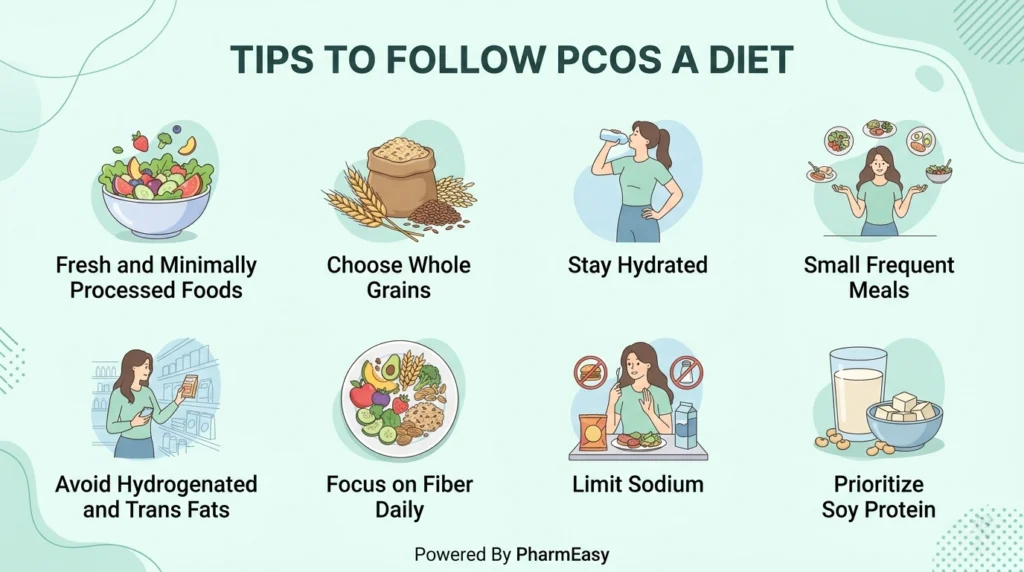
To effectively manage PCOS, regular exercise, a healthy diet, and weight control are key. Here are tips to maintain a healthy PCOS-friendly diet:
Remember, adapting your diet may seem overwhelming, but support is available to help manage your symptoms and develop a personalized treatment plan5.
It is recommended to stay hydrated by drinking an adequate amount of water throughout the day. It is also beneficial to reduce or eliminate the consumption of alcohol, sugary beverages, and processed foods. This meal plan is a suggested guideline for a PCOS diet and should not be taken as medical advice.
To ensure your nutritional needs and dietary restrictions are met, it is recommended to seek guidance from a healthcare professional or registered dietitian to develop a personalized meal plan. This plan can be customized to align with your specific preferences and requirements, but it should emphasize the inclusion of whole foods, lean sources of protein, and a variety of fruits and vegetables. It is advisable to limit the intake of processed foods, sugar, and unhealthy fats6. Before following any of the diets consult your doctor or nutritionist and proceed.
Also Read: PCOS Is Now PMOS? Here’s What Every Woman Should Know
Managing PCOS involves various strategies tailored to individual symptoms and goals. Following are some tips for managing PCOS:
Also Read: Female Infertility: Causes, Symptoms, Treatment & More
Remember, it is important to consult with healthcare professionals experienced in PCOS management to develop a personalized treatment plan based on individual needs and circumstances7.
Also Read: PCOD Diet Chart: Foods to Eat, Avoid, Meal Plan & Lifestyle Tips
In addition to diet, regular exercise, stress management, and adequate sleep can help manage PCOS symptoms.
The best treatment option for PCOS depends on individual symptoms and goals and may include a combination of lifestyle changes, medications, and/or fertility treatments.
PCOS cannot be cured, but symptoms can be managed effectively through lifestyle modifications and appropriate medical interventions.
There is no perfect diet for PCOS, but adopting a balanced and nutritious diet rich in whole foods, fibre, and lean proteins can be beneficial.
Yes, some women with PCOS may experience thinning hair or hair loss.
Disclaimer: The information provided here is for educational/awareness purposes only and is not intended to be a substitute for medical treatment by a healthcare professional and should not be relied upon to diagnose or treat any medical condition. The reader should consult a registered medical practitioner to determine the appropriateness of the information and before consuming any medication. PharmEasy does not provide any guarantee or warranty (express or implied) regarding the accuracy, adequacy, completeness, legality, reliability or usefulness of the information; and disclaims any liability arising thereof.
Links and product recommendations in the information provided here are advertisements of third-party products available on the website. PharmEasy does not make any representation on the accuracy or suitability of such products/services. Advertisements do not influence the editorial decisions or content. The information in this blog is subject to change without notice. The authors and administrators reserve the right to modify, add, or remove content without notification. It is your responsibility to review this disclaimer regularly for any changes.
2
0Discussing the pleasures and health benefits of certain solo endeavours may raise many eyebrows, such as in the case of masturbation and its association with prostate cancer. It is a malignant tumour of the prostate gland and is one of the main causes of death due to cancer in men worldwide. It is the third most common cancer in Indian men and has been linked to risk factors like vasectomy procedures, obesity, diabetes mellitus, and poor BMI1. Men will be glad to know that studies suggest that frequent ejaculation through intercourse or masturbation has health benefits, and lowering the risk of prostate cancer is one of them2. Contrary to popular belief, masturbation, if done in moderation, does not increase the risk of prostate cancer.
Masturbation is a common sexual act that has been misunderstood and seen as taboo by society. It involves self-stimulation of the genitalia to achieve sexual release, orgasm, or ejaculation and feel sexual pleasure. People of all genders and sexual orientations can engage in this private activity. It can be both self or partner-assisted.
The ejaculate in men is essentially semen, which contains a large portion of the seminal fluid, a sperm-nourishing liquid. The prostate gland, which is found in men just below the urinary bladder, is responsible for producing this seminal fluid. Hence, the close link between masturbation and prostate cancer cannot be ignored2.
Regular masturbation can be beneficial for the prostate’s health, which can thereby reduce the risk of prostate cancer. Here are a few benefits of masturbation:
One of the most extensive studies was published in European Urology in 2016, in which over 31,000 males were followed for over 20 years. The researchers concluded that frequent ejaculators (irrespective of masturbation or intercourse) had lower prostate cancer rates than other males4.
The precise reason for the positive relationship between masturbation and prostate cancer is not entirely understood since the cancer of the prostate gland is multifactorial. Studies show prolonged contact between the cells of the prostate gland and their secretions, such as seminal fluid, which contains sufficient levels of zinc, phosphates, citric acid, and the male hormone di-hydrotestosterone (DHT), may accelerate the growth of cancer5. Hence, it may be derived that masturbation reduces the contact between the cells and fluids of the prostate gland. However, this fact has yet to be proven.
There are several factors as mentioned below that affect the risk of developing prostate cancer. While some of these factors are beyond our control, knowing them can still help men make wise choices regarding their health6.
Also Read: Penile Cancer: Symptoms, Diagnosis & Treatment
While the research on the specific benefits of masturbation for prostate health is still developing, several studies have been conducted to provide an overview of the psychological and physiological health advantages of masturbation and other sexual behaviours that cause ejaculation in men5,7.
The following are a few potential advantages of masturbation for prostate health:
Masturbation and prostate cancer have an intricate relationship. As explained, prostate cancer risk can be decreased by ejaculations through sexual acts like masturbation5,7.
Masturbation involves external genital stimulation, which indirectly affects the prostate gland. This stimulation may keep the gland active, induce the healthy formation of seminal fluid, and drain the fluid periodically. All of these processes are natural and necessary to maintain the health of a secretory gland5,7.
Sexual activity, including masturbation, improves blood flow to the genital area. An increase in blood flow can help the prostate gland function optimally by supplying it with oxygen and other vital nutrients5,7.
Masturbation is a private, intimate, fulfilling, and pleasurable sexual activity that can help people unwind and reduce stress. Prostate difficulties and other health problems have been related to chronic stress. Masturbation may indirectly improve prostate health by lowering stress levels5,7.
Masturbation gives people a chance to know their bodies, sexual preferences, and reactions. Understanding sexual desires and pleasure can help with sexual self-awareness. Accepting your own sexuality and engaging in sexual behaviours that are pleasurable and satisfying, can both be beneficial for your sexual well-being5,7.
Studies suggest that infrequent ejaculation can improve sperm count and volume, while frequent ejaculation can often enhance sperm quality, morphology, and DNA fragmentation (breakages and patterns in the genetic material of the sperm)8.
Following an orgasm, your body releases oxytocin, a stress-reducing hormone, and blocks cortisol, a stress-inducing hormone. Research9 says that orgasms shorten the time it takes to fall asleep and enhance the quality of sleep.
Also Read: How Exercise Can Help You Deal with Breast Cancer
The inverse relationship between masturbation and prostate cancer clearly requires more scientific studies. In a country like India, it is still difficult for physicians to record a detailed history of self-stimulation or masturbation. There is a long way to go before doctors start prescribing ‘masturbation’ for better sexual health. The majority of factors that increase the chances of prostrate cancer, such as age and family history of the illness, are unchangeable. Hence, if there exists a natural and pleasurable way of reducing the risks of prostate cancer, then why not try it?
Also Read: Is Daily Sex Good for Health?
The frequency of ejaculations varies greatly from person to person and is affected by factors like age, health, and sexual choices. There is no set quota or suggested frequency for ejaculation. However, excessive acts of masturbation could be bad.
An infection or inflammation of the prostate gland, known as prostatitis, is caused by bacteria or other elements. In some people, excessive intercourse, including many ejaculations, may cause momentary pain or annoyance in the prostate or pelvic region. A proposed reason for the symptoms of chronic Prostatitis/Chronic pelvic pain syndrome is frequent ejaculation-associated free radical and lactic acid accumulation, which results in noninfectious inflammation and muscle weakness, not prostatitis10.
Age, sedentary lifestyle, chronic stress, and processed food/ red meat are a few aggravating factors in prostate cancer. If you have a family history of prostate cancer, it is best that you stay away from these.
Maintain a healthy weight, avoid processed foods with preservatives, hydrate yourself better, exercise regularly and avoid self-medicating with hormonal supplements that may derange the levels of testosterone to keep your prostate healthy
-Difficulty in the start of urination
-An interrupted flow of urine
-The desire to urinate multiple times, especially at night
-Pain while urinating
-Mild specks of blood in the urine and the semen
Disclaimer: The information provided here is for educational/awareness purposes only and is not intended to be a substitute for medical treatment by a healthcare professional and should not be relied upon to diagnose or treat any medical condition. The reader should consult a registered medical practitioner to determine the appropriateness of the information and before consuming any medication. PharmEasy does not provide any guarantee or warranty (express or implied) regarding the accuracy, adequacy, completeness, legality, reliability or usefulness of the information; and disclaims any liability arising thereof.
42
1Blood cells known as platelets help stop bleeding by the formation of blood clots. In adults, an ordinary platelet count or level is between 150,000 and 450,000 platelets per microliter of blood. However, sometimes these levels might differ and get reduced due to certain conditions.
Insufficient platelet count known as thrombocytopenia, causes easy bruising and bleeding tendencies. It lead to lack of blood clot formation making it difficult for the bleeding to stop after an injury1. In this blog, we will discuss about low platelet counts in detail- their causes, presentation and management.
One of the initial signs, when they do occur, is a cut that will not stop bleeding. Additional signs include2,3:
Symptoms of low platelet count2:
Some patients with moderately low platelet count do not exhibit any symptoms. They may also report nonspecific symptoms like easy bruising, skin rashes and bleeding from gums and other areas of mouth1,2.
There are three primary causes of reduced platelets:
Insufficient platelets are produced in the bone marrow
If you suffer from either of the following kinds of disorders, your bone marrow might not produce enough platelets.
In aplastic anaemia, the bone marrow fails to produce enough blood cells. This might be due to1:
In the case of myelodysplastic syndrome, the bone marrow either produces insufficient or faulty blood cells. This might be due to1:
The factors that contribute to a low platelet count are crucial for identifying individuals who may be at risk4:
Diagnostic methods for low platelet count:
Healthcare providers can often improve platelet counts by addressing the underlying cause, which may involve changes in medication. Additional treatment options may include:
Also Read: How To Increase Platelet Count Naturally
It is important for your doctor to know if you have any medical conditions or take medications that increase your risk of developing thrombocytopenia. If you are not sure, consult your doctor to find out if there are any prescription drugs or activities you should avoid.
Severe low platelet count can make patients more prone to1,8:
Thrombocytopenia symptoms can develop suddenly or over the years. It might also cause bleeding in more than one part of your body. Seek immediate medical help if1:
Low platelet count, or thrombocytopenia, can arise from various causes ranging from infections and medications to chronic health conditions. Therefore, recognising symptoms such as easy bruising, prolonged bleeding, or unexplained fatigue is crucial for timely diagnosis.
With proper medical evaluation and treatment, whether through lifestyle changes, medications, or targeted therapies, most cases can be effectively managed. Keep in mind that early detection and appropriate care play a key role in preventing complications and ensuring better health outcomes.
Complete Blood Count test, blood clotting time test, and peripheral blood cells test1.
Based on the root cause of low platelet count, doctors help improve the count of platelets1.
Low platelet count is also called thrombocytopenia2.
In a healthy, normal person, the platelet count is between 150 and 450 thousand per microliter of blood1.
Mild, moderate, and severe are the three levels of thrombocytopenia1.
1. Jinna S, Khandhar PB. Thrombocytopenia. [Internet]. StatPearls Publishing; [cited 2025 Sep 16]. Available from: https://www.ncbi.nlm.nih.gov/books/NBK542208/
2. National Heart, Lung, and Blood Institute. Platelet Disorders – Thrombocytopenia [Internet]. NHLBI, NIH; [cited 2025 Sep 16]. Available from: https://www.nhlbi.nih.gov/health/thrombocytopenia
3. Wilson ID. Hematemesis, Melena, and Hematochezia. In: Walker HK, Hall WD, Hurst JW, editors. Clinical Methods: The History, Physical, and Laboratory Examinations. 3rd ed. Boston: Butterworths; 1990. Chapter 85. Available from: https://www.ncbi.nlm.nih.gov/books/NBK411/
4. National Heart, Lung, and Blood Institute. Platelet Disorders – Causes and Risk Factors [Internet]. NHLBI, NIH; [cited 2025 Sep 16]. Available from: https://www.nhlbi.nih.gov/health/platelet-disorders/causes
5. Mangla A, Hamad H. Thrombocytopenia in Pregnancy [Internet]. StatPearls Publishing; [cited 2025 Sep 16]. Available from: https://www.ncbi.nlm.nih.gov/books/NBK547705/
6. Hernáez Á, Lassale C, Castro-Barquero S, Ros E, Tresserra-Rimbau A, Castañer O, et al. Mediterranean Diet Maintained Platelet Count within a Healthy Range and Decreased Thrombocytopenia-Related Mortality Risk: A Randomized Controlled Trial. Nutrients. 2021 Feb 8;13(2):559. Available from: https://pubmed.ncbi.nlm.nih.gov/33567733/
7. Izak M, Bussel JB. Management of thrombocytopenia. F1000Prime Rep. 2014 Jun 2;6:45. Available from: https://pmc.ncbi.nlm.nih.gov/articles/PMC4047949/
8. Ashworth I, Thielemans L, Chevassut T. Thrombocytopenia: the good, the bad and the ugly. Clin Med (Lond). 2022 May;22(3):214-217. Available from: https://pmc.ncbi.nlm.nih.gov/articles/PMC9135082/
Disclaimer: The information provided here is for educational/awareness purposes only and is not intended to be a substitute for medical treatment by a healthcare professional and should not be relied upon to diagnose or treat any medical condition. The reader should consult a registered medical practitioner to determine the appropriateness of the information and before consuming any medication. PharmEasy does not provide any guarantee or warranty (express or implied) regarding the accuracy, adequacy, completeness, legality, reliability or usefulness of the information; and disclaims any liability arising thereof.
Links and product recommendations in the information provided here are advertisements of third-party products available on the website. PharmEasy does not make any representation of the accuracy or suitability of such products/services. Advertisements do not influence the editorial decisions or content. The information in this blog is subject to change without notice. The authors and administrators reserve the right to modify, add, or remove content without notification. It is your responsibility to review this disclaimer regularly for any changes.
18
1This article delves into the world of cholera, an abrupt illness caused by consuming contaminated food or water harbouring Vibrio cholerae bacteria. Harmful organisms in the small intestine produce a toxin called choleragen that sticks to the intestine. This toxin triggers the release of a substance that leads to a significant release of electrolytes and water2. This faeco-oral transmitted disease triggers severe diarrhoea and dehydration, and can even be fatal. Join us as we explore the impact of this bacterial infection, often affecting regions lacking modern sanitation and clean water system1. Undeveloped nations and refugee camps, in addition to parts of the Middle East, Asia, South America, and Africa are some examples1.
Did You Know?
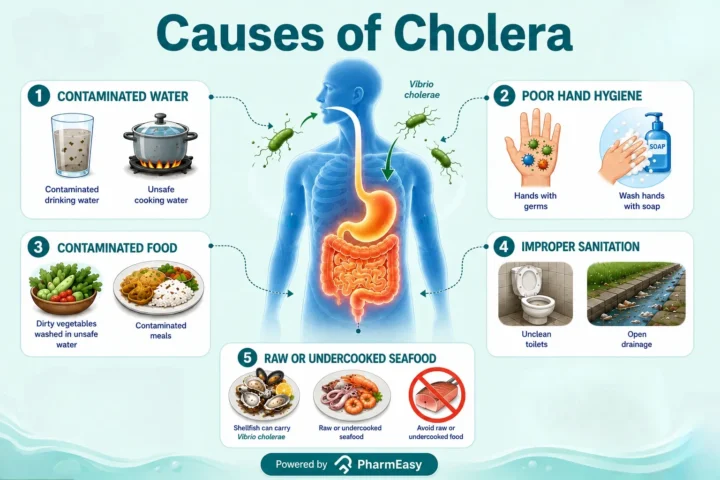
A person who has developed profuse diarrhoea implies that the amount of an infectious agent called Vibrio cholerae has reached greater numbers inside the patient’s body. This has the potential to infect others3.
The main causative agent of cholera is Vibrio cholerae (V. cholerae) bacteria, which is responsible for the infection and its transmission through contaminated water and food sources.
Vibrio cholerae bacteria, being the causal microbe for cholera, are transferred from infected to healthy individuals through their faeces. V. cholerae grows within people when they consume food, water, or both that is infected with the bacteria. The small intestines then may release fluid as a result of the bacteria, which results in diarrhoea1.
Dr. Rajeev Singh, BAMS
Out of 10 infected people, 1 person will develop severe symptoms that are listed below3:
When there is a case of profuse water-like diarrhoea, then additional signs are examined in such individuals:
Exploring the factors that increase susceptibility to cholera:
You may have come across news pieces that in the rural areas of economically poor countries, cholera is a common disease. The reason for this may be the lack of proper water sanitation, compromised sewage disposal and hygiene issues. In such places, the food and water are usually infected with Vibrio cholerae bacteria, consumption of which leads to diarrhoea and other symptoms. They typically take 2–3 days to manifest.
Dr. Siddharth Gupta, B.A.M.S, M.D (Ayu)
After examining the patient for several signs and symptoms, a confirmatory test is required to declare and outline the degree of cholera infection.
When someone contracts cholera their focus should be on preventing dehydration. Since the body fluids are constantly being lost, the water intake must compensate for the loss.
Cholera can cause excessive diarrhoea and vomiting, resulting in the loss of important substances in the body.
Insufficient levels of these substances can lead to dehydration and various symptoms:
If left untreated, severe dehydration caused by cholera can lead to serious complications:
Disclaimer: The information included on this site is for educational purposes only and is not intended to be a substitute for medical treatment by a healthcare professional. Because of unique individual needs, the reader should consult their physician to determine the appropriateness of the information for the reader’s situation.
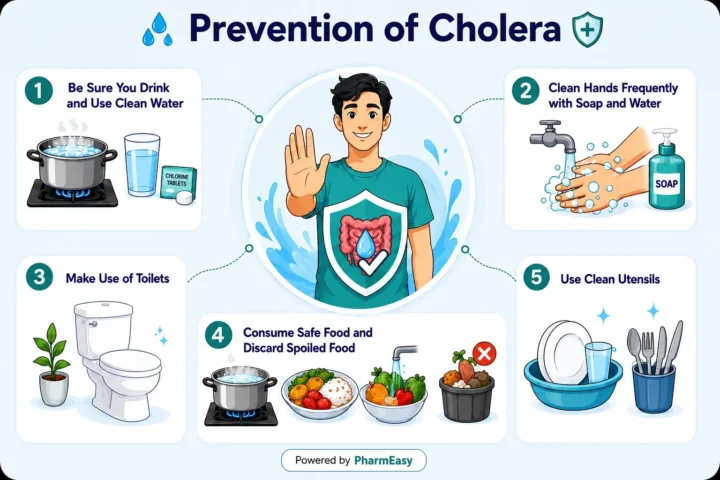
Bacteria causing cholera are not contagious, however, preventive measures can be undertaken to avoid contracting the infection from another person1. There are 5 fundamental cholera preventive steps as per Centres for Disease Control and Prevention (CDC)8:
Also Read: Food Allergies: Symptoms, Types, Diagnosis & Home Remedies
It is observed that after consumption of contaminated food, a person takes 12 hours to even upto 5 days to develop severe symptoms.
Therefore, anyone who experiences any of the above mentioned symptoms should immediately visit the doctor. Some early symptoms might fade within a few days. Early diagnosis and onset of administering medications can prevent a patient’s life1.
Cholera is a serious but preventable bacterial infection caused by Vibrio cholerae, primarily spreading through contaminated food and water in regions with poor sanitation. While it can be life-threatening due to severe dehydration, timely rehydration therapy oral or intravenous leads to recovery in over 99% of cases. Antibiotics and zinc supplementation further aid treatment. Prevention through clean water, proper hand hygiene, safe food practices, and good sanitation remains the most effective defense against this disease. Early medical attention is crucial upon onset of symptoms.
Also Read: Viral Fever: Causes, Symptoms, and Treatment Options
There are no specific animal hosts for Vibrio cholerae bacteria4.
There is one vaccine for cholera which has been approved by FDA1.
There are many serogroups of V. cholerae, however, two types – O1 and O139 – are the reasons for cholera outbreaks9.
During the 19th century, cholera unfolded across the world from its unique reservoir inside the Ganges delta in India9.
Vibrio cholerae bacteria infects the intestine and causes diarrhoea3.
Disclaimer: The information provided here is for educational/awareness purposes only and is not intended to be a substitute for medical treatment by a healthcare professional and should not be relied upon to diagnose or treat any medical condition. The reader should consult a registered medical practitioner to determine the appropriateness of the information and before consuming any medication. PharmEasy does not provide any guarantee or warranty (express or implied) regarding the accuracy, adequacy, completeness, legality, reliability or usefulness of the information; and disclaims any liability arising thereof.
Links and product recommendations in the information provided here are advertisements of third-party products available on the website. PharmEasy does not make any representation on the accuracy or suitability of such products/services. Advertisements do not influence the editorial decisions or content. The information in this blog is subject to change without notice. The authors and administrators reserve the right to modify, add, or remove content without notification. It is your responsibility to review this disclaimer regularly for any changes.
0
0The human body relies on a variety of hormones, vitamins, and nutrients to maintain balance and proper cell function. Vitamin D, also known as the sunshine vitamin or calciferol, is a fat-soluble vitamin that is essential for multiple body functions and overall health. It can be obtained through diet and sun exposure1. This blog focuses on the benefits of vitamin D and some of its sources.
Did You Know?
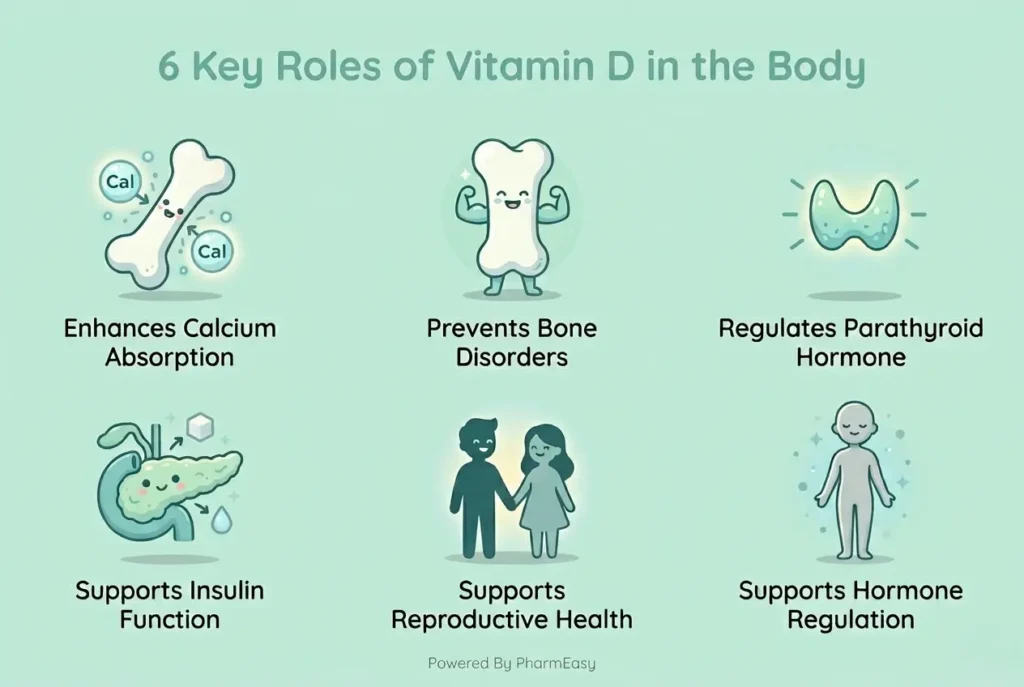
The minerals calcium and phosphate are present in major quantities in teeth, bones, and muscles. The amount of calcium and phosphate available in the body is regulated by vitamin D. Vitamin D deficiency may lead to conditions like osteoporosis, bone fractures and delayed recovery, and weak and softened bones in children (rickets) and adults (osteomalacia)2,3.
Studies have found that people with low vitamin D levels are more likely to experience symptoms of depression and anxiety than those with normal levels3. In addition, vitamin D supplementation has been shown to improve mood in people with depression.
Our body needs vitamin D for multiple bodily functions that include maintaining bone health, regulation of muscle function, and upliftment of mood. According to some studies, vitamin D might also guard against conditions like various forms of cancer, cardiovascular diseases, and depression3.
Dr. Rajeev Singh, BAMS
The Food and Nutrition Board (FNB) committee has set Recommended Dietary Allowances (RDAs) for vitamin D that indicate its needed daily intake to support proper bone health and normal calcium metabolism in individuals without any health conditions.
The RDAs for vitamin D are provided in two units of measurement: micrograms (mcg) and international units (IU). It is important to note that 1 mcg of vitamin D is equivalent to 40 IU3.
Age Group: 0 to 12 months
Age Group: 1 to 70 years
Age Group: More than 70 years
For pregnant women & lactating women
The best sources of vitamin D are fatty fish (salmon, mackerel), cod liver oil, fortified cereals, oranges, milk, and dairy products1. Although there is no measurable amount of vitamin D in fruits, fortified fruit products like juices and smoothies may provide vitamin D8.
As we all know, we must consume foods that are rich in vitamin D because just sun exposure may not suffice. Vitamin D is essential for calcium absorption, muscle regulation, and some other functions. Some studies show that mushrooms may give a good boost of vitamin D. According to some research, 100g servings of vitamin D might be able to provide 50 to 100% of the daily requirement of vitamin D13.
Dr. Siddharth Gupta, B.A.M.S, M.D (Ayu)
Also Read: Best Vegetable Sources of Vitamin A
An appropriate diet and sun exposure are both required to get adequate levels of vitamin D. Fruits do not naturally contain vitamin D. However, some fruit-based products, such as fortified juices or smoothies, may contain added vitamin D. Along with consuming foods that give you vitamin D, about 10 to 15 minutes of exposure to the sun thrice a week is usually sufficient to maintain optimum vitamin D levels in the body.
Also Read: Vitamin D for Women – Daily Need, Normal Range, Deficiency & Solution
Vitamin D deficiency can cause rickets in children, characterised by weak muscles, bone pain, joint deformities, and osteomalacia in adults, characterised by fatigue, bone pain, muscle aches, cramps, and depression2,3.
Older adults, dark-skinned people, people with obesity, people with chronic kidney or liver disease, and people who consume medicines that might interact with vitamin D levels (e.g., seizure medicines) are at higher risk of vitamin D deficiency11.
As per a study it is found that there is no association between the ingestion of vitamin D-rich food and the formation of kidney stones12.
Yes, but certain studies have shown that even people in countries with abundant sunlight throughout the year can experience a deficiency in vitamin D2.
Disclaimer: The information provided here is for educational/awareness purposes only and is not intended to be a substitute for medical treatment by a healthcare professional and should not be relied upon to diagnose or treat any medical condition. The reader should consult a registered medical practitioner to determine the appropriateness of the information and before consuming any medication. PharmEasy does not provide any guarantee or warranty (express or implied) regarding the accuracy, adequacy, completeness, legality, reliability or usefulness of the information; and disclaims any liability arising thereof.
Links and product recommendations in the information provided here are advertisements of third-party products available on the website. PharmEasy does not make any representation on the accuracy or suitability of such products/services. Advertisements do not influence the editorial decisions or content. The information in this blog is subject to change without notice. The authors and administrators reserve the right to modify, add, or remove content without notification. It is your responsibility to review this disclaimer regularly for any change
1
0


