
लजेनेरिया सिसेरिया, जिसे अंग्रेजी में बॉटल गॉर्ड और हिंदी में लौकी के नाम से जाना जाता है, भारत में यह एक आम सब्जी है। लौकी (बॉटल गॉर्ड) का इस्तेमाल परंपरागत रूप से बुखार, खांसी, दर्द और अस्थमा जैसी कई स्वास्थ्य संबंधी दिक्कतों में मदद के लिए किया जाता रहा है। इसके फ़ायदों के लिए इसका इस्तेमाल प्राचीन काल से किया जाता रहा है। साथ ही इसे विटामिन बी, सी और अन्य पोषक तत्वों का भी बेहतर स्रोत माना जाता है। यह अपने आकार, बोतल, डंबल या अंडाकार आकार के लिए जाना जाता है।
आपको लौकी (बॉटल गॉर्ड) खाने में बोरिंग लग सकती है, लेकिन इसे पृथ्वी पर वातावरण के अनुकूल बनने वाले शुरुआती पौधों में से एक माना जाता है। यह स्वास्थ्य को बढ़ावा देने वाले कई फ़ायदों से भी भरपूर हो सकता है।1,2 अगर आप बॉटल गॉर्ड या लौकी (बॉटल गॉर्ड) के बारे में और जानना चाहते हैं तो पढ़ना जारी रखें।
Read in English: Coconut: Uses, Benefits, Side Effects and More!
लौकी (बॉटल गॉर्ड) में ये गुण हो सकते हैं:
Read in English: Raw Papaya: Uses, Benefits, Side Effects and More!
पशुओं के कई अध्ययनों से पता चला है कि लौकी (बॉटल गॉर्ड) में ऐसे गुण होते है, जो लीवर के लिए अच्छे हो सकते हैं। लौकी कई संभावित फ़ायदा प्रदान करती है, जो लीवर की स्थिति और कार्यों में सहायक होते है। इन संभावित फ़ायदों को पशुओं पर किये गए परीक्षणों में देखा गया है। लीवर के किसी भी रोग के लिए लौकी (बॉटल गॉर्ड) का इस्तेमाल करने से पहले आपको अपने स्वास्थ्य सेवा प्रदाता से संपर्क करना चाहिए।1,4
लौकी (बॉटल गॉर्ड) का सेवन याददाश्त के लिए फ़ायदेमंद हो सकता है। लौकी (बॉटल गॉर्ड) में कुछ यौगिक मस्तिष्क पर कार्य करके दर्द निवारक और केंद्रीय तंत्रिका तंत्र (सीएनसी) अवसादकारी गतिविधि दर्शती हैं।1,4 सीएनसी अवसादकारी गतिविधि मन को शांत करने पर इसके संभावित प्रभावों का संकेत देती है। मस्तिष्क के फ़ायदे के लिए लौकी (बॉटल गॉर्ड) का उपयोग करने से पहले, आपको अपने स्वास्थ्य सेवा प्रदाता से संपर्क करना चाहिए और उचित निदान और उपचार प्राप्त करना चाहिए।
एक पशु अध्ययन के अनुसार लौकी (बॉटल गॉर्ड) का जूस कैंसर कोशिकाओं के खिलाफ कार्य करता है। इसके अतिरिक्त, इसके स्टेम अर्क के एक प्रयोगशाला अध्ययन के अनुसार यह कैंसर कोशिका लाइनों के खिलाफ शक्तिशाली साइटोटॉक्सिक (शरीर की कोशिकाओं के लिए विषाक्त) गतिविधि दर्शाता है। लौकी (बॉटल गॉर्ड) की यह कैंसर विरोधी क्रिया इसकी संभावित एंटीऑक्सीडेंट और साइटोटॉक्सिक क्षमताओं के कारण होती है।1 लौकी (बॉटल गॉर्ड) के इन संभावित लाभों का प्रयोगशाला अध्ययनों में अध्ययन किया गया है। हालाँकि, चल रहे उपचार को बदलने या बंद करने के लिए किसी भी हर्बल सप्लीमेंट या उपचार का उपयोग करने से पहले आपको अपने डॉक्टर से परामर्श करना चाहिए।
डायबिटीज़ के रोगियों को ठीक करने के लिए पारंपरिक रूप से लौकी (बॉटल गॉर्ड) का प्रयोग किया जाता रहा है। कम वसा और उच्च फाइबर सामग्री के कारण, डायबिटीज़ वाले लोगों के लिए लौकी (बॉटल गॉर्ड) को पसंदीदा भोजन के रूप में खाने का सुझाव दिया जा रहा है। एक पशु परीक्षण के अनुसार, लौकी (बॉटल गॉर्ड) का अर्क डायबिटीज़ वाले पशुओं में ब्लड शुगर के स्तर को प्रभावी ढंग से कम कर सकता है।4 पशुओं पर किए गए परीक्षणों में लौकी (बॉटल गॉर्ड) के संभावित डायबिटीज़-रोधी लाभों का अवलोकन किया गया है, और मनुष्यों में इन गुणों को मान्य करने के लिए अधिक अध्ययनों की आवश्यकता है।
लौकी (बॉटल गॉर्ड) वज़न कम करने के लिए एक अच्छा विकल्प हो सकता है क्योंकि इसमें कैलोरी कम होती है और इसमें ज्यादातर पानी ही होता है। यह डाइटरी फाइबर में भी समृद्ध होती है और इसमें कम फैट और कोलेस्ट्रॉल होता है। इन गुणों से वज़न कम करने में मदद मिल सकती है।4 आप अपना वज़न कम करने में मदद करने के लिए अपने नियमित आहार में लौकी (बॉटल गॉर्ड) को ले सकते हैं। हालाँकि, वज़न घटाने के लिए किसी भी हर्बल के उपचार का उपयोग करने से पहले, आपको अपने स्वास्थ्य देखभाल प्रदाता से इसके संभावित उपयोगों और दुष्प्रभावों के बारे में परामर्श करना चाहिए।
लौकी (बॉटल गॉर्ड) विटामिन C और जिंक का एक अच्छा स्रोत है जो त्वचा के लिए कई फ़ायदे प्रदान कर सकता है।3 विटामिन C त्वचा के समग्र स्वास्थ्य के लिए आवश्यक विटामिन है। यह त्वचा को पराबैंगनी विकिरण से होने वाले नुकसान से बचा सकता है। यह त्वचा की उम्र बढ़ने के लक्षणों को रोकने में भी मदद कर सकता है, जैसे त्वचा ढीली होना। यह त्वचा बैरियर लिपिड के उत्पादन को बढ़ाकर त्वचा बैरियर को मजबूत करने में भी मदद कर सकता है।5. यदि आप किसी भी त्वचा की बीमारी से पीड़ित हैं, तो त्वचा की देखभाल करने वाले डॉक्टर या त्वचा विशेषज्ञ से संपर्क करें, क्योंकि वे आपको हर्ब्स और सब्जियों के उपयोग और सीमाओं के बारे में मार्गदर्शन करने में सक्षम होंगे।
हालाँकि ऐसे अध्ययन हैं जो विभिन्न स्थितियों में लौकी (बॉटल गॉर्ड) के लाभों को दर्शाते हैं, लेकिन ये अभी तक अपर्याप्त हैं, और मानव स्वास्थ्य पर लौकी (बॉटल गॉर्ड) के लाभों की वास्तविक सीमा को स्थापित करने के लिए आगे और अधिक अध्ययन करने की आवश्यकता है।
Read in English: Curry Leaves: Uses, Benefits, Side Effects and More!
Lauki(Bottle Gourd) Ka Upyog Kaise Karein?
पौधों के सभी भागों, जिनमें फल, पत्ते, तने, छाल, फल की छाल, बीज और तेल शामिल हैं, का उपयोग पारंपरिक चिकित्सा में भी किया जा सकता है।
किसी भी हर्बल सप्लीमेंट लेने से पहले आपको किसी योग्य डॉक्टर से परामर्श करना चाहिए। बिना किसी योग्य चिकित्सक से परामर्श किए आधुनिक चिकित्सा के चल रहे उपचार को आयुर्वेदिक/औषधीय तैयारी से न रोकें या न बदलें।
कड़वे स्वाद वाली लौकी (बॉटल गॉर्ड) का जूस पीने से गंभीर जहरीली प्रतिक्रिया हो सकती है। लौकी (बॉटल गॉर्ड) के जूस से जहर के लक्षणों में उल्टी, पेट दर्द, दस्त, हेमाटोकेशिया (बदली में खून), हेमेटेमेसिस (खून की उल्टी), सदमे और यहां तक कि मौत भी शामिल हो सकती है। इन लक्षणों में से किसी को भी देखने पर आपको तुरंत अपने डॉक्टर से परामर्श करना चाहिए।
लौकी (बॉटल गॉर्ड) के साथ बरती जाने वाली कुछ सावधानियाँ:
इसके औषधीय लाभों के लिए लौकी (बॉटल गॉर्ड) का उपयोग करने से पहले अपने स्वास्थ्य सेवा प्रदाता से संपर्क करें।
अन्य दवाओं के साथ लौकी (बॉटल गॉर्ड) की सुरक्षा या परस्पर क्रिया का पता लगाने के लिए पर्याप्त डेटा की कमी है। इसलिए, यदि आप कोई भी दवा ले रहे हैं, तो आपको खाद्य पदार्थों और सब्जियों के साथ संभावित परस्पर क्रिया के बारे में अपने डॉक्टर से परामर्श करना चाहिए। वे आपको किसी विशेष दवा की सावधानी और परस्पर क्रिया के बारे में बेहतर मार्गदर्शन कर पाएंगे।
बॉटल गॉर्ड या लौकी (बॉटल गॉर्ड) में विटामिन C का भरपूर मात्रा में समावेश होता है। विटामिन C त्वचा के स्वास्थ्य के लिए फायदेमंद हो सकती है। विटामिन C त्वचा को पराबैंगनी किरणों से होने वाली क्षति से बचाने में उपयोगी हो सकती है। विटामिन C के स्रोत के रूप में लौकी (बॉटल गॉर्ड) का जूस इस्तेमाल किया जा सकता है।3,5
लौकी (बॉटल गॉर्ड) में कम कैलोरी होती है और इसमें अधिकतर पानी होता है। लौकी (बॉटल गॉर्ड) में डाइटरी फाइबर भी भरपूर होता है। लौकी (बॉटल गॉर्ड) के जूस के पोषक गुणों के कारण यह उन लोगों के लिए अच्छा विकल्प बन सकता है जो स्वस्थ भोजन करना चाहते हैं और वज़न को नियंत्रित करना चाहते हैं।4 हालाँकि, इसके उपयोग और मनुष्यों पर लाभकारी प्रभावों का समर्थन करने वाले डेटा की कमी है। वज़न कम करने के तरीकों के बारे में अधिक जानकारी प्राप्त करने के लिए आप डॉक्टर या आहार विशेषज्ञ से मिल सकते हैं।
लौकी (बॉटल गॉर्ड) में पोषणा की मात्रा अच्छी होती है और इसमें बहुत सारे विटामिन, खनिज और कार्बोहाइड्रेट होते हैं। इसके पोषण लाभों के लिए लौकी (बॉटल गॉर्ड) का जूस पीया जा सकता है। यह लीवर को स्वस्थ रखने में भी मदद कर सकता है और रोग की स्थिति और त्वचा के स्वास्थ्य में भी मदद कर सकता है।1–5
लौकी (बॉटल गॉर्ड) के जूस का स्वाद कड़वा होता है, जो काफी ज़हरीला हो सकता है। यदि आपको उल्टी, पेट में दर्द, दस्त, हेमाटोकेशिया (मूत्र में रक्त) या हेमेटेमिसिस (खून उल्टी) जैसे लक्षण दिखाई देते हैं, तो तुरंत अपने डॉक्टर से संपर्क करें। ये लौकी (बॉटल गॉर्ड) के जूस के विषाक्तता के लक्षण हैं।6 यदि आपको ये लक्षण दिखाई देते हैं, तो तुरंत अपने स्वास्थ्य सेवा प्रदाता से संपर्क करें और अपना इलाज कराएं।
Disclaimer:
The information included at this site is for educational purposes only and is not intended to be a substitute for medical treatment by a healthcare professional. Because of unique individual needs, the reader should consult their physician to determine the appropriateness of the information for the reader’s situation
 1
1  0
0White blood cells (WBCs), which are a type of blood cells are an essential part of our immune system and play a critical role in protecting the body against infection, illness, and disease. However, an abnormally high number of white blood cells in the bloodstream can indicate an underlying medical condition that requires urgent attention. So, whether you’re a medical professional or just eager to learn more, join us for an in-depth look at WBCs, their importance, normal range, dangerous levels, low WBC count and medical treatment for low WBC.
Did you know?
The WBCs value includes the sum total of the subtypes of white blood cells which include eosinophils, neutrophils, lymphocytes, atypical leucocytes and monocytes. The normal range for WBCs for different age groups is as follows:
A WBC count lower than the given range is leukopenia and higher than the range is called leukocytosis. Either is dangerous and requires an immediate medical opinion. After ordering a complete blood test profile, your doctor will diagnose leukocytosis or leukopenia and determine the need for further evaluation and tests.
In case of an abnormal laboratory value, your doctor will do a physical examination and take a detailed history to ascertain/identify the possible cause of an abnormal WBC count. Depending on the signs and symptoms, the need for hematology/oncology consultation, genetic testing will be evaluated1,2.
White blood cells (WBCs) are crucial for maintaining your body’s health. They guard it against outside contaminants and stop infection. But did you know that even the excess WBCs might also cause a big problem? Leukocytosis refers to a condition in which there are more white blood cells than usual. Studies14 have revealed that while WBCs counts often rise as they perform their duties, there are certain additional circumstances in which they could do so, such as women who are pregnant may have somewhat higher number of WBCs.
Dr. Smita Barode, B.A.M.S, M.S.
A dangerous WBC count may vary depending on the individual’s health condition and medical history. However, a general guideline is that white blood cell count above 11 x109/L (leukocytosis) can be fatal.
A low level of WBCs in your body commonly called as leukopenia may increase the risk of infections in all age groups and developmental defects in children. Leukopenia is asymptomatic, i.e. it may present without any symptoms but it can cause infections which may have the following symptoms2,3:
If you have any of the above complaints, you should seek medical guidance at the earliest for a proper management and do not rely on any home remedies or self-medication.
Following are the conditions/causes associated with a low WBC count in the body2,3:
WBCs are produced by the spleen. It may enlarge and cease to function properly as a result of infections, blood clots, and other issues. From my perspective, the result will be a decrease in WBC13.
Dr. Rajeev Singh, BAMS
Following are the ways by which the levels of WBCs can be restored4,5:

A study6 conducted by Lassale et al. in 2021 stated that Mediterranean diets which are rich in healthy foods like fruits, vegetables, beans, seafood and nuts have the potential to increase WBC levels.

Montagnana et al. in 2017 conducted a review7 in 2017 which stated that dark chocolate consumption may increase the level of WBCs in the body.
However, you should refrain from the following foods if you have low WBC count8:
In my experience, your body’s ability to produce WBCs may be impacted by poor nutrition or insufficient amounts of certain vitamins, such as folic acid and B12. Abusing alcohol might affect both your WBC levels and the nutrients in your body13.
Dr. Siddharth Gupta, B.A.M.S, M.D (Ayu)
Also Read: Anaemia: Causes, Symptoms, Types, Diagnosis & More!
The white blood cells value includes the sum total of the subtypes of white blood cells which include eosinophils, neutrophils, lymphocytes, atypical leucocytes and monocytes. The normal range for white blood cells for adults is 4.5-11 x109/L. A dangerous white blood cell count may vary depending on the individual’s health condition and medical history. White blood cell count above 11 x109/L (leukocytosis) can indicate a sign of danger. On the other hand, leukopenia or the abnormal reduction of the white blood cells can be dangerous too. It’s important to consult with your healthcare professional if you have concerns about your white blood cell count. There are no medicines approved to improve the levels of white blood cells, however dietary changes and supplements may improve the level of white blood cells.
Low blood cell count is not associated with any symptoms but it may cause infections which may be associated with fever, chills, redness, sweating, mouth sores, sore throat, tiredness, skin rashes, toothache and flu-like symptoms4,5.
The most common causes for low white blood cell counts include cancer and cancer treatment like radiotherapy, antipsychotic medications, medications used to treat hyperthyroidism, HIV, Hepatitis and megaloblastic anaemia, etc4,5.
Normal reference range varies from laboratory to laboratory; generally a range of 4.5-11×109/L is considered normal for adults1.
Vitamin B6 and B12 supplements may help increase white blood cells8,9.
Indian milkvetch or astragalus, also known as Katira or Huang which is a flowering plant was found to improve white blood cell counts9.
1. Riley LK, Rupert J. Evaluation of patients with leukocytosis. American family physician. 2015 Dec 1; 92(11):1004-11. Available at: https://www.aafp.org/pubs/afp/issues/2015/1201/p1004.html
2. Low white blood cell count [Internet]. Health A to Z. NHS; 2023 [cited 2023 May 11]. Available from: https://www.nhs.uk/conditions/low-white-blood-cell-count/
3. White blood cell count and diet [Internet]. Oncology Nutrition. Academy of Nutrition and Dietetics. Available from: https://community.eatrightpro.org/ecm-site-theme-1/erfc/eating-well-when-unwell/white-blood-count-diet
4. Sand KL, Flatebo T, Andersen MB, Maghazachi AA. Effects of exercise on leukocytosis and blood hemostasis in 800 healthy young females and males. World journal of experimental medicine. 2013 Feb 2; 3(1):11. Available at: https://www.ncbi.nlm.nih.gov/pmc/articles/PMC3905589/
5. Hernáez Á, Lassale C, Castro-Barquero S, Babio N, Ros E, Castañer O, Tresserra-Rimbau A, Pintó X, Martínez-González MÁ, Corella D, Salas-Salvadó J. Mediterranean diet and white blood cell count—A randomized controlled trial. Foods. 2021 Jun 2; 10(6):1268. Available at: https://www.ncbi.nlm.nih.gov/pmc/articles/PMC8227102/
6. Hernáez Á, Lassale C, Castro-Barquero S, Babio N, Ros E, Castañer O, et al. Mediterranean diet and white blood cell count—A randomized controlled trial. Foods. 2021;10(6):1268. doi:10.3390/foods10061268. Available at: https://www.mdpi.com/2304-8158/10/6/1268
7. Montagnana M, Danese E, Lima-Oliveira G, Salvagno GL, Lippi G. Dark chocolate intake acutely enhances neutrophil count in peripheral venous blood. Iranian Journal of Pathology. 2017 Jul 1; 12(3):311-2. Available at: https://www.ncbi.nlm.nih.gov/pmc/articles/PMC5835384/
8. Hawkins WW, Evans MK. White blood cells and lymphoid tissue in vitamin B6 insufficiency. American Journal of Physiology-Legacy Content. 1952 Jul 1; 170(1):160-7. Available at: https://pubmed.ncbi.nlm.nih.gov/12985879/
9. Lewicki S, Lewicka A, Kalicki B, Kłos A, Bertrandt J, Zdanowski R. The influence of vitamin B12 supplementation on the level of white blood cells and lymphocytes phenotype in rats fed a low-protein diet. Central-European journal of immunology. 2014; 39(4):419. Available at: https://www.ncbi.nlm.nih.gov/pmc/articles/PMC4439950/
10. Varughese T, Joseph J, Menon R. Efficacy of Jackfruit365™ Green Jackfruit Flour Fortified Diet on Pegfilgrastim to Prevent Chemotherapy-Induced Leukopenia, Irrespective of Tumor Type or Drugs Used—A Retrospective Study. Biomolecules. 2020 Feb 2; 10(2):218. Available at: https://pubmed.ncbi.nlm.nih.gov/32024271/
11. Weng XS. Treatment of leucopenia with pure Astragalus preparation–an analysis of 115 leucopenic cases. Zhongguo Zhong xi yi jie he za zhi Zhongguo Zhongxiyi Jiehe Zazhi= Chinese Journal of Integrated Traditional and Western Medicine. 1995 Aug 1; 15(8):462-4. Available at: https://pubmed.ncbi.nlm.nih.gov/8580691/
12. Chang KH, Tan R, Chung CH. The use of lithium carbonate to correct leukopenia during cancer treatment. Zhonghua yi xue za zhi= Chinese Medical Journal; Free China ed. 1989 Mar 1; 43(3):165-70. Available at: https://pubmed.ncbi.nlm.nih.gov/2507118/
13. Morstyn G, Campbell L, Lieschke G, Layton JE, Maher D, O’Connor M, et al. Treatment of chemotherapy-induced neutropenia by subcutaneously administered granulocyte colony-stimulating factor with optimization of dose and duration of therapy. J Clin Oncol. 1989;7(10):1554-1562 Available at: https://ascopubs.org/doi/abs/10.1200/JCO.1989.7.10.1554
14. Stump-Sutliff KA. Why is my white blood cell count low? In: WebMD [Internet]. Atlanta (GA): WebMD; 2024 [cited 2026 May 25]. Available at: https://www.webmd.com/cancer/white-blood-cell-count-low
15. Guthrie L. What is leukocytosis? WebMD [Internet]. 2026 Feb 13 [cited 2026 May 25]. Available at: https://www.webmd.com/a-to-z-guides/what-is-leukocytosis
16. Sand KL, Flatebø T, Andersen MB, Maghazachi AA. Effects of exercise on leukocytosis and blood hemostasis in 800 healthy young females and males. World J Exp Med. 2013;3(1):11-20. doi:10.5493/wjem.v3.i1.11. PMID: 24520539. Available at: https://pmc.ncbi.nlm.nih.gov/articles/PMC3905589
Disclaimer: The information provided here is for educational/awareness purposes only and is not intended to be a substitute for medical treatment by a healthcare professional and should not be relied upon to diagnose or treat any medical condition. The reader should consult a registered medical practitioner to determine the appropriateness of the information and before consuming any medication. PharmEasy does not provide any guarantee or warranty (express or implied) regarding the accuracy, adequacy, completeness, legality, reliability or usefulness of the information; and disclaims any liability arising thereof.
Links and product recommendations in the information provided here are advertisements of third-party products available on the website. PharmEasy does not make any representation on the accuracy or suitability of such products/services. Advertisements do not influence the editorial decisions or content. The information in this blog is subject to change without notice. The authors and administrators reserve the right to modify, add, or remove content without notification. It is your responsibility to review this disclaimer regularly for any changes.
14
3The first three months of pregnancy are crucial as it is the time when organ formation takes place. It has been observed that many birth defects happen during the first 3 months of pregnancy. Neural tube defect is one of these defects1. Neural tube defects are birth defects present in the brain and the spinal cord. Globally, there are more than 3,00,000 newborns every year diagnosed with neural tube defects or 2 per thousand live births2.
Development of the brain and spine begins in the first month of pregnancy. At this stage, the developing brain and spine are called the neural tube. Neural tube defects occur when the tube does not close completely along its length3. Types of neural tube defects include Spinal bifida, Anencephaly, Encephalocele, and Iniencephaly. Spina bifida and anencephaly are more commonly reported in newborns. Foetus detected with iniencephaly and anencephaly die before birth, during the delivery or shortly after birth4,5.
Since neural tube defect occurs in the first month of pregnancy, the mother might not experience any signs and symptoms. During her regular ultrasound, the gynaecologist would possibly reveal signs of this type of birth defect. However, in babies born with neural tube defects, the following general symptoms might be seen6:
In cases of neural tube defects, normal persistent nerve damage and loss of function are evident at birth3. So, if your child has a neural tube defect, he/she will probably need admission in NICU and surgery at time of birth.
Prevention is the quintessential when it comes to neural tube defects, and thus the knowledge of risk factors and causes is also very crucial.
The exact causes of neural tube defect are still under research, although it is proposed that genetic reasons, nutritional deficiencies, and environmental factors all play a role in causing neural tube defects. Most importantly, the role of folic acid is vital for the healthy development of the foetus, especially in preventing neural tube defects. Just like any other vitamin, vitamin B9 i.e., folic acid levels are extremely crucial during pregnancy. Low levels of folic acid in females before getting pregnant or during the early stages of pregnancy can result in this type of birth defect3,7.
While the exact cause of neural tube defects remains unclear, chances of having them are higher3,4:
A female who is expecting a child should avoid or reduce the above-mentioned risk factors.
Ultrasound testing is done for detecting any abnormalities in the growing foetus. The doctor might require supporting tests to be carried out for coming to a diagnosis. The following tests are a part of the examination during pregnancy:
Amongst the four types of neural tube defects, there is no treatment for infants with anencephaly or iniencephaly. Spina bifida and encephalocele can still be treated through surgical procedures depending upon the severity of the defects14.
The doctor performs one or more surgeries to align the parts and membrane of the brain back into the skull. Sometimes, more than one surgery is required based on the complications. Frequent doctor or group of doctors’ visits may be required for the rest of their lives depending upon the severity of their condition.
Avoidance of risk factors and prevention is key for such defects.
Neural tube defects can be prevented by lowering the risk factors during the early stages of pregnancy. Taking vitamin B9 supplements as prescribed by the doctor can prevent most neural tube defects7.
Complications associated with this type of defect are very critical and life-threatening. Following is a list of complications that may arise in an infant who is suffering from neural tube defects:
A baby is at risk of facing complications at three stages i.e., when it is inside the mother’s womb, when the baby takes birth, and at the infant stage.
Neural tube defects or defects of brain and spinal cord in the developing foetus may lead to death of the baby before, during or after birth. Those with spina bifida and encephalocele type of neural tube defect can survive but may have some long-lasting complications depending upon the severity. While the exact cause of these is not clear, majority of neural tube defects can be prevented with supplementation of folic acid during pregnancy. Every woman planning to conceive should consume folic acid daily. A proper consultation with a gynaecologist or any other healthcare provider should be done prior to consuming any medication during pregnancy.
Women who plan to conceive should start folic acid supplement after consulting with a healthcare provider.
Brain and spinal cord develop from a neural tube.
A baby can live with spina bifida and encephalocele type of neural tube defect, although there may be some complications.
Beans, peas, lentils, oranges, orange juice, asparagus, broccoli, spinach, and mustard greens are foods that contain folic acid. Yet, these cannot replace the need for medication/supplementation as suggested by the gynaecologist.
People who have already had one child with this defect have a 2% to 3% higher risk of having second born with neural tube defect.
1. Medline Plus. Birth Defects [Internet]. Medlineplus.gov. National Library of Medicine; 2019. Available from: https://medlineplus.gov/birthdefects.html
2. Fadumo Ahmed Mohamed, Merga Dheresa, Temam Bashir Raru, yusuf N, Tahir Ahmed Hassen, Ame Mehadi, et al. Determinants of neural tube defects among newborns in public referral hospitals in Eastern Ethiopia. BMC Nutrition. 2023 Jul 25;9(1). Available from: https://pmc.ncbi.nlm.nih.gov/articles/PMC10369744/
3. MedlinePlus. Neural Tube Defects [Internet]. Medlineplus.gov. National Library of Medicine; 2018. Available from: https://medlineplus.gov/neuraltubedefects.html
4. CDC. Neural Tube Defects [Internet]. Birth Defects. 2024. Available from: https://www.cdc.gov/birth-defects/about/neural-tube-defects.html
5. Chikkannaiah P, Srinivasamurthy V, Satish Prasad BS, Lalyanayak P, Shivaram DN. Iniencephaly: Radiological and pathological features of a series of three cases. Journal of Neurosciences in Rural Practice [Internet]. 2014;5(4):389–93. Available from: https://www.ncbi.nlm.nih.gov/pmc/articles/PMC4173238/
6. What are the symptoms of neural tube defects? [Internet]. https://www.nichd.nih.gov/. Available from: https://www.nichd.nih.gov/health/topics/ntds/conditioninfo/symptoms
7. Greenberg JA, Bell SJ, Guan Y, Yu Y. Folic Acid Supplementation and Pregnancy: More Than Just Neural Tube Defect Prevention. Reviews in Obstetrics and Gynecology [Internet]. 2011;4(2):52. Available from: https://pmc.ncbi.nlm.nih.gov/articles/PMC3218540/
8. Alpha-Fetoprotein (AFP) Test: MedlinePlus Lab Test Information [Internet]. Medlineplus.gov. 2017. Available from: https://medlineplus.gov/lab-tests/alpha-fetoprotein-afp-test/
9. How do health care providers diagnose neural tube defects (NTDs)? [Internet]. https://www.nichd.nih.gov/. Available from: https://www.nichd.nih.gov/health/topics/ntds/conditioninfo/diagnosed
10. Reynolds T. The triple test as a screening technique for Down syndrome: reliability and relevance. International Journal of Women’s Health. 2010 May;83. Available from: https://pmc.ncbi.nlm.nih.gov/articles/PMC2971727/
11. Medline Plus. What is noninvasive prenatal testing (NIPT) and what disorders can it screen for?: MedlinePlus Genetics [Internet]. medlineplus.gov. 2021. Available from: https://medlineplus.gov/genetics/understanding/testing/nipt/
12. Quadruple screen test: MedlinePlus Medical Encyclopedia [Internet]. Medlineplus.gov. 2016. Available from: https://medlineplus.gov/ency/article/007311.htm
13. CDC. Chorionic Villus Sampling and Amniocentesis: Recommendations for Prenatal Counseling [Internet]. CDC. 2019. Available from: https://www.cdc.gov/mmwr/preview/mmwrhtml/00038393.htm
14. What are the treatments for neural tube defects (NTDs)? [Internet]. https://www.nichd.nih.gov/. Available from: https://www.nichd.nih.gov/health/topics/ntds/conditioninfo/treatment
15. Avagliano L, Massa V, George TM, Qureshy S, Bulfamante GP, Finnell RH. Overview on neural tube defects: From development to physical characteristics. Birth Defects Research. 2018 Nov 12;111(19). Available from: https://pmc.ncbi.nlm.nih.gov/articles/PMC6511489/
16. Polyhydramnios: MedlinePlus Medical Encyclopedia [Internet]. Medlineplus.gov. 2023. Available from: https://medlineplus.gov/ency/article/003267.htm
17. Chiari Malformation [Internet]. Medlineplus.gov. National Library of Medicine; 2016 [cited 2025 Nov 20]. Available from: https://medlineplus.gov/chiarimalformation.html
18. Frezer Mengiste, Mulugeta Sitot Shibeshi, Dagnachew Gechera. Neural Tube Defect in a Resource Limited Setting: Clinical Profile and Short Term Outcome. Pediatric Health, Medicine and Therapeutics [Internet]. 2023 Sep 1 [cited 2024 Jan 22];Volume 14:289–99. Available from: https://www.ncbi.nlm.nih.gov/pmc/articles/PMC10517686/
19. Flores A, C Vellozzi, Valencia D, Sniezek J. Global Burden of Neural Tube Defects, Risk Factors, and Prevention. Indian journal of community health [Internet]. 2014 Nov;26(Suppl 1):3. Available from: https://pmc.ncbi.nlm.nih.gov/articles/PMC4480200/
Disclaimer: The information provided here is for educational/awareness purposes only and is not intended to be a substitute for medical treatment by a healthcare professional and should not be relied upon to diagnose or treat any medical condition. The reader should consult a registered medical practitioner to determine the appropriateness of the information and before consuming any medication. PharmEasy does not provide any guarantee or warranty (express or implied) regarding the accuracy, adequacy, completeness, legality, reliability or usefulness of the information; and disclaims any liability arising thereof.
Links and product recommendations in the information provided here are advertisements of third-party products available on the website. PharmEasy does not make any representation on the accuracy or suitability of such products/services. Advertisements do not influence the editorial decisions or content. The information in this blog is subject to change without notice. The authors and administrators reserve the right to modify, add, or remove content without notification. It is your responsibility to review this disclaimer regularly for any changes.
0
0अक्सर हम सांभर के कटोरे में इसे तैरते हुए देखते हैं, सहजन (ड्रमस्टिक) को वैज्ञानिक दृष्टि से मोरिंगा ओलेइफेरा लैम के नाम से जाना जाता है। यह मोरिंगेसी वृक्ष परिवार से संबंधित है। यह एक छोटा, तेज़ी से बढ़ने वाला, सदाबहार पेड़ है जो उष्णकटिबंधीय (ट्रॉपिकल) क्षेत्रों में उगता है। यह भारत, बांग्लादेश, अफगानिस्तान और पाकिस्तान के हिमालयी क्षेत्रों में पाया जाता है। सहजन (ड्रमस्टिक) को हॉर्सरैडिश ट्री या ड्रमस्टिक ट्री (अंग्रेजी में), सुभंजना (संस्कृत में), हरिताशाका या अक्षीवा (आयुर्वेद में) और सैन्जना या सगुना (हिंदी में) के रूप में भी जाना जाता है।1
सहजन (ड्रमस्टिक) के प्रत्येक भाग में मानव स्वास्थ्य के लिए आवश्यक गुण होते हैं; इसलिए, यह महत्वपूर्ण पोषण संबंधी जड़ी बूटियों में से एक है। कई वर्षों से सहजन (ड्रमस्टिक) का उपयोग पारंपरिक चिकित्सा दवा के रूप में किया जाता रहा है। आयुर्वेदिक चिकित्सा पद्धति के अनुसार, सहजन (ड्रमस्टिक) की हाई न्यूट्रिशनल वैल्यू, जल धारण करने की क्षमता और शुद्धिकरण क्षमता के कारण विभिन्न बीमारियों के लिए यह उपयोगी और मददगार है।1
सहजन (ड्रमस्टिक) महत्वपूर्ण खनिज और पोषक तत्वों की बड़ी और दुर्लभ किस्म प्रदान करता है। सहजन (ड्रमस्टिक) के कंद, पत्ते, फूल, छाल, जड़ और बीज में भी बायोएक्टिव यौगिक होते हैं।1
| पोषक तत्व | मात्रा/100 ग्राम में |
| ऊर्जा | 37 किलोकैलोरी |
| प्रोटीन | 2.1 ग्राम |
| फ़ैट (वसा) | 0.2 ग्राम |
| कार्बोहाइड्रेट | 8.53 ग्राम |
| फ़ाइबर | 3.2 ग्राम |
| कैल्शियम | 30 मिलीग्राम |
| आयरन | 0.36 मिलीग्राम |
| मैगनीशियम | 45 मिलीग्राम |
| फ़ास्फोरस | 50 मिलीग्राम |
| पोटैशियम | 461 मिलीग्राम |
| सोडियम | 42 मिलीग्राम |
| ज़िंक | 0.45 मिलीग्राम |
| कॉपर | 0.084 मिलीग्राम |
| मैंगनीज | 0.259 मिलीग्राम |
| सेलेनियम | 0.7 म्युग्राम |
| विटामिन सी | 141 मिलीग्राम |
| थायमिन | 0.053 मिलीग्राम |
| राइबोफ्लेविन | 0.074 मिलीग्राम |
| विटामिन बी6 | 0.12 मिलीग्राम |
| फ़ोलेट | 44 म्युग्राम |
| विटामिन ए | 4 म्युग्राम |
टेबल 1:प्रति 100 ग्राम कच्चे सहजन (ड्रमस्टिक) के कंद (फली) में पोषण क मात्रा2
सहजन (ड्रमस्टिक) के प्रमुख घटकों में बायोलॉजिकल गतिविधियां होती हैं जो आयुर्वेद, होम्योपैथी, यूनानी, योग, निसर्ग-चिकित्सा पद्धति और सिद्धा जैसी अनेक औषधीय प्रणालियों में इसके संभावित उपयोग में भूमिका निभा सकती हैं।1 सहजन (ड्रमस्टिक) के संभावित गुण इस प्रकार हैंः
सहजन (ड्रमस्टिक) का उपयोग हाई न्यूट्रिशन वैल्यू के साथ कई प्रकार से किया जा सकता है। इस पौधे के विभिन्न भाग उत्प्रेरक के रूप में कार्य करते हैं जो विशेष रूप से दक्षिण एशिया के स्थानीय चिकित्सा प्रणालियों में विभिन्न रोगों को ठीक करने के लिए नियोजित विभिन्न गतिविधियों को करते हैं।3 सहजन (ड्रमस्टिक) के संभावित उपयोगों में से कुछ इस प्रकार हैं।
सहजन (ड्रमस्टिक) के पत्ते के रस में एंटी-डायबटीज़ गुण दिखाई देता हैं जो हमारे ब्लड ग्लूकोज़ के स्तर को कम करने में मदद करता हैं। एक पशु पर हुए अध्ययन (गुप्ता आर और अन्य 2012) से पता चला कि सहजन (ड्रमस्टिक) के पत्तों का रस डायबटीज़ की वृद्धि को कम करने में मदद कर सकता है और प्रोटीन व इंसुलिन हार्मोन के बनने में वृद्धि करके सीरम ग्लूकोज़ के स्तर में कमी भी ला सकता है।1
पशु पर हुए एक अन्य अध्ययन (नोंग एम और अन्य 2007) से पता चला कि सहजन (ड्रमस्टिक) के पत्तों का रस रक्त में ग्लूकोज़, मूत्र में शर्करा, प्रोटीन, हीमोग्लोबिन और कुल प्रोटीन के स्तर को नियंत्रित करने में मदद कर सकता है।4 हालांकि, उपरोक्त दावों को सत्यापित करने के लिए और ज़्यादा अध्ययन करने होंगे। क्योंकि डायबिटीज़ एक गंभीर बीमारी है और इसका निदान व इलाज डॉक्टर द्वारा ही किया जाना चाहिए तो कृपया डॉक्टर से परामर्श करें।
पशुओं पर हुए विभिन्न अध्ययन (बी. एस राठी और अन्य 2006, वी.आई. हुक्केरी और अन्य 2006) से पता चलता है कि सहजन (ड्रमस्टिक) के सूखे पत्तों से निकला गया रस पशुओं के मॉडल में ग्रैन्युलोमा (डेड स्पेस), कटे और चीरे घाव भरने की क्रिया प्रदर्शित कर सकता है। यह घाव की जगह को भी काफ़ी हद तक कम कर सकता है, घाव के भरने में मदद कर सकता है, और त्वचा की पपड़ी की टूटन को मज़बूत कर सकता है।4 हालांकि, घाव भरने के लिए सहजन (ड्रमस्टिक) के संभावित उपयोगों को साबित करने के लिए मनुष्यों पर अभी और ज़्यादा अध्ययन करने की आवश्यकता है।
सहजन (ड्रमस्टिक) की छाल, पत्तियां, बीज, फूल और जड़ों में ड्यूरेटिक गतिविधि होती है जो कि किडनी डिस्फंक्शन (दुष्क्रिया) वाले रोगियों में पेशाब के बनने में सहायक होती है। यह किडनी में ऑक्सालेट नमक (पथरी बनाने वाली इकाइयां) के जमाव को कम करने में भी मदद कर सकता है। पशु पर हुए एक अध्ययन (आर. वी. कराडी और अन्य 2008) में पाया गया कि सहजन (ड्रमस्टिक) की जड़ का रस किडनी में नमक और मूत्र के उत्सर्जन को कम करता है। इसके अलावा, ये रस बड़े हुए सीरम यूरिक एसिड और क्रिएटिनिन के स्तर को भी कम करते हैं।4 यह जानकारी अपर्याप्त है क्योंकि ये अध्ययन अभी सिर्फ पशुओ पर किए गए है। हालांकि, इस दावे का समर्थन करने के लिए मनुष्यों पर इसके और अधिक अध्ययन की आवश्यकता है। किडनी की बीमारी गंभीर होती हैं और उनका निदान और इलाज डॉक्टर द्वारा ही किया जाना चाहिए, इसलिए कृपया डॉक्टर से परामर्श करें। हम सलाह देते हैं कि आप डॉक्टर से सलाह लेने से पहले खुद से इलाज करने के लिए सहजन (ड्रमस्टिक) का उपयोग न करें।
सहजन (ड्रमस्टिक) के पत्ते और बीज संभावित एंटी-ट्यूमर गतिविधियों को दर्शाते है। इसमें कुछ यौगिक होते हैं जो अवरोधक के रूप में कार्य कर सकते हैं और ट्यूमर बढ़ाने वाले अणुओं की गतिविधि को बाधित कर सकते हैं। मानव कैंसर की कोशिकाओं पर इन-विट्रो अध्ययनों से पता चला कि सहजन (ड्रमस्टिक) के पत्ते के रस की अधिकतम खुराक कैंसर कोशिकाओं के संभावित विषाक्त प्रभाव कैंसर कोशिकाओं की संख्या को कम करने में अपना योगदान देती है।4 हालांकि, कैंसर के लिए सहजन (ड्रमस्टिक) के संभावित उपयोग को साबित करने के लिए अभी बहुत ज़्यादा व्यापक शोधों की आवश्यकता है। इसके अलावा, कैंसर एक गंभीर बीमारी है और इसका निदान और इलाज डॉक्टर द्वारा ही किया जाना चाहिए।
यद्यपि ऐसे और भी अध्ययन हैं जो विभिन्न स्थितियों में सहजन (ड्रमस्टिक) के संभावित उपयोगों को दर्शाते हैं, लेकिन वे अपर्याप्त हैं, और हमें मानव स्वास्थ्य पर सहजन (ड्रमस्टिक) के लाभों की वास्तविक सीमा स्थापित करने के लिए आगे और ज़्यादा अध्ययन करने की ज़रूरत है।
Sehjan(Drumstick) ka upyog kaise karein?
ड्रमस्टिक का प्रयोग निम्नलिखित तरीकों से किया जा सकता हैः
नियमित रूप से सहजन (ड्रमस्टिक) का सेवन करने से पहले आपको हमेशा अपने आयुर्वेदिक चिकित्सक से परामर्श लेना चाहिए। वे आपकी स्वास्थ्य स्थिति के अनुसार सही रूप और खुराक निर्धारित करने के लिए सबसे अच्छे व्यक्ति होंगे।
किसी भी हर्बल सप्लीमेंट को लेने से पहले आपको किसी योग्य डॉक्टर से परामर्श करना चाहिए। किसी योग्य चिकित्सक से परामर्श किए बिना आधुनिक चिकित्सा के चल रहे उपचार को आयुर्वेदिक/जड़ी-बूटियों की तैयार दवा से न तो बदलें या न ही रोकें।
पिछले कुछ वर्षों में, सहजन (ड्रमस्टिक) की प्राकृतिक उत्पत्ति और कुछ दुष्प्रभावों के कारण इस पर काफ़ी शोध किये गए है। यह एंटी-एलर्जिक एजेंट होता है और आयुर्वेदिक चिकित्सक की देखरेख में जड़ी-बूटियों के उपचार के रूप में इस्तेमाल किया जा सकता है।4,5 हालांकि, कुछ लोगों को सहजन (ड्रमस्टिक) के बीज की फलियों से एलर्जी हो सकती है। इसके सबसे सामान्य दुष्प्रभाव निम्न हैंः
आम तौर पर सहजन (ड्रमस्टिक) को सुरक्षित माना जाता है अगर इसे कम मात्रा में खाया जाए। हालांकि, दिक्कतों से बचने के लिए सामान्य सावधानी बरतनी होगी।
कृपया अपनी मर्ज़ी से दवाई न लें, कृपया चल रहे किसी भी इलाज को अपने आप न घटाएं-बढ़ाएं, न बदलें या न रोकें। कृपया स्वास्थ्य संबंधी समस्याओं के बारे में अपने डॉक्टर से परामर्श करें।
सहजन (ड्रमस्टिक) में अनेकों बायोएक्टिव यौगिक होते हैं, जो कि कई ड्रग-मेटाबोलाइजिंग एंजाइमों के साथ क्रियाएँ करते हैं जिसके परिणामस्वरूप दवा के अवशोषण, वितरण, उपापचय और शरीर से निरसन में परिवर्तन होता है और जो संभवतः विषाक्तता और उपचार की विफलता का कारण बनता है। सहजन (ड्रमस्टिक) के पत्तों का रस ऐसे एंजाइमों में से एक को रोकता है, जो दवाओं के विषाक्तीकरण के लिए ज़िम्मेदार है।6
सहजन (ड्रमस्टिक) का सेवन करने से पहले डॉक्टर से सलाह लें और सुनिश्चित करें कि यह आपके लिए सुरक्षित है।
सहजन (ड्रमस्टिक) में विटामिन A, C, B1, B2, B6 और B9 जैसे विटामिन होते हैं जो विभिन्न स्वास्थ्य स्थितियों के लिए फ़ायदेमंद हो सकते हैं।2 हालांकि, लोगों को डॉक्टर से परामर्श करने से पहले खुद से चिकित्सा के लिए सहजन (ड्रमस्टिक) का उपयोग नहीं करना चाहिए।
गर्भावस्था के दौरान सहजन (ड्रमस्टिक) के संभावित उपयोग के बारे में अपर्याप्त और अनिश्चित डेटा उपलब्ध है। कृपया इसे खाने से पहले अपनी गाइनकॉलजिस्ट (स्त्री रोग विशेषज्ञ) से परामर्श करें और इसे खाने से पहले पता करें कि यह सुरक्षित है या नहीं।
हां। सहजन (ड्रमस्टिक) के पत्तों का रस थायरॉयड हार्मोन के लिए सहायक हैं जो आगे हाइपरथायरायडिज्म (अतिरिक्त थायरॉयड हार्मोन) में और मदद कर सकता हैं।3
सहजन (ड्रमस्टिक) के अन्य सामान्य नाम मुरिन्ना या सिगरू (मलयालम में), ला केन (चाइनीज़ में), सुरगावो (गुजराती में), सैंजना या सोंजना (पंजाबी में), मॉरिगकाई (तमिल में), रावांग (अरबी में) और मुलागा या मुनागा (तेलुगु में) हैं।4
सहजन (ड्रमस्टिक) के कारण होने वाली एलर्जी की प्रतिक्रियाओं का पता लगाने के लिए स्किन प्रिक (सुईं) टेस्ट एक संभावित नैदानिक टूल है।
सहजन की तासीर उष्ण और उर्जावान करने वाली होती है। यह शरीर को ऊर्जा प्रदान करता है और पाचन को सुधारता है।
सहजन आमतौर पर अम्लता का कारण नहीं बनता और इसे पाचन के लिए अच्छा माना जाता है। हालांकि, हर व्यक्ति का शरीर अलग होता है, इसलिए कुछ लोगों को व्यक्तिगत प्रतिक्रिया के रूप में अम्लता महसूस हो सकती है। यदि सहजन खाने के बाद अम्लता होती है, तो इसकी मात्रा कम करें या किसी चिकित्सा विशेषज्ञ से परामर्श लें।
सहजन आमतौर पर रक्तचाप को बढ़ाता नहीं है, बल्कि इसे नियंत्रित करने में मदद कर सकता है। इसमें पोटैशियम और अन्य पोषक तत्व होते हैं जो रक्तचाप को संतुलित रखने में सहायक होते हैं। लेकिन अगर आपको विशेष स्वास्थ्य स्थितियाँ हैं, तो इसे आहार में शामिल करने से पहले डॉक्टर से परामर्श करें।
सहजन की फलियों को कच्चा नहीं खाना चाहिए, क्योंकि वे कठोर और पचाने में कठिन हो सकती हैं। इन्हें पकाकर या उबालकर खाना बेहतर होता है ताकि इनके पोषक तत्व आसानी से अवशोषित हो सकें और पाचन में सहायक हों।
किडनी के मरीज सहजन खा सकते हैं, लेकिन इसे आहार में शामिल करने से पहले डॉक्टर से परामर्श करना जरूरी है। सहजन में पोटैशियम की मात्रा अधिक होती है, जो किडनी की समस्याओं वाले लोगों के लिए हानिकारक हो सकता है।
कुत्तों को सहजन की सब्जी नहीं खिलानी चाहिए। इसमें कुछ ऐसे तत्व हो सकते हैं जो कुत्तों के लिए हानिकारक हो सकते हैं। कुत्तों के लिए उचित आहार के बारे में हमेशा पशु चिकित्सक से परामर्श लें।
हाँ, सहजन मधुमेह के लिए फायदेमंद हो सकता है। इसमें मौजूद पोषक तत्व और एंटीऑक्सीडेंट्स रक्त शर्करा के स्तर को नियंत्रित करने में मदद कर सकते हैं। फिर भी, इसे आहार में शामिल करने से पहले डॉक्टर से परामर्श करना उचित है।
हाँ, सहजन और मोरिंगा एक ही हैं। मोरिंगा का वैज्ञानिक नाम मोरिंगा ओलिफेरा है और इसे आमतौर पर सहजन के नाम से जाना जाता है।
Disclaimer: The information provided here is for educational/awareness purposes only and is not intended to be a substitute for medical treatment by a healthcare professional and should not be relied upon to diagnose or treat any medical condition. The reader should consult a registered medical practitioner to determine the appropriateness of the information and before consuming any medication. PharmEasy does not provide any guarantee or warranty (express or implied) regarding the accuracy, adequacy, completeness, legality, reliability or usefulness of the information; and disclaims any liability arising thereof.
Links and product recommendations in the information provided here are advertisements of third-party products available on the website. PharmEasy does not make any representation on the accuracy or suitability of such products/services. Advertisements do not influence the editorial decisions or content. The information in this blog is subject to change without notice. The authors and administrators reserve the right to modify, add, or remove content without notification. It is your responsibility to review this disclaimer regularly for any changes.
Disclaimer: The information provided here is for educational/awareness purposes only and is not intended to be a substitute for medical treatment by a healthcare professional and should not be relied upon to diagnose or treat any medical condition. The reader should consult a registered medical practitioner to determine the appropriateness of the information and before consuming any medication. PharmEasy does not provide any guarantee or warranty (express or implied) regarding the accuracy, adequacy, completeness, legality, reliability or usefulness of the information; and disclaims any liability arising thereof.
Links and product recommendations in the information provided here are advertisements of third-party products available on the website. PharmEasy does not make any representation on the accuracy or suitability of such products/services. Advertisements do not influence the editorial decisions or content. The information in this blog is subject to change without notice. The authors and administrators reserve the right to modify, add, or remove content without notification. It is your responsibility to review this disclaimer regularly for any changes.
4
1Calcium is a vital mineral that is essential for maintaining strong bones and proper functioning of the body. An average adult has about 2% calcium, with the majority of it stored in the skeleton and teeth and the remainder in tissues or blood. Inadequate calcium intake can lead to a range of health problems, including osteoporosis, a condition in which bones become fragile and brittle. Unfortunately, many people are not getting enough calcium in their diets, particularly females and children.
Let us explore the importance of calcium, the role it plays in the body, and the signs and symptoms of calcium deficiency1,2.
Here are some foods that are great sources of calcium:
Based on my observations, calcium plays an important role in many bodily functions including hormonal regulation. Some studies show that calcium might help in reducing the intensity of pre-menstrual symptoms which include mood changes, water retention, anxiety, depression, etc6.
Dr. Siddharth Gupta, B.A.M.S M.D (Ayu)
Here are some signs and symptoms to look out for that may indicate calcium deficiency:
It’s important to note that if you experience chest pain along with other symptoms like shortness of breath or fainting, you should seek emergency medical attention right away. A healthcare provider can assess your risk for calcium deficiency and determine the safest dose for you3,4.
Calcium deficiency or hypocalcemia can be caused by various health conditions and disorders. Here are a few of the causes of calcium deficiency:
Complications of calcium deficiency can be severe and wide-ranging, affecting both bone health and overall health. These include:
It is important to seek medical attention if experiencing symptoms and to go to the nearest hospital if experiencing severe symptoms2,4,5.
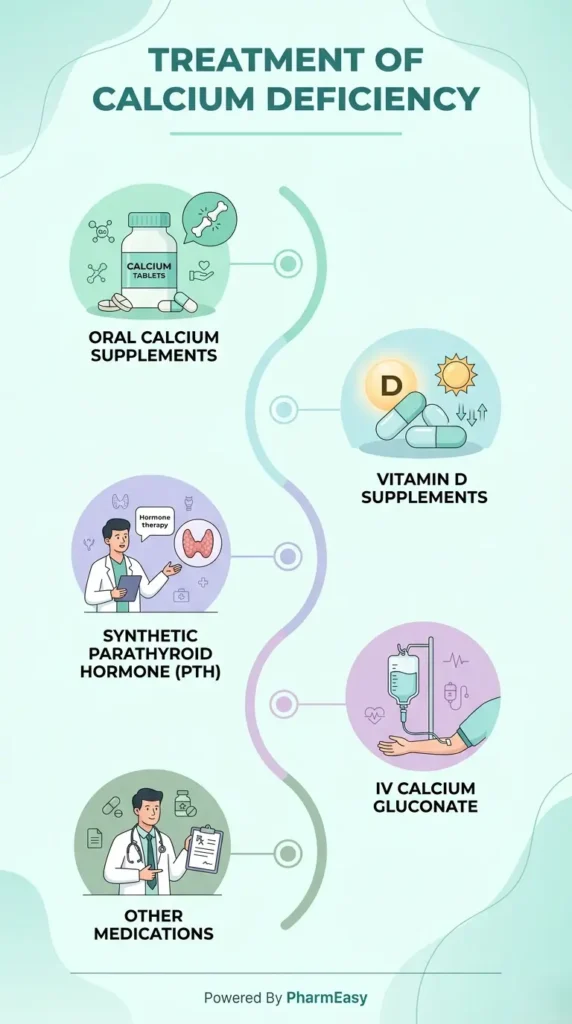
The following medications and treatments are commonly used to treat calcium deficiency:
I came across some studies which imply that calcium deficiency may lead to weight gain. I would recommend taking dietary supplementation of calcium regularly. It has been observed that a daily increment of 300 mg of dietary supplementation might help in reducing approximately 1 kg of body fat in children7.
Dr. Rajeev Singh, BAMS
If you suspect that you may have calcium deficiency based on the symptoms, it is recommended to consult a healthcare provider before taking any supplements. A healthcare provider will assess your risk of calcium deficiency and determine the appropriate and safe dose for you. Calcium deficiency is a treatable condition, and seeking medical advice can help you manage it effectively3.
Calcium is undeniably a cornerstone mineral crucial for maintaining not only strong bones and teeth but also for supporting vital bodily functions such as muscle contractions, nerve signaling, and hormonal regulation. Its deficiency can cause a spectrum of subtle to severe symptoms, ranging from fatigue and muscle spasms to life-threatening cardiac and neurological complications. Recognizing the importance of adequate calcium intake through a balanced diet and, where necessary, supplementation is essential for preventing these adverse health outcomes.
Calcium deficiency can be diagnosed through blood tests to measure calcium levels in the body.
Yes, calcium deficiency can be prevented by consuming a balanced diet rich in calcium and vitamin D, and by getting regular exercise.
The recommended daily amount of calcium varies with age and gender, but most adults need around 1,000-1,200 milligrams per day.
Foods that are high in calcium include dairy products, leafy green vegetables, tofu, and calcium-fortified foods such as cereals and orange juice.
Taking too many calcium supplements can increase the risk of kidney stones and other health problems.
Disclaimer: The information provided here is for educational/awareness purposes only and is not intended to be a substitute for medical treatment by a healthcare professional and should not be relied upon to diagnose or treat any medical condition. The reader should consult a registered medical practitioner to determine the appropriateness of the information and before consuming any medication. PharmEasy does not provide any guarantee or warranty (express or implied) regarding the accuracy, adequacy, completeness, legality, reliability or usefulness of the information; and disclaims any liability arising thereof.
Links and product recommendations in the information provided here are advertisements of third-party products available on the website. PharmEasy does not make any representation on the accuracy or suitability of such products/services. Advertisements do not influence the editorial decisions or content. The information in this blog is subject to change without notice. The authors and administrators reserve the right to modify, add, or remove content without notification. It is your responsibility to review this disclaimer regularly for any changes.
5
1Millions of people all over the world suffer from fatty liver disease. It occurs when excess fat accumulates in the liver, leading to inflammation and potential liver damage. Although it can be caused by a variety of factors, including alcohol consumption and certain medications, the most common form of fatty liver disease is non-alcoholic fatty liver disease (NAFLD), which is associated with lifestyle factors such as a poor diet and lack of exercise.
Fortunately, there are dietary interventions that can help to reverse the damage done to the liver. By making certain changes to your diet, you can reduce the amount of fat in your liver and improve liver function.
Let us dive into the world of fatty liver diets, exploring the best foods to eat and avoid, as well as some easy-to-follow tips for creating a liver-friendly meal plan1,2.
Did you know?
Fatty liver disease is a prevalent health condition that results from an excess buildup of fat in the liver. While some individuals may not experience any noticeable symptoms, the accumulation of fat can lead to severe liver damage in others. However, the good news is that fatty liver disease is often preventable and reversible through simple lifestyle modifications1.
Fatty liver disease is categorized into four grades based on the amount of fat buildup in the liver.
The following list gives you a gateway to eating foods that are good for you, if you have fatty liver disease:
Here is a list of foods to avoid if you have fatty liver disease:

Include plenty of vegetables, fruits, whole grains, nuts, and legumes in your diet. These foods are rich in fibre, vitamins, and minerals, and low in saturated and trans fats, which can be beneficial for individuals with fatty liver disease.

Processed foods, such as fast food, snacks, and baked goods, often contain high amounts of sugar, unhealthy fats, and additives that can worsen fatty liver disease. Processed foods often contain high levels of fructose, unhealthy fats such as trans fats and saturated fats, and additives like high fructose corn syrup, which can increase the amount of fat deposited in the liver and contribute to liver inflammation.

Opt for lean protein sources such as skinless poultry, fish, beans, and lentils over red meats and processed meats, which are high in saturated fats. These foods are high in protein, iron, and fiber.

Sugary beverages such as soda, juice, lemonade, and sports drinks can contribute to the development of fatty liver disease. Sugary and carbonated beverages contain high amounts of fructose and other sugars. When consumed in excess, these sugars are processed in the liver and converted into fat, leading to the accumulation of fat in the liver cells. Instead, opt for water, unsweetened tea, or coffee6.

Overeating can lead to weight gain and increase the risk of fatty liver disease. Be mindful of your portion sizes and consider using smaller plates or bowls to help control your portions. Large portion sizes can contribute to weight gain and obesity, which are risk factors for fatty liver disease. When we eat more calories than our body needs, the excess calories are stored as fat in the liver and other organs, leading to the development of fatty liver disease.

Drinking alcohol in excess can damage the liver and exacerbate fatty liver disease. If you choose to drink, do so in moderation and always consult with your healthcare provider first. It is important to note that the American Liver Foundation recommends complete abstinence from alcohol, especially for those with alcoholic fatty liver disease6.
Also Read: Grade 1 Fatty Liver: Causes, Symptoms, Diagnosis, and Reversal Strategies

Regular physical activity can aid in weight loss, improved insulin sensitivity, and a decreased risk of fatty liver disease. Try to exercise for at least 30 minutes, five days of the week, at a moderate level.
Remember, making simple lifestyle changes can go a long way in preventing and even reversing fatty liver disease. Always consult with your healthcare provider before making any significant changes to your diet or exercise routine1,4,5.
Another important fruit that you can add to your diet is grapefruit. Grapefruits are rich in naringenin, a flavonoid that has liver-protective properties (as per several lab studies). Adding grapefruits to your diet might help you avoid further liver damage8.
Dr. Rajeev Singh, BAMS
Here are some suggestions for a meal plan when you are following a fatty liver diet:





Remember to drink plenty of water throughout the day, and limit or avoid alcohol, sugary drinks, and processed foods. This meal plan is a suggested guideline for a fatty liver diet and should not be taken as medical advice.
It is recommended that you consult with a healthcare professional or a registered dietitian to create a personalized meal plan that meets your specific nutritional needs and dietary restrictions.
You can tailor it according to your diet, your specific needs and preferences, but try to focus on whole foods, lean protein sources, and plenty of fruits and vegetables while limiting your intake of processed foods, sugar, and unhealthy fats5.
Certain drugs can cause harm to the liver. If you are diagnosed with a fatty liver, it is important that you let your doctor be aware about the medicines you take. Some medicines can aggravate your liver condition and make the condition worse7.
Dr. Siddharth Gupta, B.A.M.S, M.D (Ayu)
Also Read: Hepatomegaly (Enlarged Liver): Symptoms, Causes, Diagnosis, and Treatment
Here are some tips to help manage fatty liver disease:
Also Read: Liver Fibrosis: What Is It, Causes, Symptoms & Treatment
Regular exercise, controlling diabetes, lowering cholesterol, and avoiding alcohol are other ways to manage fatty liver disease aside from diet.
The best treatment option for fatty liver disease depends on the underlying cause and severity of the condition and should be determined by a medical professional.
Fatty liver disease can be reversed in its early stages, but in more advanced cases, it can only be managed and not fully cured.
Yes, a vegetarian or vegan diet can help manage fatty liver disease. However, it is essential to ensure that you are still getting enough protein and other essential nutrients.
No, it is generally recommended to avoid alcohol altogether if you have fatty liver disease.
Disclaimer: The information provided here is for educational/awareness purposes only and is not intended to be a substitute for medical treatment by a healthcare professional and should not be relied upon to diagnose or treat any medical condition. The reader should consult a registered medical practitioner to determine the appropriateness of the information and before consuming any medication. PharmEasy does not provide any guarantee or warranty (express or implied) regarding the accuracy, adequacy, completeness, legality, reliability or usefulness of the information; and disclaims any liability arising thereof.
Links and product recommendations in the information provided here are advertisements of third-party products available on the website. PharmEasy does not make any representation on the accuracy or suitability of such products/services. Advertisements do not influence the editorial decisions or content. The information in this blog is subject to change without notice. The authors and administrators reserve the right to modify, add, or remove content without notification. It is your responsibility to review this disclaimer regularly for any changes.
34
0Cancer appears as a solid tumor (lump) that is malignant1. Penile cancer is a cancer of the penis (the external part of the male urinary and reproductive system). The cells present in the tissues of the penis give rise to different types of penile cancer.
Depending upon the type of cell affected in the penis, the type of penile cancer is determined. Following are the type of penile cancers: Squamous cell cancer, Melanoma, Basal cell cancer, Adenocarcinoma (Paget’s disease of the penis), and Sarcoma2. Penile cancers can start in any part of the penis.
Most commonly it has been found to begin on the head or foreskin of the penis. This cancer goes untreated in many individuals since it is associated with psychological distress. Males suffering from this type of cancer often delay seeking medical opinion because they fear and suffer embarrassment4 . Males who are over 55 years are most often detected with penile cancer. However, people who are under the age of 40 can also develop this type of cancer.
Did you know?
Irrespective of the type of penile cancer, mostly the foreskin and the tip of the penis (glans) get affected. Therefore, penile cancer symptoms are first visible on this part of the penis5.
Signs of penile cancer are listed as under:
The following are the symptoms of penile cancer:
Penile cancer is a rare form of cancer that starts in the tissues of the penis. The exact cause of penile cancer is not clear, but several factors have been identified that may increase the risk of developing this type of cancer:
Risk factors are not the factors causing penile cancer but these factors increase the chance of occurrence of developing penile cancer. Below are some of the risk factors3:
Upon visiting the doctor following diagnostic protocols are carried out to understand the developing penile cancer in an individual. The mean age of diagnosis of penile cancer is at the age of 60 years4.
Treatment strategy for penile cancer depends on the size of the tumour, cancer stage, spread of the cancer, and its likelihood of relapsing after the treatment3. Often, treatment options are combined to have maximum therapeutic effect, following is a list of treatments that might be employed for treating penile cancer:
In my experience, a healthy skin cell may become a cancer cell when you have penile cancer. Uncontrolled cancer cell growth results in the formation of a tumour that pushes the healthy cells aside. As time passes, cancer cells have the potential to invade further organs and tissues in your body. I strongly recommend routine complete body checkups for those who have a family history of cancer3.
Dr. Rajeev Singh, BAMS
Following are the possible preventive measures7:
Also Read: Does Masturbating Increase Risk of Prostate Cancer or Vice Versa?
Penile cancer complications are like any complication that arises due to surgical incidents such as:
Did you know squamous cell carcinoma (SCC) makes up 95% of penile cancer cases? This type of cancer develops in the epithelium that is the top layer of your skin. Different types of tissues may develop other forms of penile cancer: basal cell carcinoma (BCC), melanoma, and sarcoma. Out of these, the malignancy melanoma is more dangerous3.
Dr. Siddharth Gupta, B.A.M.S M.D (Ayu)
One should visit the doctor if the following conditions are observed. As a regular practice, one should look for the mentioned changes that occur in and around the penis:
Also Read: How Exercise Can Help You Deal with Breast Cancer
Penile cancer, though rare, is a serious condition that requires timely recognition and treatment. The stigma, fear, and lack of awareness surrounding male reproductive health often lead to delayed diagnoses, affecting outcomes. Understanding the symptoms, risk factors, and causes, especially the role of HPV and poor hygiene can empower men to take preventive steps early on.
Fortunately, with advancements in diagnostics and treatment, many cases can be managed effectively when detected in time. Maintaining proper genital hygiene, avoiding tobacco, practicing safe sex, and not ignoring unusual symptoms are key pillars of prevention. If you notice any persistent changes in or around the penis, do not hesitate to consult a doctor. Early action can make a significant difference, not just in treatment success but also in overall well-being and quality of life.
Also Read: Jaundice: Symptoms, Treatment, Causes and Types
As soon as your doctor confirms penile cancer, treatment strategies should be discussed with the doctor.
Most men can typically have an erection and continue their sexual life normally after the cancerous area has been removed (wide local excision)9. Most men can typically have an erection and continue their sexual life normally after the cancerous area has been removed (wide local excision)9.
Penile tissue is kept alive during many cancer therapies. This means that your penis finally recovers to resemble its pre-treatment appearance almost exactly. You’re still able to urinate when standing10.
A surgical oncologist, a urologist who focuses on urinary tract issues, a medical oncologist, and a radiation oncologist are frequently on a penile cancer team.
This occurs often 7 to 14 days following your operation11.
Disclaimer: The information provided here is for educational/awareness purposes only and is not intended to be a substitute for medical treatment by a healthcare professional and should not be relied upon to diagnose or treat any medical condition. The reader should consult a registered medical practitioner to determine the appropriateness of the information and before consuming any medication. PharmEasy does not provide any guarantee or warranty (express or implied) regarding the accuracy, adequacy, completeness, legality, reliability or usefulness of the information; and disclaims any liability arising thereof.
3
0HIV remains a significant global public health issue, affecting millions worldwide. HIV is a virus that attacks the immune system and can lead to AIDS, a serious condition that weakens the body’s ability to fight off infections and diseases. Blood, semen, vaginal secretions, and breast milk are among the biological fluids through which it can spread. However, it cannot be spread through casual contact such as hugging or sharing food. Fortunately, antiretroviral therapy (ART) is available to treat and prevent HIV, but without proper treatment, HIV can progress to AIDS over time. In recent years, there has been significant progress in HIV research towards finding a cure.
While a cure for HIV is not yet available, the ongoing research and advancements in the field give hope for a future where HIV is no longer a threat to public health1,2.
Let us will explore the latest developments in HIV symptoms and treatment options.
Depending on the stage of infection, the symptoms of HIV might vary. There are three stages of HIV infection: acute (initial) stage, clinical latency (chronic) stage, and acquired immunodeficiency syndrome (AIDS) stage. The following are the symptoms of each stage:
However, some people may show symptoms. These symptoms may be:
Here are some research studies that might bring us closer to finding a cure for HIV:
The challenges and limitations of finding a cure for HIV are numerous and complex, and they involve biological, social, economic, and ethical considerations. Let us discuss them below:
Also Read: Human Papillomavirus (HPV): What Is It, Causes, Symptoms, and Prevention
While there is currently no known cure for HIV, significant progress has been made in developing effective treatment options that can help manage the virus and prevent its spread. With early detection and proper medical care, people living with HIV can lead long, healthy lives. It’s important to educate ourselves and others about the symptoms of HIV, as well as prevention methods such as safe sex practices and regular testing. Continued research and innovation in the field of HIV treatment and prevention offer hope for a future where a cure may eventually be possible.
No, there is currently no cure for HIV. However, advances in treatment have made it possible for people living with HIV to live long and healthy lives. Research is ongoing towards finding a cure, but it is a complex and challenging process.
Taking HIV treatment as prescribed can improve your immune system, reduce HIV-related complications, decrease the risk of transmission, and increase your overall health and quality of life.
ART is highly effective in treating HIV and can lower the amount of HIV in the body to undetectable levels, reducing the risk of transmission to others.
Common side effects of HIV medication include nausea, diarrhoea, fatigue, and headache, but they often subside after a few weeks of treatment.
No, it is important to continue taking HIV medication as prescribed to maintain an undetectable viral load and prevent the virus from becoming resistant to the medication.
Disclaimer: The information provided here is for educational/awareness purposes only and is not intended to be a substitute for medical treatment by a healthcare professional and should not be relied upon to diagnose or treat any medical condition. The reader should consult a registered medical practitioner to determine the appropriateness of the information and before consuming any medication. PharmEasy does not provide any guarantee or warranty (express or implied) regarding the accuracy, adequacy, completeness, legality, reliability or usefulness of the information; and disclaims any liability arising thereof.
Links and product recommendations in the information provided here are advertisements of third-party products available on the website. PharmEasy does not make any representation on the accuracy or suitability of such products/services. Advertisements do not influence the editorial decisions or content. The information in this blog is subject to change without notice. The authors and administrators reserve the right to modify, add, or remove content without notification. It is your responsibility to review this disclaimer regularly for any changes.
2
0Fatty liver disease is a condition that affects millions of people worldwide with a quickly rising prevalence. It occurs when there is an abnormal buildup of fat in the liver cells, which can lead to liver inflammation and damage.
Grade 1 fatty liver, also known as mild or simple fatty liver, is the least severe type of fatty liver disease. In this stage, the accumulation of fat in the liver cells is minimal and does not cause significant liver damage. However, it is essential to address this condition promptly as it can progress to more severe stages of fatty liver disease, such as grade 2 or 3.
Let us explore the causes, symptoms, diagnosis, and reversal strategies for grade 1 fatty liver to help maintain liver health1,7.
Friendly Reminder: The information shared here is for educational purposes only and the reader should consult a registered medical practitioner before implementing any changes to their health routine.
Did you know?
Grade 1 fatty liver, also known as mild fatty liver or simple fatty liver, may not cause any noticeable symptoms in most people. However, some people might experience the following signs and symptoms:
It is essential to note that these symptoms are not specific to grade 1 fatty liver and can be indicative of other liver conditions or health problems. Therefore, it is crucial to consult a healthcare provider if you experience any of these symptoms or have concerns about your liver health.
The exact causes of grade 1 fatty liver disease are not entirely understood. However, research has identified several factors that may contribute to the development of the condition. Grade 1 fatty liver disease, as well as more severe forms of fatty liver disease, may be associated with:
These factors can contribute to the accumulation of fat in the liver cells, leading to grade 1 fatty liver disease2,4.
Medications like statins when used for a longer period of time, started early in the disease course and used at high doses have shown to be beneficial for managing signs of fatty liver clinically.
Dr. Ashish Bajaj, M.B.B.S, M.D. in Clinical Pharmacology and Toxicology
Grade 1 fatty liver disease may be associated with several risk factors, including:
Identifying and managing these risk factors can help reduce the likelihood of developing grade 1 fatty liver disease and its associated complications.
The diagnosis of grade 1 fatty liver may not show any symptoms but can be detected during routine medical checkups or through tests conducted for other reasons. If the liver appears unusual on ultrasound or if there are abnormal liver enzyme test results, then additional tests may be ordered to determine the presence of fatty liver disease.
Diagnostic tests used to determine the diagnosis and severity of fatty liver disease include:
It is important to note that liver biopsy carries small risks and may cause discomfort. The procedure is performed by inserting a needle through the abdominal wall and into the liver. Your doctor will discuss the procedure in detail with you and address any concerns you may have3.
Grade 1 Fatty liver disease is not dangerous if it is in the early stage as it is a mild condition (grade 1) where the fat deposition is less than one-third of the total liver (33%). Therefore, it can be reversible with the help of diet and physical exercise interventions, controlling lipid derangements, reducing weight and total alcohol abstinence.
Dr. M.G. Kartheeka, MBBS, MD(Pediatrics)
Currently, there is no medication specifically designed to treat fatty liver disease. Instead, doctors focus on managing contributing factors and recommending lifestyle changes that can improve overall health. The following treatments may be recommended:
There are no proven medical treatments – yet – for non-alcoholic fatty liver disease. So that means that eating a healthy diet and exercising regularly are the best ways to both prevent liver damage from starting or reverse liver disease once it’s in the early stages.
Dr. Ashish Bajaj, M.B.B.S, M.D. in Clinical Pharmacology and Toxicology.
At present, there are no established medical or surgical interventions available to treat fatty liver. However, there are some preventative and reversal strategies that can help alleviate the damage.
If you have fatty liver, you should:
Overall, the best approach to preventing fatty liver disease is to maintain a healthy weight, engage in regular exercise, limit alcohol intake, and take medications as prescribed.
Here are some complications that may occur if grade 1 fatty liver is left untreated:
Here are some interesting facts about grade 1 fatty liver diseases:
Also Read: Protein in Urine (Proteinuria): What Is It, Causes, Symptoms, Diagnosis & More
It is essential to consult a healthcare provider if you experience any symptoms of fatty liver disease or have risk factors for the condition, such as obesity, insulin resistance, or excessive alcohol consumption. They can perform a thorough evaluation, order appropriate tests, and provide treatment or referral to a specialist if necessary. Early detection and management of grade 1 fatty liver disease can prevent the progression of the condition and maintain liver function2.
Also Read: Crystals in Urine: Types, Causes, Symptoms & When to Worry
Yes, grade 1 fatty liver can be reversed if proper treatment is provided.
In most cases, medication is not necessary for grade 1 fatty liver disease. However, in rare cases, medication may be prescribed to treat underlying health conditions that may be contributing to the fatty liver.
Yes, excessive alcohol consumption can contribute to the development of fatty liver disease.
No, while grade 1 fatty liver disease itself is not a direct risk factor for liver cancer if left untreated, it can progress to more severe stages of liver disease, which might increase the risk of liver cancer.
Grade 1 fatty liver disease involves a mild buildup of fat in the liver, while grade 2 fatty liver disease involves a moderate buildup of fat in the liver.
Disclaimer: The information provided here is for educational/awareness purposes only and is not intended to be a substitute for medical treatment by a healthcare professional and should not be relied upon to diagnose or treat any medical condition. The reader should consult a registered medical practitioner to determine the appropriateness of the information and before consuming any medication. PharmEasy does not provide any guarantee or warranty (express or implied) regarding the accuracy, adequacy, completeness, legality, reliability or usefulness of the information; and disclaims any liability arising thereof.
Links and product recommendations in the information provided here are advertisements of third-party products available on the website. PharmEasy does not make any representation on the accuracy or suitability of such products/services. Advertisements do not influence the editorial decisions or content. The information in this blog is subject to change without notice. The authors and administrators reserve the right to modify, add, or remove content without notification. It is your responsibility to review this disclaimer regularly for any changes.
62
1Hepatomegaly, also known as an enlarged liver, occurs when the liver swells beyond its normal size, indicating some health issues. It is not a disease in itself but it is often considered a symptom of underlying liver disease. The liver performs essential functions in the body, including filtering toxins from the blood and regulating cholesterol. An enlarged liver can indicate a potential problem with these functions, and prompt investigation is necessary to identify and address the underlying cause1,2.
Let’s take a closer look at what is hepatomegaly, its causes, diagnosis and treatment.
Hepatomegaly may not cause noticeable symptoms on its own. However, it may be accompanied by signs and symptoms like:
If you experience any of these symptoms, consult with your healthcare provider promptly for a timely diagnosis and appropriate treatment1,3.
Did you know?
The causes of liver enlargement refer to the various medical conditions that lead to an increase in liver size. Several conditions can cause the liver to enlarge. The possible causes include:
Fatty liver which a very common cause of hepatomegaly is on the rise primarily because of an increase in obesity, type 2 diabetes, and consumption of alcohol. Appropriate lifestyle changes and early diagnosis helps to beat it.
Dr. M.G. Kartheeka, MBBS MD
The causes of hepatomegaly may vary and are not the same as risk factors. Risk factors increase the likelihood of developing liver problems but do not necessarily cause liver enlargement. Hepatomegaly, or an enlarged liver, can be caused by a variety of factors, including:
To diagnose an enlarged liver, your doctor may perform the following procedures4:
The treatment for hepatomegaly depends on the underlying cause of the disease. Here are some key points regarding the treatment of hepatomegaly:
Your healthcare provider will advise on the best course of treatment for your specific situation1,4.
To prevent the risk of developing hepatomegaly, here are some do’s and don’ts to follow:
Also Read: Hepatitis B: What It Is, Causes, Symptoms & Treatment
Hepatomegaly, or an enlarged liver, can lead to several complications, especially if left untreated. Some of the common complications of hepatomegaly are:
Hepatomegaly with or without elevated liver function tests may be secondary to multiple causes, which include drug side effects, active lupus infection, fatty infiltration, hepatic vein or artery thrombosis, and congestion secondary to right heart failure.
Dr. Ashish Bajaj, M.B.B.S. M.D. in Clinical Pharmacology and Toxicology
If you suspect any swelling or tenderness in the liver area or have unusual symptoms, it is essential to seek medical attention. Don’t hesitate to contact your healthcare provider if you notice persistent fever, confusion or disorientation, weakness, lightheadedness, or yellowing of the eyes or skin. These signs may indicate a more severe underlying condition and require immediate evaluation and treatment. So, if you are concerned about any symptoms or changes in your body, it’s always better to consult with a medical professional right away1.
Also Read: Natural Home Remedies for Fatty Liver
No, hepatomegaly itself is not typically fatal. However, the underlying conditions that cause hepatomegaly, such as liver disease or cancer, can be life-threatening if left untreated.
Yes, other viral infections such as cytomegalovirus (CMV) and Epstein-Barr virus (EBV) can also cause hepatomegaly.
Yes, hepatomegaly may be reversible in certain cases. However, it is important to consult with your healthcare provider to see the extent of your disease and to get the best possible care1.
Hepatomegaly is a relatively common medical condition and can occur in both adults and children.
No, hepatomegaly is not contagious, but certain underlying conditions that cause hepatomegaly such as tuberculosis may be contagious.
Disclaimer: The information provided here is for educational/awareness purposes only and is not intended to be a substitute for medical treatment by a healthcare professional and should not be relied upon to diagnose or treat any medical condition. The reader should consult a registered medical practitioner to determine the appropriateness of the information and before consuming any medication. PharmEasy does not provide any guarantee or warranty (express or implied) regarding the accuracy, adequacy, completeness, legality, reliability or usefulness of the information; and disclaims any liability arising thereof.
Links and product recommendations in the information provided here are advertisements of third-party products available on the website. PharmEasy does not make any representation on the accuracy or suitability of such products/services. Advertisements do not influence the editorial decisions or content. The information in this blog is subject to change without notice. The authors and administrators reserve the right to modify, add, or remove content without notification. It is your responsibility to review this disclaimer regularly for any changes.
5
1


