




Can Ozempic Cause Headaches? Causes, Home Remedies & Prevention Tips
By Dr. Akash N. Shah +2 more

Medically reviewed by Dr. Akash N. Shah
Last updated: Sep 29, 2026 Published on: Jul 21, 2026


Get,

to manage your symptom
Get your,

4 Cr+ families
benefitted

OTP sent to 9988776655



You’ve successfully subscribed to receive
doctor-approved tips on
Whatsapp

Get ready to feel your best.


Register to Avail the Offer
Send OTPBy continuing, you agree with our Privacy Policy and Terms and Conditions
Hi There,
Sign up on PharmEasy now!!


Trusted by 4 crore+ families

OTP sent to 9988776655
You have unlocked 25% off on medicines


Code: NU25

By Dr. Akash N. Shah +2 more
Table of Contents
Getting headaches after starting Ozempic can be uncomfortable, but it does not always mean the medicine is unsuitable for you. In many cases, headaches are temporary and improve over time as the body adjusts1. Ozempic is a prescription medicine used in adults with type 2 diabetes to help manage blood sugar levels2. It can also help reduce the risk of heart attack and stroke in people with type 2 diabetes and heart disease2. This article explains why headaches may occur while taking Ozempic, how to manage mild symptoms at home, and when to seek medical advice.


Answer a few quick questions to check eligibility.
Your response has been submitted.
Our team will contact you shortly.
Headaches can occur while taking Ozempic, although they are not among the most common side effects. They are often linked to circumstances that may arise during treatment rather than to a single direct effect of the medicine1. Possible contributors include:
Headache due to Ozempic is usually mild to moderate in severity and may occur along with tiredness or dizziness4.
Not all headaches feel the same. While headache due to Ozempic is usually discussed in the context of treatment-related factors such as reduced intake, dehydration, or low blood sugar, other headaches may have different triggers and symptom patterns. The table below summarises the key differences.
| Feature | Headache due to Ozempic | Other Common Headaches |
| Common cause | Reduced food intake, dehydration, low blood sugar, or dose escalation1,7 | Stress, poor sleep, dehydration, infections, migraine triggers, or other medical causes8 |
| How it feels | Usually a dull, steady, mild-to-moderate ache, often in the forehead1 | May be throbbing, pressure-like, one-sided, or severe around one eye, depending on the headache type8 |
| When it occurs | More common after starting Ozempic, especially during the first 12 weeks1,7 | Can occur at any time depending on the triggers8 |
| Associated symptoms | May occur with nausea, dizziness, tiredness, shakiness, or signs of dehydration4 | May be accompanied by light or sound sensitivity, vomiting, fever, nasal congestion, or neck pain, depending on the type of headache8 |
| Improves with | Hydration, regular meals, rest, and addressing low blood sugar if present1 | Depends on the cause and may include rest, hydration, stress management, or specific headache treatments8 |
Headaches due to Ozempic are more likely when the body is adjusting to the medicine, when the dose is increased, or when eating and fluid intake change. They may occur in the following situations:
Note: Not everyone taking Ozempic may experience headaches. If a headache is severe, does not go away, or occurs with other worrying symptoms, seek immediate medical advice.
If you develop a mild headache while taking Ozempic, the following home care steps may help ease discomfort.
Note: These home care tips may help relieve mild headaches but are not specific treatments for headaches due to Ozempic. If the headache is severe, persistent, keeps coming back, or is accompanied by symptoms such as vision changes, confusion, severe vomiting, or difficulty speaking, seek medical attention promptly. Do not stop taking Ozempic without consulting your doctor.
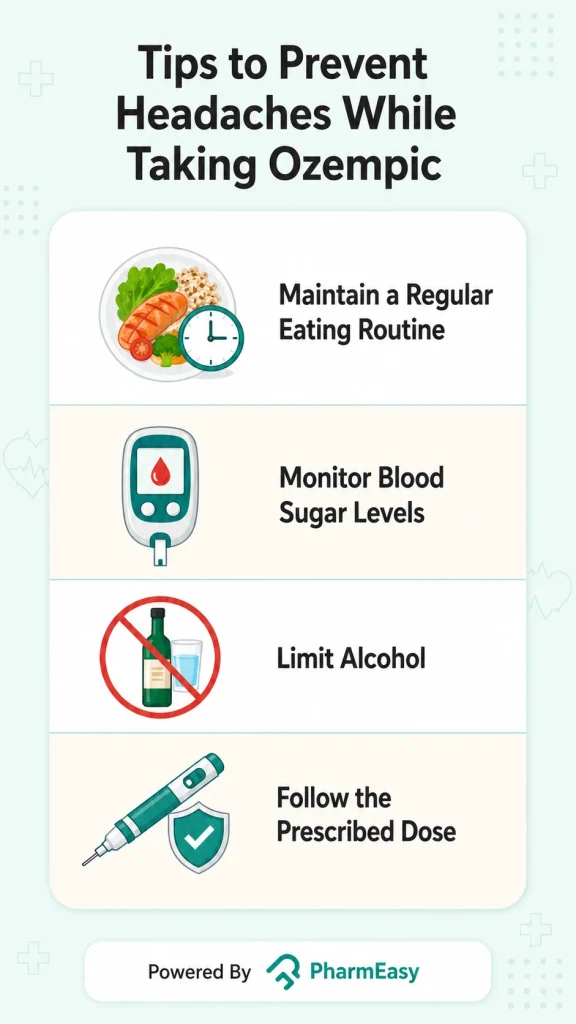
Understanding the link between Ozempic and headaches can help you take simple steps to lower the risk and stay comfortable during treatment. Here are a few examples:
Note: These tips may help reduce the risk of headaches while taking Ozempic, but they may not prevent headaches in everyone.
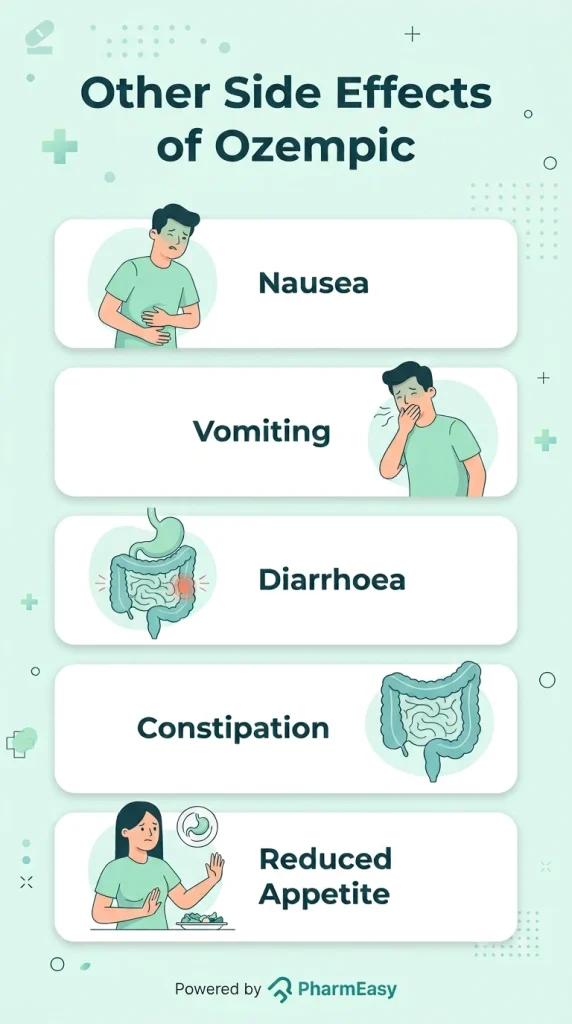
Ozempic can cause several other side effects, such as:
While the list of side effects due to Ozempic is long, below are a few less common and mild side effects. However, one should consult with their endocrinologist to better understand the safety and tolerability of Ozempic, as the effects can vary for each individual.
Also Read: Natural Ozempic: What It Is, Benefits, Safety & Natural Alternatives for Weight Loss
While mild headaches often improve on their own, you should seek medical advice if you experience:
Also Read: Wegovy vs Ozempic: Differences, Uses, Dosage, Side Effects and More!
Headache due to Ozempic is usually mild and temporary, and it often improves as the body adjusts to treatment. Staying hydrated, eating regular meals, monitoring blood sugar when advised, and following the prescribed dose may help lower the risk. Consult a doctor if headaches are severe, persistent, worsening, or occur with other concerning symptoms.
You can often ease a mild Ozempic-related headache by staying hydrated, resting, avoiding prolonged fasting, and eating regular, balanced meals. If the headache is severe, persistent, or accompanied by symptoms such as dizziness, confusion, or vision changes, contact your doctor1,2.
Ozempic-related headaches are usually temporary and may be more common during the first few weeks to months of treatment, especially while the dose is being increased. They are generally mild, improve as the body adjusts, and do not usually interfere with daily activities1,7.
Ozempic side effects are usually most noticeable during the first few weeks of treatment or after a dose increase, when the body is adjusting to the medicine1,7.
1. Ferreira ET, Garcia LMP, Londero RG. Headache and GLP-1 receptor agonists: when medications are therapeutic and when they contribute to the symptom. Arq Neuropsiquiatr. 2025;83(10):001-007. doi:10.1055/s-0045-1812303. Available from: https://pubmed.ncbi.nlm.nih.gov/41145149/
2. OZEMPIC (semaglutide). 2023. Available from: https://www.accessdata.fda.gov/drugsatfda_docs/label/2023/209637s020s021lbl.pdf
3. Herron E. Reducing or Discontinuing Insulin or Sulfonylurea When Initiating a Glucagon-like Peptide-1 Agonist. Federal Practitioner. 2024;41(2). doi:10.12788/fp.0452. Available from: https://pubmed.ncbi.nlm.nih.gov/38835925/
4. Semaglutide Injection. 2026. Available from: https://medlineplus.gov/druginfo/meds/a618008.html
5. Gorgojo-Martínez JJ, Mezquita-Raya P, Carretero-Gómez J, et al. Clinical Recommendations to Manage Gastrointestinal Adverse Events in Patients Treated with Glp-1 Receptor Agonists: A Multidisciplinary Expert Consensus. JCM. 2022;12(1):145. doi:10.3390/jcm12010145. Available from: https://pubmed.ncbi.nlm.nih.gov/36614945/
6. Lu W, Wang S, Tang H, Yuan T, Zuo W, Liu Y. Neuropsychiatric adverse events associated with Glucagon-like peptide-1 receptor agonists: a pharmacovigilance analysis of the FDA Adverse Event Reporting System database. Eur Psychiatr. 2025;68(1):e20. doi:10.1192/j.eurpsy.2024.1803. Available from: https://pubmed.ncbi.nlm.nih.gov/39901452/
7. 209637Orig1s037. 2025. Available from: https://www.accessdata.fda.gov/drugsatfda_docs/nda/2026/209637Orig1s037.pdf
8. Headache. 2026. Available from: https://www.ninds.nih.gov/health-information/disorders/headache
9. Medicines for headaches. Available from: https://www.healthdirect.gov.au/medicines-for-headaches
10. Swift R, Davidson D. Alcohol hangover: mechanisms and mediators. Alcohol Health Res World. 1998;22(1):54-60. Available from: https://pubmed.ncbi.nlm.nih.gov/15706734/
Disclaimer: The information provided here is for educational/awareness purposes only and is not intended to be a substitute for medical treatment by a healthcare professional and should not be relied upon to diagnose or treat any medical condition. The reader should consult a registered medical practitioner to determine the appropriateness of the information and before consuming any medication. PharmEasy does not provide any guarantee or warranty (express or implied) regarding the accuracy, adequacy, completeness, legality, reliability or usefulness of the information; and disclaims any liability arising thereof.
Links and product recommendations in the information provided here are advertisements of third-party products available on the website. PharmEasy does not make any representation on the accuracy or suitability of such products/services. Advertisements do not influence the editorial decisions or content. The information in this blog is subject to change without notice. The authors and administrators reserve the right to modify, add, or remove content without notification. It is your responsibility to review this disclaimer regularly for any changes.


Comments

Leave your comment...
You may also like






















Comments