




Mouth Ulcers and HIV: Symptoms, Causes, Diagnosis & More
By Dr. Nikita Toshi +2 more

Medically reviewed by Dr. Nikita Toshi
Last updated: Oct 16, 2026 Published on: May 27, 2026


Get,

to manage your symptom
Get your,

4 Cr+ families
benefitted

OTP sent to 9988776655



You’ve successfully subscribed to receive
doctor-approved tips on
Whatsapp

Get ready to feel your best.


Register to Avail the Offer
Send OTPBy continuing, you agree with our Privacy Policy and Terms and Conditions
Hi There,
Sign up on PharmEasy now!!


Trusted by 4 crore+ families

OTP sent to 9988776655
You have unlocked 25% off on medicines


Code: NU25

By Dr. Nikita Toshi +2 more
Table of Contents
Have you ever experienced recurring mouth ulcers that make eating, drinking, and even speaking difficult? While mouth ulcers are common and usually harmless, recurrent or persistent ulcers can raise concerns about underlying health conditions. A common concern surrounding mouth ulcers is their possible association with Human Immunodeficiency Virus (HIV) infection.
The truth is that not all mouth ulcers are associated with HIV. Mouth ulcers can be caused by stress, nutritional deficiencies, infections, autoimmune disorders, and even unintentional bites inside the mouth, among other causes. However, in some cases, frequent or severe mouth ulcers may be associated with a weakened immune system, including HIV infection2.

Understanding the potential link between mouth ulcers and HIV might help people see warning signs early and seek medical attention when necessary. In this blog, we will take a look at the link between mouth ulcers and HIV, as well as symptoms, causes, diagnosis, treatment, and strategies for managing and avoiding recurring ulcers.
Mouth ulcers are painful sores that form inside your mouth. Common mouth ulcers, called recurrent aphthous ulcers, are usually found on the inner cheeks, lips, tongue, gums, and roof of the mouth, and look like tiny, shallow sores with a white or grey centre and a red border. Some patients may develop bigger ulcers (major aphthous ulcers). They might appear as a single large ulcer or in groups of small ulcers. They typically resolve within 1 or 2 weeks and are very painful. However, they can make everyday activities such as eating, drinking, brushing teeth, or speaking uncomfortable3.
Mouth ulcers are commonly caused by stress, spicy foods, vitamin deficiencies, hormonal changes, minor injuries inside the mouth, infections, and certain medical problems1,3. In some people, persistent or recurring mouth ulcers may be linked to a weak immune system, such as in HIV infection2.
Mouth ulcers can sometimes be seen in people with HIV, but having mouth ulcers does not necessarily indicate HIV. Mouth sores are common even in individuals without HIV and can develop for several reasons. Alteration in the immune system is one important cause1,3.
HIV infection weakens the immune system, making a person more likely to develop frequent, severe, or long-lasting mouth ulcers compared to a healthy individual. In addition, research shows that around 40-50% of people living with HIV develop oral infections caused by fungi, bacteria, or viruses, which may also present as mouth ulcers4.
So, while mouth ulcers are a common symptom in HIV, it is important to note that mouth ulcers can occur due to various reasons, and hence they cannot be considered as the sole sign of HIV. Moreover, oral lesions are often associated with other symptoms like weight loss, skin infections, fatigue, etc if HIV is present2.
If mouth ulcers are persistent, severe, or accompanied by other symptoms, it is important to see a doctor for an accurate diagnosis and testing.
Within a few weeks of being infected with HIV, some persons may have flu-like symptoms. These symptoms appear when the immune system reacts to an infection. While some people may not have any symptoms at all, others may notice some systemic (whole body) as well as oral symptoms during the early stages of infection. Common symptoms may include:
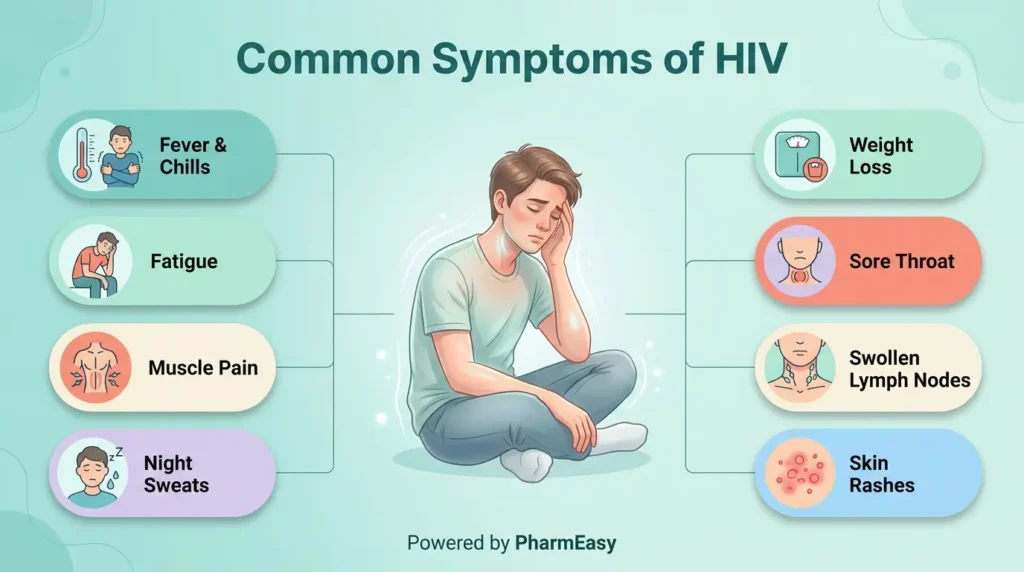
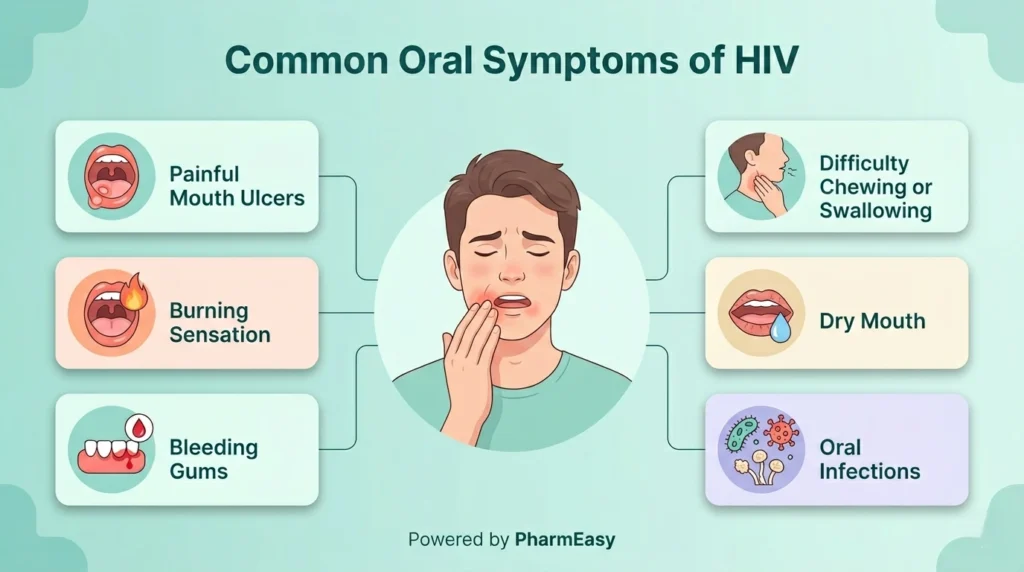
Note: These symptoms are not limited to HIV; they can also appear in a variety of other conditions. HIV can only be confirmed with thorough medical testing. If the symptoms persist or occur with a possible contact history, it is important to see a doctor.
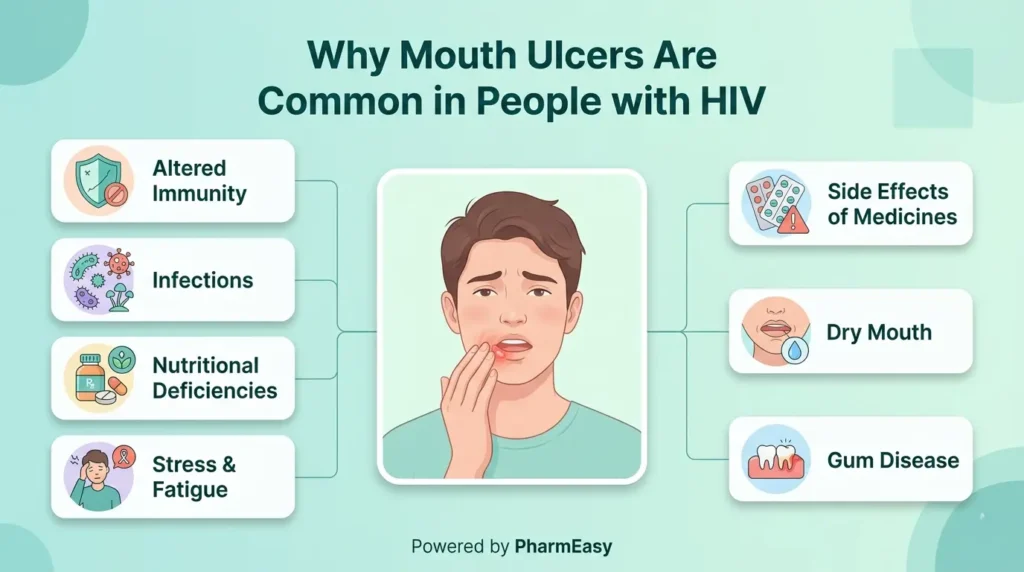
HIV patients can get mouth ulcers due to a variety of reasons. The following are some of their common causes.
HIV patients frequently complain of lesions affecting the soft lining of mouth and throat as a result of their decreased immunity. These oral disorders can be frequent, severe, or slow to heal. They include:
Mouth ulcers and other oral disorders may happen because of several reasons; therefore, proper diagnosis is essential to finding the underlying cause. To determine if these oral problems are linked to HIV, your doctor may use some tests and diagnostic methods. These include the following:
The doctor will do a thorough examination of the mouth and throat to check for the following oral symptoms:
The doctor may ask about:
If the doctor feels that your symptoms and oral findings may be related to HIV, he will advise certain confirmatory HIV tests such as:
Treating HIV symptoms like mouth ulcers involves managing underlying infection along with supportive care that helps relieve symptoms and improves immunity. The common treatment options include:
Mouth ulcers are common in people living with HIV and may become worse due to weak immunity. This can cause several problems if left untreated. These include:
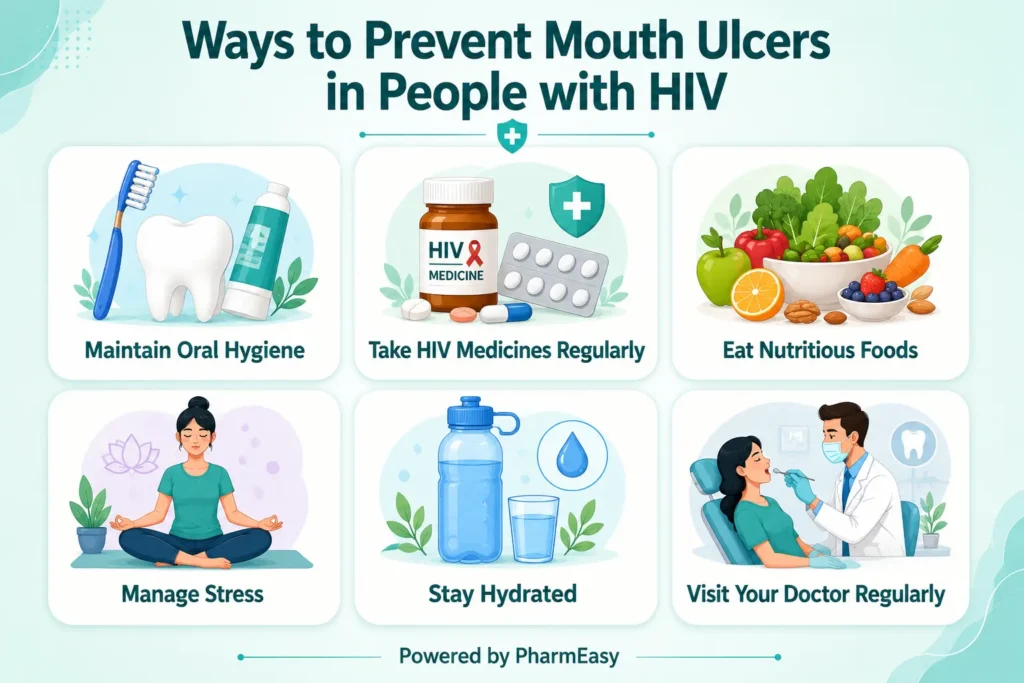
Avoiding mouth ulcers in people living with HIV is critical for reducing discomfort, improving eating ability, and maintaining good oral health by boosting immunity and avoiding triggers. The following are some tips that you can consider for this:
Note: The following preventative tips are meant to improve general awareness and shouldn’t replace medical advice. If you have recurrent or severe mouth ulcers, you should seek medical attention for an accurate diagnosis and treatment.
Regular oral check-up is anyway needed for all individuals diagnosed with HIV.
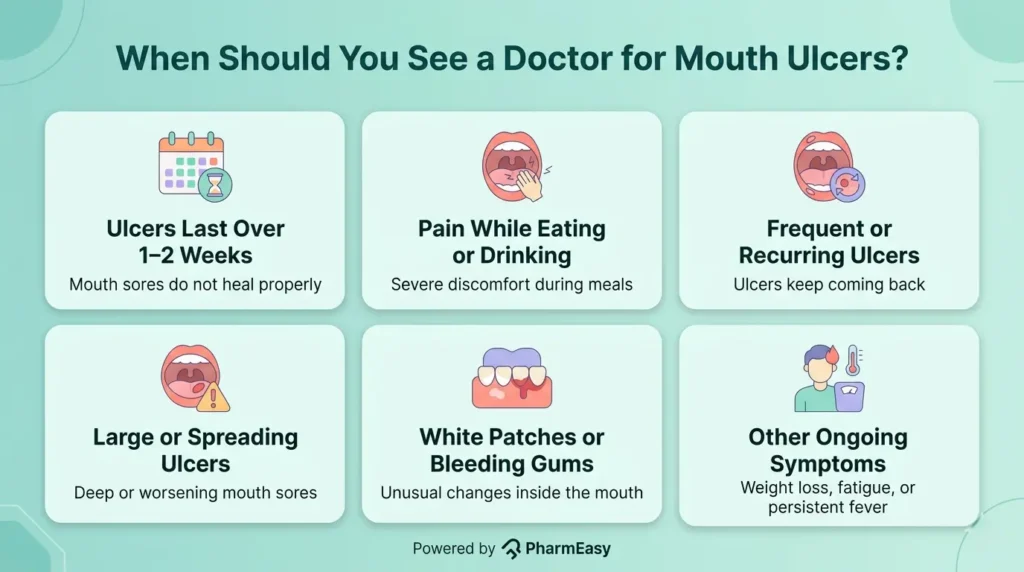
In general, mouth ulcers should not be ignored if they become frequent, severe, or do not heal as expected. Medical advice is important to avoid complications and identify any underlying infection or immune-related issues. Consult a doctor for the following reasons:
Mouth ulcer HIV transmission can occur due to direct contact with the infected lesions. If you’ve had any such contact with an infected individual, consult your doctor immediately for testing.
Also Read: HIV Cure: Is it possible? Know the Symptoms and Treatment Options
Mouth ulcers are widespread and typically harmless; they often heal on their own. They are not a direct indicator of HIV. However, if they occur frequently, severely, or for an extended period of time, seek medical attention. Early evaluation and testing, when necessary, can help in the proper diagnosis and treatment.
Oral manifestations of HIV are signs and symptoms that arise in the mouth as a result of HIV infection. These include mouth ulcers, oral thrush, gum disease, dry mouth, and other infections caused by a weakened immune system6.
Mouth ulcers are common in people with HIV, especially when the immune system becomes weak. They may be frequent, more painful, and take longer to heal compared to normal mouth ulcers2,4.
Most mouth ulcers heal on their own within 1 to 2 weeks without any treatment. If they last longer or keep coming back, medical advice should be taken3.
Spicy, sour, or salty foods like citrus fruits, tomatoes, and pickles can trigger mouth ulcers in some people1,3. Hard or sharp foods like chips or nuts may also irritate the mouth and worsen ulcers.
Soft, cool, and non-acidic foods, such as yoghurt, milk, bananas, and cooked vegetables, can make the mouth ulcers feel less painful15. Foods rich in vitamins B12, iron, and folic acid also support faster healing1. However, further research is needed.
1. Mouth Ulcers. 2025. doi: https://www.betterhealth.vic.gov.au/health/conditionsandtreatments/mouth-ulcers
2. Slayter KL, Marrie TJ. Treatment of Recurrent Aphthous Ulcers in an HIV Patient – An Emerging Use for Pentoxifylline. Canadian Journal of Infectious Diseases and Medical Microbiology. 1998;9(3):189-190. doi:10.1155/1998/569317 https://pmc.ncbi.nlm.nih.gov/articles/PMC3250908/
3. Mouth sores and ulcers (canker sores). 2024. doi: https://www.healthdirect.gov.au/mouth-sores-and-ulcers
4. Kuteyi T, Okwundu CI. Topical treatments for HIV-related oral ulcers. Cochrane HIV/AIDS Group, ed. Cochrane Database of Systematic Reviews. 2012;2012(1). doi:10.1002/14651858.CD007975.pub2 https://www.researchgate.net/publication/396572331_Clinical_features_of_oral_cavity_lesions_in_patients_with_HIV_infection
5. HIV. 2025. doi: https://medlineplus.gov/hiv.html
6. HIV/AIDS & Oral Health. 2024. doi: https://www.nidcr.nih.gov/health-info/hiv-aids
7. Lomelí-Martínez SM, González-Hernández LA, Ruiz-Anaya AJ, et al. Oral Manifestations Associated with HIV/AIDS Patients. Medicina (Kaunas). 2022;58(9):1214. doi:10.3390/medicina58091214 https://pubmed.ncbi.nlm.nih.gov/36143891/
8. Scully C, Diz Dios P. Orofacial effects of antiretroviral therapies. Oral Dis. 2001;7(4):205-210. doi: https://pubmed.ncbi.nlm.nih.gov/11575869/
9. Bajpai S, Pazare A. Oral manifestations of HIV. Contemp Clin Dent. 2010;1(1):1. doi:10.4103/0976-237X.62510 https://pubmed.ncbi.nlm.nih.gov/22114368/
10. HIV Testing. 2025. doi: https://hivinfo.nih.gov/understanding-hiv/fact-sheets/hiv-testing
11. Screening and diagnosis for HIV. 2025. doi: https://medlineplus.gov/ency/article/003538.htm
12. Layden AJ, Finkelstein JL. B-vitamins and HIV/AIDS. doi: https://www.ncbi.nlm.nih.gov/books/NBK572219/
13. Vitamins and minerals. 2024. doi: https://www.betterhealth.vic.gov.au/health/healthyliving/Vitamins-and-minerals
14. Six relaxation techniques to reduce stress. doi: https://www.health.harvard.edu/mind-and-mood/six-relaxation-techniques-to-reduce-stress
15. What to eat when your mouth is sore. 2020. doi: https://www.health.tas.gov.au/sites/default/files/2021-11/What_to_eat_when_your_mouth_is_sore.pdf
Disclaimer: The information provided here is for educational/awareness purposes only and is not intended to be a substitute for medical treatment by a healthcare professional and should not be relied upon to diagnose or treat any medical condition. The reader should consult a registered medical practitioner to determine the appropriateness of the information and before consuming any medication. PharmEasy does not provide any guarantee or warranty (express or implied) regarding the accuracy, adequacy, completeness, legality, reliability or usefulness of the information; and disclaims any liability arising thereof.
Links and product recommendations in the information provided here are advertisements of third-party products available on the website. PharmEasy does not make any representation on the accuracy or suitability of such products/services. Advertisements do not influence the editorial decisions or content. The information in this blog is subject to change without notice. The authors and administrators reserve the right to modify, add, or remove content without notification. It is your responsibility to review this disclaimer regularly for any changes.


Comments

Leave your comment...
You may also like
























Comments