




High Triglycerides: Causes, Symptoms, Diagnosis and How to Reduce It
By Ameya Tirodkar +2 more

Medically reviewed by Ameya Tirodkar
Last updated: Aug 25, 2026 Published on: Jun 3, 2026


Get,

to manage your symptom
Get your,

4 Cr+ families
benefitted

OTP sent to 9988776655



You’ve successfully subscribed to receive
doctor-approved tips on
Whatsapp

Get ready to feel your best.


Register to Avail the Offer
Send OTPBy continuing, you agree with our Privacy Policy and Terms and Conditions
Hi There,
Sign up on PharmEasy now!!


Trusted by 4 crore+ families

OTP sent to 9988776655
You have unlocked 25% off on medicines


Code: NU25

By Ameya Tirodkar +2 more
Table of Contents
You may be confused if your blood test results show high triglyceride levels, especially if you have no visible symptoms. Triglycerides are a form of fat found in the blood that your body uses for energy1. However, when their levels rise too high, they might raise the risk of serious health issues such as heart disease, stroke, fatty liver disease, and pancreatitis2.
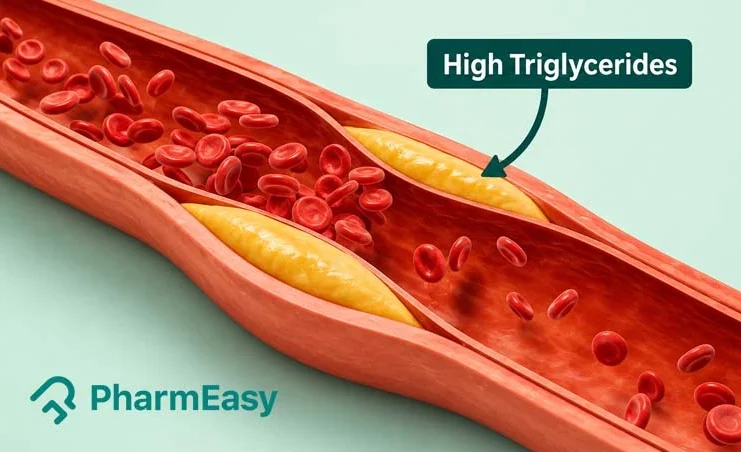
The good news is that high triglycerides can often be managed with the right lifestyle changes, healthy eating habits, and timely medical care. In this blog, you will learn what high triglycerides mean, their causes and symptoms, how they are diagnosed, and effective ways to reduce them naturally and medically.
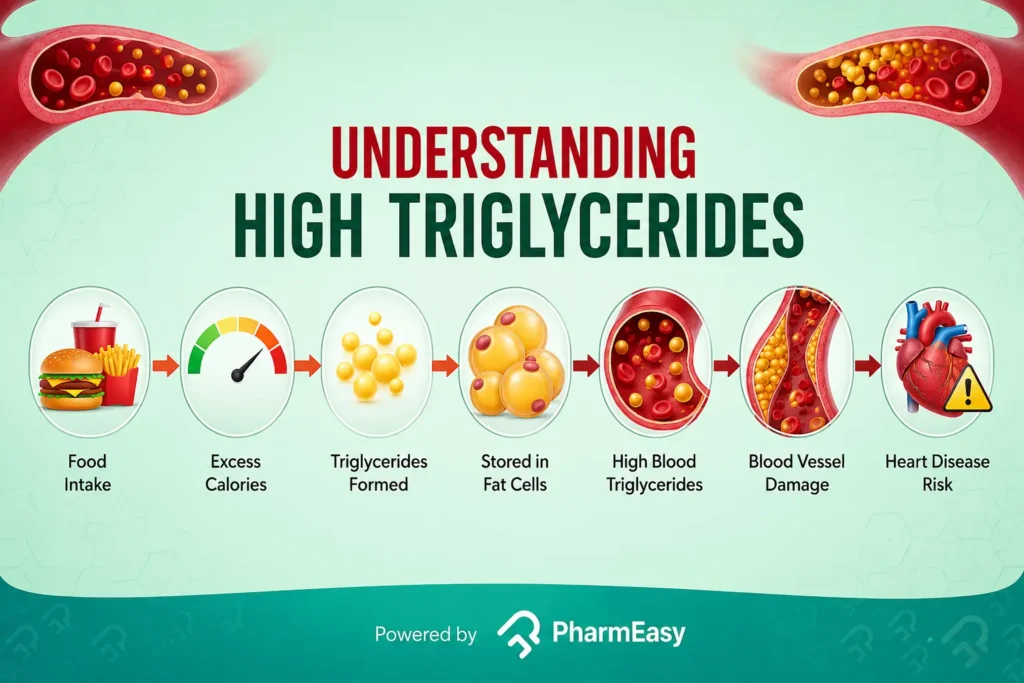
High triglycerides means that there is an excess amount of triglycerides, a type of fat (lipid), circulating in your blood.
Our bodies use calories for functioning and physical activity, which are supplied from the food we eat. Excess calories that are not utilised by the body get converted into triglycerides, which are not needed immediately. These triglycerides are stored in fat cells and used for energy when required1.
Triglycerides are important for normal body function, but having too much of them in the blood can become harmful. High triglyceride levels are frequently associated with unhealthy lifestyle practices such as consuming too much sweet or fatty food, lack of physical activity, smoking, consuming excessive alcohol, etc2. They can also occur due to conditions like diabetes, thyroid disorders, kidney disease, or due to certain medications1.
In most cases, high triglycerides do not cause noticeable symptoms2, which is why many people discover them only during a routine blood test called a lipid profile. When triglyceride levels remain high for a long time, fatty deposits can build up in blood vessels, making it harder for blood to flow properly (atherosclerosis). This increases the risk of heart-related diseases and other complications3. Very high triglyceride levels can also affect the pancreas, leading to a painful condition called pancreatitis2.
Since symptoms are often absent, regular health check-ups and lipid profile tests are important for early detection.
High triglycerides can be caused by an unhealthy lifestyle, certain medical problems, drugs, or genetics. Common causes include:
Certain medications such as corticosteroids, hormonal pills (oestrogen), antivirals (ritonavir), antipsychotics, water pills (diuretics), BP medications (beta blockers) can increase triglycerides in the body2,10.
Some genetic disorders can also cause high triglyceride levels. Examples: Familial hypertriglyceridemia and combined hyperlipidaemia3.
Identifying the reasons for high triglycerides are important for choosing the right treatment and lifestyle changes to lower triglyceride levels effectively.
Triglyceride levels are measured through a blood test known as a lipid profile. These levels help doctors determine how much fat is in your blood and whether it raises your risk of heart disease and other health issues.
The following is a table which shows the ranges of triglycerides1:
| Category | Triglyceride Ranges (mg/dL) |
| Normal | < 150 |
| Borderline high | 150 – 199 |
| High | 200 – 499 |
| Very high | 500 and above |
If you have normal triglycerides, it may suggest your body is successfully consuming and storing fats for energy without allowing excess fat to accumulate in the bloodstream. People who have normal triglyceride levels are less likely to have heart disease, stroke, or pancreatitis, especially if their other cholesterol levels are also within healthy range11.
High triglyceride levels imply that there is too much fat circulating in the blood. This usually occurs when the body consumes or retains more calories than it burns. Over time, extra fats can harden or restrict blood vessels, increasing the risk of cardiovascular disease2.
Triglyceride levels above 500 mg/dL can increase the risk of pancreatic inflammation (pancreatitis), resulting in severe stomach pain. Very high levels may also alter blood vessels in the eyes, and cause skin changes on the chest, back, arms, or legs. Extremely high triglyceride levels (above 1,500 mg/dL) can sometimes stop the body from properly breaking down fats, a very dangerous condition called multifactorial chylomicronaemia syndrome2.
Therefore, checking triglyceride levels regularly is important to identify potential health risks early. People with diabetes, obesity, heart disease, thyroid disorders, or a family history of lipid disorders may need more frequent monitoring2.
Note: Triglyceride or lipid profile levels should be interpreted by a qualified doctor, as the results might vary depending on age, medical history, medications, and other personal factors.
High triglyceride levels are detected with a simple blood test known as a lipid profile, which analyses the amount of fats (lipids) in the blood, including triglycerides, cholesterol (LDL, HDL), and total cholesterol. This test allows doctors to determine your risk of heart disease and other problems12.
Your doctor will collect a simple blood sample, usually from an arm vein, for the test. It is a short, very minimally invasive process. The obtained sample is then analysed in a laboratory to identify the concentration of triglycerides in the bloodstream, as well as other lipid parameters12.
For accurate triglyceride results, fasting is generally recommended:
Note: Taking a test without fasting can show variations in values of triglycerides and other lipids. Talk to your doctor if you are taking any medications or supplements, as they can also interfere with the result. Also, do not stop any medications without your doctor’s permission12.
Your doctor might suggest a lipid profile test in the following situations:
Your doctor might suggest taking the test in the morning following an overnight fast, making it easier to meet the fasting requirement and ensuring consistent and reliable findings15.
High triglyceride levels are addressed based on their severity and the individual’s overall risk of heart disease or pancreatitis. Doctors may give drugs to help lower triglycerides and avoid problems. Common medications include the following:
Doctors may also address conditions like diabetes or thyroid issues that trigger excessive triglyceride levels. Managing these conditions helps improve overall lipid levels2.
Note: The information provided in this section is for general educational purposes only and is not intended to substitute professional medical advice, diagnosis, or treatment.

A healthy diet plays an important role in managing high triglyceride levels. Certain foods can help improve fat metabolism, support heart health, and reduce excess triglycerides in the blood. The following are few among them:
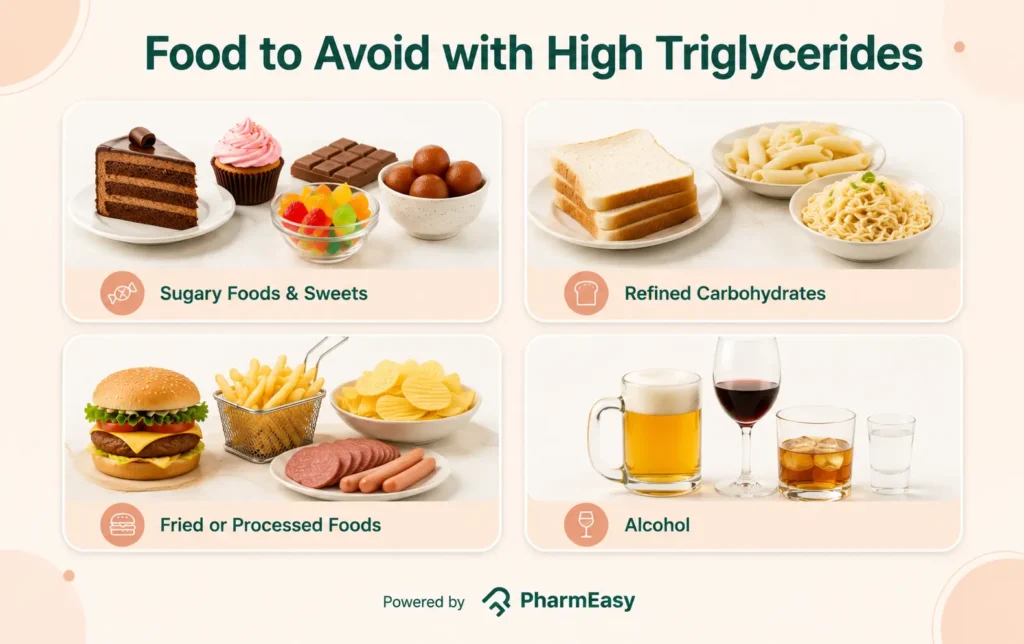
High triglyceride levels can be worsened by certain foods, so it is important to limit or avoid them to help maintain better blood lipid control. Here are few among them:
High triglyceride levels can typically be reduced with easy lifestyle adjustments that enhance fat management and general heart health. These include the following:
You should consult a doctor if:
Early diagnosis and treatment may help avoid serious complications and improve long-term health.
Also Read: 10 Healthy Fat Foods That You Should Be Eating!
High triglycerides are common and can be managed. They usually don’t show symptoms early, but if left untreated, they can increase the risk of heart disease and other health problems. Regular blood tests, healthy eating, exercise, and proper medical care can help control triglyceride levels. Making early lifestyle changes and getting timely treatment can help protect your heart and overall health.
Also Read: Low HDL (Good) Cholesterol: Causes, Symptoms & How to Increase It
No, triglycerides are not checked in a complete blood count (CBC) test. They are measured in a separate test called a lipid profile12.
Triglycerides are made up of fatty acids that can be either saturated or unsaturated. Unsaturated fats are generally considered to be a healthier option21.
High triglycerides mainly affect the blood vessels and heart. These increasing the risk of atherosclerosis (plaque buildup) in the arteries of heart and can lead to heart disease. In very severe cases, they can also affect the pancreas, leading to a condition called pancreatitis2,3.
Yes, chronic stress can contribute to high triglyceride levels. It can trigger hormonal changes that increase fat production and also lead to unhealthy habits like overeating or lack of exercise, which raise triglycerides7.
High triglycerides do not directly cause diabetes. However, they are often linked with metabolic syndrome (which includes insulin resistance- low sensitivity of tissues to insulin, decreasing blood sugar utilisation by the body) that increases the risk of developing type 2 diabetes3.
1. Triglycerides med. 2025. doi:https://medlineplus.gov/triglycerides.html
2. High Blood Triglycerides. 2025. doi:https://www.nhlbi.nih.gov/health/high-blood-triglycerides
3. Triglycerides. doi:https://www.betterhealth.vic.gov.au/health/conditionsandtreatments/triglycerides
4. Eruptive xanthomatosis. 2024. doi:https://medlineplus.gov/ency/article/007746.htm
5. Peripheral Neuropathy. doi:https://www.niddk.nih.gov/health-information/diabetes/overview/preventing-problems/nerve-damage-diabetic-neuropathies/peripheral-neuropathy
6. Pancreatitis. 2024. doi:https://medlineplus.gov/pancreatitis.html
7. Anni NS, Jung SJ, Shim JS, Jeon YW, Lee GB, Kim HC. Stressful life events and serum triglyceride levels: the Cardiovascular and Metabolic Diseases Etiology Research Center cohort in Korea. Epidemiol Health. 2021;43:e2021042. doi:10.4178/epih.e2021042 https://pubmed.ncbi.nlm.nih.gov/34126706/
8. Smellie WSA. Hypertriglyceridaemia in diabetes. BMJ. 2006;333(7581):1257-1260. doi:10.1136/bmj.39043.398738.DE https://pmc.ncbi.nlm.nih.gov/articles/PMC1702429/
9. Pearce EN. Hypothyroidism and dyslipidemia: Modern concepts and approaches. Curr Cardiol Rep. 2004;6(6):451-456. doi:10.1007/s11886-004-0054-3 https://pubmed.ncbi.nlm.nih.gov/15485607/
10. Herink MC. Medication Induced Changes in Lipids and Lipoproteins. 2025. doi:https://www.ncbi.nlm.nih.gov/books/NBK326739/
11. In brief: Triglycerides. 2025. doi:https://www.ncbi.nlm.nih.gov/books/NBK618443/
12. Lipid profile test. 2024. doi:https://medlineplus.gov/ency/article/007812.htm
13. Fasting for a Blood Test. 2025. doi:https://medlineplus.gov/lab-tests/fasting-for-a-blood-test/
14. Testing for Cholesterol. 2024. doi:https://www.cdc.gov/cholesterol/testing/index.html
15. Nigam PK. Serum Lipid Profile: Fasting or Non-fasting? Ind J Clin Biochem. 2011;26(1):96-97. doi:10.1007/s12291-010-0095-x https://pubmed.ncbi.nlm.nih.gov/22211025/
16. Fiber: The Carb That Helps You Manage Diabetes. 2024. doi:https://www.cdc.gov/diabetes/healthy-eating/fiber-helps-diabetes.html
17. Nurzyńska-Wierdak R. Green Leafy Vegetables (GLVs) as Nutritional and Preventive Agents Supporting Metabolism. Metabolites. 2025;15(8):502. doi:10.3390/metabo15080502 https://pubmed.ncbi.nlm.nih.gov/40863121/
18. Guasch-Ferré M, Tessier AJ, Petersen KS, et al. Effects of Nut Consumption on Blood Lipids and Lipoproteins: A Comprehensive Literature Update. Nutrients. 2023;15(3):596. doi:10.3390/nu15030596 https://pubmed.ncbi.nlm.nih.gov/36771303/
19. Dietary advice for management of high triglycerides. 2024. doi:https://www.cuh.nhs.uk/patient-information/dietary-advice-for-management-of-high-triglycerides/
20. Warning signs and symptoms of heart disease. 2024. doi:https://medlineplus.gov/ency/patientinstructions/000775.htm
21. Jadhav HB, Annapure US. Triglycerides of medium-chain fatty acids: a concise review. J Food Sci Technol. 2023;60(8):2143-2152. doi:10.1007/s13197-022-05499w https://pubmed.ncbi.nlm.nih.gov/35761969/
Disclaimer: The information provided here is for educational/awareness purposes only and is not intended to be a substitute for medical treatment by a healthcare professional and should not be relied upon to diagnose or treat any medical condition. The reader should consult a registered medical practitioner to determine the appropriateness of the information and before consuming any medication. PharmEasy does not provide any guarantee or warranty (express or implied) regarding the accuracy, adequacy, completeness, legality, reliability or usefulness of the information; and disclaims any liability arising thereof.
Links and product recommendations in the information provided here are advertisements of third-party products available on the website. PharmEasy does not make any representation on the accuracy or suitability of such products/services. Advertisements do not influence the editorial decisions or content. The information in this blog is subject to change without notice. The authors and administrators reserve the right to modify, add, or remove content without notification. It is your responsibility to review this disclaimer regularly for any changes.
 1
1 
Comments

Leave your comment...
You may also like

























Comments