




Are Generic Medicines Effective for Kids? A Parent’s Guide to Safety, Effectiveness & Proper Use
By Dr. Sarthak Soni +2 more

Medically reviewed by Dr. Sarthak Soni
Last updated: Sep 11, 2026 Published on: Jul 30, 2026


Get,

to manage your symptom
Get your,

4 Cr+ families
benefitted

OTP sent to 9988776655



You’ve successfully subscribed to receive
doctor-approved tips on
Whatsapp

Get ready to feel your best.


Register to Avail the Offer
Send OTPBy continuing, you agree with our Privacy Policy and Terms and Conditions
Hi There,
Sign up on PharmEasy now!!


Trusted by 4 crore+ families

OTP sent to 9988776655
You have unlocked 25% off on medicines


Code: NU25

By Dr. Sarthak Soni +2 more
Table of Contents
When filling a prescription, it is common to find a generic medicine option instead of a well-known brand. This often leads to questions such as: Are generic medicines safe? Do they work as well as branded medicines? Is the cheaper option always a viable choice? All these questions are particularly pressing when the medicines are for children.
This blog addresses such common concerns. It will help improve our understanding of what generic medicines are, how they compare with branded medicines, and whether they are safe and effective for children, as well as provide practical tips to help parents use them correctly and confidently.
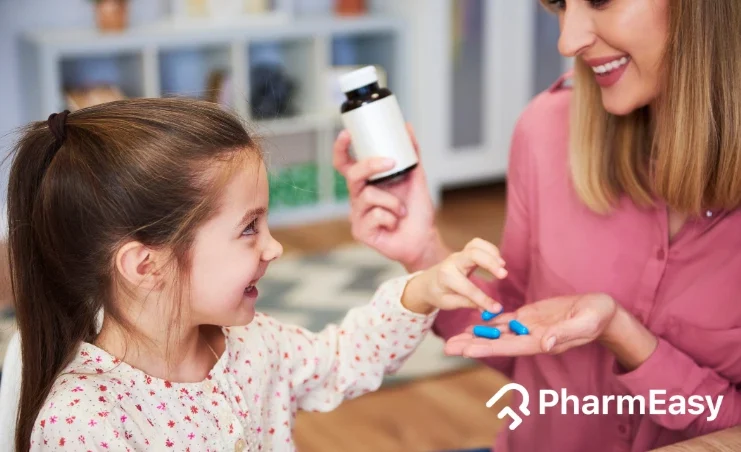
Generic medicines are low-cost alternatives to branded medicines. They contain the same active ingredients, dosage, and strength, but are typically half the cost of branded medicines. However, these generic medicines must comply with the same strict quality, safety, and effectiveness standards set by regulatory authorities1,2.
While the low cost may seem like a good motivation to switch to generic medicines, the choice between branded and generic medicines is critical with respect to children. This is because children’s developing bodies respond differently from adults, making it very important to ensure the child receives the correct dose, which is usually determined by the child’s age, weight, and sometimes body surface area, rather than the standard adult dose3.
While generic medicines contain the active ingredients as in the branded medicines, there may be differences in the inactive ingredients (often known as excipients), such as flavouring agents, colouring agents, or preservatives. These ingredients do not affect the medicine’s effectiveness but may pose serious harm to children with allergies, intolerances, or any other existing medical conditions4,5.
Therefore, while generic medicines for kids are effective and safe, they should always be used under the guidance of a doctor, with careful attention to the child’s age, weight, dosage, and formulation to ensure safe and effective management.
Generic medications for kids are widely used for many common illnesses. They offer the same therapeutic benefits as branded medicines while making management more affordable1,2. Below are some common conditions for which generic medicines may be prescribed by a paediatrician.
Fever is one of the most common reasons children need medication. It is usually caused by viral infections but may also occur with bacterial infections. The two most commonly used generic medicines are paracetamol (acetaminophen) and ibuprofen (only for children older than 6 months)6,7.
Examples: Paracetamol Tablets/Syrup/Oral Suspension/Drops, Ibuprofen Tablets/Oral Suspension8
Children commonly develop bacterial infections such as ear infections, strep throat, urinary tract infections, and certain respiratory infections. Antibiotics are usually prescribed as they are effective against bacterial infections9.
Examples: Amoxicillin Syrup/Capsules, Azithromycin Tablets/Oral Suspension8
Many children experience seasonal allergies, allergic rhinitis, itchy skin rashes, or hives caused by allergens such as pollen, dust mites, pet dander, or certain foods.
Antihistamines are generally prescribed to help relieve symptoms such as sneezing, itching, watery eyes, and runny nose10.
Examples: Cetirizine Tablets/Syrup/Oral Disintegrating Strips, Loratadine Tablets, Fexofenadine Tablets/Oral Suspension8
Intestinal worm infections are common among children, particularly in areas where sanitation and hygiene may be inadequate. Anthelmintic medications are usually prescribed for deworming11,12.
Examples: Albendazole Tablets/Oral Suspension, Mebendazole Tablets/Oral Suspension8
Important: While generic medicines for kids are as safe and effective as branded medicines when used correctly, parents should always consult a paediatrician before giving any medication to a child.
Doctors carefully select medicines for children to ensure they are both safe and effective. If a quality-approved generic medicine is available, it may be prescribed because it provides the same therapeutic benefits as the branded medicine but at a much lower cost.
When choosing generic medicines for kids, doctors consider factors such as13:
Children of different ages may need different medicine formulations. Doctors choose a dosage form based on the child’s age, ability to swallow, and the type of medicine being prescribed14,15.
Oral drops are ideal for infants because they allow very small doses to be measured accurately. They are easy to administer and are preferred for babies who cannot swallow larger volumes of liquid medicine.
Syrups and suspensions are commonly used for young children because they are easier to swallow than tablets and can provide flexible dosing based on the child’s weight. Many are flavoured to improve acceptance.
Dispersible tablets are ideal for children who cannot safely swallow conventional tablets because they can be dissolved in a small amount of water and consumed in liquid form. Chewable tablets can be chewed instead of swallowed whole, and these formulations are preferred for children who are not yet able to swallow conventional tablets but can safely take solid medicines.
Older children who do not have any swallowing restrictions may be prescribed conventional tablets or capsules. These dosage forms are convenient, provide accurate dosing, and are generally more stable than liquid formulations.
Note: The appropriate medicine form depends on the child’s age, medical condition, and ability to take the medication. It is good practice to always follow the doctor’s instructions and never switch between dosage forms without medical advice.
Before giving a generic medicine to a child, it is important to ensure it is the right medicine and is being used safely. Some precautions include16,17:
Even safe and effective generic medicines for kids can cause problems if they are not used correctly. So, it is best to avoid these common mistakes:
These simple tips can make medicine administration easier and help the child receive the full benefit:
Generic medicines for kids are generally safe and effective when used as prescribed. However, parents should seek medical advice if they are unsure about the medicine or if their child’s condition does not improve as expected. A doctor’s consultation is required after taking the generic medicine if:
Also Read: Cough Syrup for Kids: What to Give, What to Avoid & Safe Dosage
Generic medicines are a safe, effective, and affordable option for managing many common childhood illnesses when they are approved by regulatory authorities and used correctly. They contain the same active ingredients as branded medicines and provide the same therapeutic benefits while helping reduce healthcare costs.
The key to safe and effective management is choosing the right medicine, using the correct dose and dosage form based on your child’s age and weight, and following the doctor’s instructions. Parents should always read medicine labels carefully, avoid self-medication, and seek medical advice if they have any concerns or if their child’s symptoms persist or worsen.
Generic medicines approved by regulatory authorities are considered as safe and effective as branded medicines. They contain the same active ingredient, strength, and dosage form and must meet the same quality and safety standards1,2. However, they should always be used under the guidance of a doctor and in the correct dose for your child’s age and weight.
If the generic medicine contains the same active ingredient, strength, dosage form, and route of administration, it can usually be substituted for the branded medicine2,16. However, always consult your child’s doctor or pharmacist before making the switch, especially if your child has a chronic condition or requires specialised treatment.
There is no fixed age at which children can start taking medicines. Medicines can be prescribed from birth if needed, but the type of medicine, dose, and dosage form depend on the child’s age, weight, medical condition, and overall health14. Always give medicines only as prescribed by a doctor.
Some of the most commonly used medicines in children include paracetamol (acetaminophen) for fever and pain, ibuprofen for pain and inflammation (in children over 6 months, unless advised otherwise), amoxicillin for certain bacterial infections, and cetirizine for allergies6,7,9,10. The most appropriate medicine depends on the child’s specific condition and should be recommended by a doctor.
1. Generic Drug Facts. FDA. June 2, 2026. Accessed July 9, 2026. Available from: https://www.fda.gov/drugs/generic-drugs/generic-drug-facts
2. Joshi S, Shetty Y, Karande S. Generic drugs – The Indian scenario. J Postgrad Med. 2019;65(2):67-69. doi:10.4103/jpgm.JPGM_420_18. Available from: https://pmc.ncbi.nlm.nih.gov/articles/PMC6515776/
3. Ferro A. Paediatric prescribing: why children are not small adults. Br J Clin Pharmacol. 2015;79(3):351-353. doi:10.1111/bcp.12540. Available from: https://pmc.ncbi.nlm.nih.gov/articles/PMC4345945/
4. Strauss J, Greeff OBW. Excipient-related adverse drug reactions: A clinical approach. Curr Allergy Clin Immunol. 2015;28:24-27. Accessed July 9, 2026. Available from: https://www.researchgate.net/publication/282956386_Excipient-related_adverse_drug_reactions_A_clinical_approach
5. Reker D, Blum SM, Steiger C, Anger KE, Sommer JM, Fanikos J, Traverso G. “Inactive” ingredients in oral medications. Sci Transl Med. 2019 Mar 13;11(483):eaau6753. doi: 10.1126/scitranslmed.aau6753. Available from: https://people.uniud.it/sites/default/files/2019.SciTranMed%20-%20Inactive%20components.pdf
6. Barbi E, Marzuillo P, Neri E, Naviglio S, Krauss BS. Fever in Children: Pearls and Pitfalls. Children. 2017;4(9):81. doi:10.3390/children4090081. Available from: https://pubmed.ncbi.nlm.nih.gov/28862659/
7. How and when to give ibuprofen for children. NHS. June 30, 2022. Accessed July 10, 2026.Available from: https://www.nhs.uk/medicines/ibuprofen-for-children/how-and-when-to-give-ibuprofen-for-children/
8. Jan Aushadhi Products. Government of India. Accessed July 9, 2026. Available from: https://janaushadhi.gov.in/product-portfolio/product-view-list
9. Alter SJ, Vidwan NK, Sobande PO, Omoloja A, Bennett JS. Common Childhood Bacterial Infections. Curr Probl Pediatr Adolesc Health Care. 2011;41(10):256-283. doi:10.1016/j.cppeds.2011.06.001. Available from: https://pubmed.ncbi.nlm.nih.gov/22005120/
10. Chad Z. Allergies in children. Paediatr Child Health. 2001;6(8):555-566. doi:10.1093/pch/6.8.555. Available from: https://pubmed.ncbi.nlm.nih.gov/20084126/
11. Weatherhead JE. Pediatric Pharmacotherapy: Anthelminthic Treatment. Handb Exp Pharmacol. 2020;261:339-362. doi:10.1007/164_2019_254. Available from: https://pubmed.ncbi.nlm.nih.gov/31555913/
12. Fauziah N, Aviani JK, Agrianfanny YN, Fatimah SN. Intestinal Parasitic Infection and Nutritional Status in Children under Five Years Old: A Systematic Review. Trop Med Infect Dis. 2022;7(11):371. doi:10.3390/tropicalmed7110371. Available from: https://pubmed.ncbi.nlm.nih.gov/36422922/
13. Eckstein S, ed. Clinical investigation of medicinal products in the paediatric population. In: Manual for Research Ethics Committees. 6th ed. Cambridge University Press; 2003:420-428. doi:10.1017/CBO9780511550089.060. Available from: https://www.cambridge.org/core/books/abs/manual-for-research-ethics-committees/clinical-investigation-of-medicinal-products-in-the-paediatric-population/AD1A0BC46FD42CF156505B83F3F639CE
14. Nunn T. Age-appropriate formulations – paediatric needs. 2011. Accessed July 9, 2026. Available from: https://www.ema.europa.eu/en/documents/presentation/presentation-age-appropriate-formulations-paediatric-needs_en.pdf
15. van Riet-Nales DA, Schobben AFAM, Vromans H, Egberts TCG, Rademaker CMA. Safe and effective pharmacotherapy in infants and preschool children: importance of formulation aspects. Arch Dis Child. 2016;101(7):662-669. doi:10.1136/archdischild-2015-308227. Available from: https://pmc.ncbi.nlm.nih.gov/articles/PMC4941170/
16. Got a Sick Kid? Don’t Guess. Read the Label. Make sure you’re giving your children the right medicine and the right amount. FDA. July 24, 2025. Accessed July 9, 2026. Available from: https://www.fda.gov/drugs/safe-use-over-counter-otc-medicines-children/got-sick-kid-dont-guess-read-label-make-sure-youre-giving-your-children-right-medicine-and-right
17. A Parent’s Guide to Over-the-Counter Medicines for Children. HealthyChildren.org. July 6, 2026. Accessed July 9, 2026. Available from: https://www.healthychildren.org/English/safety-prevention/at-home/medication-safety/Pages/Choosing-Over-the-Counter-Medicines-for-Your-Child.aspx
18. Medication Safety Tips for Families. HealthyChildren.org. November 12, 2025. Accessed July 9, 2026. Available from: https://www.healthychildren.org/English/safety-prevention/at-home/medication-safety/Pages/Medication-Safety-Tips.aspx
19. As They Grow: Teaching Your Children How To Use Medicines Safely. FDA. Accessed July 9, 2026. Available from: https://www.fda.gov/drugs/information-consumers-and-patients-drugs/they-grow-teaching-your-children-how-use-medicines-safely
20. Alhamad H, Patel N, Donyai P. Towards Medicines Reuse: A Narrative Review of the Different Therapeutic Classes and Dosage Forms of Medication Waste in Different Countries. Pharmacy (Basel). 2020;8(4):230. doi:10.3390/pharmacy8040230. Available from: https://pmc.ncbi.nlm.nih.gov/articles/PMC7712270/
21. When your baby or infant has a fever: MedlinePlus Medical Encyclopedia. Accessed July 9, 2026. Available from: https://medlineplus.gov/ency/patientinstructions/000319.htm
Disclaimer: The information provided here is for educational/awareness purposes only and is not intended to be a substitute for medical treatment by a healthcare professional and should not be relied upon to diagnose or treat any medical condition. The reader should consult a registered medical practitioner to determine the appropriateness of the information and before consuming any medication. PharmEasy does not provide any guarantee or warranty (express or implied) regarding the accuracy, adequacy, completeness, legality, reliability or usefulness of the information; and disclaims any liability arising thereof.
Links and product recommendations in the information provided here are advertisements of third-party products available on the website. PharmEasy does not make any representation on the accuracy or suitability of such products/services. Advertisements do not influence the editorial decisions or content. The information in this blog is subject to change without notice. The authors and administrators reserve the right to modify, add, or remove content without notification. It is your responsibility to review this disclaimer regularly for any changes.


Comments

Leave your comment...
You may also like




















Comments