




Hemolysis: Meaning, Causes, Types, Symptoms, Diagnosis & Treatment
By Dr. Vishesh Bharucha +2 more

Medically reviewed by Dr. Vishesh Bharucha
Last updated: Sep 10, 2026 Published on: Jul 24, 2026


Get,

to manage your symptom
Get your,

4 Cr+ families
benefitted

OTP sent to 9988776655



You’ve successfully subscribed to receive
doctor-approved tips on
Whatsapp

Get ready to feel your best.


Register to Avail the Offer
Send OTPBy continuing, you agree with our Privacy Policy and Terms and Conditions
Hi There,
Sign up on PharmEasy now!!


Trusted by 4 crore+ families

OTP sent to 9988776655
You have unlocked 25% off on medicines


Code: NU25

By Dr. Vishesh Bharucha +2 more
Table of Contents
Did you know that your red blood cells (RBCs) usually live for about 120 days? At the end of their lifespan, they are naturally broken down and recycled by the body through a process called hemolysis1.
However, if RBCs are destroyed much earlier than expected, or in larger numbers than usual, it can cause problems. This may happen because of inherited blood disorders or other medical conditions, and it can sometimes lead to anaemia or serious complications2. Though many complications can be prevented or managed well when the cause is found and treated early.
In this blog, we will explain the meaning of hemolysis, its causes and types, common symptoms, how doctors diagnose it, and the treatment options that may help.
Hemolysis means the breakdown of RBCs. This can be a normal part of how the body renews blood cells. RBCs usually circulate for about 120 days before old or damaged cells are removed1.
Did You Know?
Problems can occur when RBCs are destroyed faster than the bone marrow can replace them. This usually happens for two broad reasons: intrinsic causes, where the issue is within the RBCs themselves, and extrinsic causes, where something outside the RBCs damages them.
The defect is within the RBC itself, such as an abnormality in the RBC membrane, enzymes, or haemoglobin. While most intrinsic causes are inherited (present from birth), some may be acquired later in life.
The RBCs are structurally normal, but they are destroyed by factors outside the RBC, such as immune reactions, infections, certain medications or toxins, mechanical injury, or an enlarged spleen. These causes usually develop later in life, although not all extrinsic causes are acquired.
Important: Although intrinsic haemolytic anaemias are usually inherited and extrinsic haemolytic anaemias are often acquired, this is not always the case. Some intrinsic causes may be acquired, so the terms intrinsic and extrinsic do not strictly mean inherited and acquired, respectively.
Symptoms can vary from person to person. They may depend on how quickly RBCs are being destroyed, how severe the condition is, and what is causing it. Common hemolysis symptoms and signs include6,12:
Note: Dark or reddish-brown urine is more commonly seen in intravascular hemolysis due to the presence of haemoglobin in the urine (haemoglobinuria). In extravascular hemolysis, urine usually does not become dark because RBCs are broken down mainly in the spleen and liver. Dark urine caused by haemoglobinuria should also be distinguished from haematuria (blood in the urine) and myoglobinuria (muscle protein in the urine).
Doctors may describe hemolysis in different ways, depending on where RBCs are destroyed and what is causing the destruction.
If your doctor suspects hemolysis, they may recommend a complete blood count to check for anaemia. They may also advise other blood or urine tests, such as6:
Additional tests, such as G6PD tests, may be recommended depending on the suspected cause.
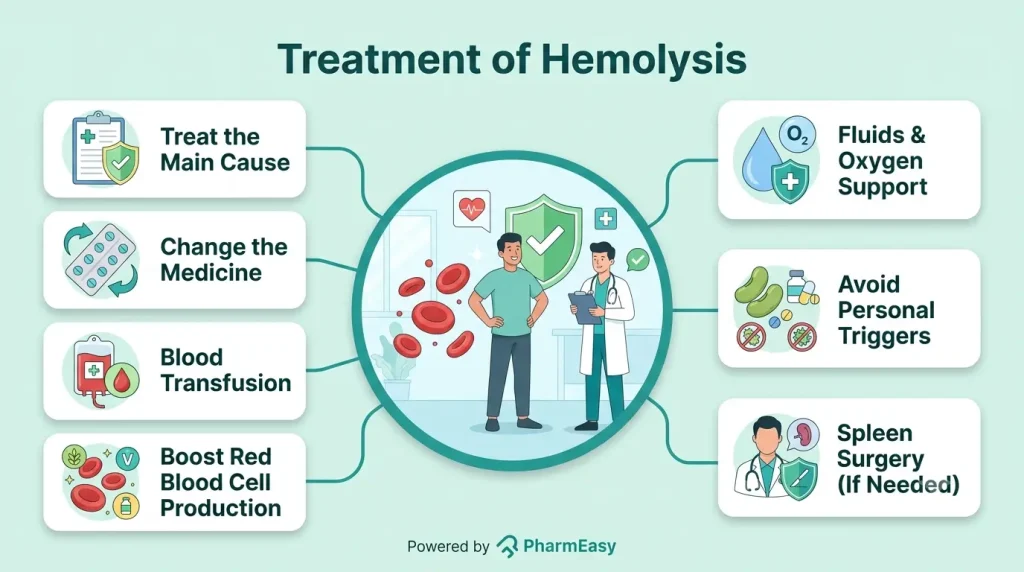
Treatment depends on the cause, how severe the hemolysis is, and the person’s overall health. Your doctor may recommend one or more of the following options4,6,13:
If hemolysis is severe or not treated, it may lead to complications such as13,14:
Also Read: High GGT Levels: Normal Range, Causes, Symptoms, Risks & Treatment
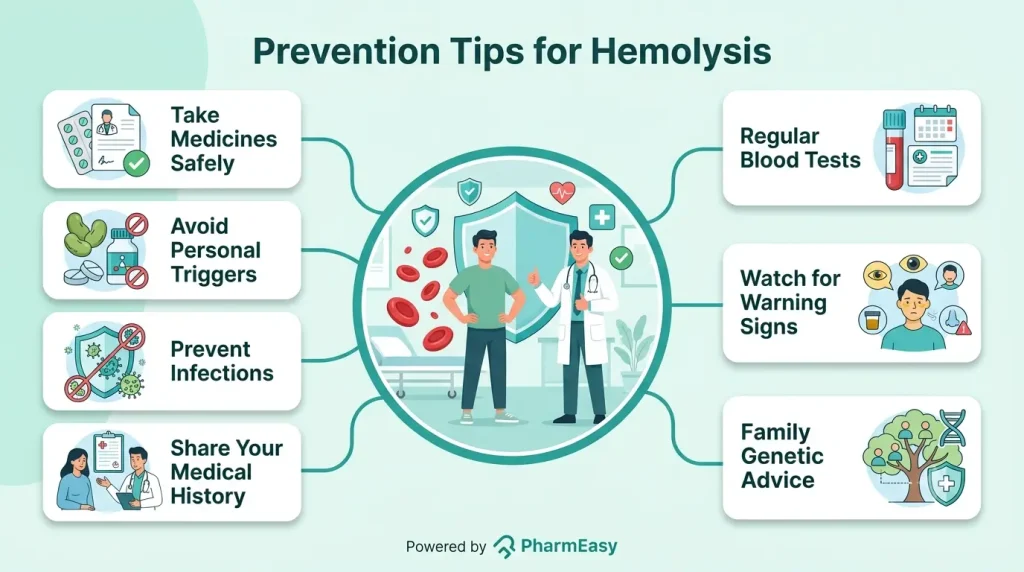
Not every type of hemolysis can be prevented. However, the following steps may help lower the risk of severe episodes and related complications:
Also Read: What Is a Dangerous White Blood Cell Count and How to Increase White Blood Cells?
Speak to a doctor if you notice any of the following symptoms, especially if they are new, persistent, or getting worse4,6,12,13:
Also Read: Folate Deficiency: Meaning, Causes, Symptoms, Treatment & Prevention
Hemolysis is a normal process when old RBCs are removed from the body. It becomes a concern when RBCs break down too early or too quickly. This may happen because of inherited blood disorders or acquired medical conditions. Mild cases may cause few or no symptoms, but severe cases can lead to serious complications. Recognising symptoms early, finding the cause, and getting timely treatment can make a meaningful difference. If you have symptoms that may suggest hemolysis, speak to your doctor for the right diagnosis and care.
Hemolysis simply means the breakdown of RBCs, and it can be a normal body process. However, when RBCs break down too early or too quickly, it may point to an underlying medical condition that needs evaluation1.
Hemolysis may be triggered by inherited blood disorders, autoimmune diseases, infections, certain medicines, blood transfusion reactions, toxins, mechanical heart valves, and, in people with G6PD deficiency, foods such as fava beans4,6.
When RBCs break down, they release potassium. Significant hemolysis can therefore increase blood potassium levels, although falsely elevated potassium (pseudohyperkalaemia) can also occur if blood cells break during sample collection15,16.
Mild cases of premature or excessive hemolysis may not be serious, but severe cases could be life-threatening. They can lead to severe anaemia or other complications1,13. This makes early medical treatment important.
Most foods do not cause hemolysis. However, fava beans can trigger hemolysis in some people with G6PD deficiency. If you have this condition, ask your doctor which foods, medicines, or other triggers you should avoid4.
Severe hemolysis may cause hyperkalaemia, which means high potassium levels in the blood, because potassium is released from damaged RBCs. This needs medical evaluation, especially if symptoms such as muscle weakness or abnormal heart rhythms occur15.
1. Thiagarajan P, Parker CJ, Prchal JT. How Do Red Blood Cells Die? Front Physiol. 2021;12:655393. doi:10.3389/fphys.2021.655393 https://pubmed.ncbi.nlm.nih.gov/33790808/
2. Zhong H, Yazdanbakhsh K. Hemolysis and immune regulation. Curr Opin Hematol. 2018;25(3):177-182. doi:10.1097/MOH.0000000000000423 https://pmc.ncbi.nlm.nih.gov/articles/PMC6309361/
3. Hemolysis. MedlinePlus. Accessed July 20, 2026. https://medlineplus.gov/ency/article/002372.htm
4. Mak GK, Shah M. Glucose-6-Phosphate Dehydrogenase Deficiency. StatPearls. Accessed July 20, 2026. http://www.ncbi.nlm.nih.gov/books/NBK470315/
5. Higa S, Keapoletswe K, Cirneanu L, Hagenaars S, LI J, Zagadailov E. P1476: The Clinical Characteristics And Overall Survival Of Patients With Pyruvate Kinase Deficiency In The UK: A Real-World Study. HemaSphere. 2023;7(Suppl):e0113950. doi:10.1097/01.HS9.0000972788.01139.50 https://pmc.ncbi.nlm.nih.gov/articles/PMC10430506/
6. Hemolytic anemia: MedlinePlus. Accessed July 20, 2026. https://medlineplus.gov/ency/article/000571.htm
7. Thomas L. Hemolysis as Influence & Interference Factor. EJIFCC. 2002;13(4):95-98. Accessed July 20, 2026. https://pmc.ncbi.nlm.nih.gov/articles/PMC6208064/
8. Patil HR, O’Keefe JH, Lavie CJ, Magalski A, Vogel RA, McCullough PA. Cardiovascular Damage Resulting from Chronic Excessive Endurance Exercise. Mo Med. 2012;109(4):312-321. Accessed July 20, 2026. https://pmc.ncbi.nlm.nih.gov/articles/PMC6179786/
9. Chaudhary P, Maharjan N, Subedi B. Microangiopathic Hemolytic Anemia as the Initial Presentation of Metastatic Signet-Ring Cell Carcinoma of the Colon: A Case Report. Cureus. 16(12):e76034. doi:10.7759/cureus.76034 https://pubmed.ncbi.nlm.nih.gov/39835047/
10. Tozluklu NN, Güvenç B. Autoimmune Hemolytic Anemia as the Presenting Feature of Chronic Lymphocytic Leukemia: Two Contrasting Cases Across Different Age Groups. Hematol Transfus Cell Ther. 2025;47:106115. doi:10.1016/j.htct.2025.106115 https://pmc.ncbi.nlm.nih.gov/articles/PMC8616265/
11. Lv Y, Lau WY, Li Y, et al. Hypersplenism: History and current status. Exp Ther Med. 2016;12(4):2377-2382. doi:10.3892/etm.2016.3683 https://pubmed.ncbi.nlm.nih.gov/27703501/
12. Palmer D, Seviar D. How to approach hemolysis: Haemolytic anaemia for the general physician. Clin Med. 2022;22(3):210-213. doi:10.7861/clinmed.2022-0142 https://pubmed.ncbi.nlm.nih.gov/35584830/
13. Turner J, Parsi M, Badireddy M. Anemia. StatPearls. Accessed July 20, 2026. http://www.ncbi.nlm.nih.gov/books/NBK499994/
14. Palmer D, Seviar D. How to approach hemolysis: Haemolytic anaemia for the general physician. Clin Med. 2022;22(3):210-213. doi:10.7861/clinmed.2022-0142 https://pubmed.ncbi.nlm.nih.gov/35584830/
15. High potassium level. MedlinePlus. Accessed July 20, 2026. https://medlineplus.gov/ency/article/001179.htm
16. Asirvatham JR, Moses V, Bjornson L. Errors in Potassium Measurement: A Laboratory Perspective for the Clinician. North Am J Med Sci. 2013;5(4):255-259. doi:10.4103/1947-2714.110426 https://pmc.ncbi.nlm.nih.gov/articles/PMC3662091/
Disclaimer: The information provided here is for educational/awareness purposes only and is not intended to be a substitute for medical treatment by a healthcare professional and should not be relied upon to diagnose or treat any medical condition. The reader should consult a registered medical practitioner to determine the appropriateness of the information and before consuming any medication. PharmEasy does not provide any guarantee or warranty (express or implied) regarding the accuracy, adequacy, completeness, legality, reliability or usefulness of the information; and disclaims any liability arising thereof.
Links and product recommendations in the information provided here are advertisements of third-party products available on the website. PharmEasy does not make any representation on the accuracy or suitability of such products/services. Advertisements do not influence the editorial decisions or content. The information in this blog is subject to change without notice. The authors and administrators reserve the right to modify, add, or remove content without notification. It is your responsibility to review this disclaimer regularly for any changes.


Comments

Leave your comment...
You may also like

























Comments