




Types of Headaches: Causes, Symptoms, Treatment, and Prevention Guide
By Dr. Vishesh Bharucha +2 more

Medically reviewed by Dr. Vishesh Bharucha
Last updated: Sep 15, 2026 Published on: Jul 20, 2026


Get,

to manage your symptom
Get your,

4 Cr+ families
benefitted

OTP sent to 9988776655



You’ve successfully subscribed to receive
doctor-approved tips on
Whatsapp

Get ready to feel your best.


Register to Avail the Offer
Send OTPBy continuing, you agree with our Privacy Policy and Terms and Conditions
Hi There,
Sign up on PharmEasy now!!


Trusted by 4 crore+ families

OTP sent to 9988776655
You have unlocked 25% off on medicines


Code: NU25

By Dr. Vishesh Bharucha +2 more
Table of Contents
Headaches are among the most common health conditions, affecting individuals of all ages across the world. According to the World Health Organisation (WHO), headache disorders affect over 40% of the world’s population1. While many people have occasional headaches, regular episodes can interfere with work, sleep, and other everyday activities. Understanding the different types of headaches can help identify their causes and improve their treatment and prevention2. In this blog, we will discuss how many types of headaches are there, their causes, how they are diagnosed, their treatment options, and simple tips to prevent them.

A headache is a pain or discomfort felt in the head, scalp, or face. It can range from mild to severe and may last for a few minutes or several hours2. Headaches occur when pain-sensitive structures in and around the head, such as blood vessels, nerves, muscles, and tissues, become irritated or triggered due to factors such as smell, stress, and medications2,3.
Headaches, especially when they occur frequently, can affect a person’s quality of life and even cause problems at work. The fear of getting another headache can greatly affect family relationships, social activities, and job performance. Living with long-term headaches may also increase the risk of other health problems, such as anxiety and depression, which is more commonly observed in people with migraines, a type of headache1.
There are two types of headaches: primary headaches and secondary headaches. The table below highlights the key differences between these two types:
| Feature | Primary Headaches | Secondary Headaches |
| Definition | Headaches that are not caused by any medical condition, but are a part of a headache disorder4. | Headaches that occur due to an underlying health problem5. |
| Common causes | Occurs due to complex changes in the brain and nervous system mechanisms that are involved in sensing and processing pain4. Factors such as stress, hormonal changes, lack of sleep, certain foods, and genetics can act as a trigger that brings on headache episodes2. | Occurs when an underlying health condition irritates or puts pressure on the pain-sensitive structures in the head and neck (such as nerves, brain covering [meninges], blood vessels, muscles and tissues covering the skull). These conditions can include brain infections, head injuries, medication overuse, extremely high blood pressure, acute sinus infections (long-term infections rarely cause headaches), strokes, tumours, and other brain disorders2,5. |
| Examples | Migraine, tension headache, cluster headache, etc.4. | Sinus headache, medication-overuse headache, cervicogenic headache, etc5. |
| Severity | Usually not life-threatening, but can interfere with quality of life1,4. | Depends on the cause and can range from mild to life-threatening5. |
| Treatment | Symptom management, trigger avoidance and prescription medications if needed2. | Treating underlying health condition5. |
Understanding the different types of headaches and their causes can help you identify possible triggers, recognise warning signs, and seek the right treatment when needed. Here are some of the common types of headaches:
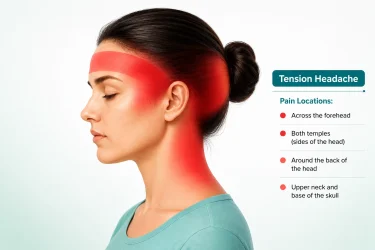
These are among the most common types of primary headaches. They usually last between 30 minutes and one week. Although they can start around puberty, they are most common in people in their 30s. Women and young people are more likely to experience this headache.
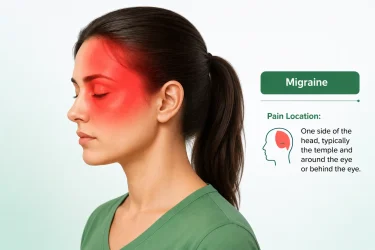
This is a type of primary headache that occurs repeatedly2. It can last between 4 and 72 hours. It often begins during puberty and is most common in people aged 35 to 45 years. Women are more likely to be affected than men due to hormonal issues. Migraine attacks in children are usually shorter than in adults1.
Note: Food triggers can vary from person to person. Alcohol (especially red wine), excess caffeine intake or suddenly stopping caffeine, chocolate, fish, and processed meats may trigger migraines in some people.
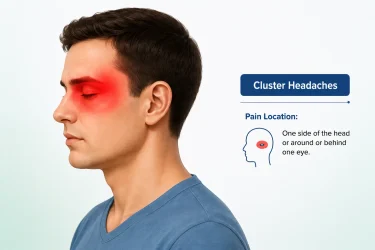
These are extremely painful but rare types of primary headaches. They can last from 15 minutes to 3 hours. The pain occurs in clusters or as repeated episodes, at the same time each day or night for many weeks. They most commonly occur between the ages of 20 and 40 years but can occur at any age, including in children and older adults2. These are more common in men than in women7.
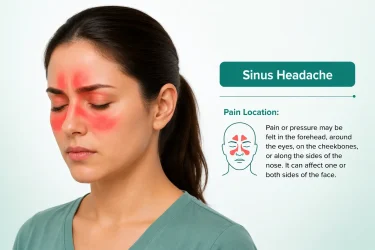
This is a type of secondary headache caused by the sinus issues9. Without treatment, the pain can persist for 4 weeks or less than that and become worse when a person bends forward or lies down. However, in most cases, the headache usually improves as the infection subsides9,10.
Note: Many headaches that people believe are caused by sinus problems are actually migraines. This is a common misunderstanding about headaches7.
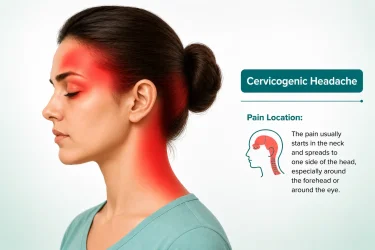
This is a type of secondary headache, which is rare and chronic. It is most commonly seen in people aged between 30 and 44 years. It is often mistaken for primary headaches, such as migraine and tension-type headache. The pain goes away when the underlying condition is treated successfully.
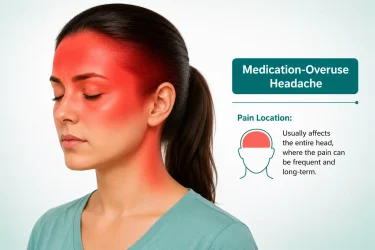
This is a type of secondary headache caused by the overuse of medications. It is also known as rebound headache. Medication-overuse headache is characterised as:
As there are different types of headaches and their reasons vary, doctors might use more than one diagnostic procedure to determine the cause of a headache. These include:
Note: High BP causes headache only when it causes hypertensive emergencies or BP rises suddenly. Mild or moderate high blood pressure does not usually cause headaches.
Note: If the doctor suspects that the increased pressure inside the skull is caused by a tumour or another growth, they may recommend a CT scan or MRI before considering a lumbar puncture. In some cases, a lumbar puncture may not be safe.
The treatment options usually available for headaches include:
Frequent headaches can often be managed by identifying and avoiding the triggers that cause them. The following measures may help lower the risk of recurrent headaches:


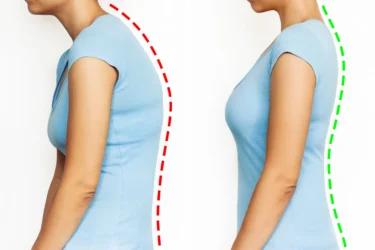



Also Read: Home Remedies For Headache By Dr. Siddharth Gupta
It is very important to consult a doctor if the headache:
Headaches are a common ailment and their severity can range from a mild ache to severe pain that interferes with daily activities. While most headaches are harmless, some may be a sign of an underlying health problem that needs medical attention. Knowing the different types of headaches, their symptoms, causes, and treatments can help you manage them better and recognise when to see a doctor.
The 5 C’s of headaches are common triggers that can worsen or cause headaches: Cheese, chocolate, citrus fruits, caffeine, and coke. Avoiding these triggers may help reduce headaches in some people, especially those with migraines16.
The type of headache can often be identified by its location, how the pain feels, how long it lasts, and its symptoms (such as nausea, sensitivity to light, or nasal congestion). A doctor might correlate these along with the individual’s medical history and triggers and, in some cases, recommend tests to rule out serious underlying conditions2,10.
Headaches that start suddenly and are severe; occur after a head injury; or are accompanied by symptoms such as weakness, confusion, seizures, fever, vision changes, or difficulty speaking require immediate medical attention as they may be a sign of serious conditions such as a stroke, meningitis, or bleeding in the brain2,5.
Consult a doctor immediately if your headaches are sudden or severe, occur after a head injury, or are associated with fever, confusion, weakness, vision problems, seizures, or difficulty speaking. These symptoms may be a sign of a serious condition and should not be ignored2.
A brain tumour-related headache is usually persistent, gradually worsens over time, and may be worse in the morning or with coughing and straining. It is important to note that these symptoms may also occur if a person has a migraine or cluster headache. A person with tumour may have other associated symptoms, such as seizures, vision changes, weakness, or difficulty speaking. Most headaches are not caused by brain tumours; however, a new or worsening headache with neurological symptoms should be evaluated by a doctor5.
1. Migraine and other headache disorders. 2025. Available from: https://www.who.int/news-room/fact-sheets/detail/headache-disorders
2. Headache. 2026. Available from: https://www.ninds.nih.gov/health-information/disorders/headache
3. The anatomy of head pain. In: Handbook of Clinical Neurology. Vol 198. Elsevier; 2023:41-60. doi:10.1016/B978-0-12-823356-6.00001-9 Available from: https://pubmed.ncbi.nlm.nih.gov/38043970/
4. Wang Z, Yang X, Zhao B, Li W. Primary headache disorders: From pathophysiology to neurostimulation therapies. Heliyon. 2023;9(4):e14786. doi:10.1016/j.heliyon.2023.e14786. Available from: https://pubmed.ncbi.nlm.nih.gov/37077680/
5. Wijeratne T, Wijeratne C, Korajkic N, Bird S, Sales C, Riederer F. Secondary headaches – red and green flags and their significance for diagnostics. eNeurologicalSci. 2023;32:100473. doi:10.1016/j.ensci.2023. 100473. Available from: https://pmc.ncbi.nlm.nih.gov/articles/PMC10339125/
6. Nihir Shah, Asuncion RMD, Hameed S. Muscle Contraction Tension Headache. 2024. Available from: https://www.ncbi.nlm.nih.gov/books/NBK562274/
7. Headache: When to worry, what to do. 2024. Available from: https://www.health.harvard.edu/pain/headache-when-to-worry-what-to-do
8. Cluster headache. 2025. Available from: https://medlineplus.gov/ency/article/000786.htm
9. Sinusitis. 2024. Available from: https://medlineplus.gov/ency/article/000647.htm
10. Headaches. 2025. Available from: https://www.healthdirect.gov.au/headaches
11. Al Khalili Y, K. Ly N, Murphy PB. Cervicogenic Headache. 2022. Available from: https://www.ncbi.nlm.nih.gov/books/NBK507862/
12. Aleksenko D, Lui F, Sánchez-Manso JC. Medication Overuse Headache. 2025. Available from: https://www.ncbi.nlm.nih.gov/sites/books/NBK470171/
13. Medication Overuse Headache. 2022. Available from: https://headaches.org/resources/medication-overuse-headache/
14. Kim KT. Lumbar puncture: considerations, procedure, and complications. encephalitis. 2022;2(4):93-97. doi:10.47936/encephalitis.2022.00045 Available from: https://pmc.ncbi.nlm.nih.gov/articles/PMC10295920/
15. Eskey CJ, Ogilvy CS. Fluoroscopy-guided lumbar puncture: decreased frequency of traumatic tap and implications for the assessment of CT-negative acute subarachnoid hemorrhage. AJNR Am J Neuroradiol. 2001;22(3):571-576. Available from: https://pubmed.ncbi.nlm.nih.gov/11237986/
16. Speight N. Best practice: migraine. Arch Dis Child. 2006 Jun;91(6):541. PMID: 16714736; PMCID: PMC2082764. Available from: https://pmc.ncbi.nlm.nih.gov/articles/PMC2082764/
Disclaimer: The information provided here is for educational/awareness purposes only and is not intended to be a substitute for medical treatment by a healthcare professional and should not be relied upon to diagnose or treat any medical condition. The reader should consult a registered medical practitioner to determine the appropriateness of the information and before consuming any medication. PharmEasy does not provide any guarantee or warranty (express or implied) regarding the accuracy, adequacy, completeness, legality, reliability or usefulness of the information; and disclaims any liability arising thereof.
Links and product recommendations in the information provided here are advertisements of third-party products available on the website. PharmEasy does not make any representation on the accuracy or suitability of such products/services. Advertisements do not influence the editorial decisions or content. The information in this blog is subject to change without notice. The authors and administrators reserve the right to modify, add, or remove content without notification. It is your responsibility to review this disclaimer regularly for any changes.


Comments

Leave your comment...
You may also like























Comments