




Cat Fleas: Causes, Symptoms, Treatment & Home Remedies
By Dr. Ramani Jairam +2 more

Medically reviewed by Dr. Ramani Jairam
Last updated: Jul 9, 2026 Published on: Jul 9, 2026


Get,

to manage your symptom
Get your,

4 Cr+ families
benefitted

OTP sent to 9988776655



You’ve successfully subscribed to receive
doctor-approved tips on
Whatsapp

Get ready to feel your best.


Register to Avail the Offer
Send OTPBy continuing, you agree with our Privacy Policy and Terms and Conditions
Hi There,
Sign up on PharmEasy now!!


Trusted by 4 crore+ families

OTP sent to 9988776655
You have unlocked 25% off on medicines


Code: NU25

By Dr. Ramani Jairam +2 more
Table of Contents
If your cat is constantly scratching, is restless, or has tiny black specks on its fur, cat fleas may be the reason. According to a study, about 46.5% of free-roaming domestic cats in the United States are found to be infested by cat fleas1. Ctenocephalides felis felis is the main flea species that affects cats. This article discusses cat fleas, their causes, symptoms, treatment, home remedies, and prevention tips1.

Cat fleas or Ctenocephalides felis felis is the most common ectoparasite (organisms that live on the outside of their host) in cats. It leads to physical irritation, annoyance, and itchiness in cats. It may lead to an allergic reaction, which is known as flea allergic dermatitis (FAD). In severe cases, it may also lead to anemia (lack of healthy red blood cells). Oftentimes, fleas appear even after the cat is administered routine flea control medicine; therefore, it is important that fleas are effectively managed2.
Cat fleas have six legs that are suitable for jumping. Fleas can be transferred to cats in several different ways, as follows3:
The symptoms of cat fleas may vary from minimal to severe and include:
Beyond the general symptoms, cat flea bites can sometimes lead to serious health conditions such as:
Humans may develop cat scratch disease if they are scratched or bitten by a cat infected with certain bacteria, often spread to cats by fleas. This may lead to symptoms such as swollen lymph nodes, fever, and fatigue.
If your cat becomes infected with fleas, you should follow these protocols:
Flea treatment for cats can involve the use of insect growth regulators that interfere with the growth and development of fleas. These include:
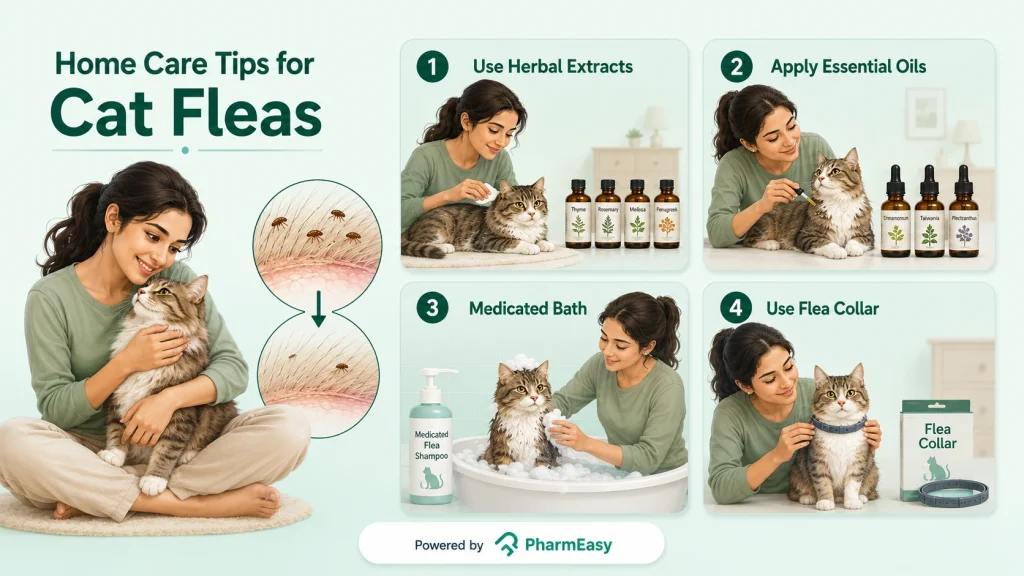
Certain home care tips can help in the management of fleas. The following are some home remedies for fleas on cats that can be used:
Cats fleas can be avoided by following these tips:
You should see a veterinarian for advice on periodic treatment for cat fleas. You should also visit a veterinarian if you notice signs of fleas; symptoms of FAD, such as intense itching, redness, hair loss; or signs of anemia such as pale gums and weakness6.
Also Read: Cat Vomiting: Causes, Symptoms, Treatment & Home Remedies
The symptoms associated with cat fleas can cause discomfort if not appropriately treated. Cat fleas can also lead to complications such as FAD and anemia. Early identification, effective medication, and good hygiene of the pet and the house is important to ensure complete recovery. It is the cat owner’s responsibility to know how to avoid fleas from being transmitted to their pets, identify them and get rid of them7.
If your cat seems to be excessively scratching and seems irritated, check for fleas on the skin. Adult fleas are visible to the owner on the surface of the skin6.
Fleas usually prefer to live on cats and may not affect the owner’s body unless the pet has been gone for a while11.
Cat fleas can cause discomfort, itchiness, hair loss, and restlessness. In some cases, they may also lead to serious complications, such as flea allergy dermatitis, tapeworm, and anemia6.
Yes, it is important to bathe your cat with a mild or medicated soap and shampoo, which will help kill the adult fleas7.
Yes, it is safe. Fleas prefer to stay on dogs and cats and rarely breed on humans11.
Yes, insecticide application in your house is important in such a case. Apply insecticides to carpets, behind beds, beneath sofa cushions, and where the pet sleeps5.
1. Gin TE, Moore CO, Tomlinson T, et al. Pathogenic bacterial species and the microbiome of cat fleas (Ctenocephalides felis) inhabiting flea-infested homes. PLOS ONE. 2026;21(1):e0341824. doi:10.1371/journal.pone.0341824 https://journals.plos.org/plosone/article?id=10.1371/journal.pone.0341824
2. Flea Control in Cats – Meng Siak, Mandy Burrows, 2013. Accessed June 23, 2026. https://journals.sagepub.com/doi/10.1177/1098612X12470341
3. How to Get Rid of Fleas. Texas A&M AgriLife Extension Service. Accessed June 23, 2026. https://agrilifeextension.tamu.edu/library/insects/controlling-fleas/
4. CDC. Preventing Fleas. Fleas. May 21, 2025. Accessed June 23, 2026. https://www.cdc.gov/fleas/prevention/index.html
5. Flea Control and Prevention | Entomology. Accessed June 23, 2026. https://entomology.mgcafe.uky.edu/ef602
6. Gale J. When should I take my cat to the vet for fleas? The Institute for Environmental Research and Education. December 6, 2025. Accessed June 23, 2026. https://iere.org/when-should-i-take-my-cat-to-the-vet-for-fleas/
7. Frank C. How to get rid of fleas: Protecting your home and pets. Harvard Health. November 12, 2024. Accessed June 23, 2026. https://www.health.harvard.edu/healthy-aging-and-longevity/how-to-get-rid-of-fleas-protecting-your-home-and-pets
8. Moog F, Plichart GV, Blua JL, Cadiergues MC. Evaluation of a plant-based food supplement to control flea populations in dogs: A prospective double-blind randomized study. Int J Parasitol Drugs Drug Resist. 2020;12:35-38. doi:10.1016/j.ijpddr.2020.02.001 https://pubmed.ncbi.nlm.nih.gov/32114287/
9. Recent Advancements in the Control of Cat Fleas. Accessed June 23, 2026. https://www.mdpi.com/2075-4450/11/10/668
10. Fleas. Available from: https://www.sciencedirect.com/topics/agricultural-and-biological-sciences/cat-flea
11. Fleas: MedlinePlus Medical Encyclopedia. Accessed June 23, 2026. https://medlineplus.gov/ency/article/001329.htm
Disclaimer: The information provided here is for educational/awareness purposes only and is not intended to be a substitute for medical treatment by a healthcare professional and should not be relied upon to diagnose or treat any medical condition. The reader should consult a registered medical practitioner to determine the appropriateness of the information and before consuming any medication. PharmEasy does not provide any guarantee or warranty (express or implied) regarding the accuracy, adequacy, completeness, legality, reliability or usefulness of the information; and disclaims any liability arising thereof.
Links and product recommendations in the information provided here are advertisements of third-party products available on the website. PharmEasy does not make any representation on the accuracy or suitability of such products/services. Advertisements do not influence the editorial decisions or content. The information in this blog is subject to change without notice. The authors and administrators reserve the right to modify, add, or remove content without notification. It is your responsibility to review this disclaimer regularly for any changes.


Comments

Leave your comment...
You may also like




















Comments