




Typhoid Fever Rash: When Rose Spots Appear & What You Should Do
By Dr. Vishesh Bharucha +2 more

Medically reviewed by Dr. Vishesh Bharucha
Last updated: Oct 16, 2026 Published on: Jun 19, 2026


Get,

to manage your symptom
Get your,

4 Cr+ families
benefitted

OTP sent to 9988776655



You’ve successfully subscribed to receive
doctor-approved tips on
Whatsapp

Get ready to feel your best.


Register to Avail the Offer
Send OTPBy continuing, you agree with our Privacy Policy and Terms and Conditions
Hi There,
Sign up on PharmEasy now!!


Trusted by 4 crore+ families

OTP sent to 9988776655
You have unlocked 25% off on medicines


Code: NU25

By Dr. Vishesh Bharucha +2 more
Table of Contents
Typhoid fever is a bacterial infection caused by Salmonella typhi that typically causes high fever, weakness, and digestive issues such as abdominal discomfort and diarrhoea. While these symptoms are generally known, many individuals are unaware that a unique skin rash known as “rose spots” can emerge in some cases1. This article will explain what a typhoid rash is, how it is formed, etc.
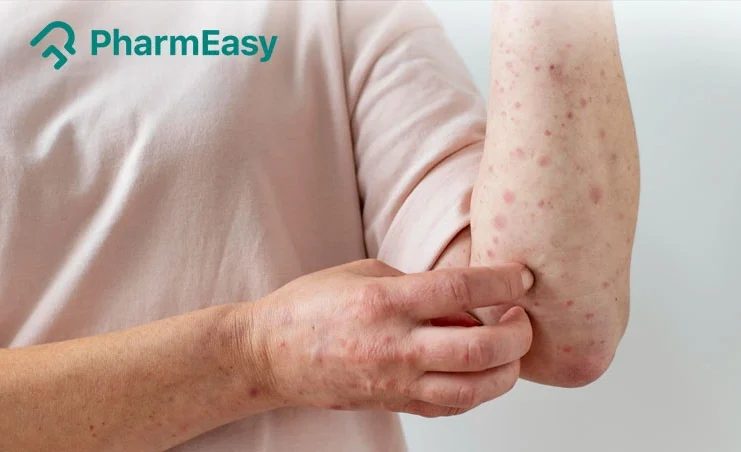
A typhoid fever rash is a type of skin change called “rose spots” that can occasionally appear in patients who have typhoid fever caused by Salmonella typhi. These appear as flat to slightly raised, small red or pink spots, usually about 2-4 mm in size, mainly on the lower chest and abdomen (sometimes spread to back or upper parts of the arms and legs), after the first week of infection. However, this rash is not very common and can also be hard to notice in people with darker skin. It is seen in less than one-fourth of patients, and usually disappears in 2-5 days, but when it occurs, clinicians can suspect the illness2,3.
Typhoid fever rose spots usually do not appear alone; they often appear with other common symptoms of typhoid infection, such as:
Severe ones include:
Though the exact cause of these spots is not clearly understood, they are thought to occur when the tiny clumps of typhoid causing bacteria travel through the bloodstream and get trapped in very small blood vessels in the skin, resulting in a mild local skin reaction. This reaction is said to cause small, faint pink or red patches, most commonly on the chest and abdomen5.
All the people having a typhoid infection may not develop these spots1. And if it occurs, the severity of the rash can vary from person to person. Some patients may develop only a few barely noticeable spots, while others may not get any rash at all. Factors like the strength of the immune system and how early treatment is started can also influence how visible the rash becomes.
Rose spots typhoid rashes are usually diagnosed as a part of the overall evaluation of typhoid fever rather than as a separate condition. The following are the ways by which the doctors diagnose it with other typhoid-related symptoms:
Note: Blood culture accuracy depends on timing, blood volume, prior antibiotic use, and lab methods.
Since the rash seen during typhoid fever is a sign of the underlying infection rather than a separate skin condition, the treatment mainly focuses on the infection. The doctors might recommend different medications based on the patient’s severity and conditions. The treatment options include the following:
Also Read: Typhoid in Kids: Symptoms, Causes, Treatment & Prevention Guide
Consulting a doctor is very important when the rashes or rose spots occur along with symptoms such as fever, fatigue or weakness, headache, abdominal pain, diarrhoea, or loss of appetite, as these can indicate typhoid fever1. An immediate consultation is very important when symptoms such as blood in stool, difficulty in concentrating, confusions, hallucinations, bleeding from nose, etc., appear alone or along with other common symptoms4.
Also Read: All You Need To Know About Typhoid!
Typhoid fever rash, often known as rose spots, is a small skin-based symptom that may develop in individuals with typhoid infection, but it is not always present in all. Since it usually appears with other symptoms like fever and stomach problems, it helps doctors suspect typhoid fever but cannot be used alone to confirm the disease. Early detection and medical advice are critical because typhoid fever requires proper antibiotic therapy. With timely treatment, both the infection and the associated rash usually disappear without any complications.
According to some studies, thyroid fever rose spots appear after the first week of infection and usually last only for 2-3 days5.
The skin spots seen during typhoid fever are rose or light pink spots. These are very small, and slightly raised, usually appearing on the chest and stomach. They fade away on their own in a few days4,8
The rose spots that occur during typhoid fever usually last for 2-3 days5.
Typhoid rash itself is usually not dangerous. However, it is considered as a sign of an underlying typhoid infection, which can become serious if not treated properly1.
No, the typhoid rash is usually not itchy or painful. It typically appears as small, rose spots that fade on their own3
No; not every typhoid patient develops rose spots. It is observed in less than 25% of the cases and is often absent in many people with typhoid fever1.
1. Bhandari J, Thada PK, Hashmi MF, DeVos E. Typhoid Fever. 2024. https://www.ncbi.nlm.nih.gov/books/NBK557513/
2. Centers for Disease Control and Prevention. Symptoms of typhoid fever and paratyphoid fever [Internet]. Atlanta (GA): CDC; 2025 Aug 5 https://www.cdc.gov/typhoid-fever/signs-symptoms/index.html
3. Arun V A, Ananthakrishnan R. Rose Spots: Pathognomonic Rash of Enteric Fever. Journal of Clinical Infectious Diseases Society. 2023; 1(2):154-155. DOI: 10.4103/CIDS.CIDS_22_23 https://journals.lww.com/cids/fulltext/2023/01020/rose_spots__pathognomonic_rash_of_enteric_fever.6.aspx
4. Typhoid fever. 2025. https://medlineplus.gov/ency/article/001332.htm
5. Newton P, Kamat R. A 10‐Year‐Old Girl with a Rash and Abdominal Pain. CLIN INFECT DIS. 2009;48(5):683-684. doi:10.1086/596761 https://www.researchgate.net/publication/311743456_A_10-Year-Old_Girl_with_a_Rash_and_Abdominal_Pain
6. Typhoid and Paratyphoid Fever. 2025. https://www.cdc.gov/yellow-book/hcp/travel-associated-infections-diseases/typhoid-and-paratyphoid-fever.html
7. Bhume RJ, Babaliche P. Clinical Profile and the Role of Rapid Serological Tests: Typhifast IgM and Enterocheck WB in the Diagnosis of Typhoid Fever. Indian Journal of Critical Care Medicine. 2020;24(5):307-312. doi:10.5005/jp-journals-10071-23417 https://pubmed.ncbi.nlm.nih.gov/32728320/
8. National Health Service (NHS). Typhoid fever [Internet]. London: NHS; [cited 2026 Jun 17]. Available from: https://www.nhs.uk/conditions/typhoid-fever/
Disclaimer: The information provided here is for educational/awareness purposes only and is not intended to be a substitute for medical treatment by a healthcare professional and should not be relied upon to diagnose or treat any medical condition. The reader should consult a registered medical practitioner to determine the appropriateness of the information and before consuming any medication. PharmEasy does not provide any guarantee or warranty (express or implied) regarding the accuracy, adequacy, completeness, legality, reliability or usefulness of the information; and disclaims any liability arising thereof.
Links and product recommendations in the information provided here are advertisements of third-party products available on the website. PharmEasy does not make any representation on the accuracy or suitability of such products/services. Advertisements do not influence the editorial decisions or content. The information in this blog is subject to change without notice. The authors and administrators reserve the right to modify, add, or remove content without notification. It is your responsibility to review this disclaimer regularly for any changes.


Comments

Leave your comment...
You may also like
























Comments