




Bacteria in Urine: Causes, Symptoms, Test, Treatment & Prevention
By Dr. Aniket Hase +2 more

Medically reviewed by Dr. Aniket Hase
Last updated: Aug 17, 2026 Published on: Jun 15, 2026


Get,

to manage your symptom
Get your,

4 Cr+ families
benefitted

OTP sent to 9988776655



You’ve successfully subscribed to receive
doctor-approved tips on
Whatsapp

Get ready to feel your best.


Register to Avail the Offer
Send OTPBy continuing, you agree with our Privacy Policy and Terms and Conditions
Hi There,
Sign up on PharmEasy now!!


Trusted by 4 crore+ families

OTP sent to 9988776655
You have unlocked 25% off on medicines


Code: NU25

By Dr. Aniket Hase +2 more
Table of Contents
Urine is normally clean (sterile) and does not contain any harmful bacteria. However, bacteria may enter the urinary tract, commonly through the urethra, and grow in the bladder. When these bacteria show up in a urine sample, the condition is known as bacteriuria. This can occur due to poor hygiene, contamination during sample collection for urine testing, or a urinary tract infection (UTI)1,2.
In this blog, we will explain what bacteria in urine means, its common causes and risk factors, the symptoms to watch for, the tests used for diagnosis, management options, and simple tips to help avoid urinary infections and maintain good urinary health.

Bacteria in urine, also called bacteriuria, refers to the presence of microorganisms in urine, where they are not normally found. Since urine is typically sterile, the presence of bacteria may indicate contamination or an infection in the urinary tract (such as a UTI)1.
Bacteria can enter the urinary tract through the urethra and multiply in the bladder, kidneys, or other parts of the urinary system2. In some people, bacteria in urine may not cause any symptoms, while in others, it can lead to burning during urination, frequent urination, fever, or lower abdominal pain3,6
The condition may be temporary and harmless in some cases, but persistent or symptomatic bacteriuria often requires medical evaluation and treatment3.
Common bacteria types found in urine include8 :
As already mentioned, in some cases, bacteria may be present in the urine without causing any symptoms. This condition is known as asymptomatic bacteriuria9.
However, when bacteria lead to a UTI, bacteria in urine symptoms may include10:
Note: Sometimes, dark-coloured or strong-smelling urine may simply be due to dehydration and not necessarily an infection.
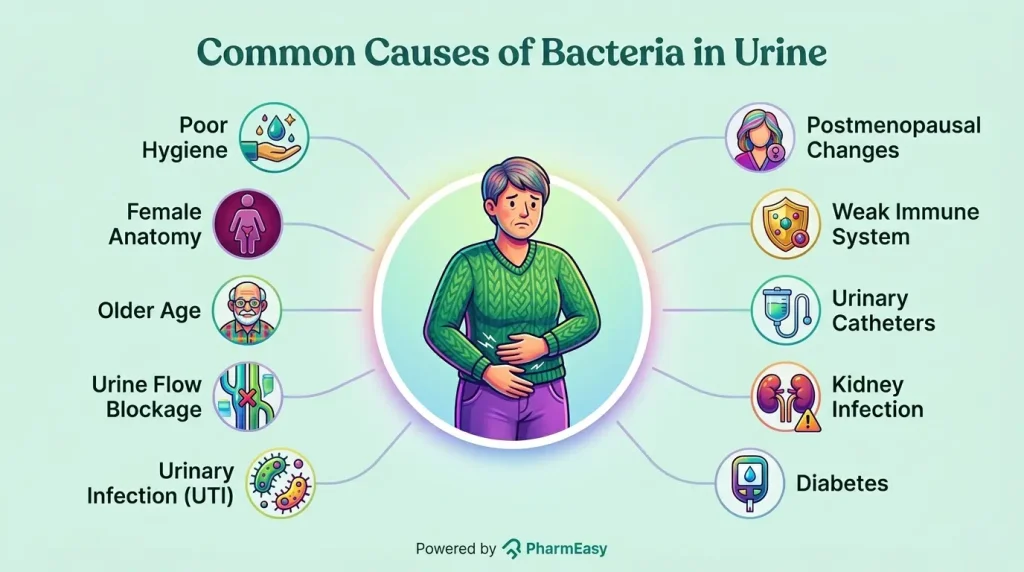
Bacteria can enter and grow in the urinary tract due to several factors. Common causes and risk factors include:
Doctors diagnose bacteria in urine based on symptoms, medical history, physical examination, and laboratory tests. Common diagnostic methods include:
Note: The normal bacteria in urine level is usually considered absent or insignificant, as the bacteria in urine normal range typically indicates no harmful bacterial growth in a properly collected urine sample.
Note: Sometimes, if a urine sample is not examined promptly or is left standing at room temperature instead of being stored at a cooler temperature, bacteria may grow in the urine sample1. This does not always indicate a true urinary infection unless it is accompanied by significant pus cells and symptoms suggestive of a UTI7.
Management for bacteria present in urine depends on the underlying cause, severity of symptoms, and the type of bacteria present. Minor infections may go away on their own with proper hydration that flushes out the bacteria, however most infections require antibiotics. Common management approaches include11:
Important: Bacteria in urine during pregnancy should not be ignored, as untreated infections may increase the risk of complications such as kidney infections, low birth weight, or preterm birth11,12,13.
Note: Treatment duration may vary depending on the severity of the infection. Simple bladder infections often improve within 3 to 7 days of treatment, whereas kidney or complicated infections may require antibiotics for up to 14 days11. However, it is important not to self-medicate or take antibiotics without medical advice, as improper treatment may worsen the infection, contribute to antibiotic resistance, or make recurrent infections difficult to manage. Always consult a doctor for proper diagnosis and guided management.

The following measures may help reduce the risk of bacteria in urine:
Also Read: Simple Home Remedies for Frequent Urination
You should contact a doctor if you experience symptoms that may suggest a urinary tract or kidney infection, including:
Also Read: Ketones in Urine: When and Why to Test for Them and What They Mean
Bacteria in urine can occur for several reasons, ranging from mild contamination to urinary tract infections and other underlying health conditions. While some people may not experience any symptoms, others may develop discomfort, frequent urination, fever, or even kidney-related complications if left unaddressed. Therefore, early diagnosis through urine tests and timely treatment can help avoid the infection from worsening.
In addition to these measures, maintaining proper hygiene, staying hydrated, and following healthy urinary habits can also play an important role in reducing the risk of recurrent infections. If symptoms persist or become severe, it is important to see a doctor and seek medical attention promptly.
Yes, bacteria in urine can usually be managed successfully. Depending on the cause and severity, doctors may prescribe antibiotics and recommend drinking plenty of fluids. Some cases without symptoms may not require any treatment3,11.
The presence of bacteria in urine may indicate a UTI or bacterial colonisation. It can cause symptoms such as burning during urination, frequent urination, fever, or abdominal pain. If left untreated, the infection may spread to the kidneys4,11.
Escherichia coli is the most common bacterium found in urine. Other bacteria may include Proteus, Klebsiella, Enterococcus, Pseudomonas, Enterobacter, and Streptococcus species8 .
1. Urine Culture – StatPearls – NCBI Bookshelf. Accessed May 22, 2026. https://www.ncbi.nlm.nih.gov/books/NBK557569/
2. Flores-Mireles AL, Walker JN, Caparon M, Hultgren SJ. Urinary tract infections: epidemiology, mechanisms of infection and treatment options. Nat Rev Microbiol. 2015;13(5):269-284. doi:10.1038/nrmicro3432 https://pubmed.ncbi.nlm.nih.gov/25853778/
3. Givler DN, Givler A. Asymptomatic Bacteriuria. In: StatPearls. StatPearls Publishing; 2026. Accessed May 22, 2026. http://www.ncbi.nlm.nih.gov/books/NBK441848/
4. Vyas S, Varshney D, Sharma P, Juyal R, Nautiyal V, Shrotriya V. An Overview of the Predictors of Symptomatic Urinary Tract Infection Among Nursing Students. Ann Med Health Sci Res. 2015;5(1):54-58. doi:10.4103/2141-9248.149790 https://pubmed.ncbi.nlm.nih.gov/25745578/
5. Abney SE, Bright KR, McKinney J, Ijaz MK, Gerba CP. Toilet hygiene—review and research needs. J Appl Microbiol. 2021;131(6):2705-2714. doi:10.1111/jam.15121 https://pubmed.ncbi.nlm.nih.gov/33899991/
6. Symptoms & Causes of Bladder Infection in Adults – NIDDK. National Institute of Diabetes and Digestive and Kidney Diseases. Accessed May 22, 2026. https://www.niddk.nih.gov/health-information/urologic-diseases/bladder-infection-uti-in-adults/symptoms-causes
7. Khan ZR, Ullah Z, Alwakeedi A, Majeed I, Snyder J. Urine Analysis as a Reliable Indicator of a Urinary Tract Infection: A Cross-Sectional Study. Cureus. 18(1):e101074. doi:10.7759/cureus.101074 https://www.researchgate.net/publication/399592287_Urine_Analysis_as_a_Reliable_Indicator_of_a_Urinary_Tract_Infection_A_Cross-Sectional_Study
8. Vranic SM, Zatric N, Rebic V, Aljicevic M, Abdulzaimovic A. The Most Frequent Isolates from Outpatients with Urinary Tract Infection. Mater Socio-Medica. 2017;29(1):17-20. doi:10.5455/msm.2017.29.17-20 https://pubmed.ncbi.nlm.nih.gov/28484348/
9. Asymptomatic bacteriuria: MedlinePlus Medical Encyclopedia. Accessed May 22, 2026. https://medlineplus.gov/ency/article/000520.htm
10. Urinary tract infections (UTIs). nhs.uk. October 18, 2017. Accessed May 22, 2026. https://www.nhs.uk/conditions/urinary-tract-infections-utis/
11. Crader MF, Kharsa A, Leslie SW. Bacteriuria. In: StatPearls. StatPearls Publishing; 2026. Accessed May 22, 2026. http://www.ncbi.nlm.nih.gov/books/NBK482276/
12. Kim YM, Kim JY, Lee MY, et al. Prospective study of bidet toilet use: Association of abnormal vaginal colonization and preterm birth in high-risk pregnant women. J Obstet Gynaecol Res. 2019;45(6):1134-1142. doi:10.1111/jog.13953 https://pubmed.ncbi.nlm.nih.gov/30884065/
13. Urinary Tract Infection in Pregnancy – StatPearls – NCBI Bookshelf. Accessed May 25, 2026. https://www.ncbi.nlm.nih.gov/books/NBK537047/
14. CDC. Urinary Tract Infection Basics. Urinary Tract Infection. March 23, 2026. Accessed May 22, 2026. https://www.cdc.gov/uti/about/index.html
Disclaimer: The information provided here is for educational/awareness purposes only and is not intended to be a substitute for medical treatment by a healthcare professional and should not be relied upon to diagnose or treat any medical condition. The reader should consult a registered medical practitioner to determine the appropriateness of the information and before consuming any medication. PharmEasy does not provide any guarantee or warranty (express or implied) regarding the accuracy, adequacy, completeness, legality, reliability or usefulness of the information; and disclaims any liability arising thereof.
Links and product recommendations in the information provided here are advertisements of third-party products available on the website. PharmEasy does not make any representation on the accuracy or suitability of such products/services. Advertisements do not influence the editorial decisions or content. The information in this blog is subject to change without notice. The authors and administrators reserve the right to modify, add, or remove content without notification. It is your responsibility to review this disclaimer regularly for any changes.
 1
1 
Comments

Leave your comment...
You may also like

























Comments