




Low HDL (Good) Cholesterol: Causes, Symptoms & How to Increase It
By Ameya Tirodkar +2 more

Medically reviewed by Ameya Tirodkar
Last updated: Aug 18, 2026 Published on: Jun 15, 2026


Get,

to manage your symptom
Get your,

4 Cr+ families
benefitted

OTP sent to 9988776655



You’ve successfully subscribed to receive
doctor-approved tips on
Whatsapp

Get ready to feel your best.


Register to Avail the Offer
Send OTPBy continuing, you agree with our Privacy Policy and Terms and Conditions
Hi There,
Sign up on PharmEasy now!!


Trusted by 4 crore+ families

OTP sent to 9988776655
You have unlocked 25% off on medicines


Code: NU25

By Ameya Tirodkar +2 more
Table of Contents
Most of us have heard people talk about the dangers of high cholesterol. But have you heard about problems caused by low cholesterol? Yes, that can happen too, especially with low high-density lipoprotein (HDL), often called the good cholesterol, and yes, it deserves attention!
Cholesterol is a fatty substance that is essential for many important functions in the body. It helps maintain the structure and flexibility of cell membranes. It also plays a key role in producing vitamin D, hormones such as cortisol and testosterone, and bile acids that aid digestion and the absorption of vitamins A, D, E, and K. Since cholesterol does not dissolve easily in blood, it is transported through the bloodstream by lipoproteins (biochemical molecules made of protein and fat) such as HDL, low-density lipoprotein (LDL), and very-low-density lipoprotein (VLDL), which together contribute to total cholesterol levels. Abnormal levels of any of these lipoproteins can lead to health problems, particularly those related to heart health1.
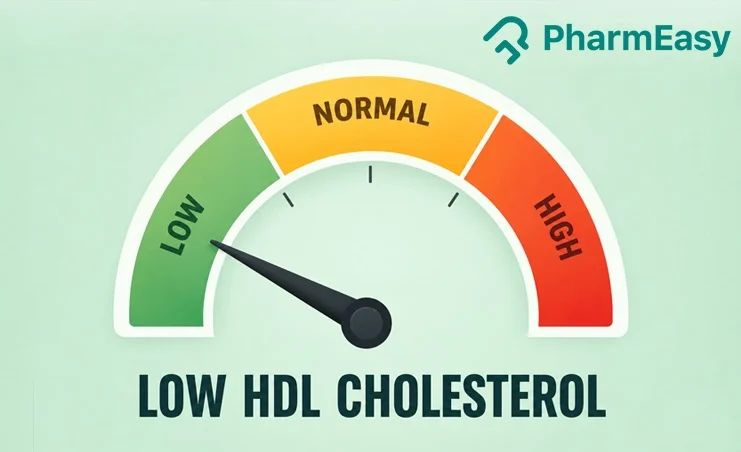
In this blog, we will explore what HDL cholesterol low means, its causes, symptoms, risks, and effective ways to increase it naturally and maintain better heart health.
As discussed, cholesterol travels through the bloodstream with the help of lipoproteins. Among these, LDL and HDL are the two main types.
The following table provides the average values for optimal HDL cholesterol levels4.
| Group | Healthy HDL Level | Low HDL Level |
| Men (Age 20 or Older) | Greater than or equal to 60 mg/dL | Less than 40 mg/dL |
| Women (Age 20 or Older) | Greater than or equal to 60 mg/dL | Less than 50 mg/dL |
Note: Results may vary from person to person and should always be interpreted by a doctor.
Low HDL cholesterol means the body is becoming less effective at clearing excess cholesterol from the bloodstream. This can increase the risk of plaque buildup in the arteries, coronary artery disease, heart attack, and stroke5.
Important: Low HDL is considered an independent risk factor for cardiovascular disease5.
HDL cholesterol low usually does not cause noticeable symptoms in most people and is often detected during a routine blood test. However, certain underlying conditions associated with low HDL may show physical signs that can indicate an increased cardiovascular risk.
Some low HDL cholesterol symptoms include6:
The answer to why HDL cholesterol is low can lie in several medical, genetic, and medication-related factors. Certain low HDL cholesterol causes include6:
Some inherited disorders affect cholesterol metabolism and lead to very low HDL levels. These include6:
Note: Certain medications may also contribute to low HDL cholesterol levels, including beta blockers and anabolic steroids.
Many lifestyle factors can affect HDL cholesterol levels in the body. Common risk factors of low HDL cholesterol include6:
Low HDL cholesterol is usually diagnosed through a fasting lipid profile blood test, which measures6:
In some cases, additional tests such as nuclear magnetic resonance (NMR) may be used to measure lipoprotein particle numbers, although these tests are not routinely used.
Doctors may also recommend other investigations to identify underlying causes associated with low HDL cholesterol. These may include6:
Note: Although these signs may occur in some cases, HDL cholesterol low itself is usually ‘silent.’ Regular cholesterol screening is therefore important for early detection and management.
There is currently no specific treatment recommended solely to increase HDL cholesterol levels. Instead, management mainly focuses on reducing overall cardiovascular risk and improving heart health through lifestyle changes.
However, some cholesterol-lowering medications, such as statins, may slightly increase HDL levels while effectively lowering LDL cholesterol. Another medication called niacin might significantly raise HDL cholesterol levels; however, studies have shown limited additional cardiovascular benefit when added to standard statin therapy6.
Important: Do not self-medicate or start any cholesterol-lowering medicines or supplements without consulting a doctor. Proper medical evaluation and guidance are important to determine the underlying cause of low HDL cholesterol and the most appropriate treatment approach.
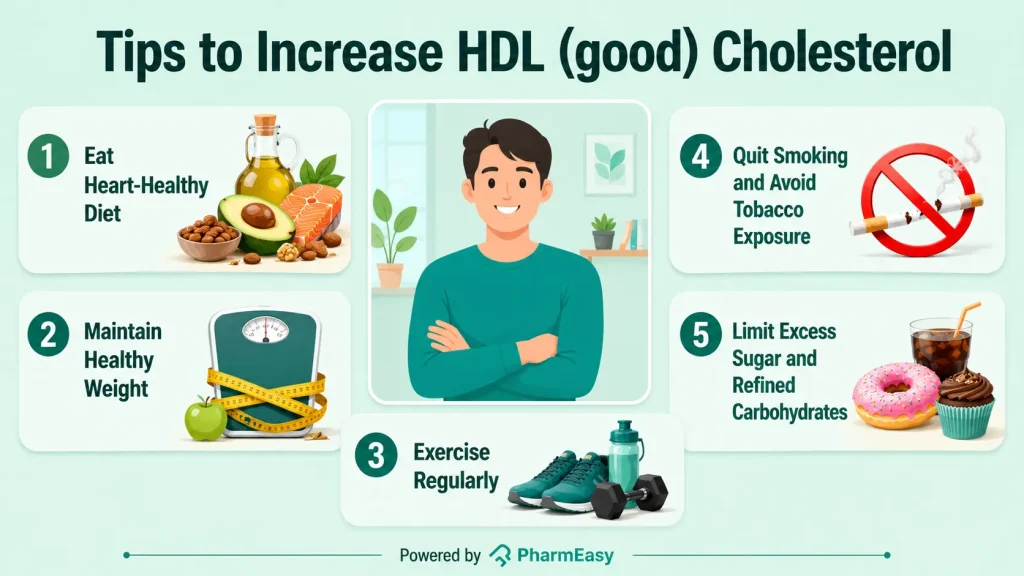
Making healthy lifestyle changes can help improve HDL cholesterol levels and support overall heart health. Some effective ways to increase HDL cholesterol include2:
Choose healthy unsaturated fats over saturated and trans fats. We will discuss more dietary options in the next section.
Losing excess weight (especially around the waist) can help raise HDL cholesterol levels and reduce cardiovascular risk.
Regular physical activity, especially aerobic exercises such as walking, jogging, cycling, or swimming, can help increase HDL cholesterol while lowering LDL (bad) cholesterol. Aim for at least 30 minutes of exercise on most days of the week.
Smoking lowers HDL cholesterol levels and damages blood vessels. Quitting smoking can improve HDL levels and overall heart health.
Reducing sugary foods, sweetened beverages, and refined carbohydrates may help improve HDL cholesterol levels.
Excessive alcohol consumption can contribute to weight gain and negatively affect cholesterol levels. So, alcohol should only be consumed in moderation, if at all.
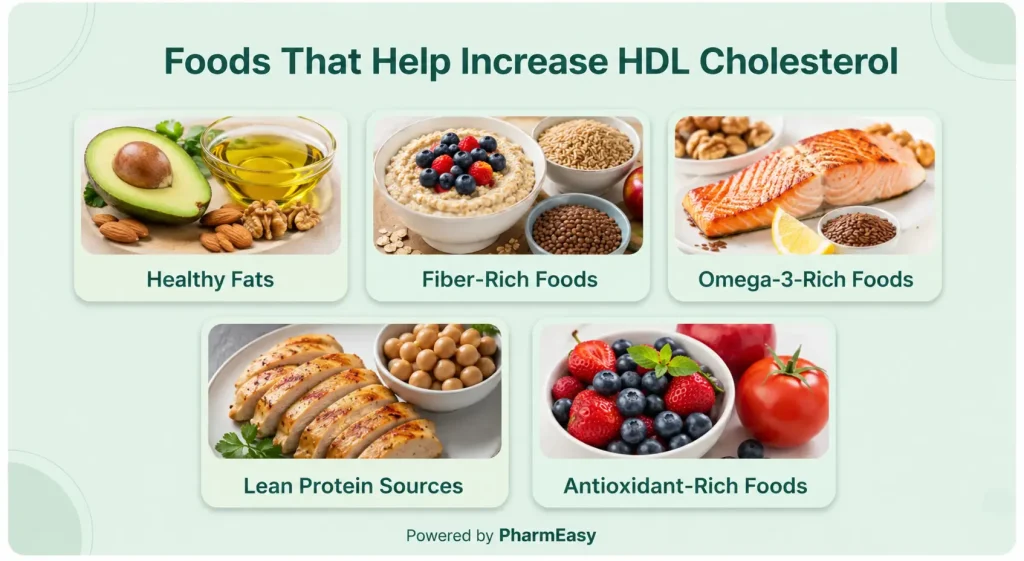
Including heart-healthy foods in your daily diet may help improve HDL cholesterol levels and support overall cardiovascular health. Some beneficial food options include:
At the same time, it is important to limit fried foods, processed snacks, sugary foods, trans fats, and excessive saturated fats, as these may negatively affect cholesterol levels and heart health2.
Low HDL cholesterol can increase the risk of several health complications, particularly those related to heart and blood vessel health. Possible complications include6:
Regular health checkups and lipid profile testing can help detect low HDL cholesterol early and reduce the risk of future heart-related complications. You should consult a doctor if you:
Also Read: High LDL (Bad) Cholesterol: Causes, Symptoms & How to Reduce It
HDL, or good cholesterol, plays an important role in protecting heart health by helping remove excess cholesterol from the bloodstream. Low HDL cholesterol levels may increase the risk of heart disease, stroke, and other metabolic complications, especially when combined with unhealthy lifestyle habits or underlying medical conditions.
Although low HDL often does not cause noticeable symptoms, regular cholesterol screening can help with early detection and management. Further, adopting healthy lifestyle habits such as eating a balanced diet, exercising regularly, maintaining a healthy weight, and avoiding smoking can help improve HDL levels and support overall cardiovascular health.
If you have persistently low HDL cholesterol or other risk factors for heart disease, consult a doctor for proper evaluation, diagnosis, and personalised treatment guidance.
HDL cholesterol usually improves with diet. This may support better HDL levels over time2.
Some drinks, such as green tea, have shown benefits in helping reduce LDL (bad) cholesterol levels, although their effect on raising HDL cholesterol is not very significant10. Thus, focusing on an overall healthy lifestyle, balanced diet, regular exercise, and weight management is more important for improving HDL cholesterol levels and supporting heart health
Yes. Low HDL cholesterol can increase the risk of plaque buildup in the arteries, heart disease, stroke, and other cardiovascular complications, especially when combined with high LDL cholesterol or other risk factors6.
Improving HDL cholesterol levels depends on lifestyle changes, diet, exercise habits, weight management, and overall health. A doctor can help guide this process based on your individual medical history, risk factors, and test results.
In general, higher HDL (‘good’) cholesterol levels are considered better for heart health because HDL helps remove excess cholesterol from the bloodstream. Low HDL levels may increase the risk of heart disease and stroke3,6. However, cholesterol levels should always be interpreted in the context of your overall health, medical history, and other lipid levels. You should always consult a doctor for proper evaluation and personalised guidance.
Fruits rich in fibre and antioxidants may help support healthy HDL levels. These include apple, grapes, mango, pineapple, watermelon, orange, kiwi, pomegranate, avocado, and papaya, as part of a balanced, heart-healthy diet11.
1. Huff T, Boyd B, Jialal I. Physiology, Cholesterol. In: StatPearls. StatPearls Publishing; 2026. Accessed May 19, 2026. http://www.ncbi.nlm.nih.gov/books/NBK470561/
2. HDL: The “Good” Cholesterol. Accessed May 19, 2026. https://medlineplus.gov/hdlthegoodcholesterol.html
3. CDC. LDL and HDL Cholesterol and Triglycerides. Cholesterol. March 13, 2026. Accessed May 19, 2026. https://www.cdc.gov/cholesterol/about/ldl-and-hdl-cholesterol-and-triglycerides.html
4. Cholesterol Levels: What You Need to Know. Accessed May 19, 2026. https://medlineplus.gov/cholesterollevelswhatyouneedtoknow.html
5. Rezkalla SH, MD RAK. Low HDL—The Challenge. Clin Med Res. 2025;23(2):60-66. doi:10.3121/cmr.2025.1970 https://pubmed.ncbi.nlm.nih.gov/40813253/
6. Van Name JP, Sharma S. Low HDL Cholesterol(Archived). In: StatPearls. StatPearls Publishing; 2026. Accessed May 19, 2026. http://www.ncbi.nlm.nih.gov/books/NBK560749/
7. Liu AG, Ford NA, Hu FB, Zelman KM, Mozaffarian D, Kris-Etherton PM. A healthy approach to dietary fats: understanding the science and taking action to reduce consumer confusion. Nutr J. 2017;16:53. doi:10.1186/s12937-017-0271-4 https://pubmed.ncbi.nlm.nih.gov/28854932/
8. Richter CK, Skulas-Ray AC, Champagne CM, Kris-Etherton PM. Plant Protein and Animal Proteins: Do They Differentially Affect Cardiovascular Disease Risk?12. Adv Nutr. 2015;6(6):712-728. doi:10.3945/an.115.009654 https://pmc.ncbi.nlm.nih.gov/articles/PMC4642426/
9. Rahaman MdM, Hossain R, Herrera‐Bravo J, et al. Natural antioxidants from some fruits, seeds, foods, natural products, and associated health benefits: An update. Food Sci Nutr. 2023;11(4):1657-1670. doi:10.1002/fsn3.3217 https://pmc.ncbi.nlm.nih.gov/articles/PMC10084981/
10. Hartley L, Flowers N, Holmes J, et al. Green and black tea for the primary prevention of cardiovascular disease. Cochrane Database Syst Rev. 2013;2013(6):CD009934. doi:10.1002/14651858.CD009934.pub2 https://pubmed.ncbi.nlm.nih.gov/23780706/
11. Zuraini NZA, Sekar M, Wu YS, et al. Promising Nutritional Fruits Against Cardiovascular Diseases: An Overview of Experimental Evidence and Understanding Their Mechanisms of Action. Vasc Health Risk Manag. 2021;17:739-769. doi:10.2147/VHRM.S328096 https://pubmed.ncbi.nlm.nih.gov/34858028/
Disclaimer: The information provided here is for educational/awareness purposes only and is not intended to be a substitute for medical treatment by a healthcare professional and should not be relied upon to diagnose or treat any medical condition. The reader should consult a registered medical practitioner to determine the appropriateness of the information and before consuming any medication. PharmEasy does not provide any guarantee or warranty (express or implied) regarding the accuracy, adequacy, completeness, legality, reliability or usefulness of the information; and disclaims any liability arising thereof.
Links and product recommendations in the information provided here are advertisements of third-party products available on the website. PharmEasy does not make any representation on the accuracy or suitability of such products/services. Advertisements do not influence the editorial decisions or content. The information in this blog is subject to change without notice. The authors and administrators reserve the right to modify, add, or remove content without notification. It is your responsibility to review this disclaimer regularly for any changes.


Comments

Leave your comment...
You may also like














Comments