Last updated: Aug 27, 2026Published on: Aug 27, 2026
Table of Contents
Introduction
The human body contains various minerals which are essential to maintain a healthy life. These include electrolytes, which are the minerals carrying electrical charges. Electrolytes are important in maintaining the body’s water balance and nutrient levels, and in balancing acid-base levels. Chloride is one of the electrolytes that is involved in the major functions of the body. Chloride imbalances can be reflected as too high chloride (hyperchloremia) or too low chloride (hypochloraemia). These imbalances can lead to fatigue, vomiting or symptoms of dehydration, which might affect some daily activities. The blog will cover what hyperchloremia is, its causes, symptoms, diagnosis, treatment, and measures needed to take for a healthy chloride level balance.
What Is Hyperchloremia?
Hyperchloremia is a state in which serum chloride levels are found to be higher than the normal reference range at the laboratory where the test is done. The kidneys are the main organ which are involved in the regulation of chloride levels in the blood1. Hyperchloremia can be seen associated with some kidney diseases, dehydration or some conditions in which there are increased levels of acids in the blood (metabolic acidosis)2. Symptoms of metabolic acidosis might be hard to notice and can include nausea, vomiting, confusion and increased heartbeat3.
Advertisement
Did You Know?
For chloride, adequate intakes (AI) values are used, which is the amount of chloride that can provide enough nutrition. AI values can vary from children to adults. For adults in the age group of 14-50 and for pregnant and breastfeeding women, it is 2.3 g/day; in the age group of 51-70, it is 2.0 g/day, and for people aged 71 and more, it is 1.8 g/day4.
Hyperchloremia occurs in about 25% to 45% of patients who are critically ill. The levels usually spike with first 24 hours and are mostly associated with aggressive fluid resuscitation5.
An increase in chloride levels is found to be associated with the increased risk of mortality in patients admitted to ICU6. Hyperchloremia can thus be a beneficial prognostic marker in such cases.
What Is the Normal Chloride Range?
Interpretation of chloride levels is as mentioned below7:
Serum Chloride Levels
Value
Normal range
96-106 mmol/L
Hyperchloremia
>106 mmol/L
Hypochloraemia
<96 mmol/L
The normal range of chloride levels in blood is 96-106 mmol/L however, slight variations are expected based on the laboratory conducting the test.
Causes of Hyperchloremia
Hyperchloremia can be pseudo hyperchloremia or true hyperchloremia. When some other components, such as bromide or iodide, are high in blood, it can give rise to pseudo hyperchloremia. These give the impression of excessive chloride even though there is no actual rise of chloride1.
True hyperchloremia is caused by the actual rise of chlorides in blood, which is caused by:
Water Loss: Net water loss can happen as a result of fever, limited water intake, excessive sweating and excess fluid loss in conditions like diabetes insipidus1.
Loss of water and electrolytes: Severe diarrhoea or vomiting, increased urination due to some substances (osmotic diuresis) and after relief of a urinary obstruction (post-obstructive diuresis) can lead to excessive loss of water along with some electrolytes1.
Rapid infusion of normal saline: When normal saline is given rapidly, excess chlorides from the saline can increase the concentration of chlorides in the blood. It can lead to increased acids in the blood (hyperchloremic acidosis)8.
Volume resuscitation: In critically ill patients, replacing the lost fluids (volume resuscitation) may induce increased chloride levels in blood and thereby hyperchloremic acidosis8.
Reduced renal function: Kidneys are the major organ taking part in the maintenance of electrolytes in the blood either by absorption or secretion. Several kidney diseases can affect the normal excretion of chlorides that happens in the kidneys, which can contribute to the increased level of chlorides in the blood7. It can include diseases causing damage to tubules in kidneys (interstitial nephritis) or acute kidney injury.
Metabolic acidosis: In normal conditions, in the blood there is a balance between chloride and sodium. In conditions where too much acid appears in the blood or there is excessive loss of bicarbonate, such as diabetic ketoacidosis, hyperparathyroidism (increased parathyroid hormone), severe dehydration and renal tubular acidosis, this balance is disrupted. To regain the balance, the kidneys start reabsorbing chloride causing hyperchloremia1.
Respiratory Alkalosis: In individuals showing faster or deeper breaths(hyperventilation), as in pregnancy, any lung infections, or anxiety, chloride levels are increased along with a reduced bicarbonate concentration9.
Medicines: Certain medicines such as carbonic anhydrase inhibitors can change the levels of certain electrolytes in the blood, which can lead to hyperchloremia and later to increased acid levels (metabolic acidosis)1.
Symptoms of Hyperchloremia
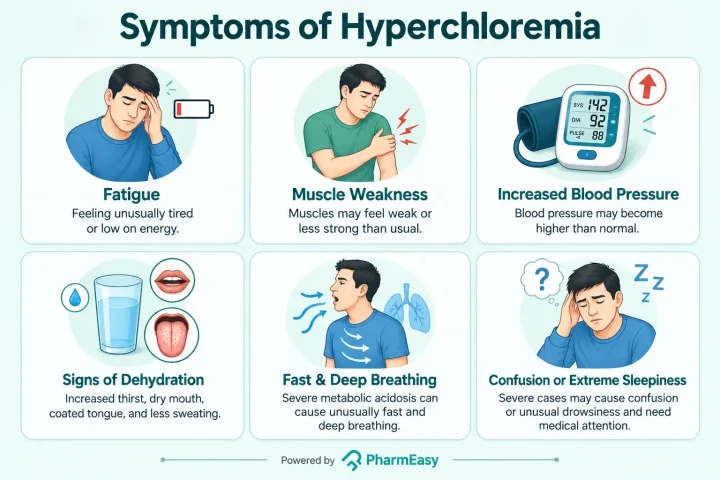
Mild isolated hyperchloremia has no specific symptoms. Symptoms generally arise from dehydration, metabolic acidosis or underlying illness. Hyperchloremia symptoms can include:
Signs of dehydration such as increased thirst, dry moist linings (mucous membranes), coated tongue and reduced sweating9.
Significant metabolic acidosis can cause rapid and deep breathing, confusion or lethargy which requires medical attention11.
Who Is at Risk of Hyperchloremia?
Certain categories of people are more likely to develop hyperchloremia due to some underlying medical conditions. The risk factors/categories associated with hyperchloremia include:
Kidney-related disorders: In patients who have interstitial nephritis, a condition called renal tubular acidosis can result, in which tubules of the kidneys fail to maintain the acid-base balance in the body, which might increase the risk for hyperchloremic metabolic acidosis9.
In electrolyte disturbances: People who are more prone to show electrolyte disturbances due to excessive saline intake at an increased risk of developing hyperchloremia7.
People with underlying conditions: In certain non-kidney conditions also like diabetes mellites, diabetes insipidus or adrenal insufficiency, an imbalance of electrolytes might be seen, which can increase the risk for hyperchloremia1,7.
Patients taking some medicines: Some patients who are taking medicines such as carbonic anhydrase inhibitors for their individualised concerns are more prone to develop hyperchloremia7. Patients who are undergoing chemotherapy might face dehydration from diarrhoea or vomiting, which can lead to electrolyte imbalances and hyperchloremic metabolic acidosis12. Patients who are receiving intravenous administration of normal saline as a part of fluid replacement are at an increased risk for developing hyperchloremia7.
How Is Hyperchloremia Diagnosed?
If any symptoms of fluid or electrolyte imbalances are seen, checking chloride levels may be advised by your doctor. Tests for assessing the chloride status include:
Measurement of serum chloride: The first and most common method to get the serum chloride status is by a blood test. A serum chloride test can be done separately or as a part of a complete electrolyte panel including other electrolytes like sodium, potassium, magnesium, bicarbonate etc. This can contribute to finding any conditions linked with the imbalance of fluids or acid levels in the body2,13.
Analysis of blood gas: Acid-base balance in the body can be assessed by arterial blood gas (ABG) analysis. Here, chloride levels are checked along with some other blood gas parameters. It can give an idea about the status of electrolytes in the body, and thereby the patient’s status can be assessed7.
Chloride levels in urine: Chloride levels in urine are valuable in distinguishing the reason behind chloride imbalances in blood, whether it is caused by any kidney-related issues or non-kidney-related issues. This test is also helpful in finding the normal functioning of kidneys, including the absorption and excretion of electrolytes. A proper understanding of the underlying cause of chloride level imbalances can help in providing the appropriate treatment for the patient7.
Kidney Function Tests: Kidney function tests are helpful in assessing the kidney function. If hyperchloremia occurs without any obvious cause, this test can be done to check for underlying kidney issues that may leading to fluid and electrolyte imbalances14.
Treatment of Hyperchloremia
Hyperchloremia treatment depends on the hyperchloremia causes behind the electrolyte imbalances in the body. It is based on treating the cause rather than the chloride number. Your doctor will decide your treatment based on your underlying medical conditions and current needs, which may include:
Managing dehydration: Dehydration management is based on replacing lost electrolytes and addressing the underlying cause. For mild to moderate cases, oral rehydration therapy (ORT) is advised. If dehydration is a result of diarrhoea or vomiting, medicines targeting these can be taken15. If dehydration is caused by poor intake of water, an adequate amount of water intake is needed to manage the chloride levels16.
Adjusting IV fluids: In patients on IV fluids, adjusting levels can help in managing the imbalances. Balanced crystalloids or colloids are preferred in specific situations compared to normal saline because of their composition of physiologically balanced contents7.
Changing medications: Certain medicines such as diuretics (water pills) need to be adjusted to replenish the electrolytes that are lost through urine15. In people who are taking chemotherapy, they should switch to medicines which induce fewer side effects related to diarrhoea and vomiting12.
Managing the underlying conditions: Managing underlying conditions such as kidney issues or other causes of metabolic acidosis and hyperchloremia can help in managing the chloride imbalance7.
Bicarbonate therapy: Bicarbonate therapy may be beneficial in some cases of hyperchloremic metabolic acidosis cases. However, more clinical evidences are needed to evaluate in which specific situations bicarbonate can be effective17.
Balanced Diet: A balanced diet with limited salt intake along with an individualised fluid intake is recommended. WHO recommends that adults should consume less than 5g salt/day18.
Possible Complications of Untreated Hyperchloremia
Complications related to hyperchloremia can affect various other systems in the body, which can impact the normal physiological mechanisms in the body. The complications can include:
Kidney-related: Hyperchloremia leads to narrowing of the blood vessels in the kidneys and reduces the filtering capacity (glomerular filtration rate) of the kidneys8. It can also affect the normal functioning of kidney comprising absorption and excretion of some electrolytes7.
Stomach-related: Increased acid levels as a result of hyperchloremia (hyperchloremic acidosis) can lead to less blood flow to the stomach (reduced gastric perfusion) which might lead to reduced oxygen supply to the tissues and complications like ulcers8.
Heart-related: Hyperchloremia can lead to fluid retention causing oedema and high blood pressure. This can overload the heart, leading to decreased pumping action (less cardiac output) and impairment in heart muscle contractions, also decreasing blood flow to the smaller vessels7.
Neurological: Metabolic acidosis due to hyperchloremia can manifest as confusion and lethargy. In severe cases, seizures or coma can be associated7.
Liver: In people with cirrhosis (end-stage of liver disease), buildup of fluids can occur4.
Untreated hyperchloremic metabolic acidosis can be dangerous to your health. Very severe cases of metabolic acidosis can lead to shock and death.
Tips to Maintain Healthy Chloride Levels
Following healthy habits can help in managing chloride levels in the body, which can be contributed by dietary modifications, maintaining adequate hydration and adjusting medicines that might cause imbalances.
Dietary Management: The foods containing chloride are:
Foods containing chloride: Seaweed, celery, tomatoes, lettuce and olives are considered foods with a higher amount of chloride4.
Fruits: Fruits such as apples, melons, berries and bananas are found to be high in chloride19.
Processed foods: Hot dogs, cheese, ready-to-eat processed meats and potato chips are sodium-processed and contain high chloride levels10.
Condiments: Soy sauce, ketchup and Worcestershire sauce are found to be high in sodium and chloride10.
Chloride is found in various foods. It is also found in salts. Balanced intake of salt and chloride-containing foods are recommended to maintain healthy chloride levels.
Avoiding Dehydration: Inadequate water intake, fever and increased ambient room temperature can put you at an increased risk for dehydration. Managing these can help in avoiding dehydration that causes chloride level imbalances9.
Adjusting Medications: Switching to alternatives in individuals taking medicines such as carbonic anhydrase inhibitors, chemotherapy etc which induce hyperchloremia can be helpful in avoiding chloride imbalances in the body. However, these need to be adjusted only under medical supervision.
Managing Underlying Conditions: Controlling underlying medical conditions, such as diabetes, hyperparathyroidism, and kidney diseases can help prevent hyperchloremia occurring due to these factors9.
When Should You Consult a Doctor?
You need to consult a doctor if any symptoms of acid or fluid imbalances are present, which include prolonged vomiting, difficulty breathing, signs of weakness, tiredness, dehydration, and loose stools2.
Emergency medical visits are needed for signs of difficulty in breathing or severe dehydration. Untreated metabolic acidosis might lead to shock or death11.
Conclusion
Hyperchloremia is the condition in which there is too much chloride in the blood. It can lead to symptoms including fatigue and increased blood pressure. However, untreated hyperchloremia can affect major functions of organs such as the heart, liver, and kidney. Assessment of chloride as a part of routine checkup is recommended if you are at risk of hyperchloremia. Testing promptly if any symptoms are noted help in early diagnosis and proper management of chloride imbalances.
A chloride blood test which is done separately or as a part of an electrolyte panel (that tests for electrolytes such as chloride, sodium, potassium and bicarbonates in the blood) can help detect chloride levels in the blood2.
Is hyperchloremia dangerous?
Untreated hyperchloremia can lead to major complications which can adversely affect the normal functioning of some organs in the body. It can include impaired kidney function, reduced blood pumping effects of the heart and confusion, coma and seizures related to the brain and nervous system7.
Does drinking water lower chloride levels?
Dehydration can lead to hyperchloremia in which case consuming enough water may help flush out excess chlorine. However, inf high chlorine levels are due to an underlying condition, drinking water alone might not reverse the condition. A proper assessment of the contribution of other factors, such as the presence of kidney disease or intake of any medicines needed to be done1.
Can dehydration cause high chloride levels?
Dehydration associated with inadequate water intake, diarrhoea, vomiting, excessive urination linked with diabetes (diabetes insipidus) or due to some substances (osmotic diuresis) can lead to high chloride levels in the blood1.
Zhou D, Li T, Zhao D, et al. Increase in chloride from baseline is independently associated with mortality in intracerebral hemorrhage patients admitted to intensive care unit: A retrospective study. J Intensive Med. 2022;2(4):274-281. doi:10.1016/j.jointm.2022.04.002. https://pubmed.ncbi.nlm.nih.gov/36788937/
Sagar N, Lohiya S. A Comprehensive Review of Chloride Management in Critically Ill Patients. Cureus. 16(3):e55625. doi:10.7759/cureus.55625. https://pubmed.ncbi.nlm.nih.gov/38586759/
Verzicco I, Regolisti G, Quaini F, et al. Electrolyte Disorders Induced by Antineoplastic Drugs. Front Oncol. 2020;10:779. doi:10.3389/fonc.2020.00779. https://pubmed.ncbi.nlm.nih.gov/32509580/
Nagami GT. Managing Patients with Hyperchloremia. Clin J Am Soc Nephrol CJASN. 2025;20(12):1818-1820. doi:10.2215/CJN.0000000806. https://pubmed.ncbi.nlm.nih.gov/40587230/
Tong L, Wu S, Li D, Cao Y, Liu H. Hyperchloremic metabolic acidosis potentially benefiting sodium bicarbonate therapy: A multi-center cohort study. Eur J Intern Med. 2025;132:67-75. doi:10.1016/j.ejim.2024.10.001. https://pubmed.ncbi.nlm.nih.gov/39395843/
Raut SK, Singh K, Sanghvi S, et al. Chloride ions in health and disease. Biosci Rep. 2024;44(5):BSR20240029. doi:10.1042/BSR20240029. https://pubmed.ncbi.nlm.nih.gov/38573803/
Disclaimer: The information provided here is for educational/awareness purposes only and is not intended to be a substitute for medical treatment by a healthcare professional and should not be relied upon to diagnose or treat any medical condition. The reader should consult a registered medical practitioner to determine the appropriateness of the information and before consuming any medication. PharmEasy does not provide any guarantee or warranty (express or implied) regarding the accuracy, adequacy, completeness, legality, reliability or usefulness of the information; and disclaims any liability arising thereof.
Links and product recommendations in the informationprovided here are advertisements of third-party products available on the website. PharmEasy does not make any representation on the accuracy or suitability of such products/services. Advertisements do not influence the editorial decisions or content. The information in this blog is subject to change without notice. The authors and administrators reserve the right to modify, add, or remove content without notification. It is your responsibility to review this disclaimer regularly for any changes.








































Comments