




A Complete Guide to Baby Vaccination: Schedule, Common Concerns & More
By Dr. Sarthak Soni +2 more

Medically reviewed by Dr. Sarthak Soni
Last updated: Sep 8, 2026 Published on: Jul 14, 2026


Get,

to manage your symptom
Get your,

4 Cr+ families
benefitted

OTP sent to 9988776655



You’ve successfully subscribed to receive
doctor-approved tips on
Whatsapp

Get ready to feel your best.


Register to Avail the Offer
Send OTPBy continuing, you agree with our Privacy Policy and Terms and Conditions
Hi There,
Sign up on PharmEasy now!!


Trusted by 4 crore+ families

OTP sent to 9988776655
You have unlocked 25% off on medicines


Code: NU25

By Dr. Sarthak Soni +2 more
Table of Contents
Baby vaccination is one of the most important steps in protecting infants from serious infections. Our immune system is underdeveloped at birth, and it evolves through a lifetime of environmental exposures from childhood through adulthood, until it eventually weakens in old age1. Therefore, during the first few years of life, a baby is vulnerable to infections. Immediately after birth, paediatricians recommend a baby vaccine schedule that helps build immunity as the baby grows, reducing the risk of infections during the early years.
Despite the many benefits of baby vaccination, some parents still question their safety, necessity to follow a specific schedule, and aftereffects. These concerns are common and understandable.

This article provides a comprehensive overview of baby vaccination, including the baby vaccine schedule and common parental concerns.
Babies are prone to infection from the time they are born. Though they receive antibodies from their mother during childbirth and through breast milk, these wane off in some months, giving them protection only for the first few months2. This is where the role of vaccines emerges.
Baby vaccination is important because it:
Baby vaccination is a safe and effective way to protect babies from infections before they are naturally exposed to them. Vaccines contain killed or weakened forms of viruses or bacteria, which are enough to make the body respond by producing antibodies against these viruses or bacteria, but they do not cause the infection itself or its complications5. Once exposed, the body remembers the pathogen and is fully prepared to fight off future infections. This helps the body’s natural defences build resistance to specific infections and strengthens the immune system5.
This early protection is especially important because some infections can cause serious complications before a baby has the chance to develop strong natural immunity. Vaccination helps the immune system recognise specific pathogens in advance, so the body can respond faster and more effectively if the child is exposed later. Vaccinations in the first years of a baby’s life offer protection against diseases like polio, whooping cough, measles and diphtheria. Following a scheduled vaccination chart for recommended doses also leads to protection against almost 30 diseases, including Human papillomavirus vaccine (HPV) and rotavirus6.
Timely immunisation also reduces the chance of disease spreading within families and communities, helping protect newborns, children with weakened immune systems, and others who may not be able to receive certain vaccines. In the first few months of life, a baby receives some passive protection through antibodies passed from their mother during pregnancy and through breast milk. This holds because if a mother is vaccinated during pregnancy for a disease, then the baby gets passive immunity. However, this wears off in a few months following their birth, and they must get vaccinated again so that they remain healthy7.
Universally recommended vaccines like Hepatitis B, Bacillus Calmette-Guerin (BCG), and diphtheria-pertussis-tetanus vaccines have been embraced by all countries. The WHO also enlists these vaccinations under the Essential Programme on Immunization8. However, some vaccinations are also based on how common a particular disease is in that country/region. For example, in countries where yellow fever and malaria are common, vaccines against these diseases are recommended8.
Here is a simple baby vaccination chart given as per the Indian Academy of Paediatrics (IAP)9 based on commonly recommended immunisation timing.
| Age | Vaccine name | What it helps to protect |
| At birth3 | BCG Oral Polio Vaccine (OPV) Hepatitis B | Tuberculosis Paralysis by polio virus Hepatitis B |
| 6 weeks | Hexavalent-1 (DTwP/DTaP-1, IPV-1, Hib-1, Hep B-2) Rotavirus Vaccine (RVV)-1 Pneumococcal Conjugate Vaccine (PCV)-1 | Diphtheria, Pertussis, Tetanus, Polio, Hepatitis B and Haemophilus influenzae type b (Hib) Rotavirus Septicaemia, meningitis, pneumonia and mild infections such as otitis media and sinusitis |
| 10 weeks | Hexavalent-2 RVV-2 PCV-2 | Diphtheria, Pertussis, Tetanus, Polio, Hepatitis B and Hib; Rotavirus septicaemia, meningitis, pneumonia and mild infections such as otitis media and sinusitis |
| 14 weeks | Hexavalent-3 RVV-3 PCV-3 | Diphtheria, Pertussis, Tetanus, Polio, Hepatitis B and Hib; Rotavirus septicaemia, meningitis, pneumonia and mild infections such as otitis media and sinusitis |
| 6 months | Influenza (IIV)-1 | Influenza |
| 7 months | Influenza (IIV)-2 | Influenza |
| 6-9 months | Typhoid Conjugate Vaccine (no booster dose) | Typhoid fever |
| 9 months | 1.MMR-1 | Measles, mumps and rubella |
| 12 months | Hepatitis A Vaccine | Hepatitis A infection |
| 15 months | MMR-2 Varicella-1 PCV-booster | Measles, mumps and rubella; chickenpox; septicaemia, meningitis, pneumonia and mild infections such as otitis media and sinusitis |
| 16-18 months | Pentavalent (DTwP/DTaP-B1, Hib-B1, IPV-B1P) (Booster doses) | Diphtheria, pertussis, tetanus, influenza and polio |
| 18-19 months | Hepatitis A-2 (only for inactivated hepatitis A vaccine) Varicella-2 | Hepatitis A Chickenpox |
| 4-6 years | DPT – 2nd booster dose IPV-2 2nd booster dose MMR-3 | Diphtheria, pertussis, tetanus, measles, mumps, and rubella |
| 9-15 years | HPV | Cancer and genital warts |
| 10 years | Tdap | Tetanus, diphtheria, and pertussis |
| 15-18 years | HPV | Cancer and genital warts |
| 16 years | Td/Tdap | Tetanus, diphtheria, and pertussis |
| Annual | Flu Vaccine | Influenza |
It is recommended that babies 6 months and older get a flu vaccine every year. Flu is more hazardous than a cold and can lead to serious health conditions. Generally, two doses are recommended10.
Some vaccines require more than one dose. These are usually given in a scheduled pattern spaced across months. The vaccines that are given multiple times are known as the primary series, in which the first dose starts the protection, while the second and third doses help to strengthen and maintain the immunity11.
Booster doses are important, since the effect of the initial vaccine might wane. Thus, booster doses help reinforce immunity and maintain protection against infections11.
Here is a list of vaccines for babies commonly included in early childhood immunisation, and what each one is used for3,4:
Vaccines are administered according to a recommended schedule over time. If a baby misses a scheduled dose, there is usually no need to restart the entire vaccine series. Also, parents should not panic and instead should seek advice from a doctor on how to administer the missed doses. Usually, the remaining doses are given according to a catch-up vaccination schedule, allowing the baby to continue from where they left off and receive the recommended protection as soon as possible12.
A catch-up vaccination schedule helps a paediatrician to safely bring the baby’s immunisations up to date. Vaccinations may be delayed for various reasons, such as missed appointments, vaccine shortages, changes in vaccination recommendations, or temporary medical conditions12.
Every country should have catch-up vaccination policies and schedules in place to help children safely receive missed vaccines, as per WHO recommendations. For instance, if a child misses out on a Hepatitis B vaccine, then they can still complete their vaccination schedule. In Hepatitis, three doses are given: dose 1 at the first visit, dose 2 after 1 month of the first dose, and dose 3 after 6 months of the first dose. If by chance a baby misses out on any of the doses, they can receive the missed dose as per the catch-up schedule without starting over13.
However, this is not true in case a baby has never received a vaccine. In this case, a delayed vaccine has to be administered. When a vaccine is delayed, it leaves children unprotected against diseases. If a measles or pertussis vaccine is delayed, it leads to an increased risk of these infections14.
Some vaccines are also given up to a certain age, like the rotavirus vaccine. If a baby is given a delayed shot of this vaccine, then they may not be protected well against this disease and are at a higher risk of acquiring infection14.
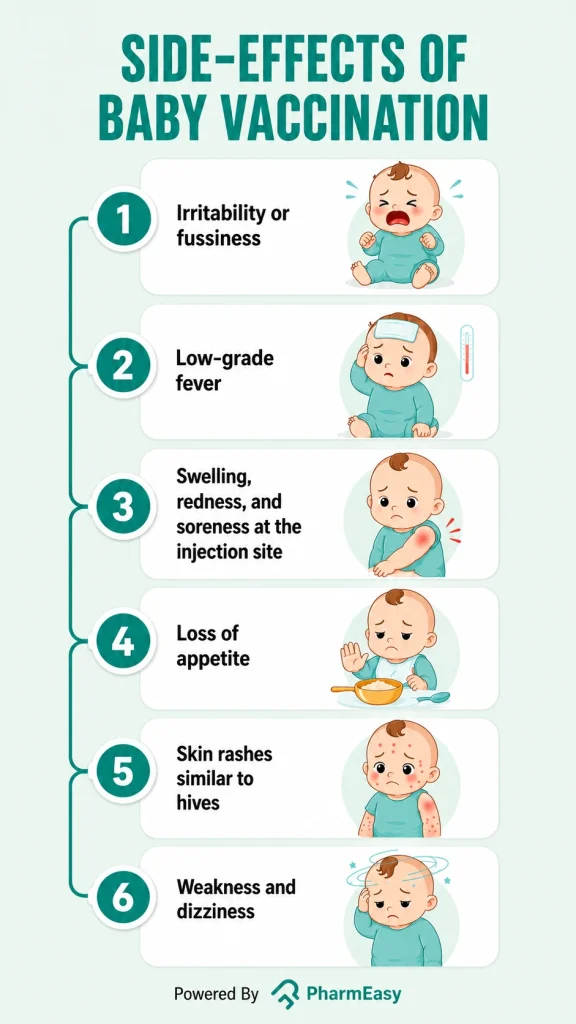
Like any other medication, vaccines can also cause side effects. However, the side effects from vaccination are mostly mild and resolve within a few days. In many cases, these reactions are a sign that your baby’s immune system is responding to the vaccine and building protection against the disease.
Common side effects include15:
In very rare cases, a serious allergic reaction such as swelling of the face and throat may take place.
The following are some common myths about baby vaccination:
1. Myth: Babies should develop immunity by getting the disease rather than through vaccination.
Fact: Vaccines help the immune system build protection in a way similar to natural infection but without causing the disease or exposing babies to its potentially severe complications. As a result, vaccination provides safe and effective immunity while reducing the risk of serious illness, hospitalisation, and death16.
2. Myth: A child can get the disease from a vaccine.
Fact: Most vaccines contain inactivated (killed) germs or only parts of the germ, making it impossible for them to cause the disease. Some vaccines contain weakened live organisms, which may occasionally cause mild symptoms. These mild reactions are generally harmless and indicate that the immune system is responding to the vaccine16.
3. Myth: Vaccines contain toxic chemicals that make them unsafe.
Fact: Vaccines contain carefully selected ingredients in very small amounts to ensure they are safe and effective. Thimerosal, a mercury-containing preservative, was previously used in some multi-dose vaccine vials to prevent contamination. However, it is no longer used in routine childhood vaccines in many countries. Other ingredients, such as aluminium and formaldehyde, are present only in small amounts well below the described safety limits. All vaccine ingredients undergo rigorous testing to ensure they are safe for children16.
4. Myth: A child does not need to get vaccinated if other children around have been vaccinated.
Fact: When a community is vaccinated, it helps in herd immunity against contagious diseases, thus lowering their spread. This type of vaccination is particularly important for people who cannot get vaccinated, such as pregnant women, people with low immunity, and infants. If many people choose not to get vaccinated and depend only on herd immunity, then with time the community protection will disappear16.
5. Myth: Children in our community are safe from eradicated diseases because they no longer pose a threat to our local community.
Fact: Vaccine-preventable diseases have become less common but have not been eradicated. Vaccine immunisation can never be 100%. There is always a chance of a community getting an outbreak of a disease17.
6. Myth: Giving multiple vaccines to a child at a time can strain a child’s immune system. It could also lead to side effects.
Fact: Multiple vaccines at the same time help reduce time, money, and repeated clinic visits. These also help reduce the discomfort that a child may face after every vaccination, while ensuring that the child receives the recommended vaccination as per the schedule17.
Parents should speak to a paediatrician before or after their baby’s vaccination if they have any concerns. Here are some conditions that may need a doctor’s advice before a vaccine is given18:
Parents must monitor their vaccinated baby for at least one day. Some of the signs to look out for after vaccination and seek immediate consultation include19:
Baby vaccination is a proven, routine way to protect infants from serious disease. Following the recommended baby vaccine schedule gives babies the best chance for early protection.
Also Read: Breaking Down the Baby’s Growth Stages | 0-5 Years
The best time for baby vaccination is to follow the immunisation schedule. The most critical period is the first 12 to 18 months, as babies are prone to illness and are still building their immune systems. Seek your doctor’s advice on the vaccination schedule20.
You can sometimes delay a baby’s vaccination for a few days due to a minor illness; however, intentionally delaying a vaccine is discouraged. Babies have developing immune systems, making them more vulnerable to infections than adults. Vaccines help by training the immune system to recognise and fight disease-causing germs, providing protection when children need it most18.
Vaccines are essential for babies because their immune systems are still developing and they cannot fight serious diseases. Timely vaccinations build protection against diseases like measles, pertussis, polio, and diphtheria20.
Dress your baby in soft, loose-fitting, and comfortable clothing after vaccination. This allows you to inspect the injection spot19.
Yes, some babies may sleep more than usual after vaccination. Studies have found that infants often sleep longer during the first 24 hours after immunisation, particularly if they develop a mild fever. This is a normal response as the immune system builds protection and usually resolves on its own within a day or two21.
Before your baby’s vaccination, review the information provided by your doctor, carry your child’s vaccination record, and note down any questions you may have. Dress your baby in comfortable clothing and bring a favourite toy or blanket to help keep them calm during the appointment22,23.
Disclaimer: The information provided here is for educational/awareness purposes only and is not intended to be a substitute for medical treatment by a healthcare professional and should not be relied upon to diagnose or treat any medical condition. The reader should consult a registered medical practitioner to determine the appropriateness of the information and before consuming any medication. PharmEasy does not provide any guarantee or warranty (express or implied) regarding the accuracy, adequacy, completeness, legality, reliability or usefulness of the information; and disclaims any liability arising thereof.
Links and product recommendations in the information provided here are advertisements of third-party products available on the website. PharmEasy does not make any representation on the accuracy or suitability of such products/services. Advertisements do not influence the editorial decisions or content. The information in this blog is subject to change without notice. The authors and administrators reserve the right to modify, add, or remove content without notification. It is your responsibility to review this disclaimer regularly for any changes.
 1
1 
Comments

Leave your comment...
You may also like
























Comments