




Adrenal Tumor: Symptoms, Causes, Diagnosis and Treatment
By Dr. Akash N. Shah +2 more

Medically reviewed by Dr. Akash N. Shah
Last updated: Oct 13, 2026 Published on: Oct 13, 2026


Get,

to manage your symptom
Get your,

4 Cr+ families
benefitted

OTP sent to 9988776655



You’ve successfully subscribed to receive
doctor-approved tips on
Whatsapp

Get ready to feel your best.


Register to Avail the Offer
Send OTPBy continuing, you agree with our Privacy Policy and Terms and Conditions
Hi There,
Sign up on PharmEasy now!!


Trusted by 4 crore+ families

OTP sent to 9988776655
You have unlocked 25% off on medicines


Code: NU25

By Dr. Akash N. Shah +2 more
Table of Contents
An adrenal tumor is any abnormal growth that develops in one of the two adrenal glands. These tumors can be benign (non-cancerous) or cancerous. Additionally, some may produce excess hormones, while others may not1.
In this blog, we will discuss the symptoms, causes, diagnosis, and management options for adrenal tumors.
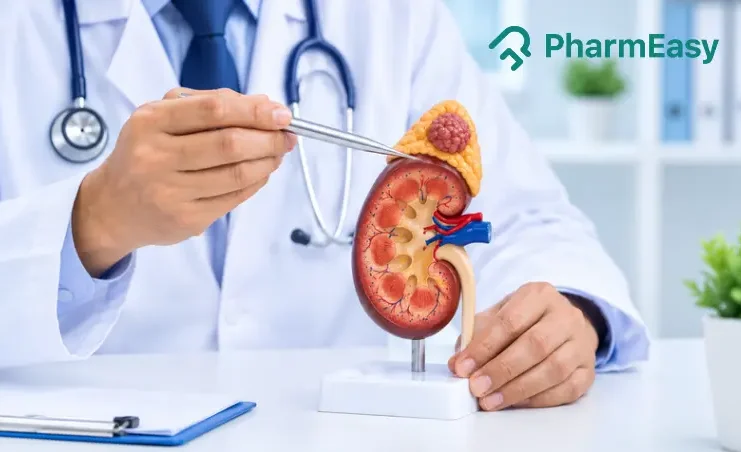
Adrenal glands are small glands located above both your kidneys. They produce hormones that regulate several important functions, including blood pressure, metabolism, and the body’s salt and water balance, and also help the body respond to stress2.
An adrenal tumor develops when cells in an adrenal gland grow abnormally. Most adrenal gland tumors detected incidentally on an abdominal scan are benign, but a small number might be cancerous or hormone producing tumor3.
Adrenal gland tumors can develop from different types of cells and include3,4,5:
The terms adrenal tumor and adrenal cancer are related, but it is important to understand that they do not mean the same thing. The table below will help you understand the difference better.
| Feature | Adrenal Tumor | Adrenal Cancer |
| Meaning | Abnormal growth in an adrenal gland that may be benign or malignant1,3 | A malignant tumor that develops in the adrenal gland1 |
| Cancerous? | Not always | Always |
| Risk of spreading | Benign tumors do not spread to other parts of the body6 | Cancer can invade nearby tissues and may spread to other organs6 |
Note: All adrenal cancers are adrenal tumors, but not all adrenal tumors are adrenal cancers. It is very important to keep in mind that the term adrenal tumor simply means an abnormal growth of the adrenal gland and does not automatically indicate adrenal gland cancer.
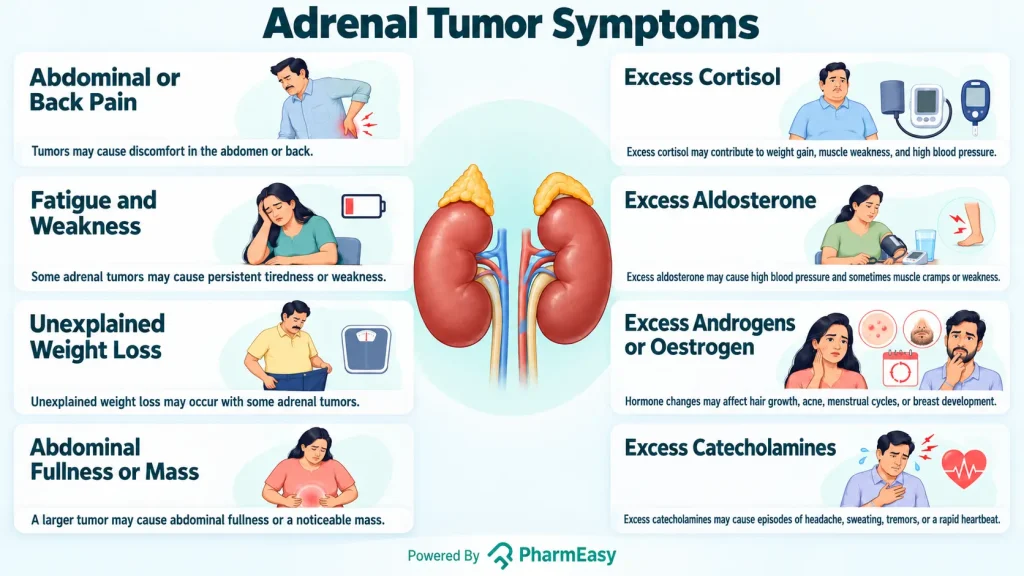
Most adrenal tumors do not cause symptoms, especially when they are small and do not produce an excess of any hormones. Adrenal tumor symptoms may include5,7:
Some tumors may produce excess hormones, which can cause additional adrenal tumor symptoms:
Adrenal gland tumor causes are not always known. These tumors develop when cells in the adrenal gland grow and divide abnormally. In some cases, genetic changes or inherited conditions may increase the risk of developing certain adrenal tumors1.
Some inherited conditions associated with some adrenal tumors include4,5,10:
However, having one of these conditions does not mean that a person will definitely develop an adrenal tumor. You should keep in mind that most adrenal tumors develop without a clearly identifiable adrenal gland tumor cause.
Adrenal tumors can develop in anyone, and most people who develop them do not have a known risk factor. However, certain factors may increase the risk of developing some types of adrenal tumors:
For most adrenal masses, no specific modifiable risk factor is known. Risk depends largely on the tumour type, age and, in some cases, inherited genetic conditions.
Adrenal tumors are often found incidentally during imaging tests done for another health problem11. When an adrenal tumor is suspected, doctors may use the following tests for an adrenal tumor diagnosis:
Based on the results of these tests, the doctor can determine whether the tumor is benign or cancerous and whether it is producing excess hormones. This helps them to make a proper adrenal tumor diagnosis and help guide the treatment plan.
The management of an adrenal gland tumor depends on its type, size, whether it produces hormones, and whether it causes symptoms. Some tumors may only need monitoring, while others may require treatment. Adrenal gland tumor treatment/management options include:

Small, benign tumors and not causing any hormone excess may not require immediate treatment13. Your doctor may recommend regular imaging tests and hormone tests to monitor the tumor and subsequently decide if any active treatment is to be initiated.

Medicines may be used to control excess hormone production and manage symptoms, particularly in hormone-producing tumors such as pheochromocytoma. Often the medications are used for patient preparation, optimisation of health status , before subjecting to any surgical procedure4.

If the adrenal tumor is found to be cancerous, after considering several aspects, radiation therapy, chemotherapy, or other cancer treatments may be recommended. Your doctor will decide this based on the type and stage of the cancer1,5.

Surgery to remove the tumor or the affected adrenal gland (adrenalectomy) may be recommended if the tumor is large, produces excess hormones, causes symptoms, or has features that raise concern for cancer14.
Also Read: Neuroendocrine Tumours (NETs): Symptoms, Causes, Stages, Diagnosis and Treatment
There is no established way to prevent most adrenal tumours. Most arise without an identifiable cause. People with certain inherited conditions may benefit from genetic counselling and condition-specific surveillance.
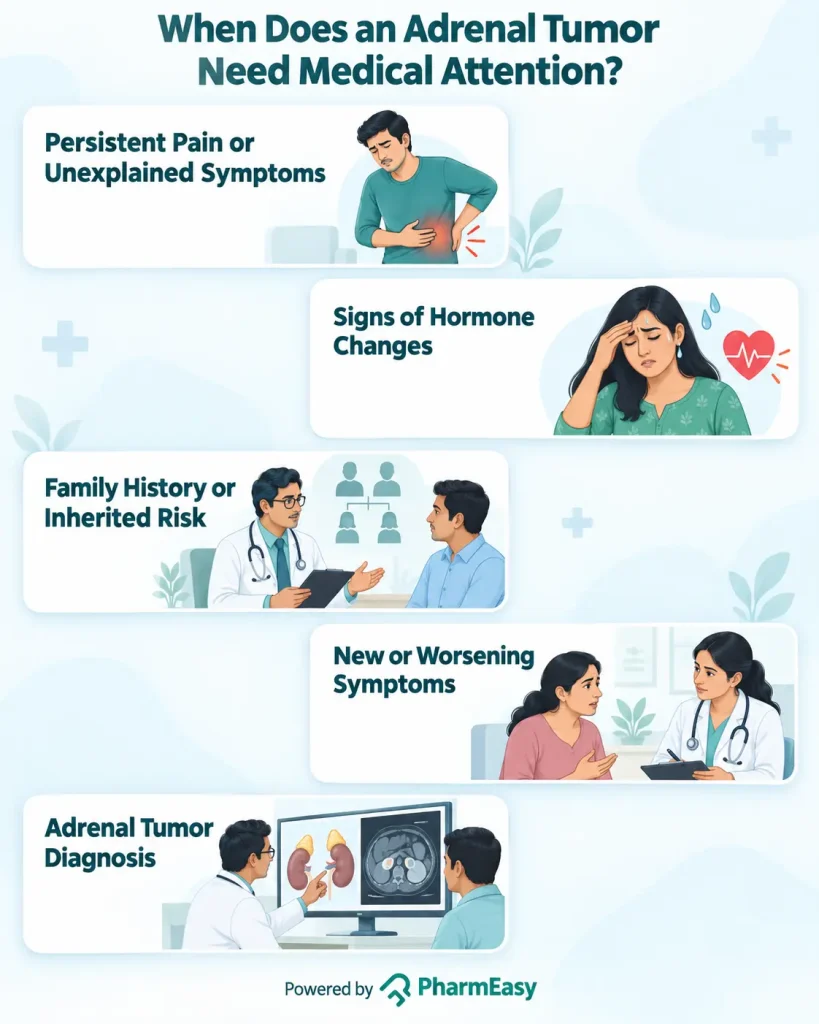
You should see a doctor if you:
Most adrenal tumors are not cancerous and may not need treatment if they are small and do not produce hormones. However, some tumors can cause hormone-related symptoms or require treatment based on their size and type. In such cases, early diagnosis and timely medical care can help ensure the right treatment and improve outcomes.
If you have persistent symptoms or have been diagnosed with an adrenal tumor, follow your doctor’s advice for evaluation and regular follow-up.
The seriousness of an adrenal tumor depends on its type, size, hormone production, and whether it is cancerous. Therefore, if you have any concerning symptoms, you should check with a doctor.
If both adrenal glands are removed or do not work properly, you may be able to live a normal life with the help of lifelong hormone replacement medicines15. However, the decision should only be made in consultation with a doctor. A person on such hormone replacement therapy, may need to learn about self dose adjustments during acute illnesses.
Stress does not cause adrenal tumors. Most adrenal tumors develop for reasons that are not clearly known1. However, stress may worsen some symptoms caused by hormone-producing tumors8.
An adrenal tumor can be benign (non-cancerous) or malignant (cancerous). Most adrenal tumors are benign3.
1. Menon G, Prasath S, Correa R. Adrenocortical Carcinoma. StatPearls. Accessed September 1, 2026. http://www.ncbi.nlm.nih.gov/books/NBK546580/
2. Dutt M, Wehrle CJ, Jialal I. Physiology, Adrenal Gland. StatPearls. Accessed September 1, 2026. http://www.ncbi.nlm.nih.gov/books/NBK537260/
3. Adrenal Gland Cancer. MedlinePlus. Accessed September 1, 2026. https://medlineplus.gov/adrenalglandcancer.html
4. Gupta PK, Marwaha B. Pheochromocytoma. StatPearls. Accessed September 1, 2026. http://www.ncbi.nlm.nih.gov/books/NBK589700/
5. Guild A, Allison J, Karsonovich T, Mahapatra S, Challagundla KB. Neuroblastoma. StatPearls. Accessed September 1, 2026. http://www.ncbi.nlm.nih.gov/books/NBK448111/
6. Benign and malignant tumours. Cancer Research UK. Accessed September 1, 2026. https://www.cancerresearchuk.org/about-cancer/what-is-cancer/how-cancer-start-grow-spread/how-cancers-grow
7. Kerkhofs TM, Roumen RM, Demeyere TB, van der Linden AN, Haak HR. Adrenal Tumors with Unexpected Outcome: A Review of the Literature. Int J Endocrinol. 2015;2015:710514. doi:10.1155/2015/710514 https://pubmed.ncbi.nlm.nih.gov/25883649/
8. Symptoms of Adrenocortical Carcinoma. NCI. February 19, 2026. Accessed September 1, 2026. https://www.cancer.gov/types/adrenocortical/symptoms
9. What are the symptoms of adrenal gland disorders? National Institute of Child Health and Human Development. January 31, 2017. Accessed September 1, 2026. https://www.nichd.nih.gov/health/topics/adrenalgland/conditioninfo/symptoms
10. Adrenal Cancer Risk Factors. American Cancer Society. Accessed September 1, 2026. https://www.cancer.org/cancer/types/adrenal-cancer/causes-risks-prevention/risk-factors.html
11. Papierska L, Cichocki A, Sankowski AJ, Cwikła JB. Adrenal incidentaloma imaging – the first steps in therapeutic management. Pol J Radiol. 2013;78(4):47-55. doi:10.12659/PJR.889541 https://pubmed.ncbi.nlm.nih.gov/24505223/
12. Kerkhofs TM, Roumen RM, Demeyere TB, van der Linden AN, Haak HR. Adrenal Tumors with Unexpected Outcome: A Review of the Literature. Int J Endocrinol. 2015;2015:710514. doi:10.1155/2015/710514 https://pubmed.ncbi.nlm.nih.gov/25883649/
13. Benign Tumors. MedlinePlus. Accessed September 1, 2026. https://medlineplus.gov/benigntumors.html
14. Dogrul AB, Cennet O, Dincer AH. Minimally invasive techniques in benign and malignant adrenal tumors. World J Clin Cases. 2022;10(35):12812-12821. doi:10.12998/wjcc.v10.i35.12812 https://pmc.ncbi.nlm.nih.gov/articles/PMC9782958/
15. Li AY, Dream S. Adrenalectomy. StatPearls. Accessed September 1, 2026. http://www.ncbi.nlm.nih.gov/books/NBK559093/
Disclaimer: The information provided here is for educational/awareness purposes only and is not intended to be a substitute for medical treatment by a healthcare professional and should not be relied upon to diagnose or treat any medical condition. The reader should consult a registered medical practitioner to determine the appropriateness of the information and before consuming any medication. PharmEasy does not provide any guarantee or warranty (express or implied) regarding the accuracy, adequacy, completeness, legality, reliability or usefulness of the information; and disclaims any liability arising thereof.
Links and product recommendations in the information provided here are advertisements of third-party products available on the website. PharmEasy does not make any representation on the accuracy or suitability of such products/services. Advertisements do not influence the editorial decisions or content. The information in this blog is subject to change without notice. The authors and administrators reserve the right to modify, add, or remove content without notification. It is your responsibility to review this disclaimer regularly for any changes.


Comments

Leave your comment...
You may also like
























Comments