



Starting a GLP-1 Medicine: A Simple Guide for Patients
By Dr. Nisha Dahiya +2 more

Medically reviewed by Dr. Nisha Dahiya
Last updated: Sep 29, 2026 Published on: Sep 29, 2026


Get,

to manage your symptom
Get your,

4 Cr+ families
benefitted

OTP sent to 9988776655



You’ve successfully subscribed to receive
doctor-approved tips on
Whatsapp

Get ready to feel your best.


Register to Avail the Offer
Send OTPBy continuing, you agree with our Privacy Policy and Terms and Conditions
Hi There,
Sign up on PharmEasy now!!


Trusted by 4 crore+ families

OTP sent to 9988776655
You have unlocked 25% off on medicines


Code: NU25

By Dr. Nisha Dahiya +2 more
Table of Contents
Starting a new medicine can bring up a few questions, especially when you are not sure what to expect. If you’ve been prescribed a medicine that belongs to the class of GLP-1 RA or GLP and GIP dual RA , this guide is for you.
In here, we will explain how GLP-1 RA containing medicines work, what you may notice during the first few weeks, their common side effects, important safety information, and simple ways to support your treatment.


Answer a few quick questions to check eligibility.
Your response has been submitted.
Our team will contact you shortly.
GLP-1 medications are prescription drugs that mimic the action of the hormone called glucagon-like peptide-1, produced by the gut. This hormone helps decrease appetite, increases the feeling of fullness after eating, and also plays a role in regulating blood sugar levels1.
GLP-1 analogue medicines are prescribed by doctors along with diet and exercise to improve blood sugar control. Some are also used to reduce the risk of adverse cardiovascular events (like stroke and heart attack) and for weight loss in people with obesity1,2. The available drugs include Ozempic and Wegovy (semaglutide), Mounjaro and Zepbound (tirzepatide), etc1.
GLP-1 drugs help turn down your appetite signal. They slow down the movement of food through the stomach, making you feel full for a longer time, and help your body secrete insulin when blood sugar is high1,2. Since digestion and appetite are altered, nausea, bloating or changes in bowel habits can also be among the most common side effects after starting the treatment2,3.
Take GLP-1 medicines exactly as prescribed by your doctor. Do not increase, reduce, or change the timing of your dose without medical advice, even if you feel the medicine is working too slowly or you experience side effects.
GLP-1 treatment typically starts at a low dose and increases gradually. This process called titration, allows the body to get used to the new drug and helps reduce the gastrointestinal side effects. Gradually escalating the dose minimises the harsh side-effects the patient has to deal with and allows for better long-term compliance.
The exact schedule depends on the medicine you have been prescribed and your individual treatment plan. Do not copy another person’s dosing schedule or make changes based on advice found online.
During the first few weeks of treatment, you may experience gastrointestinal side effects as your body adjusts to the medicine. You may also find that you feel nauseous, bloated, constipated, or have diarrhoea4.
These side effects may settle as your body adapts to the medicine and do not necessarily mean that there is anything wrong4. GLP-1 medicines work gradually, so their effects may become more noticeable over time rather than immediately.
If these side effects are persistent, or get worse, it is important to consult your doctor, who can decide if you need any changes in your treatment plan4.
Some people experience their digestion issues returning after increasing the dose. These usually goes away when the body gets used to the medication2,3. But if you feel the symptoms are too severe or they continue for a long time, contact your doctor2. Never self-adjust your dose.
Your doctor may decide to keep you on a dose for longer, adjust the pace of dose change or recommend other ways to manage symptoms. The effect can be different for everyone. It depends on which medication you get, how big the dose is, what other medication you take and your general condition4.
Most common side effects are linked to how these medicines affect appetite and digestion. Because GLP-1 medicines slow stomach emptying and can change how much you eat, digestive symptoms are particularly common, especially when treatment starts or the dose increases2,3.
These include:
These side effects are common with GLP-1 medicines, but you do not have to simply live with them. Talk to your doctor if they bother you, as they may suggest ways to manage them7.

Tell your doctor about side effects rather than trying to manage them silently. Your doctor may:
Most people can use these medicines safely when they are prescribed and monitored appropriately. However, there are some situations you should inform your doctor about before and during treatment.
Tell your doctor if you are pregnant, planning a pregnancy or think you may be pregnant. GLP-1 medicines should not be used during pregnancy or while trying to become pregnant. If you are planning a pregnancy, ask your doctor when you should stop your medicine, as the timing can vary between medicines. Usually doctors stop the medicines 2-3 months before allowing you to plan a pregnancy.
Use reliable contraception while taking a GLP-1 medicine. If you take semaglutide or tirzepatide medicines and use the contraceptive pill, you may need extra protection, such as condoms, for 4 weeks after starting treatment and after each dose increase, as this GLP-1 medicine can interfere with the effectiveness of the contraceptive pill9.
According to some animal studies, tirzepatide is known to pose a risk to the unborn child3. Therefore, it’s important to ask your doctor which contraceptive advice is right for you when you are using GLP-1 medicines.
GLP-1 medicines usually do not cause low blood sugar on their own. However, the risk can increase when they are taken with insulin or sulfonylureas, so your doctor may adjust your other diabetes medicines2,5.
Symptoms of low blood sugar may include:
Tell your doctor if you have low blood sugar episodes. Avoid skipping meals, monitor your blood sugar levels regularly and follow your doctor’s instructions.
GLP-1 medicines are generally not prescribed by doctors to people who have:
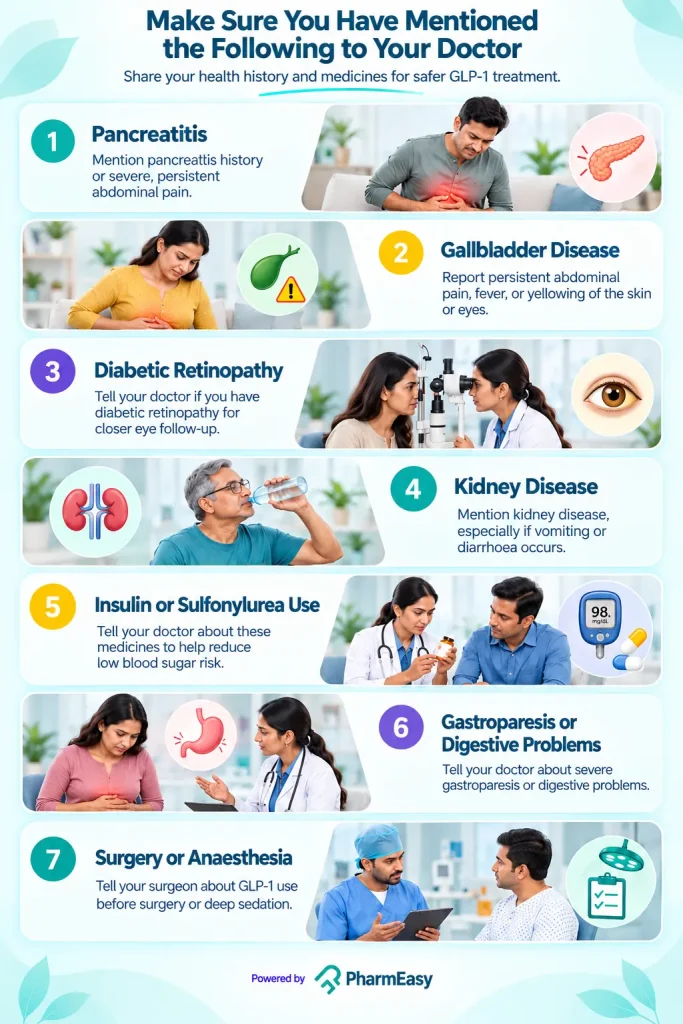
You should inform your doctor everything about your health because in certain cases, some extra monitoring may be needed with GLP-1 medications. These include:
The following are some serious side effects that should not be ignored, although they are rare. Contact your doctor immediately and get emergency medical care if you experience:
If any of these symptoms occur, contact your doctor straight away so they can take the next steps.
Starting a GLP-1 medicine is not a one-time decision. Your doctor may want to check how you are responding, whether side effects are manageable and whether your dose needs to change.
Depending on your health and the reason you are taking the medicine, your doctor and care team may monitor things such as:
Follow your regular appointments and tell your doctor about any changes or new symptoms. Do not change your treatment or try to figure out what’s causing the symptoms by yourselves. Your doctor can review your symptoms and decide what is best for you based on your health and the medicine you take.

GLP-1 medicines are usually prescribed alongside healthy diet and regular physical activity2. Since these medicines can reduce your appetite, it’s important to focus on getting enough nutritious food rather than simply eating less.
The following can help you with your diet during medication use:
There is no need to copy someone else’s “GLP-1 diet”. Your doctor might recommend food choices based on your medical conditions and dietary needs.
Moving your body is crucial during the treatment period. The following are some tips on how to stay physically active:
Also Read: How to Stay Consistent With GLP-1 Medication: Tips, Challenges, Benefits & Long-Term Success
Starting a GLP-1 medicine can feel like a big change, but you do not have to figure everything out on your own. Mild digestive symptoms and changes in appetite can occur as your body adjusts, but regular follow-ups help your doctor manage your dose and monitor your health. If you have questions or notice something that concerns you, contact your doctor or healthcare team rather than relying on internet searches, changing your dose yourself or ignoring symptoms.
Try eating smaller meals slowly and drinking enough fluids. If nausea is severe, persistent, or affects your ability to eat or drink, contact your doctor, they can help manage nausea with some medicines4.
No, do not change or stop your dose without speaking with your doctor. Your doctor can adjust the dose or treatment schedule safely if needed4.
Tell your doctor about your medical conditions, allergies and all medicines or supplements you take. Also mention if you are pregnant, planning to get pregnant, or have had problems with your stomach, kidneys, gallbladder, retina or pancreas. Mention family history of thyroid cancer2,3.
1. GLP-1 agonists. MedlinePlus. 2026. Available from: https://medlineplus.gov/ency/article/007853.htm
2. Ozempic. 2026. Available from: https://www.accessdata.fda.gov/drugsatfda_docs/label/2026/209637s038lbl.pdf
3. Mounjaro. 2026. Available from: https://www.accessdata.fda.gov/drugsatfda_docs/label/2026/215866s009lbl.pdf
4. Gorgojo-Martínez JJ, Mezquita-Raya P, Carretero-Gómez J, et al. Clinical recommendations to manage gastrointestinal adverse events in patients treated with GLP-1 receptor agonists: A multidisciplinary expert consensus. J Clin Med. 2022;12(1):145. doi:10.3390/jcm12010145 https://pubmed.ncbi.nlm.nih.gov/36614945/
5. Filippatos TD, Panagiotopoulou TV, Elisaf MS. Adverse effects of GLP-1 receptor agonists. Rev Diabet Stud. 2014;11(3):202-230. doi:10.1900/RDS.2014.11.202 https://pubmed.ncbi.nlm.nih.gov/26177483/
6. Wegovy. 2023. Available from: https://www.accessdata.fda.gov/drugsatfda_docs/label/2023/215256Orig1s006lbl.pdf
7. GLP-1 receptor agonists: reminder of the potential side effects and to be aware of the potential for misuse. GOV.UK. 2024. Available from: https://www.gov.uk/drug-safety-update/glp-1-receptor-agonists-reminder-of-the-potential-side-effects-and-to-be-aware-of-the-potential-for-misuse?
8. Dobbie LJ, Parretti HM, Fallows E, et al. Ten top tips for the management of GLP-1 receptor agonists in adults within primary care. Obes Facts. 2025;18(6):535-540. doi:10.1159/000546472 https://pubmed.ncbi.nlm.nih.gov/40388902/
9. GLP-1 medicines for weight loss and diabetes: what you need to know. GOV.UK. 2026. Available from: https://www.gov.uk/government/publications/glp-1-medicines-for-weight-loss-and-diabetes-what-you-need-to-know/glp-1-medicines-for-weight-loss-and-diabetes-what-you-need-to-know
10. GLP-1 and dual GIP/GLP-1 receptor agonists: potential risk of pulmonary aspiration during general anaesthesia or deep sedation – GOV.UK. 2025. Available from: https://www.gov.uk/drug-safety-update/glp-1-and-dual-gip-slash-glp-1-receptor-agonists-potential-risk-of-pulmonary-aspiration-during-general-anaesthesia-or-deep-sedation
11. Mozaffarian D, Agarwal M, Aggarwal M, et al. Nutritional priorities to support GLP-1 therapy for obesity: A joint advisory from the American College of Lifestyle Medicine, the American Society for Nutrition, the Obesity Medicine Association, and the Obesity Society. Obes Pillars. 2025;15:100181. doi:10.1016/j.obpill.2025.100181 https://pubmed.ncbi.nlm.nih.gov/40445127/
12. Codella R, Senesi P, Luzi L. GLP-1 agonists and exercise: The future of lifestyle prioritization. Front Clin Diabetes Healthc. 6:1720794. doi:10.3389/fcdhc.2025.1720794 https://pubmed.ncbi.nlm.nih.gov/41367404/
13. Mulcahy J, DeLaRosby A, Norwood T. Transforming Care: Implications of Glucagon Like Peptide-1 Receptor Agonists on Physical Therapist Practice. Phys Ther. 2025 Jun 2;105(6):pzaf061. doi: 10.1093/ptj/pzaf061. PMID: 40305684; PMCID: PMC12203058. https://pubmed.ncbi.nlm.nih.gov/40305684/
Disclaimer: The information provided here is for educational/awareness purposes only and is not intended to be a substitute for medical treatment by a healthcare professional and should not be relied upon to diagnose or treat any medical condition. The reader should consult a registered medical practitioner to determine the appropriateness of the information and before consuming any medication. PharmEasy does not provide any guarantee or warranty (express or implied) regarding the accuracy, adequacy, completeness, legality, reliability or usefulness of the information; and disclaims any liability arising thereof.
Links and product recommendations in the information provided here are advertisements of third-party products available on the website. PharmEasy does not make any representation on the accuracy or suitability of such products/services. Advertisements do not influence the editorial decisions or content. The information in this blog is subject to change without notice. The authors and administrators reserve the right to modify, add, or remove content without notification. It is your responsibility to review this disclaimer regularly for any changes.


Comments

Leave your comment...
You may also like





















Comments