



Generic Medicine Quality In India: Who Regulates It And How To Spot Fakes
By Dr. Ambika Dashrathrao Mamde +2 more

Medically reviewed by Dr. Ambika Dashrathrao Mamde
Last updated: Aug 28, 2026 Published on: Aug 28, 2026


Get,

to manage your symptom
Get your,

4 Cr+ families
benefitted

OTP sent to 9988776655



You’ve successfully subscribed to receive
doctor-approved tips on
Whatsapp

Get ready to feel your best.


Register to Avail the Offer
Send OTPBy continuing, you agree with our Privacy Policy and Terms and Conditions
Hi There,
Sign up on PharmEasy now!!


Trusted by 4 crore+ families

OTP sent to 9988776655
You have unlocked 25% off on medicines


Code: NU25

By Dr. Ambika Dashrathrao Mamde +2 more
Table of Contents
Fake or substandard medicines can seriously affect patient safety. They may not treat the illness properly, may cause unexpected side effects, and may delay recovery. They can also reduce public trust in generic medicines, even though approved generic medicines are expected to meet required quality standards. Knowing how medicines are checked and how to look for warning signs can help patients choose medicines more safely.
This article explains what generic medicines are, how medicine quality is regulated in India, why fake or substandard medicines may enter the market, and how patients can reduce the risk of buying unsafe products.

Generic medicines are medicines that contain the same active ingredient, strength, dosage form, route of administration, safety, and effectiveness as their corresponding branded medicines. They are developed to provide the same therapeutic benefits as the original branded medicine while generally costing less.
Although generic medicines must meet the same quality and performance standards, they may differ from branded medicines in inactive ingredients, such as colour, flavour, or certain preservatives. These differences generally do not affect how the medicine works, provided the generic medicine meets the required regulatory standards1.
India regulates medicines through both central and state drug control authorities. The Central Drugs Standard Control Organisation (CDSCO) sets national drug standards, approves new drugs and clinical trials, checks the quality of imported medicines, and works with state drug control authorities. State authorities handle much of the licensing, inspection, market sampling, testing, and enforcement within their states2,3.
Fake or substandard medicines may appear in the market for several reasons, including poor manufacturing practices, illegal activity, weak or inconsistent enforcement, medicine shortages, and high demand4. These problems can make it harder for patients to receive medicines that are safe, effective, and genuine.
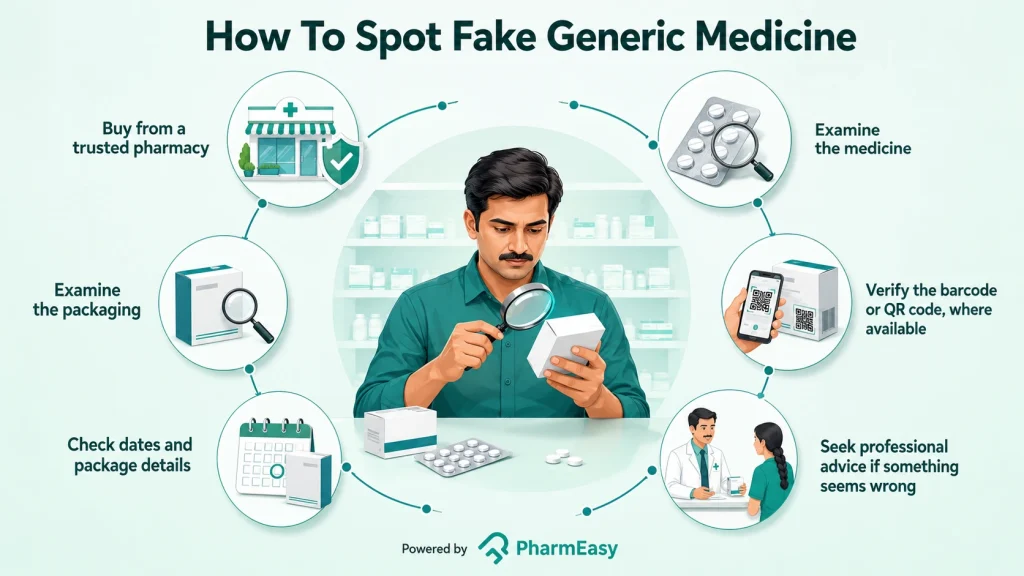
A simple visual check can help you notice possible warning signs, but it cannot prove that a medicine is genuine. Use the following steps to reduce risk and seek professional advice if anything seems unusual:
Patients should buy generic medicines from recognised government-supported outlets or licensed pharmacies whenever possible. Keeping the purchase invoice can help if you later need to check the batch number, expiry date, or source of the medicine.
The Government of India’s Pradhan Mantri Bhartiya Janaushadhi Pariyojana (PMBJP) provides generic medicines through dedicated Jan Aushadhi Kendras. The scheme states that medicines are procured from WHO GMP-certified manufacturers, and each batch is tested at NABL-accredited laboratories before supply7.
Also Read: Jan Aushadhi Yojana: The Complete Guide to India’s Generic Medicine Scheme
Government pharmacy guidance recommends obtaining medicines from authorised suppliers and checking that the medicine name, batch number and expiry date match the invoice8.
Online medicine platforms like PharmEasy may help patients order medicines through registered third-party retail pharmacies. Patients should still check whether a valid prescription is required, review the invoice, and confirm that the medicine received matches the order details9.
The verification process at PharmEasy involves the following checks to help ensure the quality of generic medicines9:
If you suspect that a medicine may be fake or substandard, do not ignore the concern. Speak with your doctor or pharmacist, keep the packaging and invoice, and avoid using the medicine until you receive appropriate advice.
The following checks may help you collect useful information:
Also Read: How to Find Generic Medicine: A Complete Guide to Finding Generic Drugs Safely
Generic medicines are a safe and affordable treatment option when they meet required quality standards. Understanding how medicines are regulated, checking the packaging, batch and expiry details, buying from trusted pharmacies, and knowing how to verify suspicious products can help patients make safer choices. When in doubt, seek advice from your pharmacist or doctor rather than relying on a medicine whose quality or authenticity is uncertain.
Yes, generic medicines in India are required to meet the same quality regulatory standards as branded medicines. The Government of India states that medications manufactured in India, whether generic or branded, must comply with the quality standards prescribed under the Drugs and Cosmetics Act, 1940 and Rules, 194510.
You can verify whether a medicine is genuine by checking its barcode or QR code on the packaging and scanning it with a mobile phone. The information displayed after scanning can be used to check the medicine’s authenticity or genuineness6.
A generic medicine generally contains the same active ingredient, dosage form, and route of administration as the corresponding branded medicine. A spurious medicine, in contrast, may be an imitation intended to deceive, be made under another drug’s name, or falsely claim to come from a particular manufacturer11,12.
Yes, online pharmacies can be used, but consumers should choose platforms that operate through licensed or registered pharmacies and follow prescription requirements where applicable. CDSCO’s e-pharmacy framework specifies that e-pharmacy outlets must be registered and that medicines requiring a prescription must be supplied against a prescription from a registered medical practitioner13.
The CDSCO regulates medicines at the national level, while state drug control authorities regulate the manufacture, sale, and distribution of medicines within their respective states. CDSCO also sets drug standards, approves new drugs and clinical trials, checks imported medicines, and coordinates with state drug control authorities2.
1. Generic Drug Facts. FDA. Published online June 2, 2026. Accessed August 12, 2026. https://www.fda.gov/drugs/generic-drugs/generic-drug-facts
2. Functions of CDSCO. Accessed August 12, 2026. https://cdsco.gov.in/opencms/opencms/en/About-us/Functions/
3. Selection of Software Services Provider (SSP) for Digital Transformation of Central Drugs Standard Control Organization, IPC & NIB. Accessed August 12, 2026. https://cdsco.gov.in/opencms/export/sites/CDSCO_WEB/Pdf-documents/EoI_DDRS_CDSCO_2ndnov23.pdf
4. Buckley GJ, Gostin LO, Committee on Understanding the Global Public Health Implications of Substandard F, Health B on G, Medicine I of. Causes of Falsified and Substandard Drugs. In: Countering the Problem of Falsified and Substandard Drugs. National Academies Press (US); 2013. Accessed August 12, 2026. https://www.ncbi.nlm.nih.gov/books/NBK202531/
5. Substandard and falsified medical products: Advice to patients and consumers. Accessed August 12, 2026. https://www.who.int/news-room/questions-and-answers/item/substandard-and-falsified-medical-products-advice-to-patients-and-consumers
6. Guidance-for-Identification-and-Verification-of-Spurious-Drugs-document.pdf. Accessed August 12, 2026. https://cdsco.gov.in/opencms/export/sites/CDSCO_WEB/Pdf-documents/Guidance-for-Identification-and-Verification-of-Spurious-Drugs-document.pdf
7. JANAUSHADHI. Accessed August 12, 2026. https://janaushadhi.gov.in/about-pmbjb
8. Prescription Guidelines Booklet. Accessed August 12, 2026. https://dfda.goa.gov.in/images/uploads/prescription_guidelines_booklet_for_doctors_pharmacists.pdf
9. T&C – India’s most trusted online medicine ordering platform. Accessed August 12, 2026. https://pharmeasy.in/legal/terms-and-conditions
10. Variations in Generic Medicines. Accessed August 12, 2026. https://www.pib.gov.in/PressReleasePage.aspx?PRID=2242926®=3&lang=1
11. Generic Medicines. Accessed August 12, 2026. https://www.pib.gov.in/PressReleasePage.aspx?PRID=1576624®=48&lang=2
12. Sale of Spurious Drugs. Accessed August 12, 2026. https://www.pib.gov.in/PressReleasePage.aspx?PRID=2239582®=1&lang=1
13. Public Notice: Public consultation regarding regulation of sale of drugs in the country. Accessed August 12, 2026. https://cdsco.gov.in/opencms/resources/UploadCDSCOWeb/2018/UploadPublic_NoticesFiles/public_notice16march_76.pdf
Disclaimer: The information provided here is for educational/awareness purposes only and is not intended to be a substitute for medical treatment by a healthcare professional and should not be relied upon to diagnose or treat any medical condition. The reader should consult a registered medical practitioner to determine the appropriateness of the information and before consuming any medication. PharmEasy does not provide any guarantee or warranty (express or implied) regarding the accuracy, adequacy, completeness, legality, reliability or usefulness of the information; and disclaims any liability arising thereof.
Links and product recommendations in the information provided here are advertisements of third-party products available on the website. PharmEasy does not make any representation on the accuracy or suitability of such products/services. Advertisements do not influence the editorial decisions or content. The information in this blog is subject to change without notice. The authors and administrators reserve the right to modify, add, or remove content without notification. It is your responsibility to review this disclaimer regularly for any changes.


Comments

Leave your comment...
You may also like





















Comments