




Skin Cancer: Symptoms, Causes, Diagnosis & Treatment
By Dr. Raina N. Nahar +2 more

Medically reviewed by Dr. Raina N. Nahar
Last updated: Aug 27, 2026 Published on: Aug 27, 2026


Get,

to manage your symptom
Get your,

4 Cr+ families
benefitted

OTP sent to 9988776655



You’ve successfully subscribed to receive
doctor-approved tips on
Whatsapp

Get ready to feel your best.


Register to Avail the Offer
Send OTPBy continuing, you agree with our Privacy Policy and Terms and Conditions
Hi There,
Sign up on PharmEasy now!!


Trusted by 4 crore+ families

OTP sent to 9988776655
You have unlocked 25% off on medicines


Code: NU25

By Dr. Raina N. Nahar +2 more
Table of Contents
Noticing a new mole, a changing spot on your skin, or a sore that does not heal can make you wonder whether it could be skin cancer.
Skin cancer is a broad group of conditions in which cells and tissues in the skin grow abnormally1.
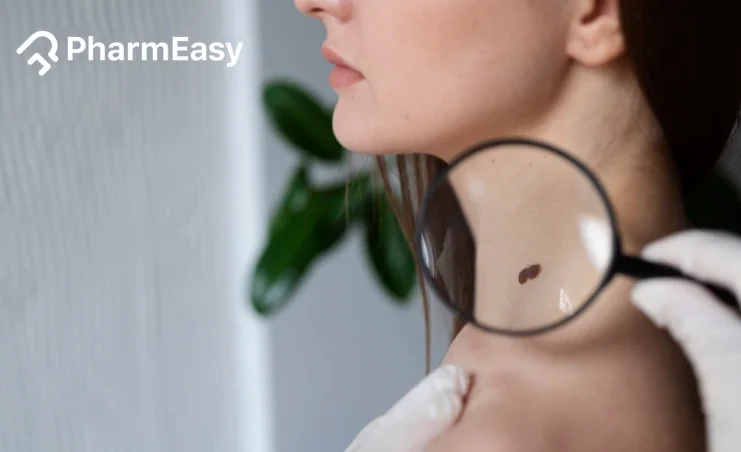
Understanding what is skin cancer, skin cancer types, their symptoms, causes, and risk factors, as well as how they are diagnosed and treated, can help you recognise warning signs and aid in early stage skin cancer. Knowing how to protect your skin and when to seek medical advice can also support early detection and better outcomes.
Skin cancer is a broad group of conditions in which cells and tissues in the skin grow abnormally. A majority of the skin cancer subtypes, such as melanoma, squamous cell carcinoma, and basal cell carcinoma are primarily caused by UV exposure1. Among these, squamous cell cancer and basal cell cancer are the two most prevalent forms. They typically appear on the hands, arms, neck, head, and face. Melanoma is a less prevalent but more serious kind of skin cancer2.
The type of skin cancer depends on which type of skin cells become cancerous4.
A change in the skin is the most common sign of skin cancer. Skin cancer symptoms include5.
Skin cancer develops when abnormal changes in skin cells cause them to grow and multiply uncontrollably, with UV radiation being a major cause of many types of skin cancer1,4. Various skin cancer causes include:
Several factors, such as the following, can increase the risk of developing skin cancer:
Possible complications of skin cancer include1:
Skin cancer is diagnosed by examining suspicious skin changes and, when needed, examining a skin sample under a microscope1.
Treatment depends on the type and stage of skin cancer, the size and location of the tumour, and the person’s overall health8. Skin cancer treatment involves8:
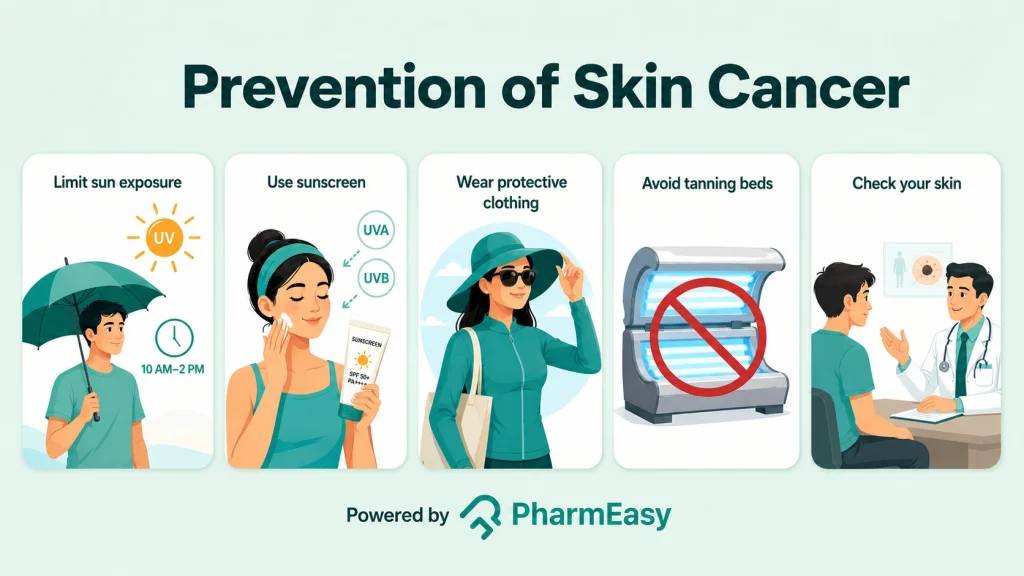
Some of the tips to prevent skin cancer include10:
You should seek medical advice if you notice a new or changing skin lesion, particularly one that looks different from your other moles or if its history is concerning. Early evaluation is important to help detect skin cancer early and prevent complications. If a lesion is suspicious, further evaluation such as dermoscopy or a skin biopsy may be needed1,9.
Also Read: Black Spots on Skin: Causes, Types, Treatment & Prevention
Skin cancer can often be treated successfully when it is diagnosed and treated early. Being familiar with changes in your skin, protecting yourself from UV exposure, and having suspicious or changing spots checked by a dermatologist can support early detection. If you notice a new, changing, or unusual skin lesion, do not ignore it; seek medical advice for appropriate evaluation and treatment.
Most skin cancers, especially basal cell and squamous cell cancers, can usually be cured with appropriate treatment and exhibit good treatment outcomes1.
Early skin cancer may appear as a new or changing skin lesion that looks different from your other moles or spots. It can look like a pink, pearly bump, a pink rough patch, or a brown to black spot with an uneven colour or irregular border1.
Skin cancer can be detected early by having suspicious skin lesions examined by a doctor. A skin examination, dermoscopy, and, when needed, a biopsy can help determine whether a suspicious lesion is skin cancer1.
Yes, many people with skin cancer can have a good treatment outcome when the cancer is detected early, especially with cancers such as basal cell and squamous cell carcinoma1.
Yes, skin cancer can occur at any age, including in children. However, skin cancer is more common in older adults1.
One sunburn does not mean that you will develop skin cancer, but it causes sun related skin damage and increases your risk of skin cancer. Having more sunburns increases this risk further11.
Yes, skin cancer can cause itching in the affected area. It may also cause pain, bleeding, or other discomfort1.
No, skin cancer is not contagious and cannot normally spread from one person to another through everyday contact12.
1. Sathe NC, Zito PM. Skin Cancer. In: StatPearls. StatPearls Publishing; 2026. Accessed August 14, 2026. http://www.ncbi.nlm.nih.gov/books/NBK441949/
2. Skin Cancer. Accessed August 14, 2026. https://medlineplus.gov/skincancer.html
3. Skin Cancer: Facts and Stats. Office of Student Life. January 4, 2023. Accessed August 14, 2026. https://geiselmed.dartmouth.edu/students/student-wellness-resources/sun-safety-and-skin-cancer-prevention/skin-cancer-facts-and-stats/
4. CDC. Skin Cancer Basics. Skin Cancer. July 6, 2026. Accessed August 14, 2026. https://www.cdc.gov/skin-cancer/about/index.html
5. CDC. Symptoms of Skin Cancer. Skin Cancer. July 6, 2026. Accessed August 14, 2026. https://www.cdc.gov/skin-cancer/symptoms/index.html
6. Skin Cancer. Accessed August 14, 2026. https://medschool.cuanschutz.edu/colorado-cancer-center/for-patients-families/cancers-we-treat/skin-cancer
7. CDC. Skin Cancer Risk Factors. Skin Cancer. July 6, 2026. Accessed August 14, 2026. https://www.cdc.gov/skin-cancer/risk-factors/index.html
8. Skin Cancer Treatment – NCI. February 10, 2026. Accessed August 14, 2026. https://www.cancer.gov/types/skin/patient/skin-treatment-pdq
9. Sonthalia S, Yumeen S, Kaliyadan F. Dermoscopy Overview and Extradiagnostic Applications. In: StatPearls. StatPearls Publishing; 2026. Accessed August 21, 2026. http://www.ncbi.nlm.nih.gov/books/NBK537131/
10. Skin Cancer. Harvard Health. February 27, 2023. Accessed August 14, 2026. https://www.health.harvard.edu/topics/skin-cancer
11. CDC. Preventing Sunburn. Skin Cancer. July 6, 2026. Accessed August 21, 2026. https://www.cdc.gov/skin-cancer/prevention/sunburn.html
12. Common Cancer Myths and Misconceptions – NCI. January 18, 2023. Accessed August 14, 2026. https://www.cancer.gov/about-cancer/causes-prevention/risk/myths
Disclaimer: The information provided here is for educational/awareness purposes only and is not intended to be a substitute for medical treatment by a healthcare professional and should not be relied upon to diagnose or treat any medical condition. The reader should consult a registered medical practitioner to determine the appropriateness of the information and before consuming any medication. PharmEasy does not provide any guarantee or warranty (express or implied) regarding the accuracy, adequacy, completeness, legality, reliability or usefulness of the information; and disclaims any liability arising thereof.
Links and product recommendations in the information provided here are advertisements of third-party products available on the website. PharmEasy does not make any representation on the accuracy or suitability of such products/services. Advertisements do not influence the editorial decisions or content. The information in this blog is subject to change without notice. The authors and administrators reserve the right to modify, add, or remove content without notification. It is your responsibility to review this disclaimer regularly for any changes.


Comments

Leave your comment...
You may also like






















Comments