




Throat Cancer: Symptoms, Causes, Diagnosis & Treatment
By Dr. Parth Mehta +2 more

Medically reviewed by Dr. Parth Mehta
Last updated: Aug 27, 2026 Published on: Aug 27, 2026


Get,

to manage your symptom
Get your,

4 Cr+ families
benefitted

OTP sent to 9988776655



You’ve successfully subscribed to receive
doctor-approved tips on
Whatsapp

Get ready to feel your best.


Register to Avail the Offer
Send OTPBy continuing, you agree with our Privacy Policy and Terms and Conditions
Hi There,
Sign up on PharmEasy now!!


Trusted by 4 crore+ families

OTP sent to 9988776655
You have unlocked 25% off on medicines


Code: NU25

By Dr. Parth Mehta +2 more
Table of Contents
A sore throat that keeps coming back, hoarseness that does not improve, trouble swallowing, or a lump in the neck can naturally make you worry about throat cancer. These symptoms often have causes other than cancer, but persistent or worsening changes should not be ignored1. Learning about the types, symptoms, causes, risk factors, diagnosis, and treatment of throat cancer can help you recognise warning signs early. Knowing when to seek medical advice may also support earlier detection and better treatment outcomes.

Throat cancer refers to cancer that develops in the throat (pharynx) or voice box (larynx). The throat is the passage behind the nose and mouth that leads to the food pipe and windpipe. Cancer can start in different parts of this area, including the tonsils, the base of the tongue, or the voice box1.
Did You Know?
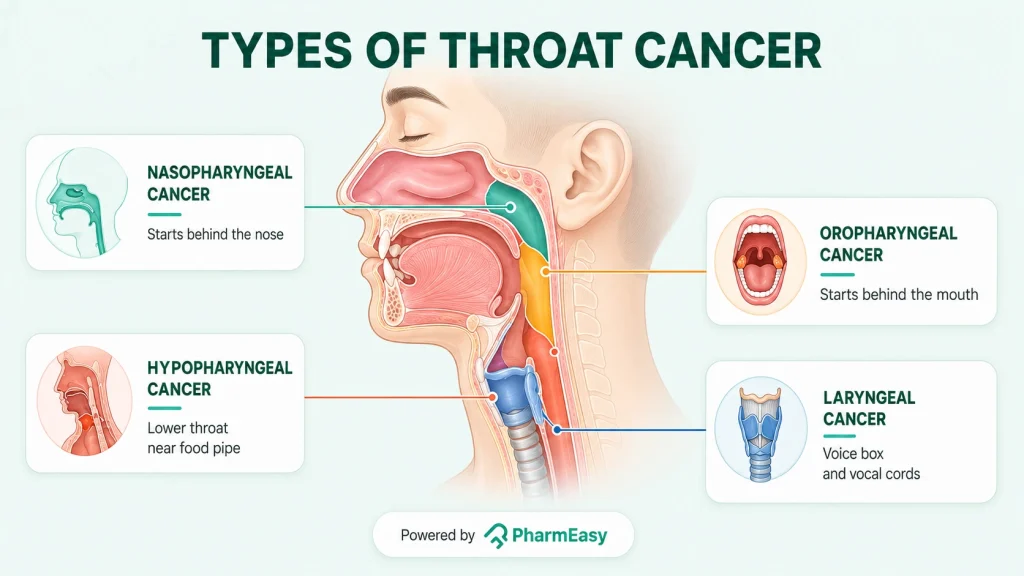
Cancer can develop in several parts of the throat. The main types are named after the area where the cancer starts:
The stage of throat cancer helps doctors describe how large the cancer is and whether it has spread. Staging can differ depending on the part of the throat affected, so the points below are a general guide rather than a substitute for a doctor’s explanation.
Note: These are general descriptions. The exact meaning of each stage varies between cancers of the nasopharynx, oropharynx, hypopharynx and larynx. HPV-related oropharyngeal cancers also have a different staging approach from some other throat cancers.
Throat cancer symptoms depend on where the cancer starts and how advanced it is. Some symptoms are common and can be caused by less serious conditions, but symptoms that persist should be checked by a doctor. Possible symptoms include:
Throat cancer develops when cells in the throat or voice box change and begin to grow in an abnormal, uncontrolled way. There is usually no single cause. Instead, several factors can increase the chance of these cell changes.
A risk factor is something that increases the chance of developing a disease. Having a risk factor does not mean a person will develop throat cancer, but it can make the condition more likely. Important risk factors include:
Note: A person can have one or more risk factors and never develop throat cancer. A person can also develop throat cancer without any known risk factors. If you notice possible warning signs, speak with a doctor for proper evaluation.
Throat cancer diagnosis usually involves checking the throat and neck, looking closely at the affected area, and confirming the diagnosis with a tissue sample if needed. The tests used depend on the symptoms and the part of the throat involved.
Note: Depending on the suspected cancer type, the doctor may recommend HPV testing or other laboratory tests on the biopsy sample. These results can help classify the cancer and guide treatment choices.
Also Read: Can CBC Test Detect Cancer? Unveiling the Potential of Blood Tests
Throat cancer treatment depends on the cancer type, location, stage, tumour size, overall health, and whether the cancer has spread. A care team may recommend one treatment or a combination of treatments.
Note: Treatment may also include supportive care to help with swallowing, nutrition, speech, pain and other treatment-related effects.
Throat cancer cannot always be prevented, but reducing known risks can lower the chance of developing it. The following steps may help reduce risk:
Note: These measures may lower risk, but they cannot guarantee complete prevention. A doctor or dentist should evaluate persistent, unusual, or worsening throat symptoms.
See a doctor if you have a sore throat, hoarseness, swallowing problems, or other throat symptoms that last for several weeks or keep coming back without a clear reason. Seek medical attention promptly if you notice a neck lump, unexplained weight loss, persistent ear pain, or blood in saliva or phlegm1,7. These symptoms can have many causes and do not necessarily mean cancer but getting them checked can help identify the problem early.
Also Read: Early Signs of Mouth Cancer You Should Know
Throat cancer can appear in different ways, and its symptoms may resemble those of less serious conditions. Persistent throat changes, voice changes, swallowing problems, or a neck lump should be assessed by a doctor. Knowing the warning signs and reducing avoidable risks may help with earlier detection and timely treatment.
Survival rates vary by cancer type, stage, overall health, and response to treatment. For example, US data report a 5-year relative survival rate of 62.5% for laryngeal cancer13. Some Indian studies have reported lower 5-year survival rates for laryngeal cancer, but these figures may reflect differences in stage at diagnosis, access to care, and study methods14.
Yes. Throat cancer can often be treated, and treatment is usually more effective when cancer is found early. The treatment plan may include surgery, radiation therapy, chemotherapy, targeted therapy, immunotherapy, or a combination of treatments, depending on the cancer type and stage4,5.
Throat cancer may cause a sore throat that does not improve, pain or difficulty when swallowing, hoarseness, a feeling that something is stuck in the throat, or a lump in the neck. These symptoms can also occur with non-cancer conditions, so a doctor’s assessment is important if they persist.1,2,7
No. Throat cancer is not contagious and cannot spread from one person to another through coughing, kissing, sharing food, or close contact. It develops from changes in a person’s own cells. HPV infection can spread between people, and some HPV infections can increase the risk of oropharyngeal cancer, but the cancer itself does not spread from person to person4,15.
Vaping exposes the throat to potentially harmful substances that may cause cellular damage. However, it is still unclear whether vaping directly causes throat cancer, and more long-term research is needed16.
Yes, certain high-risk types of HPV, especially HPV-16, can increase the risk of developing throat cancer, particularly cancer of the oropharynx4.
Acid reflux does not mean that a person will develop throat cancer. Some research has linked long-term gastro-oesophageal reflux disease with a higher risk of laryngeal cancer, but more research is needed to understand this relationship17.
1. Throat cancer. Healthdirect. 2024. Accessed August 13, 2026. https://www.healthdirect.gov.au/throat-cancer
2. Throat cancer symptoms. MedlinePlus. 2025. Accessed August 13, 2026. https://medlineplus.gov/throatcancer.html
3. Throat cancer. NCI. Accessed August 13, 2026. https://www.cancer.gov/publications/dictionaries/cancer-terms/def/throat-cancer
4. Oral cavity, oropharynx, hypopharynx, & larynx cancer prevention – NCI. 2024. Accessed August 13, 2026. https://www.cancer.gov/types/head-and-neck/patient/oral-prevention-pdq
5. Laryngeal cancer treatment. NCI. 2025. Accessed August 13, 2026. https://www.cancer.gov/types/head-and-neck/patient/adult/laryngeal-treatment-pdq
6. Oral cavity and oropharyngeal cancer stages. American Cancer Society. 2026. Accessed August 13, 2026. https://www.cancer.org/cancer/types/oral-cavity-and-oropharyngeal-cancer/detection-diagnosis-staging/staging.html
7. Throat Cancer. MedlinePlus. 2025. Accessed August 13, 2026. https://medlineplus.gov/throatcancer.html
8. Laryngeal and hypopharyngeal cancer causes, risk factors, and prevention. American Cancer Society. 2026. Accessed August 13, 2026. https://www.cancer.org/cancer/types/laryngeal-and-hypopharyngeal-cancer/causes-risks-prevention.html
9. Head and neck cancers basics CDC. 2025. Accessed August 13, 2026. https://www.cdc.gov/head-neck-cancer/about/index.html
10. Sun G, Cheng H, Yin M. Oral hygiene and cancer risk: emerging evidence and public health perspectives. PMC. doi:10.1007/s12672-026-04527-x https://pmc.ncbi.nlm.nih.gov/articles/PMC12923711/
11. Tests for oral cavity (mouth) and oropharyngeal (throat) cancers. American Cancer Society. 2021. Accessed August 13, 2026. https://www.cancer.org/cancer/types/oral-cavity-and-oropharyngeal-cancer/detection-diagnosis-staging/how-diagnosed.html
12. Tests for laryngeal cancer. Cancer Research UK. 2024. Accessed August 13, 2026. https://www.cancerresearchuk.org/about-cancer/laryngeal-cancer/getting-diagnosed/tests-laryngeal-cancer#blood-tests
13. Laryngeal cancer: Cancer stat facts. NCI. Accessed August 13, 2026. https://seer.cancer.gov/statfacts/html/laryn.html?statfacts_page=laryn.html&x=12&y=20&utm
14. Bobdey S, Jain A, Balasubramanium G. Epidemiological review of laryngeal cancer: An Indian perspective. Indian J Med Paediatr Oncol. 2015;36(3):154-160. doi:10.4103/0971-5851.166721 https://pubmed.ncbi.nlm.nih.gov/26855523/
15. Common cancer myths and misconceptions. NCI. 2024. Accessed August 13, 2026. https://www.cancer.gov/about-cancer/causes-prevention/risk/myths
16. Szukalska M, Szyfter K, Florek E, et al. Electronic cigarettes and head and neck cancer risk: Current state of art. Cancers (Basel). 2020;12(11):3274. doi:10.3390/cancers12113274 https://pubmed.ncbi.nlm.nih.gov/33167393/
17. Acid reflux disease and cancer Risk – NCI. 2021. Accessed August 13, 2026. https://dceg.cancer.gov/news-events/news/2021/gerd-cancer-risk
18. Martín-Hernán F, Sánchez-Hernández JG, Cano J, Campo J, del Romero J. Oral cancer, HPV infection and evidence of sexual transmission. Med Oral Patol Oral Cir Bucal. 2013;18(3):e439-e444. doi:10.4317/medoral.18419 https://pmc.ncbi.nlm.nih.gov/articles/PMC3668870/
Disclaimer: The information provided here is for educational/awareness purposes only and is not intended to be a substitute for medical treatment by a healthcare professional and should not be relied upon to diagnose or treat any medical condition. The reader should consult a registered medical practitioner to determine the appropriateness of the information and before consuming any medication. PharmEasy does not provide any guarantee or warranty (express or implied) regarding the accuracy, adequacy, completeness, legality, reliability or usefulness of the information; and disclaims any liability arising thereof.
Links and product recommendations in the information provided here are advertisements of third-party products available on the website. PharmEasy does not make any representation on the accuracy or suitability of such products/services. Advertisements do not influence the editorial decisions or content. The information in this blog is subject to change without notice. The authors and administrators reserve the right to modify, add, or remove content without notification. It is your responsibility to review this disclaimer regularly for any changes.


Comments

Leave your comment...
You may also like

























Comments