




Palmar Erythema (Liver Palms): Causes, Symptoms, Treatment & More
By Dr. Swara Soumitra Pendse +2 more

Medically reviewed by Dr. Swara Soumitra Pendse
Last updated: Sep 21, 2026 Published on: Aug 20, 2026


Get,

to manage your symptom
Get your,

4 Cr+ families
benefitted

OTP sent to 9988776655



You’ve successfully subscribed to receive
doctor-approved tips on
Whatsapp

Get ready to feel your best.


Register to Avail the Offer
Send OTPBy continuing, you agree with our Privacy Policy and Terms and Conditions
Hi There,
Sign up on PharmEasy now!!


Trusted by 4 crore+ families

OTP sent to 9988776655
You have unlocked 25% off on medicines


Code: NU25

By Dr. Swara Soumitra Pendse +2 more
Table of Contents
Persistent redness and warmth of the palms can be concerning and may indicate palmar erythema. Although it is often benign, palmar erythema may also be associated with several underlying physiological or pathological conditions1.
Understanding the causes, clinical features, diagnosis, treatment, and prevention of palmar erythema can facilitate early recognition of associated disorders and guide appropriate management.
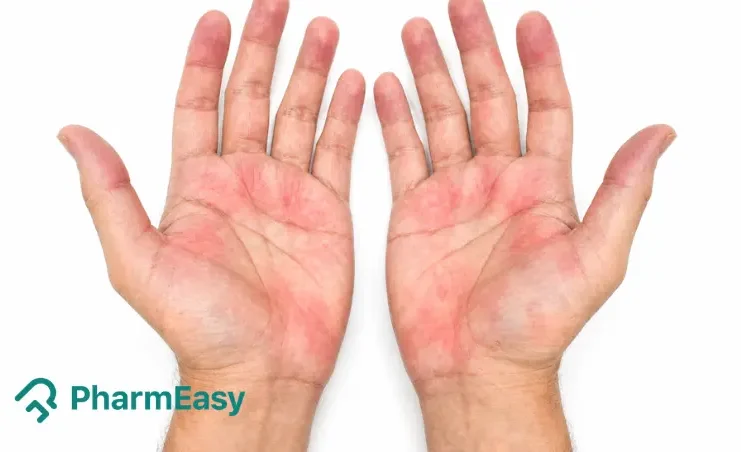
Palmar erythema is a condition in which the palms appear red and, on applying pressure, turn pale. It may involve the fingertips, nail beds, back of the hand and, rarely, even the soles of the foot1. The medical phrase, Palmar erythema means red palms2. It mostly affects the padded part of the palms at the base of the thumb and little finger. It often involves various underlying conditions, both physiological & pathological such as liver diseases, pregnancy, rheumatoid arthritis, diabetes, and brain tumours. Palmar erythema may also occur in association with chronic alcohol use and certain medications1.
Did you know?
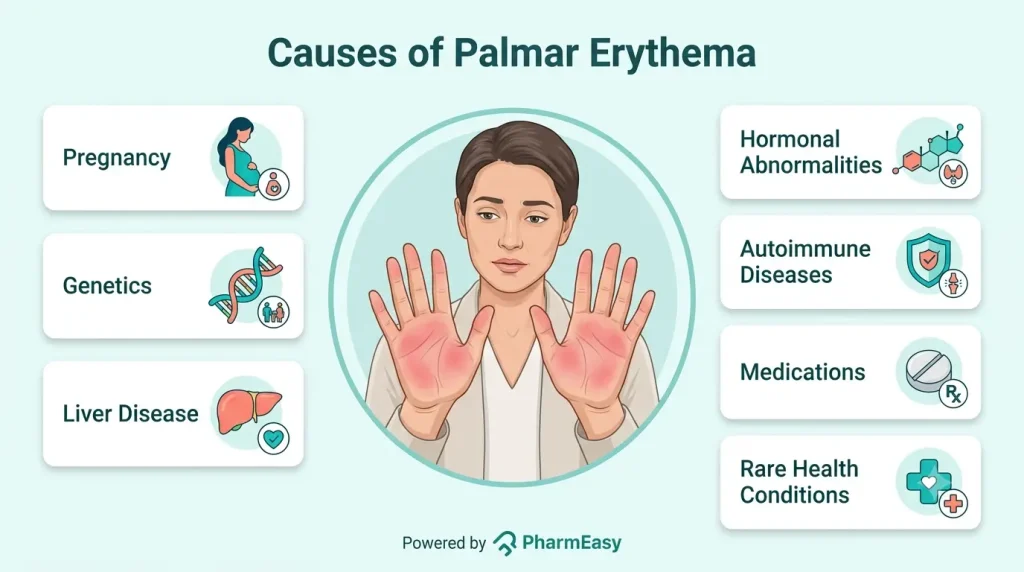
Palmar erythema may occur in several physiological and pathological conditions, including:
Palmar erythema is characterized by the following features:
Other associated symptoms depending upon the underlying cause such as autoimmune condition, liver disease, pregnancy etc, may also be noted along with the above-mentioned symptoms.
Some people are more likely to develop palmar erythema than others. People who are at a higher risk of developing palmar erythema include the following:
Palmar erythema is primarily a clinical diagnosis. Once identified, evaluation should focus on determining whether an underlying systemic disorder is present. Following the clinical examination, the primary cause of palmar erythema will be evaluated by the following:
The specific palmar erythema, rather the treatment plan depends on the underlying cause:
Palmar erythema often improves or resolves once the underlying cause is effectively treated. However, it may persist in chronic irreversible conditions such as liver cirrhosis4.
Also, the hereditary form of palmar erythema often persists throughout life and does not require any treatment unless if presents along with any associated disease or symptoms2,4.
Prevention of Palmar Erythema involves4:
Also Read: Liver Fibrosis: What Is It, Causes, Symptoms & Treatment
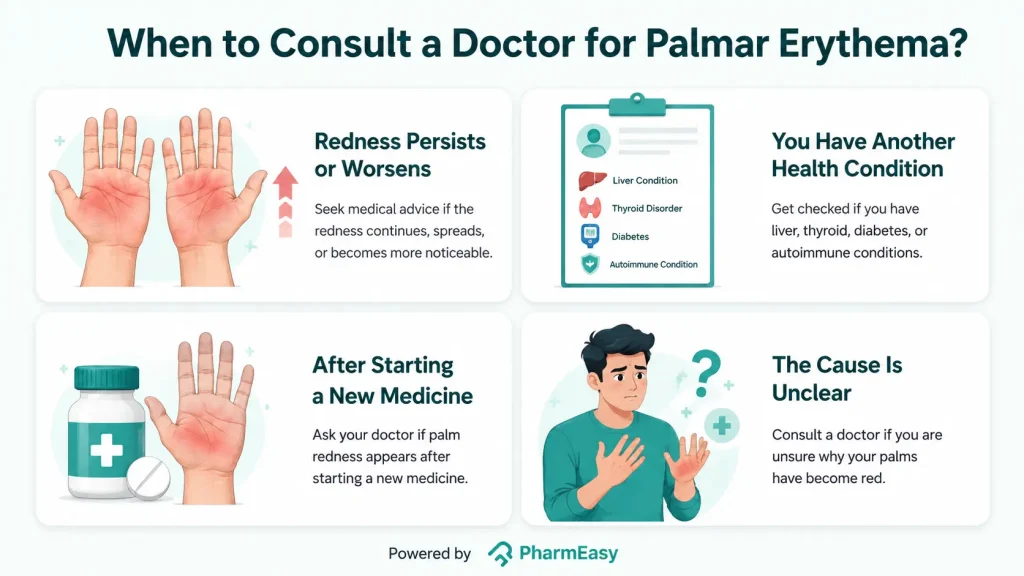
A doctor should be consulted for palmar erythema in the following conditions4:
Also Read: Facial Changes in Fatty Liver Disease: Causes, Diagnosis & Prevention
Palmar erythema is a condition in which redness of the palms occurs. Although palmar erythema is often benign, it may also serve as an important clinical sign of an underlying systemic disorder, particularly chronic liver disease. Persistent or unexplained palmar erythema warrants medical evaluation so that any associated condition can be identified and managed appropriately.
A liver that is not functioning properly leads to abnormal metabolization of hormones like oestradiol and vasoactive substances like nitric oxide. These cause dilation of capillaries and lead to redness and warmth in palms (palmar erythema) and sometimes soles3.
Yes, liver disease is one of the several diseases that are involved in causing palmar erythema. Several other conditions such as hyperthyroidism, diabetes, autoimmune, infections etc. have been found to be associated with palmar erythema4.
No, palmar erythema can be managed by controlling the underlying disease or condition. In many cases, palmar erythema improves after the underlying condition is treated, although it may persist in chronic diseases such as cirrhosis4.
The course of palmar erythema depends on its underlying cause. It may improve when the associated condition is treated, whereas hereditary palmar erythema usually persists throughout life6.
No, redness in the palms from palmar erythema is not known to be itchy6. Consult the doctor for guidance if it is felt itchy as it may indicate another condition or worsening of underlying disease.
Stress is not recognised as an established cause of palmar erythema. The condition is more commonly associated with pregnancy, liver disease, thyroid disorders, diabetes and autoimmune diseases4.
Smoking is not considered a direct cause of palmar erythema. However, it may contribute indirectly through its association with chronic liver and pulmonary diseases, which themselves have been linked to palmar erythema4˒11.
Menopause is not an established cause of palmar erythema. Hormonal conditions more commonly associated with palmar erythema include pregnancy, hyperthyroidism and diabetes4.
1. Bhandari A, Mahajan R. Skin Changes in Cirrhosis. J Clin Exp Hepatol. 2022;12(4):1215-1224. doi:10.1016/j.jceh.2021.12.013 https://pubmed.ncbi.nlm.nih.gov/35814509/
2. Langenauer J. Erythema Palmare Hereditarium (‘Red Palms’, ‘Lane’s Disease’). Case Rep Dermatol. 2014;6(3):245-247. doi:10.1159/000368822 https://pmc.ncbi.nlm.nih.gov/articles/PMC4255997/
3. Liu Y, Zhao Y, Gao X, et al. Recognizing skin conditions in patients with cirrhosis: a narrative review. Ann Med. 54(1):3017-3029. doi:10.1080/07853890.2022.2138961 https://pubmed.ncbi.nlm.nih.gov/36308406/
4. Serrao R, Zirwas M, English JC. Palmar erythema. Am J Clin Dermatol. 2007;8(6):347-356. doi:10.2165/00128071-200708060-00004 https://pubmed.ncbi.nlm.nih.gov/18039017/
5. Gurioli C, Patrizi A, Lambertini M, Neri I. Lane’s Disease (Erythema Palmare Hereditarium): A Report of Five Cases and a Review of the Literature. Pediatr Dermatol. 2017;34(5):590-594. doi:10.1111/pde.13211 https://pubmed.ncbi.nlm.nih.gov/28804916/
6. Palmar erythema. DermNet®. October 26, 2023. Accessed July 14, 2026. https://dermnetnz.org/topics/palmar-erythema
7. Lu J, Liu C, Zhou X, et al. Palmar erythema and palmar papules as predictors for dermatomyositis-related acute/subacute interstitial lung disease: a retrospective study. Rheumatology. 2021;61(1):413-421. doi:10.1093/rheumatology/keab177 https://pubmed.ncbi.nlm.nih.gov/33629112/
8. Noble JP, Boisnic S, Branchet-Gumila MC, Poisson M. Palmar erythema: cutaneous marker of neoplasms. Dermatology. 2002;204(3):209-213. doi:10.1159/000057883 https://europepmc.org/article/med/12037449
9. Palmar erythema and pruritus. Accessed July 14, 2026. https://www.aaaai.org/allergist-resources/ask-the-expert/answers/2023/palmar
10. Sow Y, Wachuku C, Barrera T, et al. Palmar and plantar erythema: An initial presentation of undifferentiated connective tissue disease. JAAD Case Rep. 2023;35:94-97. doi:10.1016/j.jdcr.2023.03.007 https://pmc.ncbi.nlm.nih.gov/articles/PMC10147949/
11. Pesut DP, Samardzic AM, Bulajic MV, Cvok-Debeljak TT. Palmar telangiectasia is associated with the intensity of smoking. J Bras Pneumol. 2019;45(2):e20180273. Published 2019 Apr 18. doi:10.1590/1806-3713/e20180273 https://pmc.ncbi.nlm.nih.gov/articles/PMC6733739/
12. Edwards E, Yosipovitch G. Skin Manifestations of Diabetes Mellitus. [Updated 2025 Mar 21]. In: Feingold KR, Adler RA, Ahmed SF, et al., editors. Endotext [Internet]. South Dartmouth (MA): MDText.com, Inc.; 2000-. Available from: https://www.ncbi.nlm.nih.gov/books/NBK481900/#
13. Kakroo SN, Banday S, Kakroo B, Beg MA. Cutaneous Manifestations of Respiratory Diseases. International Journal of Pharmaceutical and Clinical Research 2024; 16(9); 905-913. https://impactfactor.org/PDF/IJPCR/16/IJPCR,Vol16,Issue9,Article148.pdf
Disclaimer: The information provided here is for educational/awareness purposes only and is not intended to be a substitute for medical treatment by a healthcare professional and should not be relied upon to diagnose or treat any medical condition. The reader should consult a registered medical practitioner to determine the appropriateness of the information and before consuming any medication. PharmEasy does not provide any guarantee or warranty (express or implied) regarding the accuracy, adequacy, completeness, legality, reliability or usefulness of the information; and disclaims any liability arising thereof.
Links and product recommendations in the information provided here are advertisements of third-party products available on the website. PharmEasy does not make any representation on the accuracy or suitability of such products/services. Advertisements do not influence the editorial decisions or content. The information in this blog is subject to change without notice. The authors and administrators reserve the right to modify, add, or remove content without notification. It is your responsibility to review this disclaimer regularly for any changes.


Comments

Leave your comment...
You may also like



















Comments