




Triglycerides vs Cholesterol: Levels, Differences, and How to Reduce It
By Dr. Vishesh Bharucha +2 more

Medically reviewed by Dr. Vishesh Bharucha
Last updated: Aug 17, 2026 Published on: Aug 17, 2026


Get,

to manage your symptom
Get your,

4 Cr+ families
benefitted

OTP sent to 9988776655



You’ve successfully subscribed to receive
doctor-approved tips on
Whatsapp

Get ready to feel your best.


Register to Avail the Offer
Send OTPBy continuing, you agree with our Privacy Policy and Terms and Conditions
Hi There,
Sign up on PharmEasy now!!


Trusted by 4 crore+ families

OTP sent to 9988776655
You have unlocked 25% off on medicines


Code: NU25

By Dr. Vishesh Bharucha +2 more
Table of Contents
There is often a confusion between cholesterol and triglycerides, as both are types of lipids found in the blood. Elevated levels of either can significantly increase the risk of cardiovascular disease (CVD)1.
In 2022, an estimated 19.8 million people died from CVDs worldwide, accounting for approximately 32% of all global deaths, with heart attack and stroke responsible for 85% of these deaths2.
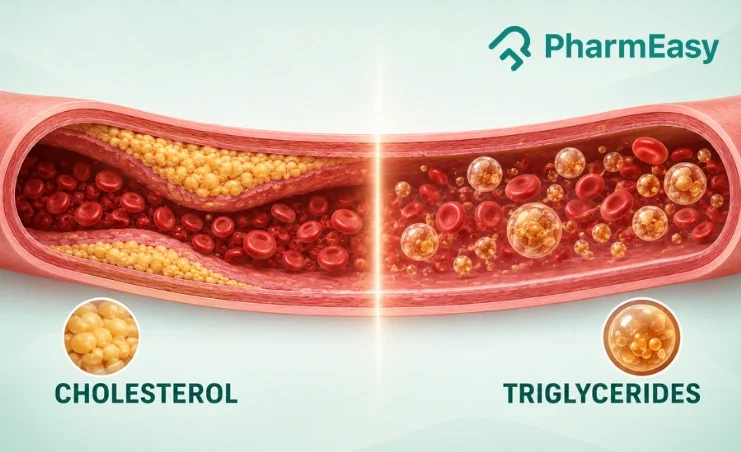
This blog explores what they are, how they differ, their ideal levels, and practical ways to keep them under control.
Cholesterol is a waxy, fat-like substance found in all cells of the body3. It plays an important role in building and maintaining cell walls and is needed to make hormones, vitamin D, and bile acids (substances that help to digest food). The liver makes most of the cholesterol the body needs, while the rest comes from foods such as meat, eggs, and dairy products. Although HDL cholesterol (good cholesterol) is essential for good health, too much LDL cholesterol (bad cholesterol) in the blood is a well-established cause of atherosclerotic cardiovascular disease (ASCVD)1,4. HDL participates in reverse cholesterol transport, but this mechanism is more complex than simply removing cholesterol from arteries.
Triglycerides are the most common type of fat in the body and are the body’s main way of storing energy5. After you eat, excess calories that the body does not need right away are converted into triglycerides and stored in fat cells for future energy use. When the body needs energy between meals or during physical activity, these stored triglycerides are broken down and used as fuel. Triglycerides also help keep the body warm and protect organs. However, high triglyceride levels are associated with an increased risk of heart disease. This risk is mainly linked to triglyceride-rich lipoproteins and remnant cholesterol (cholesterol carried in triglyceride-rich fat particles in your blood), rather than triglycerides directly causing the hardening and narrowing of the arteries5,6.
Note: Cholesterol helps build and maintain the body, while triglycerides store and provide energy. Both are necessary for normal functioning of the body; however, keeping their levels within a healthy range is important for protecting the heart.
The table below explains key details about triglycerides vs cholesterol to help you understand their roles better1,3,5,7:
| Feature | Cholesterol | Triglycerides |
| Main Function | Helps build cell membranes and is used to produce hormones, vitamin D, and bile acids for digestion | Stores excess calories and provides energy when the body needs it. |
| Primary Source | Produced mainly by the liver | Formed from excess calories consumed through food, especially carbohydrates, fats, and sugars |
| How It Travels in Blood | Carried by lipoproteins such as low-density lipoprotein (LDL) and high-density lipoprotein (HDL) | Transported primarily by chylomicrons and VLDL (very-low-density lipoproteins) |
| Normal Range | Total cholesterol: <200 mg/dL LDL: <100 mg/dL HDL: ≥60 mg/dL | <150 mg/dL |
| Health Risk When Elevated | High LDL cholesterol can accumulate on the inside of artery walls, increasing the risk of atherosclerosis, heart attack, and stroke | High triglyceride levels are associated with an increased risk of ASCVD (due to triglyceride-rich lipoproteins and remnant cholesterol). Very high triglyceride levels (≥500 mg/dL), especially ≥1000 mg/dL, can also greatly increase the risk of acute pancreatitis. |
The most common test used to measure cholesterol and triglycerides is lipid profile (lipid panel). This cholesterol and triglycerides test helps assess cardiovascular health and identify abnormalities in blood lipid levels8.
1. Purpose
2. What It Measures
3. Fasting Requirements
4. When to Get Tested
Note: Follow-up testing may be required to monitor response to treatment or lifestyle modifications.
Making healthy food choices may help improve cholesterol and triglyceride levels and reduce the risk of heart disease. Foods that can help lower cholesterol and triglyceride levels include9,10:
Foods that may increase cholesterol or triglyceride levels should be limited. These include:
Healthy lifestyle changes may help lower cholesterol and triglyceride levels and improve overall heart health. Some options include:





Also Read: High LDL (Bad) Cholesterol: Causes, Symptoms & How to Reduce It
While mild changes in cholesterol and triglyceride levels can often be managed through lifestyle modifications, it is important to consult a doctor if you have concerns about your heart health or lipid levels.
You should seek medical advice if:
Also Read: Low HDL (Good) Cholesterol: Causes, Symptoms & How to Increase It
Cholesterol and triglycerides are both essential fats that play important roles in the body; however, elevated levels of both can increase the risk of heart disease, heart attack, and stroke. Therefore, understanding the differences between cholesterol and triglycerides, knowing the levels of both, and getting regular lipid profile tests can help you stay on top of your cardiovascular health.
Healthy lifestyle habits (such as eating a balanced diet, staying physically active, maintaining a healthy weight, avoiding smoking, and limiting alcohol intake) can go a long way in improving cholesterol and triglyceride levels and reducing the risk of heart conditions.
Neither is necessarily ‘worse’ than the other. Both may increase the risk of CVDs when their levels are elevated. High LDL (bad) cholesterol is a well-established risk factor for atherosclerosis, while high triglycerides are also linked to heart disease and often occur alongside conditions such as obesity or diabetes3,5. However, your overall cardiovascular risk is determined by your complete lipid profile and other health conditions.
High triglycerides may occur even when cholesterol levels are normal. Common causes include consuming excess calories, diets high in sugar or refined carbohydrates, obesity, physical inactivity, excessive alcohol intake, uncontrolled diabetes, and certain medications5. Consulting a doctor can help identify the reason for elevated triglyceride levels and guide appropriate management.
Cholesterol and triglycerides are both lipids (serving different functions) that circulate in the bloodstream. Cholesterol helps build cells and produce hormones, while triglycerides store energy1.1 Both are measured in the lipid profile test8.
High cholesterol and triglycerides usually do not cause noticeable symptoms, including fatigue. However, they can contribute to CVDs that may result in fatigue, shortness of breath, or difficulty performing physical activities13. If you experience persistent fatigue, you should consult a doctor for further evaluation.
Triglycerides do not directly cause high cholesterol. However, both can be elevated due to similar factors such as an unhealthy diet, obesity, lack of physical activity, diabetes, or genetic conditions. As a result, high triglycerides and high cholesterol often occur together3,5.
Long-term stress may contribute to higher cholesterol and triglyceride levels. Stress triggers the release of hormones, which may affect how the body processes fats and can lead to increased triglyceride levels14. In addition, stress may lead to unhealthy lifestyle habits such as overeating, smoking, excessive alcohol consumption, and physical inactivity, which could contribute to elevated cholesterol and triglyceride levels12.
1. Cox RA, García-Palmieri MR. Cholesterol, Triglycerides, and Associated Lipoproteins. In: Walker HK, Hall WD, Hurst JW, eds. Clinical Methods: The History, Physical, and Laboratory Examinations. 3rd ed. Butterworths; 1990. Accessed June 2, 2026. http://www.ncbi.nlm.nih.gov/books/NBK351/
2. Cardiovascular diseases (CVDs). Accessed June 2, 2026. https://www.who.int/news-room/fact-sheets/detail/cardiovascular-diseases-(cvds)
3. Cholesterol. Accessed June 2, 2026. https://medlineplus.gov/cholesterol.html
4. Huff T, Boyd B, Jialal I. Physiology, Cholesterol. In: StatPearls. StatPearls Publishing; 2026. Accessed June 2, 2026. http://www.ncbi.nlm.nih.gov/books/NBK470561/
5. Triglycerides. Accessed June 2, 2026. https://medlineplus.gov/triglycerides.html
6. Services D of H& H. Triglycerides. Accessed June 2, 2026. http://www.betterhealth.vic.gov.au/health/conditionsandtreatments/triglycerides
7. Cholesterol Levels: What You Need to Know. Accessed June 2, 2026. https://medlineplus.gov/cholesterollevelswhatyouneedtoknow.html
8. Lipid profile test: MedlinePlus Medical Encyclopedia. Accessed June 2, 2026. https://medlineplus.gov/ency/article/007812.htm
9. How to Lower Cholesterol with Diet. Accessed June 2, 2026. https://medlineplus.gov/howtolowercholesterolwithdiet.html
10. Services D of H& H. Cholesterol – healthy eating tips. Accessed June 2, 2026. http://www.betterhealth.vic.gov.au/health/conditionsandtreatments/cholesterol-healthy-eating-tips
11. High cholesterol – How to lower your cholesterol. nhs.uk. May 28, 2019. Accessed June 2, 2026. https://www.nhs.uk/conditions/high-cholesterol/how-to-lower-your-cholesterol/
12. Jan 2 LR, 2025. Lifestyle Changes to Prevent a Heart Attack. www.heart.org. Accessed June 2, 2026. https://www.heart.org/en/health-topics/heart-attack/life-after-a-heart-attack/lifestyle-changes-for-heart-attack-prevention
13. Khan MR, Haider ZM, Hussain J, Malik FH, Talib I, Abdullah S. Comprehensive Analysis of Cardiovascular Diseases: Symptoms, Diagnosis, and AI Innovations. Bioengineering. 2024;11(12):1239. doi:10.3390/bioengineering11121239 https://pubmed.ncbi.nlm.nih.gov/39768057/
14. Anni NS, Jung SJ, Shim JS, Jeon YW, Lee GB, Kim HC. Stressful life events and serum triglyceride levels: the Cardiovascular and Metabolic Diseases Etiology Research Center cohort in Korea. Epidemiol Health. 2021;43:e2021042. doi:10.4178/epih.e2021042 https://pubmed.ncbi.nlm.nih.gov/34126706/
Disclaimer: The information provided here is for educational/awareness purposes only and is not intended to be a substitute for medical treatment by a healthcare professional and should not be relied upon to diagnose or treat any medical condition. The reader should consult a registered medical practitioner to determine the appropriateness of the information and before consuming any medication. PharmEasy does not provide any guarantee or warranty (express or implied) regarding the accuracy, adequacy, completeness, legality, reliability or usefulness of the information; and disclaims any liability arising thereof.
Links and product recommendations in the information provided here are advertisements of third-party products available on the website. PharmEasy does not make any representation on the accuracy or suitability of such products/services. Advertisements do not influence the editorial decisions or content. The information in this blog is subject to change without notice. The authors and administrators reserve the right to modify, add, or remove content without notification. It is your responsibility to review this disclaimer regularly for any changes.


Comments

Leave your comment...
You may also like
























Comments