




Shoulder Joint Pain: Causes, Exercises, Remedies & When to Seek Help
By Dr. Parth Mehta +2 more

Medically reviewed by Dr. Parth Mehta
Last updated: Aug 17, 2026 Published on: Aug 17, 2026


Get,

to manage your symptom
Get your,

4 Cr+ families
benefitted

OTP sent to 9988776655



You’ve successfully subscribed to receive
doctor-approved tips on
Whatsapp

Get ready to feel your best.


Register to Avail the Offer
Send OTPBy continuing, you agree with our Privacy Policy and Terms and Conditions
Hi There,
Sign up on PharmEasy now!!


Trusted by 4 crore+ families

OTP sent to 9988776655
You have unlocked 25% off on medicines


Code: NU25

By Dr. Parth Mehta +2 more
Table of Contents
Shoulder joint pain is a common condition, more commonly reported in women than in men, and is more common in high-income countries than in low-income ones1,2. The shoulder is the most movable joint in the body3. It is composed of many muscles, bones, and ligaments and soft tissues, all of which work together in a compact space to allow the shoulder joint to function smoothly. Due to many structures being involved, shoulder pain may have many different causes2.
Understanding what causes shoulder joint pain, its symptoms, exercises for the joint, and home remedies can help in the early detection and effective management of this condition, resulting in improved health and well-being.

Shoulder joint pain is often felt beneath the acromion, the bone that forms the roof of the shoulder. The pain is often felt on the outer side of the shoulder and is also known as shoulder impingement. It is difficult to pinpoint exactly what causes shoulder joint pain2, but hand and shoulder joint pain is often observed in older individuals who are engaged in physically demanding work4.
Shoulder joint pain reasons may vary; however, most involve the bones, muscles, tendons and ligaments in the shoulder joint2.
Because of the many bones, muscles, ligaments, and other soft tissues in a small space, causes of shoulder joint pain may include problems affecting any of these structures, such as2:
Shoulder and hand joint pain may be of different types depending on the underlying cause, as follows5:
Shoulder joint pain exercises help in relieving the symptoms of hand and shoulder joint pain as they improve circulation around the joint and facilitate movement. Shoulder joint pain exercises should be performed under expert guidance 3 to 4 times a day6. These exercises include:

For 5 to 10 seconds, gently roll your shoulders upward and then backwards while standing. Afterwards, keep your shoulders in a neutral, comfortable position. It helps in gaining control to shoulder blades. Shoulder rolls should be done 3 to 4 times daily with 10 to 20 repetitions at every session7,8.
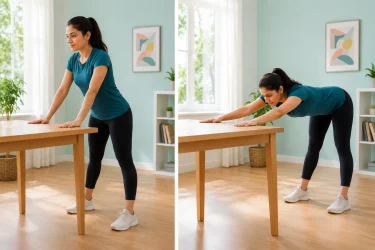
Place your hands on a table and stand with your legs apart. Let your upper body fall forward as you move away from the table. Repeat 10 to 20 times, 3 to 4 times per day6,7,8.
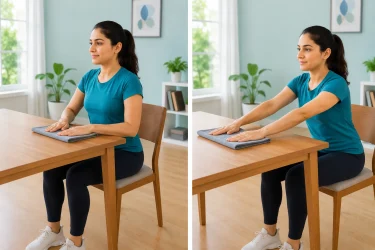
Place your hands flat on a tabletop on a cloth, while sitting or standing with your elbows bent. Move your hands forward and backwards while straightening the elbows. Make tiny movements initially as this exercise helps in forward and backward movement of arms. Perform the exercise 3 to 4 times a day with 10 to 15 repetitions at each session6,7,9.
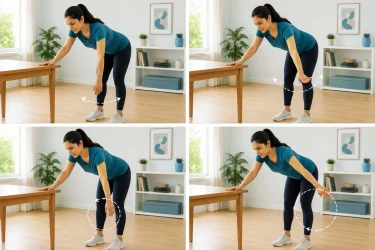
This helps to relax the shoulder if tabletop slides are too painful. Bend at the waist and lean forward by supporting yourself on a table with the hand that does not have a painful shoulder. Let the arm with the painful shoulder swing freely for 30 seconds in all directions. Perform the exercise 2 to 4 times a day with 10- 15 repetitions each time6,7,9.
These exercises may involve slight discomfort, but no worsening of shoulder joint pain after workout should occur. You should stop the exercises if you experience worsening pain.
Yoga for shoulder joint pain may also improve the range of motion by reducing the pressure in the joint. Practicing the yoga poses for 15 minutes, thrice a week for 4 weeks was shown to significantly improve shoulder joint pain10,11.

Bring one arm over the shoulder and the other behind the back, gently stretching the shoulder joint. Hold one hand comfortably with the other and practice regularly as a part of yoga routine to improve shoulder flexibility.

Stand straight with your feet together, keep the body in a straight line, and raise your arms upward while stretching the spine. Slowly return to the starting position.

Lie on your back with knees bent and feet on the floor, then lift the hips upward while keeping the shoulders supported and relaxed. Hold the pose comfortably before slowly releasing.

Acupressure is a complementary therapy that may help relieve pain and release the tension in the shoulder by stimulating specific trigger points on the body12,13.
Certain home shoulder joint pain remedies can help ease the shoulder joint pain. These include:3
Also Read: Right Shoulder Pain in Women: Causes, Symptoms, Treatment & More

Consult a doctor for shoulder joint pain remedy immediately if you have3:
Shoulder joint pain can make everyday activities difficult, but most people improve with appropriate treatment. You can ensure better recovery by being aware of your symptoms, avoiding activities that exacerbate the pain, and safe practice of gentle shoulder exercises. You should consult a doctor if the pain is severe, persists for several weeks, or is accompanied by weakness, swelling, or continuous restricted movement.
Mild soreness of the shoulder joint after certain sports, like basketball, tennis, and swimming may be caused by excessive strain and may improve with rest. However, persistent and severe pain of the shoulder joint requires medical attention2.
Yes, yoga may help improve strength, flexibility, and mobility in individuals with shoulder and hand joint pain. It may also help improve the stress markers related to shoulder joint pain10.
Shoulder joint pain while sleeping may be caused by improper posture. Supporting the painful side with a pillow and lying on the side of the unaffected arm would help3,6.
Shoulder pain should be taken seriously when it is accompanied by radiating pain from the chest to the left jaw, neck or arm and is associated with breathing difficulty, intense sweating, or dizziness, which is suggestive of a heart attack3.
Shoulder muscle pain is often caused by overuse and strain of the muscles involved, while joint pain may be felt within the shoulder as stiffness and decreased mobility. An accurate diagnosis may be made by the doctor considering your symptoms, history, physical evaluation, imaging, etc2,3.
Shoulder joint pain associated with arthritis may be evaluated by a doctor with a physical examination, checking your symptoms and medical history, and blood tests and imaging tests such as an X-ray and MRI if necessary3.
1. Lucas J, van Doorn P, Hegedus E, Lewis J, van der Windt D. A systematic review of the global prevalence and incidence of shoulder pain. BMC Musculoskelet Disord. 2022;23(1):1073. doi:10.1186/s12891-022-05973-8 https://pubmed.ncbi.nlm.nih.gov/36476476/
2. Overview: Shoulder pain. In: InformedHealth.Org [Internet]. Institute for Quality and Efficiency in Health Care (IQWiG); 2024. Accessed July 17, 2026. https://www.ncbi.nlm.nih.gov/books/NBK554693/
3. Shoulder pain: MedlinePlus Medical Encyclopedia. Accessed July 17, 2026. https://medlineplus.gov/ency/article/003171.htm
4. Hodgetts CJ, Leboeuf-Yde C, Beynon A, Walker BF. Shoulder pain prevalence by age and within occupational groups: a systematic review. Arch Physiother. 2021;11:24. doi:10.1186/s40945-021-00119-w https://pubmed.ncbi.nlm.nih.gov/34736540/
5. Shoulder pain. nhs.uk. October 23, 2017. Accessed July 20, 2026. https://www.nhs.uk/symptoms/shoulder-pain/
6. PDF. Accessed July 20, 2026. https://www.tims.nhs.uk/wp-content/uploads/2024/06/TIMS-Shoulder-pain-patient-information-leaflet-Nov23.pdf
7. Physiotools. Accessed July 20, 2026. https://www.tims.nhs.uk/wp-content/uploads/2020/07/TIMS-Shoulder-Pain-Draft.pdf
8. PowerPoint Presentation. Accessed August 4, 2026. https://www.berkshirehealthcare.nhs.uk/media/h25npcf5/bh1165g-frozen-shoulder-v1-feb-2026.pdf
9. FINAL – Non-Op Shoulder Protocol.pdf. Accessed August 4, 2026. https://www.scribd.com/document/846906675/FINAL-Non-Op-Shoulder-Protocol
10. Gandolfi MG, Zamparini F, Spinelli A, Saper RB, Prati C. Yoga For Musculoskeletal Disorders: A Review of Prospective Clinical Studies. Glob Adv Integr Med Health. 2025;14:27536130251388385. doi:10.1177/27536130251388385 https://pmc.ncbi.nlm.nih.gov/articles/PMC12638676/
11. Golec de Zavala A, Lantos D, Bowden D. Yoga Poses Increase Subjective Energy and State Self-Esteem in Comparison to ‘Power Poses.’ Front Psychol. 2017;8:752. doi:10.3389/fpsyg.2017.00752 https://www.frontiersin.org/journals/psychology/articles/10.3389/fpsyg.2017.00752/full
12. Mehta P, Dhapte V, Kadam S, Dhapte V. Contemporary acupressure therapy: Adroit cure for painless recovery of therapeutic ailments. J Tradit Complement Med. 2016;7(2):251-263. doi:10.1016/j.jtcme.2016.06.004 https://pmc.ncbi.nlm.nih.gov/articles/PMC5388088/
13. Chen YW, Wang HH. The effectiveness of acupressure on relieving pain: a systematic review. Pain Manag Nurs Off J Am Soc Pain Manag Nurses. 2014;15(2):539-550. doi:10.1016/j.pmn.2012.12.005 https://pubmed.ncbi.nlm.nih.gov/23415783/
Disclaimer: The information provided here is for educational/awareness purposes only and is not intended to be a substitute for medical treatment by a healthcare professional and should not be relied upon to diagnose or treat any medical condition. The reader should consult a registered medical practitioner to determine the appropriateness of the information and before consuming any medication. PharmEasy does not provide any guarantee or warranty (express or implied) regarding the accuracy, adequacy, completeness, legality, reliability or usefulness of the information; and disclaims any liability arising thereof.
Links and product recommendations in the information provided here are advertisements of third-party products available on the website. PharmEasy does not make any representation on the accuracy or suitability of such products/services. Advertisements do not influence the editorial decisions or content. The information in this blog is subject to change without notice. The authors and administrators reserve the right to modify, add, or remove content without notification. It is your responsibility to review this disclaimer regularly for any changes.


Comments

Leave your comment...
You may also like

























Comments