




Easy Bruising: Causes, Symptoms, Treatment & When to See a Doctor
By Dr. Avinav Gupta +2 more

Medically reviewed by Dr. Avinav Gupta
Last updated: Sep 15, 2026 Published on: Jul 22, 2026


Get,

to manage your symptom
Get your,

4 Cr+ families
benefitted

OTP sent to 9988776655



You’ve successfully subscribed to receive
doctor-approved tips on
Whatsapp

Get ready to feel your best.


Register to Avail the Offer
Send OTPBy continuing, you agree with our Privacy Policy and Terms and Conditions
Hi There,
Sign up on PharmEasy now!!


Trusted by 4 crore+ families

OTP sent to 9988776655
You have unlocked 25% off on medicines


Code: NU25

By Dr. Avinav Gupta +2 more
Table of Contents
Most people get bruises occasionally and may not remember the exact bump or injury that caused them. In many cases, such bruises are harmless. However, bruises that appear frequently , develop after very minor contact, or occur without a clear reason may sometimes point to an underlying health condition . Easy bruising can have several possible causes, some of which may need medical attention1,2. This article explains what easy bruising is a sign of, why it happens, the symptoms to look for, how doctors diagnose it, available treatment options, ways to reduce the risk, and when to consult a doctor.
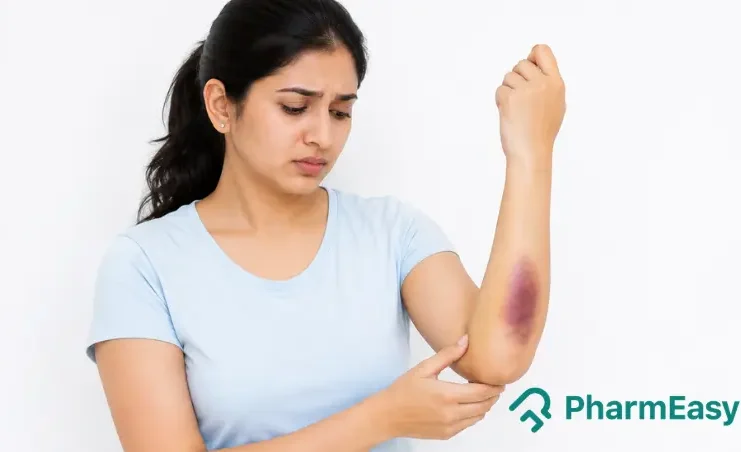
Easy bruising means developing bruises more easily than expected after a minor bump or, sometimes, without any noticeable injury; however, many such bruises are harmless1,3. A bruise forms when small blood vessels (capillaries) beneath the skin get damaged and leak blood into the surrounding tissue, leading to red, purple, blue, or yellowish discolouration1.
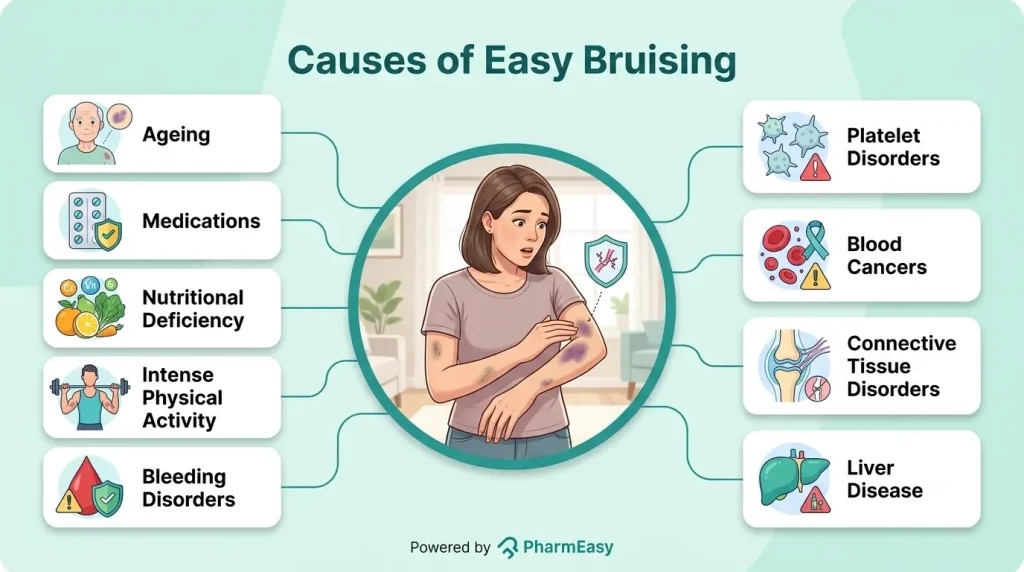
People often wonder what causes easy bruising. The reasons can range from normal age-related skin changes to medications, nutrient deficiencies, or medical conditions that affect blood vessels, platelets, or clotting. Common causes include:
Easy bruising symptoms may vary depending on the cause. Some bruises are minor, while others may appear with warning signs that suggest a bleeding or clotting problem. Symptoms and associated signs may include:
Note: These symptoms can have many possible causes and do not always indicate a serious condition. However, if bruises are frequent, unexplained, worsening, or occur with unusual bleeding, it is important to consult a doctor for proper evaluation and diagnosis.
Doctors diagnose easy bruising by looking for the underlying cause. The evaluation usually begins with questions about symptoms and medications, followed by a physical examination and, when needed, blood tests.
Treatment depends on the causes of easy bruising. Minor bruises usually heal on their own, but frequent or unexplained bruising may need treatment aimed at the underlying cause. A doctor may recommend one or more of the following approaches:

For a new bruise, the doctor may recommend applying a cold pack or ice wrapped in a cloth to the bruise for 10 to 20 minutes at a time, every 2 to 4 hours during the first 24 to 48 hours1.

If medicines such as blood thinners, aspirin, corticosteroids, or some pain relievers are contributing to bruising, the doctor may adjust the dose or recommend an alternative4,19. Do not stop blood thinners, aspirin, steroids, or any prescribed medication without consulting a doctor, as stopping them suddenly may be unsafe.

If the bruise is caused by nutrient deficiencies, such as vitamin C, vitamin K, or zinc deficiency, the doctor might prescribe supplements to help correct the deficiency2,4,20.

If easy bruising is caused by a medical condition, such as a bleeding disorder, blood cancer, liver disease, or another health problem, the doctor might suggest treatment for that particular condition6,9.
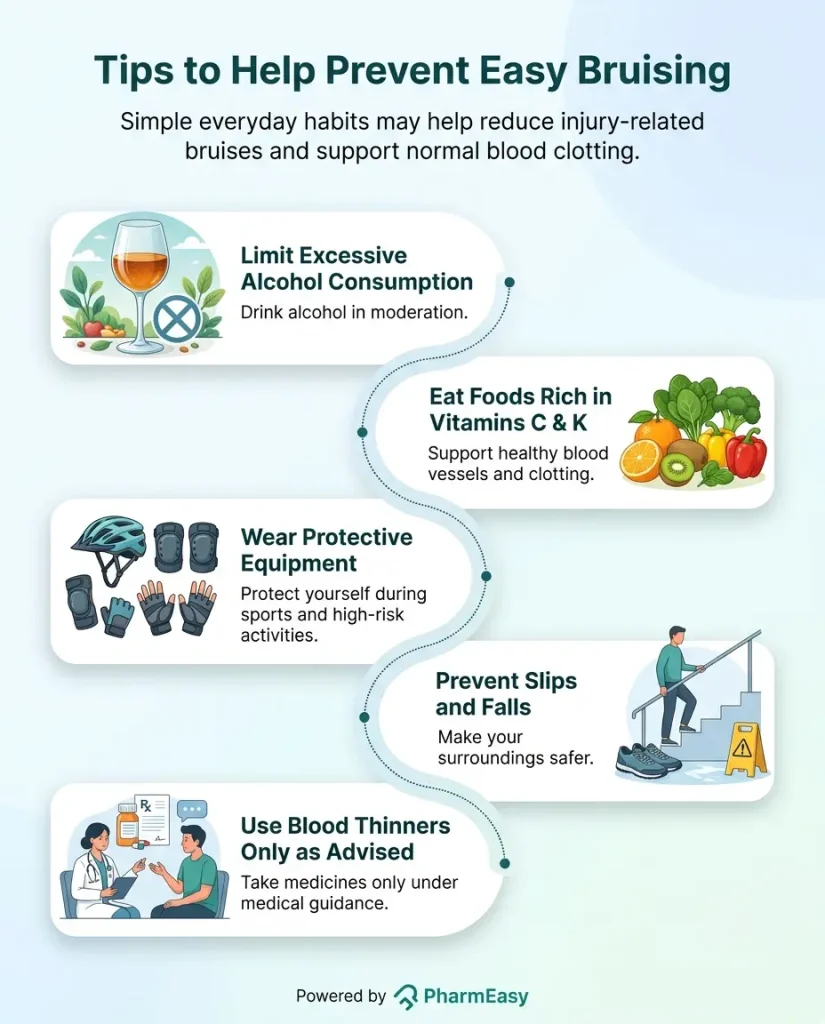
Although not all bruising can be prevented, the following steps may help reduce the risk of injury-related bruises and support normal clotting:
Note: These measures may reduce the risk of some bruises but may not prevent bruising caused by medicines or medical conditions. If bruising is frequent, unexplained, or accompanied by unusual bleeding, consult a doctor to identify and treat the cause.
Also Read: Sprained Ankle: What Is It, Causes, Symptoms & More
Consult a doctor in case of frequent or unexplained bruises, large or painful bruises, or bruises that take an unusually long time to heal1. Medical advice is also important if bruising is accompanied by frequent nosebleeds, bleeding gums, or heavy menstrual bleeding, or starts after beginning a new medication4,6. Seek medical evaluation in case there is a family history of bleeding disorders, or if bruising occurs along with unexplained weight loss, persistent fever, severe tiredness, swollen lymph nodes, or after a significant injury causing severe pain, swelling, or difficulty moving the affected limb1,9.
Also Read: Dermatitis Herpetiformis: Causes, Symptoms, Treatment, and Prevention Tips
Easy bruising means bruising more readily than expected after minor contact or without an obvious injury. While occasional bruising is usually harmless, frequent, unexplained, large, painful, or worsening bruises may sometimes signal an underlying health condition. A timely medical evaluation can help identify the cause and guide appropriate treatment. If you notice persistent or unusual bruising, consult a doctor rather than ignoring the symptoms.
Stress itself is not a direct cause of easy bruising. However, a rare condition called psychogenic purpura (Gardner-Diamond syndrome) has been associated with emotional or psychological stress. People with this condition may develop painful bruises, often after minor injuries or sometimes without a clear cause. However, this is a rare condition and is not the same as the common bruises that most people get21.
Easy bruising is often harmless2. However, if bruises occur frequently, appear without a clear cause, or are accompanied by unusual bleeding or other symptoms, it is important to consult a doctor, as they may indicate an underlying medical condition6,7.
Most bruises heal on their own within 1 to 2 weeks1, although larger or deeper bruises may take longer to fade completely.
Easy bruising does not usually indicate a heart problem. However, some medications used to treat heart conditions, such as blood thinners or aspirin, can make bruising more common3,4.
Easy bruising may sometimes be caused by deficiencies of vitamin C, vitamin K, or zinc, as these nutrients help maintain healthy blood vessels and normal blood clotting. However, bruising can also have many other causes, so a medical evaluation may be needed3,4.
Easy bruising does not directly mean diabetes. However, if a bruise takes longer than usual to heal, this may sometimes be associated with diabetes, especially if accompanied by other symptoms such as increased thirst and frequent urination22. If persistent or unexplained bruising is noticed, it is suggested to consult a doctor for proper evaluation.
1. Bumps, knocks and bruises. 2025. Available from: https://www.healthdirect.gov.au/bumps-knocks-and-bruises
2. Bruising Question – The What, Why, and How of Bruises. 2022. Available from: https://newsinhealth.nih.gov/2022/01/bruising-questions
3. Bruises. 2024. Available from: https://www.health.qld.gov.au/newsroom/podcasts/it-cant-hurt-to-ask/in-my-blood/bruises
4. Why do I bruise so easily? 2026. Available from: https://www.health.harvard.edu/preventive-care/why-do-i-bruise-so-easily-ULHGN3LM easy bruise cause ageing
5. Sports injuries. 2015. Available from: https://www.betterhealth.vic.gov.au/health/healthyliving/sports-injuries
6. Bleeding Disorders. Available from: https://www.hematology.org/education/patients/bleeding-disorders
7. About von Willebrand Disease. 2024. Available from: https://www.cdc.gov/von-willebrand/about/index.html
8. Thrombocytopenia. 2025. Available from: https://www.healthdirect.gov.au/thrombocytopenia
9. Chennamadhavuni A, Iyengar V, Mukkamalla SKR, Shimanovsky A. Leukemia. 2023. Available from: https://www.ncbi.nlm.nih.gov/books/NBK560490/
10. Ehlers-Danlos syndrome. 2022. Available from: https://medlineplus.gov/genetics/condition/ehlers-danlos-syndrome/
11. Bruising. 2024. Available from: https://liver.org.au/your-liver/symptoms/bruising/
12. Collins PW, Hamilton M, Dunstan FD, et al. Patterns of bruising in preschool children with inherited bleeding disorders: a longitudinal study. Arch Dis Child. 2017;102(12):1110-1117. doi:10.1136/archdischild-2015-310196 Available from: https://pubmed.ncbi.nlm.nih.gov/27449675/
13. Complete Blood Count (CBC). 2024. Available from: https://medlineplus.gov/lab-tests/complete-blood-count-cbc/
14. Platelet count. 2025. Available from: https://medlineplus.gov/ency/article/003647.htm
15. Fibrinogen blood test. 2025. Available from: https://medlineplus.gov/ency/article/003650.htm
16. Blood Smear. 2024. Available from: https://medlineplus.gov/lab-tests/blood-smear/
17. Partial Thromboplastin Time (PTT) Test. 2026. Available from: https://medlineplus.gov/lab-tests/partial-thromboplastin-time-ptt-test/
18. Vitamin K deficiency. 2026. Available from: https://www.healthdirect.gov.au/vitamin-k-deficiency
19. Can blood-thinners make you bruise more easily? 2026. Available from: https://www.bhf.org.uk/informationsupport/heart-matters-magazine/medical/ask-the-experts/bruises-from-blood-thinners
20. Fraser IM, Dean M. Extensive bruising secondary to vitamin C deficiency. BMJ Case Reports. 2009;2009:bcr0820080750. doi:10.1136/bcr.08.2008.0750 Available from: https://pubmed.ncbi.nlm.nih.gov/21686649/
21. Jafferany M, Bhattacharya G. Psychogenic Purpura (Gardner-Diamond Syndrome): (Brief Report). Prim Care Companion CNS Disord. Published online January 22, 2015. doi:10.4088/PCC.14br01697 Available from: https://pmc.ncbi.nlm.nih.gov/articles/PMC4468873/
22. Warning Signs and Symptoms of Diabetes. Available from: https://diabetes.org/about-diabetes/warning-signs-symptoms
Disclaimer: The information provided here is for educational/awareness purposes only and is not intended to be a substitute for medical treatment by a healthcare professional and should not be relied upon to diagnose or treat any medical condition. The reader should consult a registered medical practitioner to determine the appropriateness of the information and before consuming any medication. PharmEasy does not provide any guarantee or warranty (express or implied) regarding the accuracy, adequacy, completeness, legality, reliability or usefulness of the information; and disclaims any liability arising thereof.
Links and product recommendations in the information provided here are advertisements of third-party products available on the website. PharmEasy does not make any representation on the accuracy or suitability of such products/services. Advertisements do not influence the editorial decisions or content. The information in this blog is subject to change without notice. The authors and administrators reserve the right to modify, add, or remove content without notification. It is your responsibility to review this disclaimer regularly for any changes.


Comments

Leave your comment...
You may also like






















Comments