




Typhoid in Kids: Symptoms, Causes, Treatment & Prevention Guide
By Dr. Sarthak Soni +2 more

Medically reviewed by Dr. Sarthak Soni
Last updated: Aug 21, 2026 Published on: Jul 6, 2026


Get,

to manage your symptom
Get your,

4 Cr+ families
benefitted

OTP sent to 9988776655



You’ve successfully subscribed to receive
doctor-approved tips on
Whatsapp

Get ready to feel your best.


Register to Avail the Offer
Send OTPBy continuing, you agree with our Privacy Policy and Terms and Conditions
Hi There,
Sign up on PharmEasy now!!


Trusted by 4 crore+ families

OTP sent to 9988776655
You have unlocked 25% off on medicines


Code: NU25

By Dr. Sarthak Soni +2 more
Table of Contents
It is a well-known fact that children are prone to infections because their immune system is still not fully developed. Typhoid is one such infection common in children that causes fever and gastric symptoms like vomiting, diarrhea, stomach pain etc. While the symptoms can be distressing for the child, this infection can be cured with proper management. Early diagnosis using blood tests and correct treatment can relieve the symptoms and lead to full recovery.
This guide will cover the causes, modes of transmission, symptoms, diagnosis, and management of typhoid in children. It will also discuss about some signs which indicate that the child is recovering and share some tips to prevent typhoid in children1,2.

Typhoid fever is a gastrointestinal infection that is caused by the bacteria Salmonella typhi. It can occur in children of any age, although it is commonly seen in school-aged children (from 5-12 years). Children are generally more susceptible to typhoid as they have not acquired immunity from past infections. Also, the infection in children is different from those in adults because the fever can be milder and atypical (may not have characteristic symptoms) at this age. This means that it may be difficult to effectively diagnose typhoid and initiate appropriate treatment in children1,3.
Typhoid in kids is primarily caused by the bacteria called Salmonella typhi1.
The symptoms of typhoid fever in children may include:
Doctors use certain blood tests to diagnose typhoid in children. These include:
Doctors usually prescribe certain antibiotics to treat typhoid in children. These include11:
Note: It is important to note that doctors will advise antibiotics depending on the antimicrobial resistance (pathogens become resistant to antibiotics) status in the area at that time. Never give antibiotics to children without a doctor’s prescription. Using the wrong antibiotic or discontinuing treatment early might cause antibiotic resistance and raise the chance of treatment failure or relapse.
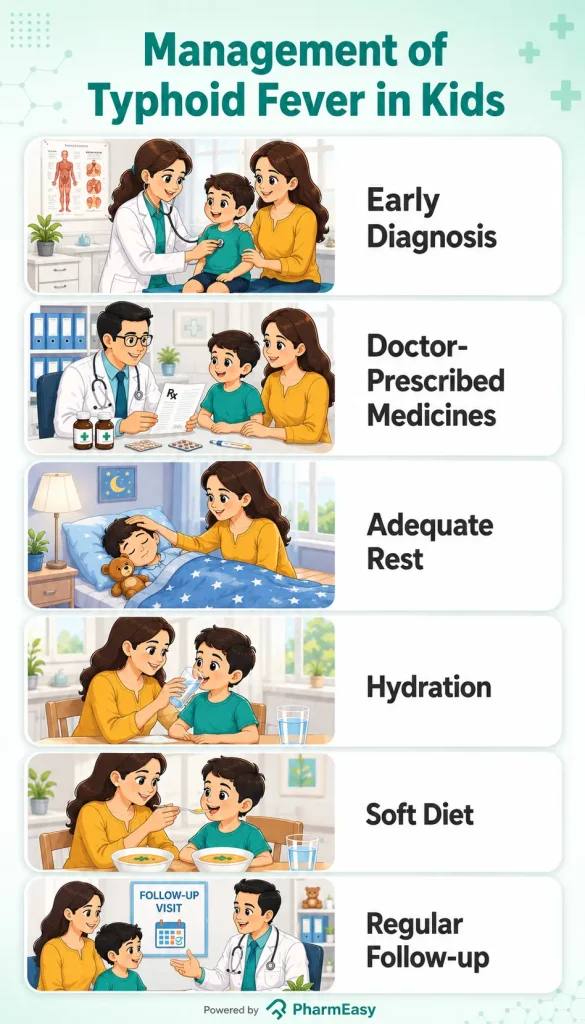
There are several ways for supportive management of typhoid fever in children. Parents should keep in mind the following things while taking care of the child at home:
It is important that parents give their children light, nutritious, and easy-to-digest food during their recovery from typhoid.
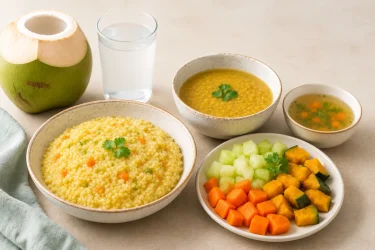
During recovery, choose foods that are gentle on their stomach and rich in nutrients. Give them soft, low-fiber and high energy foods. Include foods such as soft-cooked rice or khichdi, moong dal or other well-cooked lentils, well-boiled or steamed vegetables like bottle gourd, carrots, pumpkins etc. Give lots of fluids like coconut water and clear soups to keep the child hydrated.
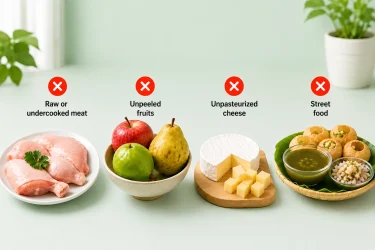
To prevent stomach irritation and aid recovery it is important to avoid certain foods, such as raw or undercooked meat, unpeeled fruits, unpasteurized cheese, and street food9. Fried, oily, high-fiber and acidic foods should also be avoided.
Also Read: Top Immunity Boosting Foods for Kids
There are a few signs that indicate that a child is recovering from typhoid infection. These are as follows:
Although typhoid fever is a serious illness, the infection can be prevented in kids with a few simple measures:
You should consult your doctor if, during the typhoid infection, your child has started developing new and more severe symptoms. These include severe abdominal pain, blood in stool, difficulty concentrating and decreased urine output. Also, if your child has had typhoid infection in the past, and symptoms return, you should inform your doctor as this could be indicative of a relapse4.
Typhoid fever is highly prevalent in children between the ages of 5 to 12. It is important that parents keep an eye out even for mild symptoms of typhoid as children may show subclinical symptoms. With early diagnosis, proper administration of antibiotics, and maintenance of hygiene, typhoid fever can be effectively managed in children.
Also Read: Typhoid Fever Rash: When Rose Spots Appear & What You Should Do
Parents should ensure that their kids are consuming soft, low-fiber meals during typhoid infection. These may include khichdi, well-cooked lentils, clear soups etc. Drinking lots of fluids is also important to prevent dehydration.
Generally, typhoid in kids can be managed well. However, in certain cases, the infection may become severe and lead to complications such as severe dehydration, seizures or bleeding. Early diagnosis and proper antibiotic treatment are essential for effective management of typhoid infection6.
For a child with typhoid fever, it is best to avoid full-fat dairy products. It needed, the child should have only boiled or pasteurized low-fat milk in moderation.
Yes, with appropriate and early treatment, typhoid fever is curable in children4.
There is no evidence of any food that can kill typhoid bacteria. Usually, antibiotics are administered to the diagnosed patient to kill the bacteria11.
There is no evidence of any food which is good for typhoid fever. However, it is important that whichever food your child consumes, should be peeled and washed properly5.
1. Sinha A, Sazawal S, Kumar R, et al. Typhoid fever in children aged less than 5 years. The Lancet. 1999;354(9180):734-737. doi:10.1016/S0140-6736(98)09001-1 Available from: https://pubmed.ncbi.nlm.nih.gov/10475185/
2. Mweu E, English M. Typhoid fever in children in Africa. Trop Med Int Health. 2008;13(4):532-540. doi:10.1111/j.1365-3156.2008.02031.x Available from: https://pmc.ncbi.nlm.nih.gov/articles/PMC2660514/
3. Indian Journal of Medical Research. Accessed June 29, 2026. Available from: https://journals.lww.com/ijmr/Fulltext/2019/50050/Typhoid_fever__Control___challenges_in_India.4.aspx
4. Typhoid fever: MedlinePlus Medical Encyclopedia. Accessed June 29, 2026. Available from: https://medlineplus.gov/ency/article/001332.htm
5. Content – Health Encyclopedia – URochester Medicine. Accessed June 29, 2026. Available from: https://www.urmc.rochester.edu/encyclopedia/content?ContentTypeID=85&redir=128.151.10.65/encyclopedia/content.cfm&ContentID=P01462
6. Rafiq H, Zia R, Naeem S. TYPHOID FEVER –CONTINUES AS A MAJOR THREAT IN CHILDREN. Available from: https://www.researchgate.net/publication/266408708_Typhoid_Fever_-Continues_As_a_Major_Threat_in_Children?__cf_chl_f_tk=8TOTsVJyg2JbKXsCQLEm61b8Ulqc9aXPvQSwKn5sJjg-1783328106-1.0.1.1-beGN_KXlEJxa7YPMwdxaAZCxDwVxVzMLVUmXYnzIEg8
7. Chernokhvostova E, Luxemburg KI, Starshinova V, Andreeva N, German G. Study on the production of IgG-, IgA- and IgM-antibodies to somatic antigens of Salmonella typhi in humans. Clin Exp Immunol. 1969;4(4):407-421. Available from: https://pubmed.ncbi.nlm.nih.gov/4182404/
8. Mallouh AA, Sa’di AR. White blood cells and bone marrow in typhoid fever. Pediatr Infect Dis J. 1987;6(6):527-529. doi:10.1097/00006454-198706000-00007Available from: https://pubmed.ncbi.nlm.nih.gov/3615066/
9. Bhandari J, Thada PK, Hashmi MF, DeVos E. Typhoid Fever. In: StatPearls. StatPearls Publishing; 2026. Accessed June 29, 2026.Available from: http://www.ncbi.nlm.nih.gov/books/NBK557513/
10. Wain J, Diep TS, Bay PVB, et al. Specimens and culture media for the laboratory diagnosis of typhoid fever. J Infect Dev Ctries. 2008;2(06):469-474. doi:10.3855/jidc.164 Available from: https://pubmed.ncbi.nlm.nih.gov/19745526/
11. Recommendations for management of common childhood conditions. Accessed June 29, 2026. Available from: https://www.who.int/publications/i/item/9789241502825
12. Dahiya S, Malik R, Sharma P, et al. Current antibiotic use in the treatment of enteric fever in children. Indian J Med Res. 2019;149(2):263-269. doi:10.4103/ijmr.IJMR_199_18 Available from: https://pubmed.ncbi.nlm.nih.gov/31219092/
13. Bhutta ZA. Current concepts in the diagnosis and treatment of typhoid fever. Published online July 6, 2006. doi:10.1136/bmj.333.7558.78 Available from: https://www.bmj.com/content/333/7558/78
14. CDC. Typhoid Vaccine VIS. Vaccines & Immunizations. June 4, 2026. Accessed June 29, 2026. Available from: https://www.cdc.gov/vaccines/hcp/current-vis/typhoid.html
15. CDC. Preventing Typhoid Fever and Paratyphoid Fever. Typhoid Fever and Paratyphoid Fever. August 5, 2025. Accessed June 29, 2026. Available from: https://www.cdc.gov/typhoid-fever/prevention/index.html
Disclaimer: The information provided here is for educational/awareness purposes only and is not intended to be a substitute for medical treatment by a healthcare professional and should not be relied upon to diagnose or treat any medical condition. The reader should consult a registered medical practitioner to determine the appropriateness of the information and before consuming any medication. PharmEasy does not provide any guarantee or warranty (express or implied) regarding the accuracy, adequacy, completeness, legality, reliability or usefulness of the information; and disclaims any liability arising thereof.
Links and product recommendations in the information provided here are advertisements of third-party products available on the website. PharmEasy does not make any representation on the accuracy or suitability of such products/services. Advertisements do not influence the editorial decisions or content. The information in this blog is subject to change without notice. The authors and administrators reserve the right to modify, add, or remove content without notification. It is your responsibility to review this disclaimer regularly for any changes.


Comments

Leave your comment...
You may also like























Comments