




Food Intolerance: What is It, Symptoms, Causes, Treatment & More
By Dr. Swara Soumitra Pendse +2 more

Medically reviewed by Dr. Swara Soumitra Pendse
Last updated: Aug 17, 2026 Published on: Aug 17, 2026


Get,

to manage your symptom
Get your,

4 Cr+ families
benefitted

OTP sent to 9988776655



You’ve successfully subscribed to receive
doctor-approved tips on
Whatsapp

Get ready to feel your best.


Register to Avail the Offer
Send OTPBy continuing, you agree with our Privacy Policy and Terms and Conditions
Hi There,
Sign up on PharmEasy now!!


Trusted by 4 crore+ families

OTP sent to 9988776655
You have unlocked 25% off on medicines


Code: NU25

By Dr. Swara Soumitra Pendse +2 more
Table of Contents
It is common for some people to experience discomfort after eating specific foods. Problems such as bloating, stomach pain, gas, headaches, or nausea may appear after consuming items like milk, wheat, spicy foods, or processed products. In many cases, these reactions are linked to food intolerance.
While usually less serious than a food allergy (that involves the immune system), food intolerance could still greatly affect daily comfort and quality of life1.

This article explains the meaning of food intolerance, its common types, causes, symptoms, diagnosis, and practical ways to manage it effectively.
Food intolerance is a non-allergic reaction to a food or ingredient that can cause symptoms after eating amounts that are usually well tolerated by others. It is one of the most common types of adverse food reactions and is estimated to affect up to 20% of the population.
Food intolerance differs from food allergy because it does not involve the immune system. Instead, it usually occurs because the body has difficulty digesting or processing certain foods or ingredients1.
Food intolerance can occur in response to a wide range of food items, ingredients, or naturally occurring food chemicals. Some of the most common types of food intolerance include1,2:
Food intolerance causes can vary from person to person and may include digestive, chemical, or gastrointestinal factors. Common causes of food intolerance include:
Symptoms of food intolerance can range widely depending on the individual. Common food intolerance symptoms include3:
Understanding the difference between food allergy and food intolerance is important because food allergies can sometimes become life-threatening, while food intolerance is usually less severe3,4.
| Feature | Food Intolerance | Food Allergy |
| Cause | Difficulty digesting or processing certain foods or ingredients | Immune system mistakenly reacts to a food protein |
| Role of antibodies (IgE) | No involvement of IgE antibodies | Often involves IgE antibodies |
| Common triggers | Lactose, gluten, caffeine, food additives, histamine | Milk, peanuts, eggs, shellfish, tree nuts, soy |
| Symptoms | Bloating, gas, diarrhoea, headaches, nausea, stomach discomfort | Hives, swelling, itching, vomiting, breathing difficulty |
| Severity | Usually uncomfortable but not life-threatening | Can become severe or life-threatening |
| Risk of anaphylaxis | No | Yes, in severe cases |
Diagnosing food intolerance can sometimes be challenging because symptoms may vary and often resemble other digestive conditions. A doctor may refer you to a dietitian or food and nutrition specialist to help identify the possible trigger foods. Common methods used to diagnose food intolerance include:
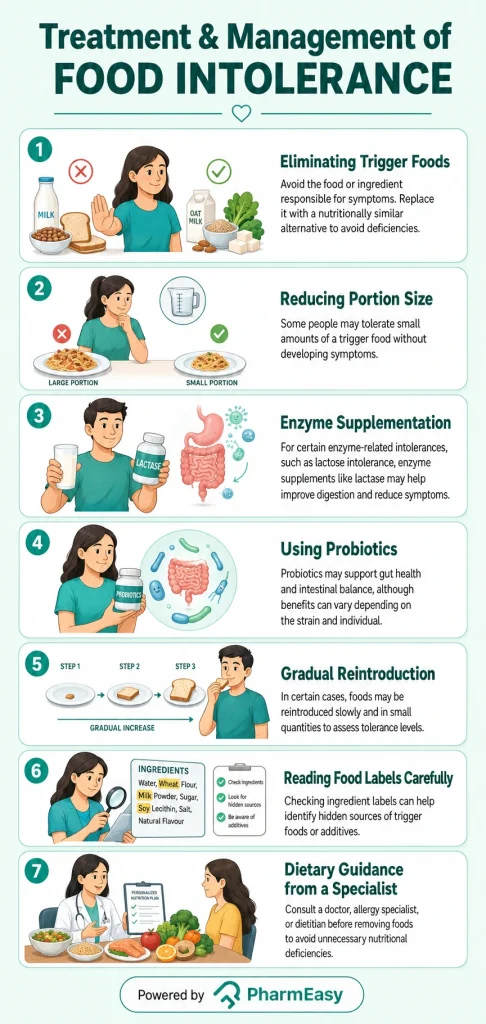
The ideal management option for food intolerance is to avoid or reduce the intake of foods that trigger symptoms. Common approaches include:
While these strategies are mostly preventive, during an adverse episode of intolerance of a food item, managing the associated symptoms is important. Medications such as antacids, antidiarrheals, or other symptom-relieving medications may be used to relieve discomfort7,8. However, these medicines do not address the underlying cause and should be used under medical guidance.
Note: The effectiveness of enzyme supplements, probiotics, and other symptom relieving medications may differ from person to person. So, it is advisable to consult a doctor before starting any new treatment for food intolerance.
You should consult a doctor if you or your child experiences symptoms of food intolerance that occur repeatedly or do not improve. Persistent digestive discomfort, bloating, diarrhoea, headaches, or reactions after eating certain foods may require medical evaluation to identify the trigger and rule out other conditions2.
In addition to this, seek immediate emergency medical help if you notice2:
These symptoms may indicate anaphylaxis, a serious and potentially life-threatening allergic reaction that requires urgent medical attention.
Also Read: Vitamin D-Rich Fruit Sources and Their Health Benefits
Food intolerance is a common condition that can affect digestion, comfort, and overall quality of life. Although it is usually less serious than a food allergy, it can still cause unpleasant symptoms such as bloating, stomach pain, headaches, and diarrhoea after eating certain foods.
Therefore, identifying and managing trigger foods is an important step in controlling symptoms. Dietary adjustments, careful food choices, and professional guidance can help most people manage food intolerance effectively while maintaining balanced nutrition.
If symptoms persist or recur frequently, it is important to seek medical advice for proper diagnosis and food intolerance treatment. A doctor or dietitian can help identify the underlying cause, recommend suitable dietary changes, and ensure nutritional needs are met safely.
No, food intolerance does not involve the immune system. It usually occurs when the body has difficulty digesting or processing certain foods or ingredients. In contrast, food allergies involve an immune reaction3.
No, adrenaline (epinephrine) is used for severe allergic reactions such as anaphylaxis, not food intolerance. Food intolerance is generally managed by avoiding or limiting triggering foods3.
Some food intolerances may have a genetic component. For example, lactose intolerance often runs in families and is more common in certain populations. However, environmental and digestive factors can also contribute1.
In some cases, symptoms may improve over time especially with proper dietary management and gut health support2,3. It is important to consult a doctor or dietitian to better understand the condition, identify trigger foods, and receive appropriate guidance for management and nutrition.
Food intolerance itself does not directly cause weight gain. However, it might contribute indirectly through inflammation, digestive discomfort, or changes in eating habits due to symptoms9.
Stress does not directly cause food intolerance, but it can worsen digestive symptoms and increase sensitivity to certain foods. Stress may also affect gut function and overall digestion10.
Hormonal changes during menopause may affect digestion and gut sensitivity11. This could make some women more sensitive to certain foods. So, although menopause does not directly cause food intolerance, symptoms may become more noticeable during this stage.
1. Tuck CJ, Biesiekierski JR, Schmid-Grendelmeier P, Pohl D. Food Intolerances. Nutrients. 2019;11(7):1684. doi:10.3390/nu11071684. https://pubmed.ncbi.nlm.nih.gov/31336652/
2. Food intolerance. nhs.uk. October 18, 2017. Accessed May 21, 2026. https://www.nhs.uk/conditions/food-intolerance/
3. Food allergy and intolerance | Better Health Channel. Accessed May 21, 2026. https://www.betterhealth.vic.gov.au/health/conditionsandtreatments/food-allergy-and-intolerance#symptoms-of-food-intolerance
4. Hage G, Sacre Y, Haddad J, Hajj M, Sayegh LN, Fakhoury-Sayegh N. Food Hypersensitivity: Distinguishing Allergy from Intolerance, Main Characteristics, and Symptoms—A Narrative Review. Nutrients. 2025;17(8):1359. doi:10.3390/nu17081359. https://pubmed.ncbi.nlm.nih.gov/40284223/
5. Goosenberg E, Afzal M. Lactose Intolerance. In: StatPearls. StatPearls Publishing; 2026. Accessed June 17, 2026. http://www.ncbi.nlm.nih.gov/books/NBK532285/
6. Jiang Z, Mei L, Li Y, et al. Enzymatic Regulation of the Gut Microbiota: Mechanisms and Implications for Host Health. Biomolecules. 2024;14(12):1638. doi:10.3390/biom14121638. https://pubmed.ncbi.nlm.nih.gov/39766345/
7. Salisbury BH, Terrell JM. Antacids. In: StatPearls. StatPearls Publishing; 2026. Accessed June 17, 2026. http://www.ncbi.nlm.nih.gov/books/NBK526049/
8. Schiller LR. Antidiarrheal Drug Therapy. Curr Gastroenterol Rep. 2017;19(5):18. doi:10.1007/s11894-017-0557-x. https://pubmed.ncbi.nlm.nih.gov/28397130/
9. Gargano D, Appanna R, Santonicola A, et al. Food Allergy and Intolerance: A Narrative Review on Nutritional Concerns. Nutrients. 2021;13(5):1638. doi:10.3390/nu13051638. https://pmc.ncbi.nlm.nih.gov/articles/PMC8152468/
10. Stress and the gut: pathophysiology, clinical consequences, diagnostic approach and treatment options – PubMed. Accessed May 21, 2026. https://pubmed.ncbi.nlm.nih.gov/22314561/
11. Shaw N, Abbott R, Pettinger C. The volume and characteristics of research on gastrointestinal symptoms in ‘natural’ peri- and postmenopause: A scoping review. Womens Health. 2025;21:17455057251387470. doi:10.1177/17455057251387470. https://pmc.ncbi.nlm.nih.gov/articles/PMC12575958/
Disclaimer: The information provided here is for educational/awareness purposes only and is not intended to be a substitute for medical treatment by a healthcare professional and should not be relied upon to diagnose or treat any medical condition. The reader should consult a registered medical practitioner to determine the appropriateness of the information and before consuming any medication. PharmEasy does not provide any guarantee or warranty (express or implied) regarding the accuracy, adequacy, completeness, legality, reliability or usefulness of the information; and disclaims any liability arising thereof.
Links and product recommendations in the information provided here are advertisements of third-party products available on the website. PharmEasy does not make any representation on the accuracy or suitability of such products/services. Advertisements do not influence the editorial decisions or content. The information in this blog is subject to change without notice. The authors and administrators reserve the right to modify, add, or remove content without notification. It is your responsibility to review this disclaimer regularly for any changes.


Comments

Leave your comment...
You may also like























Comments