




Struggling with Dry Eyes? Causes, Symptoms, Treatments & Prevention
By Dr. Poonam Rai +2 more

Medically reviewed by Dr. Poonam Rai
Last updated: Sep 11, 2026 Published on: Jun 12, 2026


Get,

to manage your symptom
Get your,

4 Cr+ families
benefitted

OTP sent to 9988776655



You’ve successfully subscribed to receive
doctor-approved tips on
Whatsapp

Get ready to feel your best.


Register to Avail the Offer
Send OTPBy continuing, you agree with our Privacy Policy and Terms and Conditions
Hi There,
Sign up on PharmEasy now!!


Trusted by 4 crore+ families

OTP sent to 9988776655
You have unlocked 25% off on medicines


Code: NU25

By Dr. Poonam Rai +2 more
Table of Contents
Do your eyes often feel itchy, tired, or irritated, especially after spending time on screens? You’re not alone. Dry eyes is one of the most common eye problems affecting millions of people worldwide. While it is usually not serious, it can cause significant discomfort and interfere with daily activities1. In this article, we’ll explore the causes, symptoms, types, treatment options, home remedies, and prevention tips for dry eyes. Understanding dry eye and its triggers can help you take the right steps to protect your eye health and improve your overall comfort.
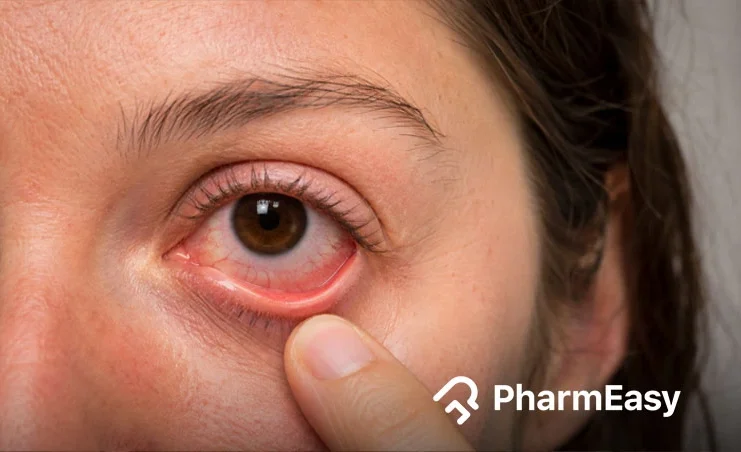
Dry eyes, or dry eye syndrome, is a common condition that occurs when your eyes do not produce enough tears or when the tears evaporate too quickly2. Tears are essential for keeping the eyes moist, comfortable, and healthy. They also help wash away dust and debris, protect the surface of the eye from infection, and support clear vision3.
The tear film contains oil, water, and mucus, which work together to prevent the tears from drying out and help them spread evenly over the eye. When the balance of these components is disrupted, tears can evaporate too quickly or fail to cover the eye properly, leading to dry, irritated, and inflamed eyes2.
Dry eyes may feel itchy and irritated, having a gritty or stinging type of sensation4.
Did You Know?
Dry eye can develop for many reasons, ranging from everyday habits and environmental factors to certain medical conditions and medications. The following are a few common dry eye causes:
People with dry eyes may experience several symptoms. The following are a few common dry eye symptoms:
Dry eye is not the same for everyone. Depending on the underlying cause, it can be classified into different types:
Evaporative dry eye occurs when tears evaporate too quickly from the surface of the eye. This is the most common type of dry eye. This condition is usually caused by the dysfunction of the meibomian glands, which produce the oily layer of tears. When they become blocked or do not function properly, tears dry up faster than normal1.
The common causes include:
Aqueous-deficient dry eye occurs when the lacrimal glands do not produce enough of the watery component of tears. Without sufficient tear production, the eyes cannot remain adequately lubricated, resulting in dryness and inflammation1.
The common causes include:
Mixed dry eye is a combination of both evaporative and aqueous-deficient dry eye. This occurs when the eyes do not produce enough tears and the tears evaporate too quickly. Many people with dry eye disease have the combination of both types of dry eye11.
Your doctor might prescribe or recommend a treatment for dry eye based on your condition. The following are a few dry eye treatment options that he might suggest:
Note: Treatment for dry eye may vary from person to person. Do not buy and use any medication without a doctor’s prescription or consent. Please consult an eye specialist for proper diagnosis and treatment.
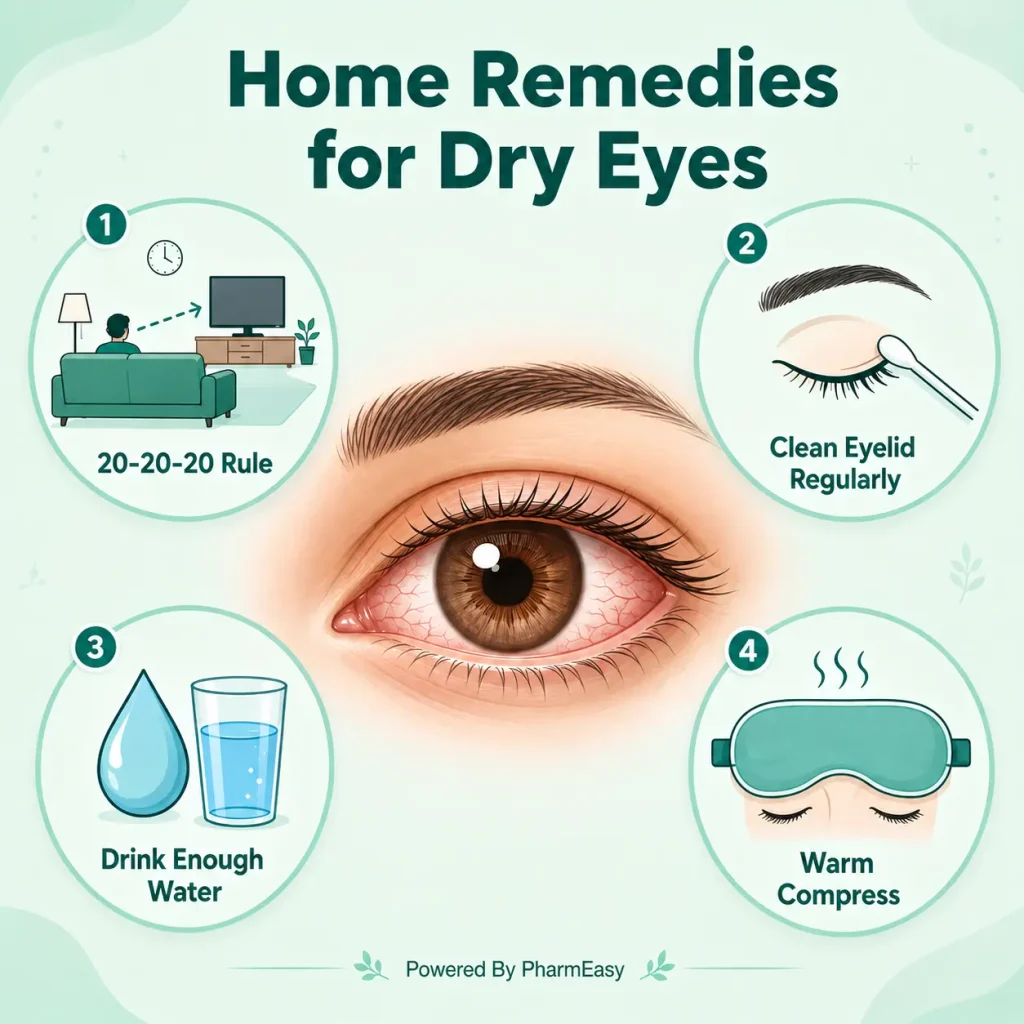
You can manage mild dry eye symptoms at your home. The following are a few easy home remedies for dry eyes.
Note: The information provided is for general awareness only and is not a substitute for professional medical advice, diagnosis, or treatment. If you have persistent or worsening dry eye symptoms, please consult an eye care professional for proper evaluation and management.
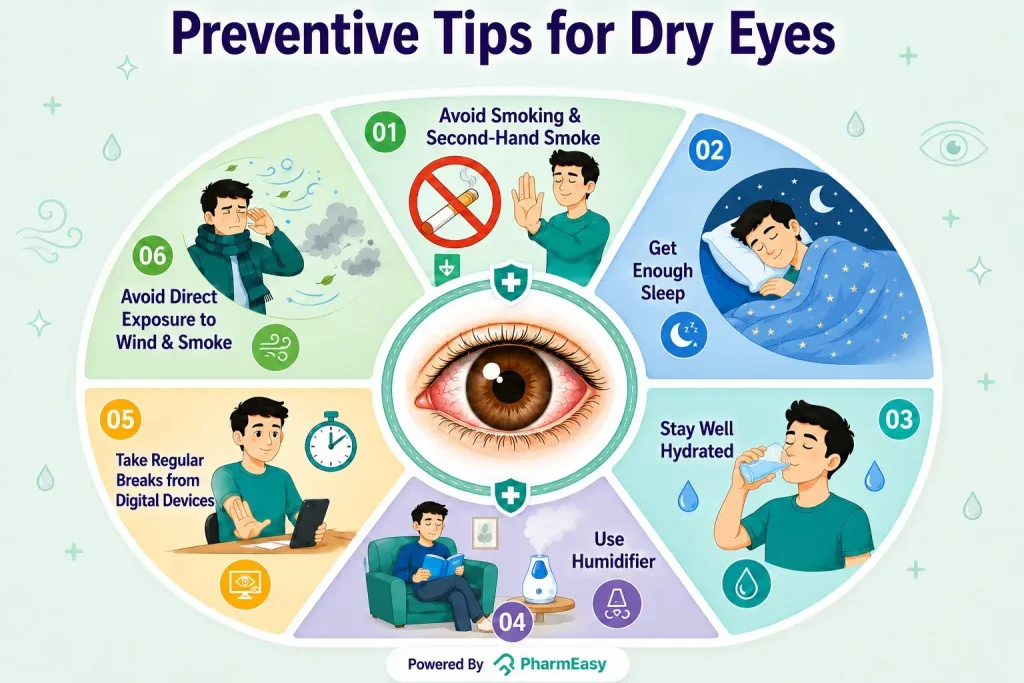
The following are a few ways by which you can avoid having dry eyes:
If your dry eye symptoms persist, worsen, or interfere with your regular activities, you should see an eye doctor. Seek medical treatment if you have severe eye pain, redness, light sensitivity, discharge, or unexpected changes in vision. Early diagnosis and treatment can assist to avoid problems and enhance long-term eye comfort4.
Also Read: Eye Stroke: Symptoms, Causes, Treatment & Prevention
Dry eye syndrome is a common condition that may affect comfort, vision, and overall well-being. It can develop because of ageing, environmental factors, medical issues, or excessive screen time. Understanding the causes, symptoms, and treatment choices will help you manage the disease more effectively. Most people can successfully lessen symptoms and maintain healthy, comfortable eyes by following proper eye care, making lifestyle changes, and seeking timely medical guidance.
Also Read: Sunken Eyes: Causes, Symptoms, Home Remedies & More
You can manage dry eye by using lubricating eye drops, taking regular screen breaks (like the 20-20-20 rule), and avoiding dry or windy environments. Warm compresses and good eyelid hygiene can also help improve tear quality. If symptoms continue, it’s best to consult an eye doctor for proper treatment2,10,15,16.
Dry eye can often be improved and well controlled with treatment during the initial stages. But it is not always completely reversible, especially if it is caused by long-term or chronic conditions. Early diagnosis and proper care can significantly reduce symptoms and prevent it from getting worse1.
Severe dry eye is an advanced form of dry eye where the eyes have very little tear production or significant damage to the eye surface. It can cause scarring of the eye’s surface or damage to the cornea9.
Vitamins A, D, and E, along with omega-3 fatty acids, may help support tear production and maintain eye health17. A balanced diet rich in these nutrients can help reduce dry eye symptoms in some people.
Dry eye can be a long-term condition for some people, especially when linked to ageing or underlying health conditions. However, symptoms can often be effectively managed with proper treatment and lifestyle changes16.
1. Aragona P, Barabino S, Di Zazzo A, et al. Dry Eye Disease: From Causes to Patient Care and Clinical Collaboration—A Narrative Review. Ophthalmol Ther. 2025;14(7):1411-1428. doi:10.1007/s40123-025-01161-8. Available from: https://pubmed.ncbi.nlm.nih.gov/40434534/
2. Better Health Channel. Dry eye [Internet]. 2023 Nov 8 [cited 2026 Jun 12]. Available from: https://www.betterhealth.vic.gov.au/health/conditionsandtreatments/dry-eye
3. National Eye Institute. How tears work [Internet]. Bethesda (MD): National Eye Institute, National Institutes of Health; 2025 Aug 6 [cited 2026 Jun 12]. Available from: https://www.nei.nih.gov/eye-health-information/healthy-vision/how-eyes-work/how-tears-work
4. Healthdirect Australia. Dry eyes [Internet]. Sydney (AU): Healthdirect Australia; reviewed 2024 May [cited 2026 Jun 12]. Available from: https://www.healthdirect.gov.au/dry-eye-disease
5. American Academy of Ophthalmology. Facts about tears [Internet]. San Francisco (CA): American Academy of Ophthalmology; 2024 Mar 15 [cited 2026 Jun 12]. Available from: https://www.aao.org/eye-health/tips-prevention/facts-about-tears
6. Ortega J, Plaska CR, Gomes BA, Ellmore TM. Spontaneous Eye Blink Rate During the Working Memory Delay Period Predicts Task Accuracy. Front Psychol. 2022;13:788231. doi:10.3389/fpsyg.2022.788231. Available from: https://www.frontiersin.org/journals/psychology/articles/10.3389/fpsyg.2022.788231/full
7. American Academy of Ophthalmology. How hormones can affect eyes and vision [Internet]. San Francisco (CA): American Academy of Ophthalmology; 2024 Jun 18 [cited 2026 Jun 12]. Available from: https://www.aao.org/eye-health/tips-prevention/how-hormones-can-affect-eyes-vision
8. Waghmare SV, Jeria S. A Review of Contact Lens-Related Risk Factors and Complications. Cureus. Published online October 10, 2022. doi:10.7759/cureus.30118. Available from: https://pubmed.ncbi.nlm.nih.gov/36381898/
9. Messmer EM. The Pathophysiology, Diagnosis, and Treatment of Dry Eye Disease. Deutsches Ärzteblatt international. Published online January 30, 2015. doi:10.3238/arztebl.2015.0071. Available from: https://pubmed.ncbi.nlm.nih.gov/25686388/
10. Narang P, Donthineni PR, D’Souza S, Basu S. Evaporative dry eye disease due to meibomian gland dysfunction: Preferred practice pattern guidelines for diagnosis and treatment. Indian Journal of Ophthalmology. 2023;71(4):1348-1356. doi:10.4103/IJO.IJO_2841_22. Available from: https://pubmed.ncbi.nlm.nih.gov/37026266/
11. Donthineni PR, Doctor MB, Shanbhag S, et al. Aqueous-deficient dry eye disease: Preferred practice pattern guidelines on clinical approach, diagnosis, and management. Indian Journal of Ophthalmology. 2023;71(4):1332-1347. doi:10.4103/IJO.IJO_2808_22. Available from: https://pubmed.ncbi.nlm.nih.gov/37026265/
12. American Academy of Ophthalmology. Lubricating eye drops for dry eyes [Internet]. San Francisco (CA): American Academy of Ophthalmology; 2024 Sep 10 [cited 2026 Jun 12]. Available from: https://www.aao.org/eye-health/treatments/lubricating-eye-drops
13. De Oliveira RC, Wilson SE. Practical guidance for the use of cyclosporine ophthalmic solutions in the management of dry eye disease. OPTH. 2019;Volume 13:1115-1122. doi:10.2147/OPTH.S184412. Available from: https://pmc.ncbi.nlm.nih.gov/articles/PMC6612764/
14. Rafizadeh SM, Asadigandomani H, Khannejad S, et al. Oculoplastic Interventions in the Management of Ocular Surface Diseases: A Comprehensive Review. Life. 2025;15(7):1110. doi:10.3390/life15071110. Available from: https://pubmed.ncbi.nlm.nih.gov/40724611/
15. Findlay Q, Reid K. Dry eye disease: when to treat and when to refer. Aust Prescr. 2018;41(5):160-163. doi:10.18773/austprescr.2018.048. Available from: https://pubmed.ncbi.nlm.nih.gov/30410213/
16. National Eye Institute. Dry eye [Internet]. Bethesda (MD): National Eye Institute, National Institutes of Health; 2025 Aug 6 [cited 2026 Jun 12]. Available fromi: https://www.nei.nih.gov/eye-health-information/eye-conditions-and-diseases/dry-eye
17. Cong Y, Zhang Y, Han Y, Wu Y, Wang D, Zhang B. Recommendations for nutritional supplements for dry eye disease: current advances. Front Pharmacol. 2024;15:1388787. doi:10.3389/fphar.2024.1388787. Also Read: https://pubmed.ncbi.nlm.nih.gov/38873421/
Disclaimer: The information provided here is for educational/awareness purposes only and is not intended to be a substitute for medical treatment by a healthcare professional and should not be relied upon to diagnose or treat any medical condition. The reader should consult a registered medical practitioner to determine the appropriateness of the information and before consuming any medication. PharmEasy does not provide any guarantee or warranty (express or implied) regarding the accuracy, adequacy, completeness, legality, reliability or usefulness of the information; and disclaims any liability arising thereof.
Links and product recommendations in the information provided here are advertisements of third-party products available on the website. PharmEasy does not make any representation on the accuracy or suitability of such products/services. Advertisements do not influence the editorial decisions or content. The information in this blog is subject to change without notice. The authors and administrators reserve the right to modify, add, or remove content without notification. It is your responsibility to review this disclaimer regularly for any changes.


Comments

Leave your comment...
You may also like






















Comments