




Everything To Know About the Influenza Vaccine & Its Importance
By Dr. Vishesh Bharucha +2 more

Medically reviewed by Dr. Avinav Gupta
Last updated: Aug 24, 2026 Published on: Jun 10, 2025


Get,

to manage your symptom
Get your,

4 Cr+ families
benefitted

OTP sent to 9988776655



You’ve successfully subscribed to receive
doctor-approved tips on
Whatsapp

Get ready to feel your best.


Register to Avail the Offer
Send OTPBy continuing, you agree with our Privacy Policy and Terms and Conditions
Hi There,
Sign up on PharmEasy now!!


Trusted by 4 crore+ families

OTP sent to 9988776655
You have unlocked 25% off on medicines


Code: NU25

By Dr. Vishesh Bharucha +2 more
Table of Contents
Seasonal influenza, commonly known as the flu, is a highly contagious respiratory illness that affects millions of people worldwide. According to the World Health Organization (WHO), it causes about one billion infections worldwide (including both symptomatic and asymptomatic), resulting in 3 to 5 million severe cases and nearly 290,000 to 650,000 deaths related to respiratory complications each year1.
While many individuals recover without complications, influenza can lead to serious health outcomes, especially among those with existing medical conditions or weakened immune systems. In severe cases, it may even result in pneumonia, sepsis, or a worsening of chronic diseases1.

Flu vaccinations that are both safe and effective have been used for more than 60 years. They continue to be the best defence against influenza and its consequences2. This article explores everything you need to know about the influenza virus vaccine, from how it works to who should get it.
Wondering what is influenza vaccine used for?
The influenza vaccine, commonly known as the flu shot, is a preventive measure designed to protect against infection from influenza viruses. It works by stimulating the body’s immune system, particularly the antibody-mediated response, and in some cases, cell-mediated immunity to produce antibodies that target the hemagglutinin (HA) and neuraminidase (NA) proteins on the virus surface, without causing an illness. This helps the body recognise and fight off the virus if exposed later3.
Influenza vaccines are available in various forms, including inactivated influenza vaccine, nasal spray, as well as recombinant options4. These types will be discussed in detail in the following section.
Influenza vaccines for adults and children are available in different forms. The main types include:
This is the most common form of the flu vaccine, which is grown inside an embryonated egg (typically a chicken or hen’s egg)4.
Inactivated influenza vaccine also includes other forms such as4:
These vaccines are produced with recombinant DNA technology. While they do utilise parts of the influenza virus genome, they are not made using whole influenza viruses and do not involve egg-based production3.
This type of vaccine contains weakened live viruses and is sprayed into the nose4.
Note: Remember that accurate dosing depends on the influenza vaccine dosage chart guidelines. Always consult with a doctor to determine the best flu vaccine option for you.
To make the differences clearer, the table below compares the main types of influenza vaccines at a glance.
| Feature | Inactivated Influenza Vaccine (IIV) | Live Attenuated Influenza Vaccine (LAIV) | Adjuvanted Influenza Vaccine |
| Type of vaccine | Killed (inactivated) virus | Weakened (live attenuated) virus | Killed (inactivated) virus with an added booster ingredient |
| Route of administration | Injection (intramuscular) | Nasal spray | Injection (intramuscular) |
| Recommended age groups | 6 months and older | Generally healthy individuals aged 2 to 49 years | Mainly older adults (often 65 years and older) |
| Use during pregnancy | Considered safe at any stage | Not recommended | Generally not the routine choice; follow medical advice |
| Use in immunocompromised individuals | Generally suitable | Not recommended | Follow medical advice |
| Key advantages | Widely suitable, including for high-risk groups | Needle-free option for eligible people | Designed to produce a stronger immune response in older adults |
| Special considerations | Most commonly used form | Avoid in pregnancy, weak immunity, and certain other groups | Used to address weaker vaccine response in older age |
As always, the most suitable vaccine depends on your age, health status, and individual circumstances, so it is best to consult your doctor.
The influenza virus vaccine plays a vital role in protecting individual and public health. Here’s why the flu vaccination is so important:
As of 31st May 2025, the maximum number of seasonal influenza A cases were noted in Tamil Nadu (909 cases) followed by Karnataka (377) prompting for more vaccination awareness11.
Dr. Nayana S Shetty, MBBS, MD
The Advisory Committee on Immunization Practices (ACIP) recommends that everyone aged 6 months and older receive a flu vaccine each year unless they have specific medical reasons that contradict it3.
Vaccination is especially important for people at higher risk of serious complications from influenza and those who may spread the virus to vulnerable individuals. These include1:
Note: Vaccination during pregnancy also helps protect the newborn for the first few months after birth.
Note: Vaccination is recommended for all eligible children, not limited to age 5.
Note: The LAIV is not recommended for immunocompromised individuals.
During pregnancy, natural changes occur in the immune system, heart, and lungs, which increase the risk of developing severe influenza and its complications compared with non-pregnant healthy adults. Catching the flu during pregnancy can therefore carry a higher risk of serious illness.
The inactivated influenza vaccine (the injectable flu shot) is considered safe to receive at any stage of pregnancy, whether in the first, second, or third trimester.
Vaccination during pregnancy offers benefits for both mother and baby12:
For these reasons, the flu vaccine is strongly encouraged during pregnancy. Pregnant women should speak with their doctor, who can confirm the right vaccine and timing.
For most people, the influenza vaccine schedule lies between September and October as they are generally considered the ideal months to get vaccinated. The main goal is for everyone to be immunised by the end of October before flu activity begins to rise significantly7.
It takes about two weeks after vaccination for the body to develop protective antibodies, which is why getting vaccinated before the peak flu season is strongly recommended.
Note: The influenza virus mutates frequently, resulting in changes to the circulating strains each year. Therefore, the influenza vaccine composition is updated annually to match the most common circulating flu strains1,3.
For most people, a single dose of the flu vaccine each year is sufficient. However, the recommendation is slightly different for some young children receiving the flu vaccine for the first time13.
Children aged 6 months through 8 years who are being vaccinated against influenza for the very first time may require two doses, given at least 4 weeks apart. This is because their immune systems may need an initial “priming” dose followed by a second dose to build adequate protection.
Once a child has received the appropriate number of doses in a previous season, they generally need only one dose annually in the following years.
If you are unsure whether your child needs one dose or two, your paediatrician or doctor can confirm based on your child’s age and vaccination history.
Influenza viruses continually undergo genetic change, which is why the flu vaccine is reviewed and updated every year. Each year, the World Health Organization (WHO) studies the influenza viruses circulating worldwide and recommends which strains the upcoming season’s vaccines should protect against. Vaccine manufacturers then use these recommendations to produce that year’s vaccines14.
WHO issues separate recommendations for the Northern Hemisphere and the Southern Hemisphere, as their flu seasons fall at different times of the year. Flu vaccines generally come in two forms based on the number of strains they cover:
The influenza vaccine is administered using two primary methods, depending on the type of vaccine and the recipient’s age and health status:
Note: Administering the influenza vaccine in pregnancy is considered safe and effective at any stage of gestation. Children may need a different influenza vaccine dose than adults. Therefore, always verify the correct influenza vaccine dose before vaccination.
Note: Nasal spray should only be administered in healthy individuals from age 2 to 49 years. It should be avoided in pregnancy, people with weak immune systems, children with asthma (2 to 4 years), and in people with long term medical conditions3.
What to Expect (in both cases)9:
The cost of the flu vaccine in India is not fixed and can vary from one place to another. Rather than a single set price, several factors influence how much you may pay.
Factors that can affect the cost include:
Because pricing changes over time and differs by provider, it is best to check the current cost directly with your hospital, clinic, or pharmacy. Some workplaces and health programmes may also offer flu vaccination at reduced or no cost.
The flu vaccine is widely available across India through several types of healthcare settings. Common places where you can get vaccinated include:
It is a good idea to call ahead to confirm availability, as stock and services may vary by location and season. Your doctor can also guide you to the most convenient option for you and your family.
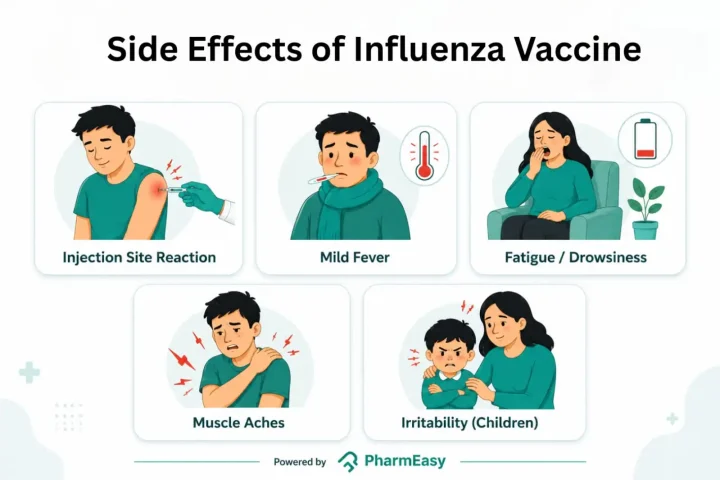
Influenza vaccine side effects are generally well-tolerated, and these may include3:
Yes, it is still possible to get the flu even after being vaccinated with the influenza virus vaccine. Here’s why:
Taking the influenza vaccine just once doesnt ensure lifelong immunity against the flu. Thus, the vaccine should be taken each year, especially by the elderly and others who are at high-risk.
Dr. Nayana S Shetty, MBBS, MD
Note: Even if the vaccine doesn’t prevent the flu entirely, it can still help your body fight it off faster and reduce the severity of the illness10.
Also Read: What Is Hantavirus? Symptoms, Causes, & Effective Prevention
Most influenza vaccine side effects (those mentioned above) are mild and short-lived. However, in rare cases, more serious reactions can occur.
Seek medical attention immediately if you experience any of the following after getting the flu vaccine3,10:
These symptoms could indicate a serious allergic reaction or another medical concern that needs prompt evaluation. If you’re unsure whether a symptom is related to the vaccine, it’s always better to consult a doctor and get it checked.
There are many misconceptions about the flu vaccine. Here, we address some of the most common myths with evidence-based facts10.
Myth 1: The flu shot can give you the flu.
Fact: This is not true. The injectable flu vaccine contains an inactivated (killed) virus, which cannot cause influenza. Mild side effects such as soreness or a low-grade fever are sometimes mistaken for the flu, but they are simply signs that the body is building protection.
Myth 2: Healthy people don’t need the flu vaccine.
Fact: Even healthy individuals can catch the flu and, in some cases, develop complications. Vaccination also helps reduce the spread of the virus to more vulnerable people around you, such as the elderly, infants, and those with chronic illnesses.
Myth 3: The flu vaccine is unsafe during pregnancy.
Fact: The inactivated flu vaccine is considered safe at any stage of pregnancy and is in fact recommended, as it protects both the mother and the baby.
Myth 4: One flu shot provides lifelong protection.
Fact: The flu vaccine does not offer lifelong immunity. Flu viruses change each year, and protection from the vaccine reduces over time, which is why annual vaccination is recommended.
Myth 5: The flu vaccine is ineffective.
Fact: While the vaccine does not offer 100% protection, it can reduce the risk of severe illness, hospitalisation, and complications. Even if a vaccinated person catches the flu, their illness is often milder.
Myth 6: Catching the flu naturally is better than getting vaccinated.
Fact: Natural infection carries a real risk of severe illness and complications. Vaccination offers protection without the dangers of going through the actual infection.
Also Read: Influenza A: What is It, Causes, Symptoms, Treatment & Prevention
Understanding what the influenza vaccine is helps to recognise why it’s important. It’s an annual shot designed to protect against the most common flu viruses circulating each year. Getting vaccinated every year helps lower your risk of infection and severe illness, and also contributes to reducing transmission, especially among vulnerable populations. While the influenza vaccine doesn’t completely stop the spread of the virus due to ongoing changes in flu strains (antigenic drift) and varying effectiveness, it significantly reduces the risk of serious complications and hospitalisations. Therefore, following the appropriate influenza vaccine schedule (getting vaccinated annually) ensures timely protection, especially for high-risk groups.
Also Read: Viral Fever: Causes, Symptoms, and Treatment Options
No, this is not true. The flu vaccine contains a killed (inactivated) virus. This means it cannot cause the flu10.
No, pregnant women are at a higher risk of complications from the flu and the inactivated flu vaccine protects both the mother and the baby. It helps provide passive immunity to the infant for the first 6 months of life when they are very young to be vaccinated10.
Most people with allergies can safely get the flu vaccine. However, if you have a severe egg allergy or have had a serious allergic reaction to a previous flu shot, you should consult your doctor first3.
People who should consult a doctor before vaccination include those with severe allergies to vaccine ingredients, a history of Guillain-Barré Syndrome within 6 weeks of a prior flu shot, or those who are currently very ill3.
Disclaimer: The information provided here is for educational/awareness purposes only and is not intended to be a substitute for medical treatment by a healthcare professional and should not be relied upon to diagnose or treat any medical condition. The reader should consult a registered medical practitioner to determine the appropriateness of the information and before consuming any medication. PharmEasy does not provide any guarantee or warranty (express or implied) regarding the accuracy, adequacy, completeness, legality, reliability or usefulness of the information; and disclaims any liability arising thereof.
Links and product recommendations in the information provided here are advertisements of third-party products available on the website. PharmEasy does not make any representation on the accuracy or suitability of such products/services. Advertisements do not influence the editorial decisions or content. The information in this blog is subject to change without notice. The authors and administrators reserve the right to modify, add, or remove content without notification. It is your responsibility to review this disclaimer regularly for any changes.


Comments

Leave your comment...
You may also like























Comments