




Almond Oil: Uses, Benefits, Side Effects By Dr. Rajeev Singh
By Dr Rajeev Singh +2 more

Medically reviewed by Dr Rajeev Singh
Last updated: Aug 17, 2026 Published on: Jan 10, 2023


Get,

to manage your symptom
Get your,

4 Cr+ families
benefitted

OTP sent to 9988776655



You’ve successfully subscribed to receive
doctor-approved tips on
Whatsapp

Get ready to feel your best.


Register to Avail the Offer
Send OTPBy continuing, you agree with our Privacy Policy and Terms and Conditions
Hi There,
Sign up on PharmEasy now!!


Trusted by 4 crore+ families

OTP sent to 9988776655
You have unlocked 25% off on medicines


Code: NU25

By Dr Rajeev Singh +2 more
Table of Contents
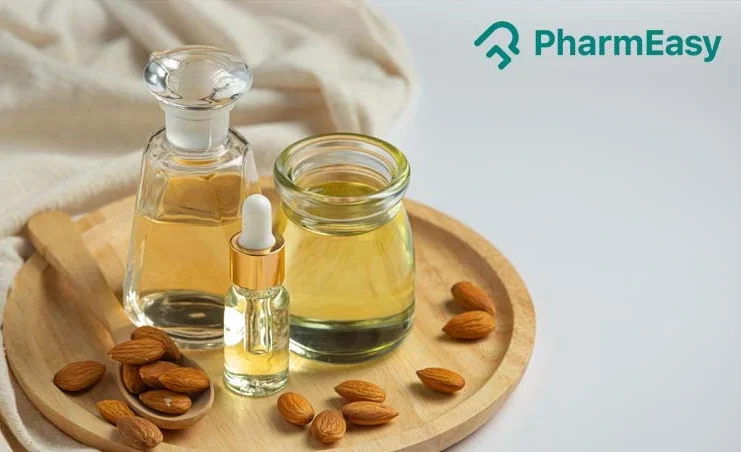
Almond oil is an edible, essential oil densely packed with a variety of nutrients that are beneficial for our health. If you are looking for a versatile oil, you must try almond oil. Almond oil is plentiful as the almond trees are cultivated as wild trees in the tropical forest and the cold and temperate regions of India, the Saharan plains, Iran, Turkey and Nepal. The oil is scientifically called Oleum amygdalae. It is prepared from two varieties of Prunus dulcis almonds, sweet and bitter. It is an oil composed of glycerine and oleic acid with a mild odour and a slightly nutty taste. Production of almond oil is an important business globally. Almond oil is produced through the separation processes of extraction and expression1,2. Let’s get to know more about this bountiful oil and how we can bring it to our home!
Did you know?
Almond oil has an abundant source of micronutrients and macronutrients. It contains bioactive compounds such as monounsaturated (MUFA) and polyunsaturated (PUFA) fatty acids, phytosterols, tocopherol and oleic acid. It is also enriched with alpha-tocopherol, beta-zoosterol and squalene4.
Nutritional value of Almond Oil per 100 grams3.
Almond oil has been used in complementary medicine systems for its immense health benefits. The following are a few properties of almond oil:
I recently read an article that says, with a high concentration of mono-unsaturated fatty acids, almond oil may assist with constipation and irritable bowel syndrome while also reducing the pace at which carbohydrates are absorbed in the stomach and improving insulin sensitivity5.
Dr. Siddharth Gupta, B.A.M.S, M.D (Ayu)
The following may be the potential benefits of eating almond oil:

Almond oil may help reduce the chances of developing heart disease. Almond oil may have antioxidant properties, eliminating free radicals and stopping bad cholesterol formation. Recent clinical trials by Jenkins et al. done in 2022 suggest that almond oil may show that when added to a daily diet, it may significantly reduce bad cholesterol and triglycerides and increase the blood levels of good cholesterol in healthy volunteers. It might enhance dyslipidaemia and endothelial function and reduce heart disease risk2,4. However, more studies are needed to conclude the benefits of almond oil for heart health. If you have heart problems, it is advisable to consult a doctor.

An animal model study4 (Al-Attar et al., 2020) found that the consumption of almond oil may normalize blood glucose. It may have a blood glucose-lowering effect related to reducing glucose absorption through the gut rather than altering insulin levels. This may be because of the lipid portion of the almond oil that may help decrease glucose levels. However, there is a requirement for research on humans to ensure that almond oil benefits diabetes. If you have diabetes, consult a doctor and get proper treatment.

Ayurveda describes many uses of almond oil for skin. Almond oil is used topically by aromatherapists, beauticians and masseuses due to its high vitamin E level. It contains oleic and linoleic acids, vitamin B and zinc that might support the nourishment of skin. A study2 done by Cantor et al. in 2006 found that almond oil may help enhance dry skin conditions such as eczema and psoriasis. Additionally, it may help soothe and revitalise the skin, boosting its tone and complexion. However, it’s best to consult a doctor before using it instead of self-medicating.

An animal study2,4 by Iwahashi 2001 et al. suggests that the inclusion of almond oil in a diet may help reduce the chances of colon cancer. It may have anti-proliferative effects that might control the spread of cancerous cells in the body. It might also help fight with breast cancer and colorectal cancer. The American practitioner, Cayce suggested the implementation of almond oil in the staple diet as it benefits people with colon cancer. Almond oil may also have free-radical scavenging activity that might help in cancer. More clinical studies may ascertain the benefits of almond oil for alleviating cancer in humans.

Almond oil may be used as a massage oil during aromatherapy. It may show a positive outcome on the quality of life of patients. According to Moradi et al., 2020, almond oil may help reduce stress, depression, anxiety and fatigue, as well as it may improve the sleep quality of an individual. Almond oil may be enriched with omega-3 fatty acids to help enhance memory functions1,4. However, more studies are needed to develop the benefits of almond oil for brain health. If you have any brain-related symptoms, take a medical consultation for an adequate line of treatment.
Though studies show the potential uses of almond oil in various conditions, these are insufficient, and there is a necessity for further studies to develop the scope of the benefits of almond oil on human health. Additionally, each person may respond differently to these herbs. It is essential to have a doctor’s advice before using almond oil for any medical condition.
I recently read an article suggesting that owing to the presence of several phytochemicals, including phytosterol, flavonoids, and polyphenols of phenolic acids, almond oil has shown to have antimutagenic and anticarcinogenic properties. This property may help with cancer6.
Dr. Rajeev Singh, BAMS
You may use almond oil as listed below:
You should consult a qualified doctor before having almond oil in large quantities. Do not discontinue or replace an ongoing modern medical treatment with an Ayurvedic/herbal preparation of almond oil without consulting an Ayurvedic physician. They will guide you with its best form and dosage per your health condition.
If you have a blocked ear canal due to earwax that doesn’t fall out on its own, I might suggest you try almond oil. Put 2 to 3 drops of almond oil in your ear 3 to 4 times a day for 3 to 5 days. However, it’s important to consult a doctor before trying this on your own7.
Dr. Smita Barode, B.A.M.S, M.S.
Despite the advantages of almond oil, it may cause certain side effects. Given below are a few side effects of almond oil:
Also Read: Badam Pisin (Almond Gum): Uses, Benefits, Side Effects & More
Having almond oil in controlled quantities might be safe. However, its consumption in larger amounts may cause harm. Therefore, it’s mandatory to keep the following precautions in mind:
Also Read: 7 Incredible Benefits Of Chia Seed Oil
More clinical research is required to know the interactions of almond oil with other drugs. Therefore, people should take medical advice from an Ayurvedic doctor. They will guide you toward the best way to have almond oil.
Also Read: Walnut Oil: Uses, Benefits, Side Effects By Dr. Smita Barode
Vitamins present in almond oil include vitamin E and vitamin K4.
Almond oil is scientifically referred to as Oleum amygdalae. It is prepared from sweet and bitter varieties of Prunus dulcis almonds. Almond oil is prepared as a glyceryl oleate (glycerine) with a mild odour and a slightly nutty taste2.
Yes. The health benefits of almond oil may be related to reducing high cholesterol levels. It may benefit heart health by decreasing bad cholesterol levels and increasing the levels of good cholesterol2.
According to the Ancient Chinese, Ayurvedic and Greco-Persian Medicine systems, almond oil may be used for managing dry skin conditions such as psoriasis. Almond oil may have moisturising and emollient properties that might help enhance skin condition, thereby providing soft and healthy skin2.
Disclaimer: The information provided here is for educational/awareness purposes only and is not intended to be a substitute for medical treatment by a healthcare professional and should not be relied upon to diagnose or treat any medical condition. The reader should consult a registered medical practitioner to determine the appropriateness of the information and before consuming any medication. PharmEasy does not provide any guarantee or warranty (express or implied) regarding the accuracy, adequacy, completeness, legality, reliability or usefulness of the information; and disclaims any liability arising thereof.
Links and product recommendations in the information provided here are advertisements of third-party products available on the website. PharmEasy does not make any representation on the accuracy or suitability of such products/services. Advertisements do not influence the editorial decisions or content. The information in this blog is subject to change without notice. The authors and administrators reserve the right to modify, add, or remove content without notification. It is your responsibility to review this disclaimer regularly for any changes.
 5
5  2
2Comments

Leave your comment...
You may also like























Comments