




Do Microwave Ovens Cause Cancer? Here’s What Doctors Say
By Dr. Vishesh Bharucha +2 more

Medically reviewed by Dr. Vishesh Bharucha
Last updated: Oct 28, 2026 Published on: Oct 28, 2026


Get,

to manage your symptom
Get your,

4 Cr+ families
benefitted

OTP sent to 9988776655



You’ve successfully subscribed to receive
doctor-approved tips on
Whatsapp

Get ready to feel your best.


Register to Avail the Offer
Send OTPBy continuing, you agree with our Privacy Policy and Terms and Conditions
Hi There,
Sign up on PharmEasy now!!


Trusted by 4 crore+ families

OTP sent to 9988776655
You have unlocked 25% off on medicines


Code: NU25

By Dr. Vishesh Bharucha +2 more
Table of Contents
Many of us, especially in metro cities, cannot imagine a single day going by without using a microwave oven. However, many of us wonder, ‘Do microwave ovens cause cancer?’ A 2024 survey by the Bureau of Energy Efficiency (BEE) found that 4% of the Indian households surveyed had a microwave oven1. Maybe the fear of getting a cancer is holding back many homes from using an oven.
There is a ton of conflicting research online, but it’s important to sift real evidence from hype. The good news is that a properly working microwave oven is generally considered safe when used according to the manufacturer’s instructions, and microwaving food does not make it radioactive. This blog explains how microwave ovens work, what research says about cancer risk, and how to use a microwave safely2.
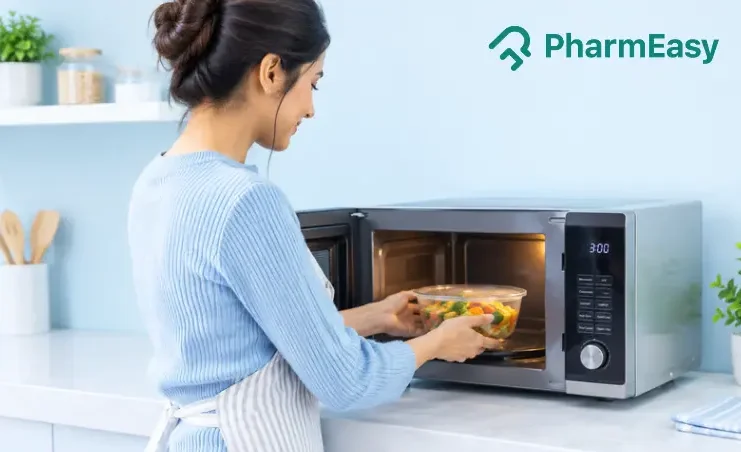
A microwave oven heats food using electromagnetic waves known as microwaves. Let’s understand how microwaves work:
There is no established evidence proving that a properly functioning microwave and cancer are associated when used as intended. Microwave ovens use a type of non-ionising radiation that does not have enough energy to damage DNA in the way that ionising radiation, such as X-rays and gamma rays, can.
Cancer may develop when changes build up in a cell’s genetic material and affect the normal processes that control cell growth, repair damage, or remove unhealthy cells. Normally, cells have natural safety checks that repair damaged DNA or stop damaged cells from growing and dividing4. Because microwave radiation does not have enough energy to directly ionise atoms or break chemical bonds in DNA in the way that ionising radiation can, it cannot cause the type of cellular changes that can lead to cancer5.
People worry that do microwaves cause cancer because they hear the word ‘radiation’ and associate it with harmful radiation such as X-rays. Another concern is the use of plastic containers for heating food. Some plastics may release chemicals into food when they are heated inappropriately. This concern is related to the type of container used, not to the microwave radiation itself. Using containers labelled as microwave-safe and following the manufacturer’s instructions can easily avoid this problem5.
A microwave oven has a number of uses for people who are short on time. The following are just some of the benefits of using a microwave:
People often search online “Is microwave safe for health?” The answer to this question is a big ‘yes’! Microwave cooking is generally safe when the oven is in good condition and used in the recommended manner3. A working microwave oven is designed with a door and safety features that keep the microwave energy inside the oven during use.
However, the way a microwave is used matters, because it is important to understand how microwaves work. Microwave ovens may not heat food evenly; some parts may remain cooler than others (cold spots). These cold spots may allow harmful bacteria to survive, especially when cooking meat, poultry, fish, eggs, and leftovers. To reduce this risk, handle food safely, heat it thoroughly, stir or turn it during heating, and let it stand for a short time before eating6.
The safe cooking temperature varies depending on the type of food. The following are a few examples:
USDA emphasizes standing time after microwave cooking because temperature continues to equalize and cold spots may persist. The usual standing/resting time recommended by US FDA after microwaving is about 3 minutes, however manufacturer instructions should be followed7,8.
Some containers that are not designed for microwave use, such as foam trays or take-away containers may melt, warp, or allow chemicals to leach into the food when heated. Therefore, it is important to use only containers labelled as ‘microwave safe’. These precautions help reduce the risk of foodborne illnesses or other health hazards while using a microwave oven6.
Note: The label, ‘microwave-safe’ does not mean that chemical transfer into food will never occur under any heating condition. Always follow the container’s instructions for microwave use and check its safety6.
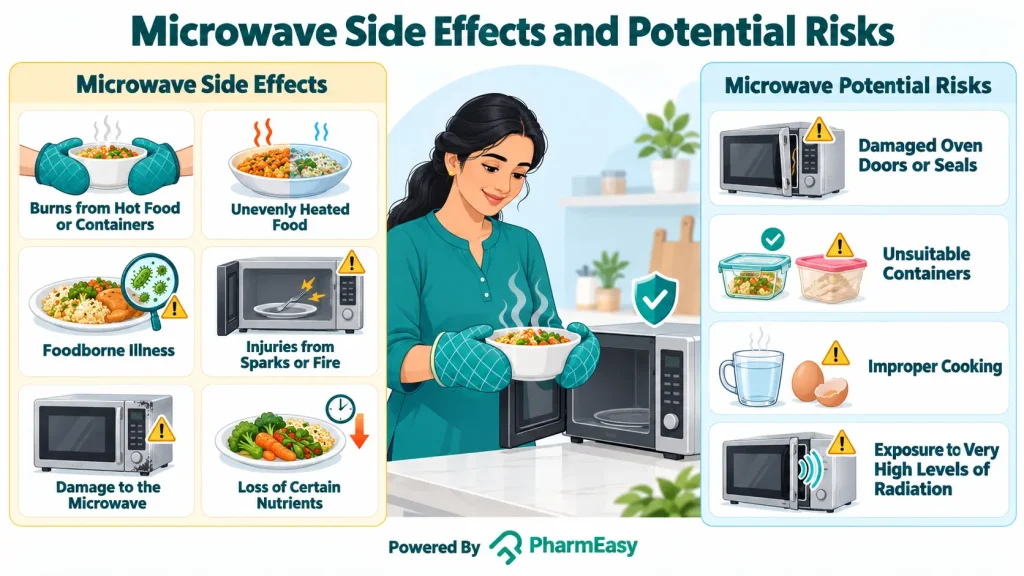
The following explains the possible side effects and potential risks associated with microwaves:
Using a properly working microwave as directed is not known to cause health problems from normal microwave exposure. However, using it incorrectly can lead to problems such as:
Certain situations can increase the risk of injury or food-safety problems when using a microwave:
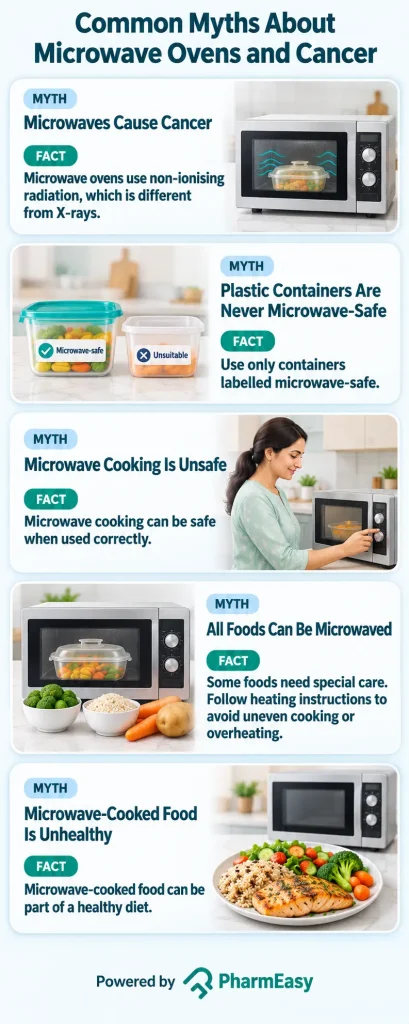
There are several myths regarding the use of microwave ovens. The following are a few common ones:
Fact: False; microwaves are a type of non-ionising radiation, which is different from the ionising radiation used in X-rays. Non-ionising radiation does not carry enough energy to directly damage DNA in the same way that X-rays and gamma rays can. A properly working microwave oven is designed to keep the microwave energy inside the oven while it is operating3.
Fact: False; there are microwave-safe plastics which can be used in ovens. However, other unsuitable ones, such as single takeaway plastic containers or cold storage containers, should not be used to avoid possible migration of chemicals into the food3.
Fact: False; like other cooking methods, microwave cooking can be safe when appropriate equipment, containers, cooking times, and food-safety practices are followed8.
Fact: False; not all foods are suitable for microwave cooking. Some foods may cook unevenly, become overheated, or burst, so it is important to follow the microwave and food manufacturer’s instructions before heating them5,9.
Fact: False; food cooked in a microwave can be part of a healthy diet. The nutritional quality depends largely on the food, duration or temperature of cooking, amount of water used and how it is prepared3,9,10.
Also Read: Can Tattoos Increase Your Risk of Cancer?
So, do microwaves cause cancer? Current evidence does not show that properly functioning microwave ovens cause cancer when they are used as directed. Microwave cooking can be an extremely convenient way to prepare or heat food while retaining many nutrients. However, safe use is important. Use microwave-safe containers, avoid damaged ovens, heat food thoroughly, and handle hot food and liquids carefully. Following these simple precautions can help you use a microwave safely as part of everyday cooking.
No, not all microwave ovens carry a cancer warning. Properly functioning microwave ovens that meet safety standards are generally considered safe when used according to the manufacturer’s instructions3.
Yes, using a properly working microwave every day can generally be considered safe. The only thing to note is that you are following the manufacturer’s instructions, using suitable containers, and a fully functional microwave3.
Reheating food in a microwave is generally safe and does not make the food unhealthy. Heat food evenly and thoroughly. Leftovers should be reheated to 165°F. Also, use microwave-safe containers to reduce food-safety risks8,9. However, reheating food which wasn’t stored properly can cause foodborne bacteria to leave toxins which are heat-resistant11.
Use a properly functioning microwave and follow the manufacturer’s instructions. Check that the door, hinges, and seals are intact/tight, and avoid using a microwave that is damaged or does not close properly3.
A properly functioning, undamaged microwave is generally safe to use, so there is no need to look for a safer alternative3. If you prefer, you can also use an induction stove or other conventional cooking methods to heat your food12.
Look for a damaged door, hinge, latch, or seal, which may increase the risk of microwave radiation leakage. If you notice any damage or suspect leakage, stop using the appliance and have it checked by a qualified service professional3.
1. India Energy Scenario for the Year 2024-25. https://www.beeindia.gov.in/WriteReadData/L45218/4600785880366907.pdf
2. Microwaves are safe to use without worrying about radiation. Cancer Council Australia. 2023. Accessed October 1, 2026. https://www.cancer.org.au/iheard/does-radiation-from-microwaves-cause-cancer
3. Microwave ovens. FDA. 2023. Accessed October 1, 2026. https://www.fda.gov/radiation-emitting-products/resources-you-radiation-emitting-products/microwave-ovens
4. What Is cancer? NCI. 2026. Accessed October 7, 2026. https://www.cancer.gov/about-cancer/understanding/what-is-cancer
5. Does heating food in the microwave cause cancer? EUFIC. 2026. Accessed October 1, 2026. https://www.eufic.org/en/misinformation/article/does-heating-food-in-the-microwave-cause-cancer
6. Cooking with microwave ovens. Food Safety and Inspection Service. USDA. 2024. Accessed October 1, 2026. https://www.fsis.usda.gov/food-safety/safe-food-handling-and-preparation/food-safety-basics/cooking-microwave-ovens
7. Cook to a safe minimum internal temperature. FoodSafety.gov. 2024. Accessed October 7, 2026. https://www.foodsafety.gov/food-safety-charts/safe-minimum-internal-temperatures
8. Cooking (food safety for moms-to-be) FDA. 2018. Accessed October 1, 2026. https://www.fda.gov/food/people-risk-foodborne-illness/cooking-food-safety-moms-be
9. Microwave Cooking and Food Safety. 2017. Accessed October 1, 2026. https://www.cfs.gov.hk/english/programme/programme_rafs/programme_rafs_ft_01_02_mcfs.html
10. Microwave cooking and nutrition. Harvard Health. 2021. Accessed October 1, 2026. https://www.health.harvard.edu/healthy-aging-and-longevity/microwave-cooking-and-nutrition
11. If I forget to put food away in the refrigerator, will proper heating or reheating kill its bacteria content? 2024. Accessed October 8, 2026. https://ask.fsis.usda.gov/article/If-I-forget-to-put-food-away-in-the-refrigerator-wont-heating-or-reheating
12. Making the switch to induction stoves or cooktops. US Department of Energy. 2023. Accessed October 1, 2026. https://www.energy.gov/articles/making-switch-induction-stoves-or-cooktops
Disclaimer: The information provided here is for educational/awareness purposes only and is not intended to be a substitute for medical treatment by a healthcare professional and should not be relied upon to diagnose or treat any medical condition. The reader should consult a registered medical practitioner to determine the appropriateness of the information and before consuming any medication. PharmEasy does not provide any guarantee or warranty (express or implied) regarding the accuracy, adequacy, completeness, legality, reliability or usefulness of the information; and disclaims any liability arising thereof.
Links and product recommendations in the information provided here are advertisements of third-party products available on the website. PharmEasy does not make any representation on the accuracy or suitability of such products/services. Advertisements do not influence the editorial decisions or content. The information in this blog is subject to change without notice. The authors and administrators reserve the right to modify, add, or remove content without notification. It is your responsibility to review this disclaimer regularly for any changes.


Comments

Leave your comment...
You may also like




















Comments