




Can Tattoos Increase Your Risk of Cancer?
By Dr. Raina N. Nahar +2 more

Medically reviewed by Dr. Raina N. Nahar
Last updated: Sep 7, 2026 Published on: Sep 7, 2026


Get,

to manage your symptom
Get your,

4 Cr+ families
benefitted

OTP sent to 9988776655



You’ve successfully subscribed to receive
doctor-approved tips on
Whatsapp

Get ready to feel your best.


Register to Avail the Offer
Send OTPBy continuing, you agree with our Privacy Policy and Terms and Conditions
Hi There,
Sign up on PharmEasy now!!


Trusted by 4 crore+ families

OTP sent to 9988776655
You have unlocked 25% off on medicines


Code: NU25

By Dr. Raina N. Nahar +2 more
Table of Contents
Getting a tattoo can feel exciting, but you may wonder whether the ink could affect your health years later. Tattoos are common worldwide yet concerns about their safety and possible long-term effects continue to grow. Some people also question whether tattoo inks contain ingredients that could increase cancer risk. Understanding what research says can help you make informed choices1. In this article, we will discuss tattoos and their risk of cancer, if any.
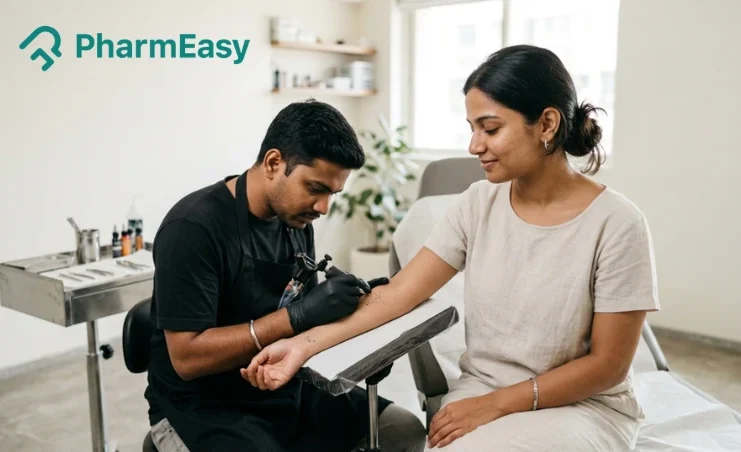
At present, tattoos are not proven to directly cause cancer. Some studies have raised concerns about a possible connection between tattoos and certain cancers, but the available evidence isn’t strong enough to confirm that tattooing itself is the cause. However, researchers are studying whether some substances in tattoo inks could have long-term effects on the body1,2.
Although there isn’t a direct connection between tattoos and cancer, there are some other potential risks associated with tattoos. A safer tattoo experience depends on several factors, including the cleanliness of the studio, the tattoo artist’s hygiene practices, the condition of the equipment used, and proper aftercare1,3. Using clean, single-use needles can help reduce the risk of infections3.
Since tattooing involves breaking the skin, maintaining good hygiene during the procedure and following proper aftercare can help prevent infections while the tattoo heals. It is also important to remember that tattoo inks are not all the same. Their ingredients can vary, and some pigments may cause skin reactions in certain people. Therefore, choosing a reputable tattoo provider is an important part of reducing avoidable complications1.
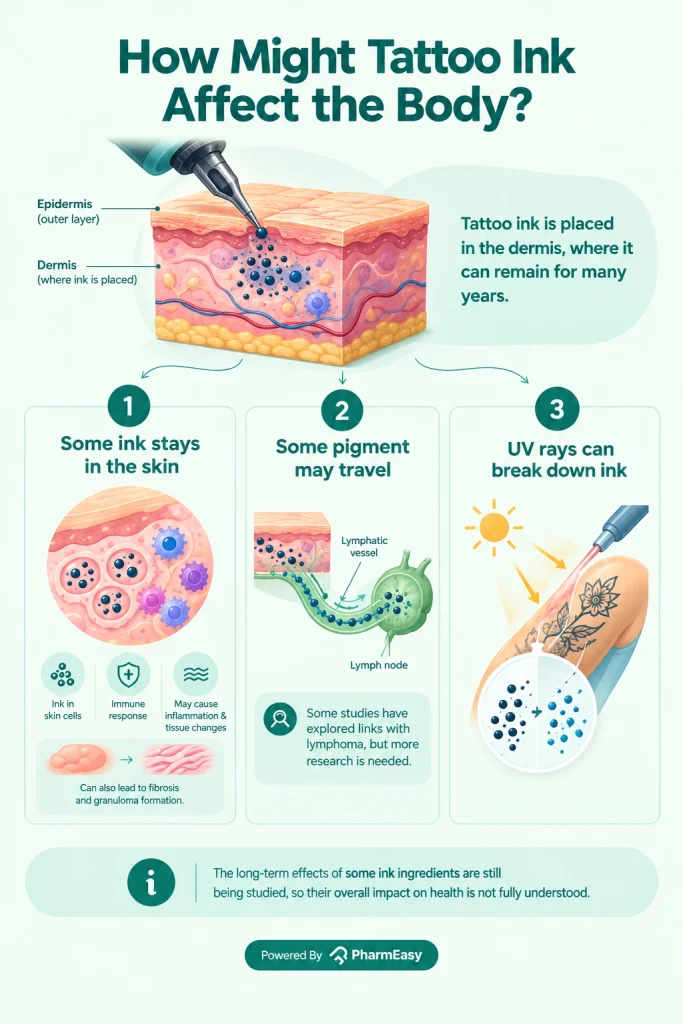
During tattooing, needles push ink into the deeper layer of the skin called the dermis. Because the pigment is placed below the skin’s surface, it can remain there for many years. The body recognises tattoo pigment as a foreign substance and responds to it. Some pigment particles may remain within skin cells, while others can move through the body.
The following are some concerns related to tattoo ink:
However, the long-term effects of some ink ingredients are still being studied, so their overall impact on health is not fully understood1.
Researchers have found that certain tattoo inks can contain substances that may be harmful, including chemicals with potentially carcinogenic properties6. However, the presence of these substances does not mean that getting a tattoo will cause cancer.
The following are some research findings:
People often wonder, “Can tattoos cause skin cancer?” Because tattooing involves repeatedly puncturing the skin, it can lead to several complications, particularly when proper hygiene or aftercare is lacking.
Common problems include:
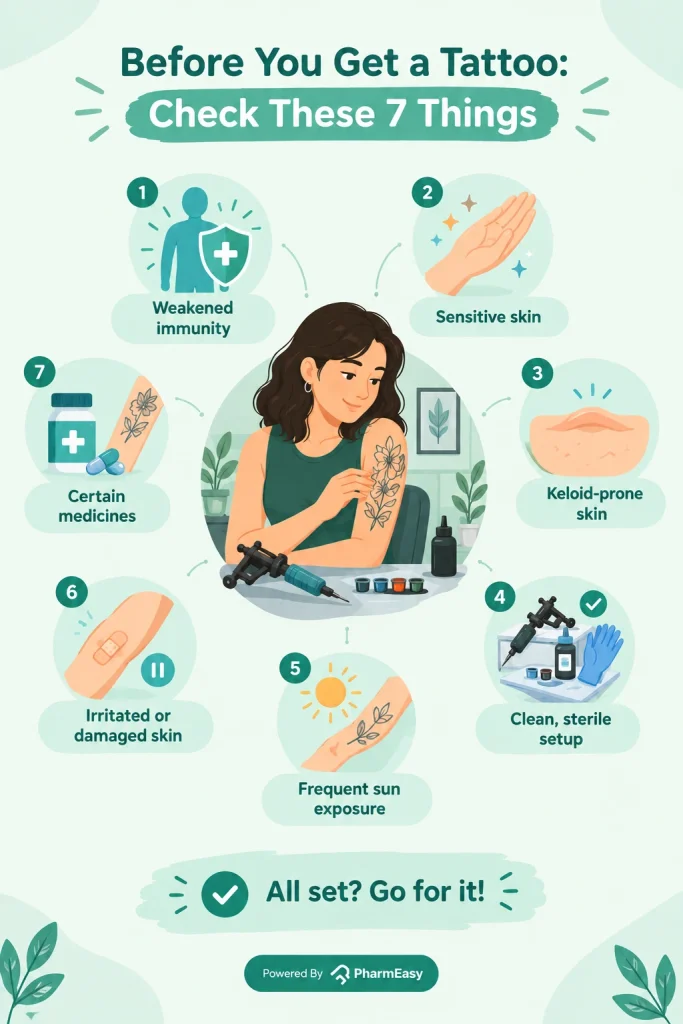
Although many people get tattoos without serious problems, certain factors can increase the risk of getting complications. The following people might be at a higher risk of tattoo complications:
Note: If a health condition or medicine affects your healing or immune system, talk to your doctor before getting a tattoo.
There are several practical steps to make tattooing safer:
Note: Tattooing can carry different risks depending on your health, skin condition, and medications. These tips are for general information and should not replace advice from a qualified doctor. If you have any health concerns, speak with your doctor before getting a tattoo.
Tattoo ink can sometimes make it harder to notice changes in the skin. This is especially important when a tattoo covers a mole, birthmark or another existing skin mark.
Note: Hence, it is better to avoid tattooing directly over moles or other spots that need regular monitoring.
Most tattoos cause some redness, tenderness or swelling while the skin heals6. However, symptoms that persist or become worse may indicate a complication. Consult your doctor for the following:
Early medical evaluation might help identify infections, allergic reactions and other skin conditions that may need treatment.
Also Read: Does Air Fryer Cause Cancer? What the Science Actually Says
According to current research, tattoos have not been proven to cause cancer. However, researchers are still learning about the long-term effects of tattoo ink. Choosing a trusted tattoo artist, making sure proper hygiene is followed and caring for your tattoo as it heals can help lower the risk of complications. It is important to keep an eye on your tattooed skin and get any unusual changes checked by a doctor.
According to several studies, some tattoo ink particles are said to move from the skin to nearby lymph nodes through the lymphatic system. Researchers have found these particles in lymph nodes, but their long-term effects on health are still not fully known1.
Some case reports have shown cancer development in individuals with tattoos soon after or years later after tattooing. Tattoo ink is said to contain certain salts and pigments which when acted upon by UV light might generate some products that may be toxic to body cells and genetic material, however, there is not enough evidence to confirm the relationship yet. Therefore, further research is needed to prove this claim1,2.
Tattoo ink can sometimes hide early signs of skin cancer by covering or changing the look of moles and other skin spots. This can make changes in their colour, shape or edges harder to notice, so avoid tattooing over moles and check your tattooed skin regularly13.
A family history of cancer does not mean you need to avoid tattoos. However, if skin cancer runs in your family, consider getting a skin check from a dermatologist first and avoid tattooing over moles or other spots that need regular monitoring13.
There is no clear proof that UV tattoos cause cancer. However, some inks may change when exposed to UV light and produce harmful compounds1.
People often search for can laser tattoo removal cause cancer, but the answer is no. Tattoo removal has not been linked to cancer. However, removal can cause side effects such as redness, soreness, scarring, pinpoint bleeding, and infection16.
1. Dodig S, Čepelak-Dodig D, Gretić D, Čepelak I. Tattooing: Immediate and long-term adverse reactions and complications. Arh Hig Rada Toksikol. 75(4):219-227. doi:10.2478/aiht-2024-75-3921 https://pubmed.ncbi.nlm.nih.gov/39718089/
2. Tudella GCN, Defante MLR, Pereira PS, et al. Is tattooing associated with an increased risk of cancer? A systematic review and meta-analysis. Clin Transl Oncol. Published online 2026. doi:10.1007/s12094-026-04388-4 https://link.springer.com/article/10.1007/s12094-026-04388-4
3. Body art and tattooing businesses. 2025. Accessed August 31, 2026. https://www.health.nsw.gov.au/environment/factsheets/Pages/tattooing.aspx
4. Capucetti A, Falivene J, Pizzichetti C, et al. Tattoo ink induces inflammation in the draining lymph node and alters the immune response to vaccination. Proc Natl Acad Sci U S A. 122(48):e2510392122. doi:10.1073/pnas.2510392122 https://pubmed.ncbi.nlm.nih.gov/41289395/
5. Nielsen C, Jerkeman M, Jöud AS. Tattoos as a risk factor for malignant lymphoma: a population-based case–control study. eClinicalMedicine. 2024;72. doi:10.1016/j.eclinm.2024.102649 https://pubmed.ncbi.nlm.nih.gov/38827888/
6. Think before you ink: Tattoo safety. FDA. 2024. Accessed August 31, 2026. https://www.fda.gov/consumers/consumer-updates/think-you-ink-tattoo-safety
7. Czaczkowska L, Jabłońska E, Bury J, Szurant N, Ratajczak-Wrona W. Chemical components of tattoo inks and their potential role in carcinogenesis and their side effects. Arch Toxicol. Published online June 27, 2026. doi:10.1007/s00204-026-04484-y https://www.researchgate.net/publication/408150546_Chemical_components_of_tattoo_inks_and_their_potential_role_in_carcinogenesis_and_their_side_effects
8. Tattoos & permanent makeup: Fact sheet. FDA. 2024. Accessed August 31, 2026. https://www.fda.gov/cosmetics/cosmetic-products/tattoos-permanent-makeup-fact-sheet
9. Temiz SA, Özlü E. Medical Complications of Tattoos. jtad. 2021;15(1):1-7. doi:10.4274/jtad.galenos.2021.02486 https://www.researchgate.net/publication/349856450_Medical_Complications_of_Tattoos
10. Can I get a tattoo? Nation Blood Clot Alliance. Accessed August 31, 2026. https://www.stoptheclot.org/faq/can-i-get-a-tattoo/
11. Tattoos. Better Health Channel. 2015. Accessed August 31, 2026. https://www.betterhealth.vic.gov.au/health/conditionsandtreatments/tattoos
12. Kluger N. Contraindications for tattooing. Curr Probl Dermatol. 2015;48:76-87. doi:10.1159/000369189 https://pubmed.ncbi.nlm.nih.gov/25833628/
13. Do tattoos cause skin cancer? 2025. Accessed August 31, 2026. https://www.aad.org/public/diseases/skin-cancer/do-tattoos-cause-skin-cancer
14. Ask the Expert: Can a tattoo increase skin cancer risk? Skin Cancer Foundation. 2024. Accessed August 31, 2026. https://www.skincancer.org/blog/ask-the-expert-can-a-tattoo-increase-skin-cancer-risk/
15. Lebhar J, Jacobs J, Rundle C, Kaplan SJ, Mosca PJ. Skin cancers arising within tattoos: A systematic review. JAAD Int. 2024;16:133-143. doi:10.1016/j.jdin.2024.03.015 https://pubmed.ncbi.nlm.nih.gov/38957835/
16. Tattoo removal: Options and results. FDA. 2023. Accessed August 31, 2026. https://www.fda.gov/consumers/consumer-updates/tattoo-removal-options-and-results
Disclaimer: The information provided here is for educational/awareness purposes only and is not intended to be a substitute for medical treatment by a healthcare professional and should not be relied upon to diagnose or treat any medical condition. The reader should consult a registered medical practitioner to determine the appropriateness of the information and before consuming any medication. PharmEasy does not provide any guarantee or warranty (express or implied) regarding the accuracy, adequacy, completeness, legality, reliability or usefulness of the information; and disclaims any liability arising thereof.
Links and product recommendations in the information provided here are advertisements of third-party products available on the website. PharmEasy does not make any representation on the accuracy or suitability of such products/services. Advertisements do not influence the editorial decisions or content. The information in this blog is subject to change without notice. The authors and administrators reserve the right to modify, add, or remove content without notification. It is your responsibility to review this disclaimer regularly for any changes.


Comments

Leave your comment...
You may also like




















Comments