
Introduction
Hearing loss may develop gradually over time or appear suddenly. It can make everyday conversations, phone calls, and familiar sounds harder to hear. Hearing loss can affect people of any age and may result from medical conditions, infections, injuries, certain medicines, or long-term exposure to loud noise1.
Recognising symptoms early can help identify the cause and guide suitable care. This blog explains the symptoms, causes, types, diagnosis, management, and prevention of hearing loss.
What Is Hearing Loss?
Hearing loss means reduced ability to hear sounds. Some people may find it hard to follow conversations, while others may have difficulty hearing even loud sounds1.
Advertisement
Normally, sound travels through the outer and middle ear to the cochlea, the hearing organ in the inner ear. The cochlea contains tiny hair cells that change sound vibrations into signals. These signals travel through the hearing nerve to the brain, where they are recognised as sound. Hearing loss can occur when any part of this pathway is affected1,2.
Did You Know?
- Hearing loss can affect just one ear or both ears and may be the same or different in each ear1,3.
- Hearing loss may be present from birth, or it can also develop later in life.
- Hearing loss can occur before or after a child learns to speak, which can influence speech and language development3.
Types of Hearing Loss
Hearing loss is commonly grouped into four main types1,3:
- Conductive hearing loss: Occurs when sound cannot travel properly through the outer or middle ear, such as due to earwax buildup, fluid in the middle ear, perforation (rupture) in the eardrum, or problems with the ear bones.
- Sensorineural hearing loss: Occurs when there is damage to the inner ear or hearing nerve. Age-related changes and prolonged exposure to loud noise are common causes.
- Mixed hearing loss: A combination of conductive and sensorineural hearing loss.
- Auditory neuropathy spectrum disorder: Occurs when sound reaches the inner ear, but the hearing signals are not sent clearly to the brain. A person may hear sounds but find it hard to understand speech, especially in noisy places.
Causes of Hearing Loss
Hearing loss can have many causes, depending on the part of the ear or hearing pathway involved. Common causes include2,4:
- Inner ear disorders (like Ménière disease)
- Damage or abnormalities of the eardrum or tiny middle-ear bones (like otosclerosis)
- Earwax/fluid buildup or foreign objects blocking the ear canal
- Prolonged or sudden exposure to loud noises, including workplace noise, explosions, concerts, or loud earphones
- Age-related changes
- Genetic conditions that affect hearing
- Infections, such as meningitis, mumps, measles, rubella, or cytomegalovirus
- Certain medicines or chemicals that can harm the inner ear
- Head or ear injuries, including skull fractures and pressure-related injuries
- Conditions affecting the hearing nerve, such as an acoustic neuroma
- Chronic health conditions or nutritional deficiencies
- Complications before or around birth, including prematurity, low birth weight, lack of oxygen, and severe newborn jaundice
Symptoms of Hearing Loss
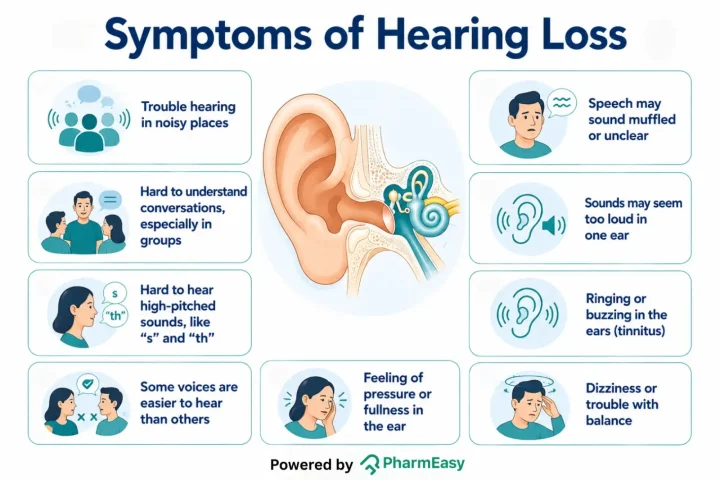
The symptoms of hearing loss can vary depending on the cause and how severe it is. Common symptoms include4,5:
- Trouble hearing clearly in noisy places
- Difficulty understanding conversations, especially when many people are speaking
- Difficulty distinguishing high-pitched sounds, such as ‘s’ and ‘th’
- Finding some voices easier to hear than others (such as lower-pitched voices)
- Speech sounding muffled, unclear, or slurred
- Sounds seeming unusually loud in one ear
- Ringing or buzzing in the ears (tinnitus)
- A feeling of pressure or fullness in the ear, which may occur with fluid behind the eardrum
- Dizziness or problems with balance, which can occur with certain inner-ear or hearing-nerve conditions
How is Hearing Loss Diagnosed?
Doctors usually start by asking about the person’s symptoms and medical history and then examining the ears. They may ask when the hearing difficulty began, whether it affects one or both ears, and whether there are related symptoms such as dizziness, ringing in the ears, pain, or discharge. They may also ask about past ear infections, family history, loud noise exposure, and medicines that can affect hearing1.
Advertisement
Depending on the person’s age and symptoms, doctors may suggest tests such as1:
- Otoscopy: Examines the ear canal and eardrum to look for earwax, foreign objects, infections, fluid, or eardrum abnormalities.
- Pure-tone audiometry: Measures how well a person can hear sounds at different pitches and volumes and helps determine the degree and type of hearing loss.
- Tympanometry: Checks how well the eardrum and middle ear are functioning and can help detect fluid, blockage, or problems with the middle-ear structures.
- Otoacoustic emissions (OAE): Measures sounds produced by the inner ear and is commonly used to screen newborns and young children.
- Auditory brainstem response: Measures how the hearing nerve and brain respond to sound and is useful when a person cannot reliably respond to conventional hearing tests, including newborns and infants.
- Weber and Rinne tests: Simple bedside tests that can help distinguish conductive hearing loss from sensorineural hearing loss.
Treatment of Hearing Loss
Management depends on the type and severity of hearing loss, its cause, and whether it is temporary or permanent. Common treatment and management options include1:
- Conductive hearing loss: Treatment may include removing excess earwax or a foreign object, treating ear infections, draining long-lasting fluid from the middle ear, or repairing the eardrum or middle-ear bones. Hearing aids or bone-conduction hearing devices may be considered if the hearing loss continues.
- Sensorineural hearing loss: This type is usually managed with hearing aids, which make sounds easier to hear and can improve communication. For severe hearing loss where hearing aids provide limited benefit, a cochlear implant may be an option.
- Mixed hearing loss: May involve addressing the conductive component while also using hearing aids or other hearing devices to manage the sensorineural component.
Important: In cases of sudden hearing loss, immediate medical attention is needed. In such cases, doctors may give steroids through a vein or directly into the ear. They usually begin this treatment within 48 to 72 hours of the hearing loss for the best chance of recovery6.
Note: Depending on the person’s needs, care may also include assistive listening devices, communication strategies, speech and language support, and hearing rehabilitation. Regular hearing checks can also help monitor changes and show whether treatment needs to be adjusted1,7.
Possible Complications of Untreated Hearing Loss
If hearing loss is not addressed, it can affect communication, daily activities, and overall well-being. Possible complications include2,8:
- Difficulty with speech and language development: In children, unaddressed hearing loss can delay speech and language development and affect learning and school performance.
- Social isolation: Difficulty in following conversations may cause a person to withdraw from social activities and interactions.
- Depression and anxiety: Ongoing communication difficulties and social withdrawal may affect emotional well-being.
- Balance problems and falls: Some conditions that cause hearing loss can also affect balance, increasing the risk of falls, particularly in older adults.
Prevention Tips for Hearing Loss
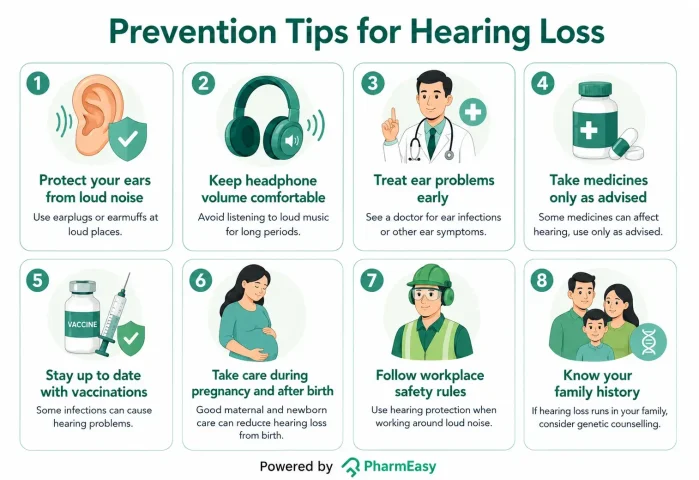
Hearing loss is not always preventable, but many cases can be reduced or avoided by protecting the ears and addressing risk factors early. Helpful prevention steps include2,8:
- Use earplugs or earmuffs in noisy workplaces, concerts, or other loud environments to protect your ears from loud sounds.
- Keep the volume at a comfortable level and limit the time spent listening to loud music through headphones or earphones.
- Seek medical care for persistent ear infections, ear discharge, or other ear-related symptoms.
- Take medicines only as advised by a doctor, as some medicines can affect hearing.
- Stay up to date with recommended immunisations, as some infections can lead to hearing loss.
- Appropriate maternal and newborn care can reduce some causes of hearing loss present at birth.
- Follow occupational hearing protection measures when exposed to loud noise or potentially harmful chemicals.
- Consider genetic counselling if there is a family history of inherited hearing loss.
When Should You Consult a Doctor?
Consider seeking medical advice if you8:
- Have hearing difficulties that interfere with daily activities, work, or social interactions.
- Notice hearing loss that persists, worsens, or affects one ear more than the other.
- Develop sudden or severe hearing loss, with or without ringing in the ear (tinnitus).
- Have hearing problems accompanied by ear pain, discharge, dizziness, or balance problems.
- Develop hearing changes along with new headaches, weakness, numbness, or other neurological symptoms.
Conclusion
Hearing plays an important role in communication and everyday life, so changes in hearing should not be ignored.
Whether hearing difficulty develops gradually or suddenly, noticing changes early and seeking medical advice can help reduce its impact on daily activities and well-being.
Also Read: Ear Infection (Otitis Media): Causes, Symptoms, Types, Treatment and Prevention
Frequently Asked Questions (FAQs)
Can children develop hearing loss?Hearing loss can be present at birth or develop during childhood due to genetic conditions, infections, ear problems, injuries, or exposure to loud sounds4.
Does hearing loss affect the brain?Hearing loss does not directly damage the brain. However, untreated hearing loss can make communication and listening more difficult and may affect social and cognitive functioning, particularly in older adults9.
Is hearing loss a genetic disease?Hearing loss itself is not always genetic, but some types are caused by inherited genetic changes. This may be present at birth or develop later in life10.
Does hearing loss cause dizziness?Hearing loss does not always cause dizziness. However, some inner-ear conditions can cause both hearing loss and dizziness or balance problems11.
References
- Anastasiadou S, Al Khalili Y. Hearing Loss. StatPearls Publishing. Accessed August 11, 2026. http://www.ncbi.nlm.nih.gov/books/NBK542323/
- Deafness and hearing loss. World Health Organization. Accessed August 11, 2026. https://www.who.int/news-room/fact-sheets/detail/deafness-and-hearing-loss
- Types of Hearing Loss. Hearing Loss in Children. CDC. May 16, 2024. Accessed August 11, 2026. https://www.cdc.gov/hearing-loss-children/about/types-of-hearing-loss.html
- Hearing loss. MedlinePlus. Accessed August 11, 2026. https://medlineplus.gov/ency/article/003044.htm
- Hearing loss. NHS. October 20, 2017. Accessed August 11, 2026. https://www.nhs.uk/conditions/hearing-loss/
- Plontke SK, Meisner C, Agrawal S, et al. Intratympanic corticosteroids for sudden sensorineural hearing loss. Cochrane Database Syst Rev. 2022;2022(7):CD008080. doi:10.1002/14651858.CD008080.pub2. Available from: https://pubmed.ncbi.nlm.nih.gov/35867413/
- Treatment and Intervention for Hearing Loss. CDC. Accessed August 11, 2026. https://www.cdc.gov/hearing-loss-children/treatment/index.html
- Hearing loss. Healthdirect. August 18, 2025. Accessed August 11, 2026. https://www.healthdirect.gov.au/hearing-loss
- Slade K, Plack CJ, Nuttall HE. The Effects of Age-Related Hearing Loss on the Brain and Cognitive Function. Trends Neurosci. 2020;43(10):810-821. doi:10.1016/j.tins.2020.07.005. Available from: https://pubmed.ncbi.nlm.nih.gov/32826080/
- Shearer AE, Hildebrand MS, Odell AM, Smith RJ. Genetic Hearing Loss Overview. Accessed August 11, 2026. http://www.ncbi.nlm.nih.gov/books/NBK1434/
- Hearing and Balance Symptoms and Conditions. American Academy of Audiology. Accessed August 11, 2026. https://www.audiology.org/consumers-and-patients/hearing-and-balance/
Disclaimer: The information provided here is for educational/awareness purposes only and is not intended to be a substitute for medical treatment by a healthcare professional and should not be relied upon to diagnose or treat any medical condition. The reader should consult a registered medical practitioner to determine the appropriateness of the information and before consuming any medication. PharmEasy does not provide any guarantee or warranty (express or implied) regarding the accuracy, adequacy, completeness, legality, reliability or usefulness of the information; and disclaims any liability arising thereof.
Links and product recommendations in the information provided here are advertisements of third-party products available on the website. PharmEasy does not make any representation on the accuracy or suitability of such products/services. Advertisements do not influence the editorial decisions or content. The information in this blog is subject to change without notice. The authors and administrators reserve the right to modify, add, or remove content without notification. It is your responsibility to review this disclaimer regularly for any changes.








































Comments