
Introduction
Have you ever had ear pain that made it difficult to sleep, or noticed that sounds suddenly seem muffled? For parents, it can be especially worrying when a child wakes up at night crying and holding their ear, complaining of discomfort. Otitis media is an infection or inflammation of the middle ear. Fluid or mucus can build up behind the eardrum, which may cause ear pain, pressure, or muffled hearing1.
This blog explains what otitis media means, the main types of middle ear infection, common causes, symptoms, prevention tips, when to seek medical care, and how ear infections are usually treated.
What Is an Ear Infection (Otitis Media)?
An ear infection, also called otitis media when it affects the middle ear, often develops after a cold, sore throat, or other respiratory infection2. Fluid can collect behind the eardrum and make it harder for sound to pass through clearly1. Ear infections are more common in children, although adults can also develop them. A child with an ear infection may pull at the ear, cry more than usual, sleep poorly, have balance problems, or seem less responsive to sounds1.
Advertisement
Did You Know?
- It is most common in children aged 6 to 24 months3.
- More than 80% of children have at least one episode during childhood3.
- By age three, about three out of four children have had at least one episode of otitis media2.
Types of Ear Infection
There are three main types of middle ear infection. They differ mainly in how quickly symptoms start and how long fluid or infection remains behind the eardrum2.
- Acute otitis media: This type develops suddenly and causes inflammation, swelling, and redness in the middle ear. Fluid and mucus may become trapped behind the eardrum, leading to symptoms such as ear pain and fever.
- Otitis media with effusion: After an ear infection improves, fluid and mucus may remain or continue to collect in the middle ear. This can cause a feeling of fullness in the ear and may lead to hearing difficulties, although some people may have no noticeable symptoms.
- Chronic suppurative otitis media: It refers to persistent infection in the middle ear leading to a hole (perforation) in the eardrum and persistent or recurring ear discharge.
- Chronic otitis media with effusion: In this type, fluid stays in the middle ear for a prolonged period or repeatedly returns. It can affect hearing and may make the ear more vulnerable to further complications.
Causes of Ear Infection
A middle ear infection can be caused by bacteria or viruses. It often follows a cold or another upper respiratory infection, which can make the Eustachian tube swollen or blocked. This tube normally helps drain fluid from the middle ear and balance pressure3.
- Bacterial infection: Bacteria such as Streptococcus pneumoniae, Haemophilus influenzae, and Moraxella catarrhalis can cause acute otitis media.
- Viral infection: Viruses, including respiratory syncytial virus, influenza virus, parainfluenza virus, rhinovirus, and adenovirus, can cause acute otitis media.
- Upper respiratory infection: A viral upper respiratory infection commonly occurs before an ear infection and can contribute to its development by disrupting Eustachian tube function.
- Eustachian tube dysfunction: Problems with the Eustachian tube can interfere with normal middle ear ventilation and promote inflammation and infection.
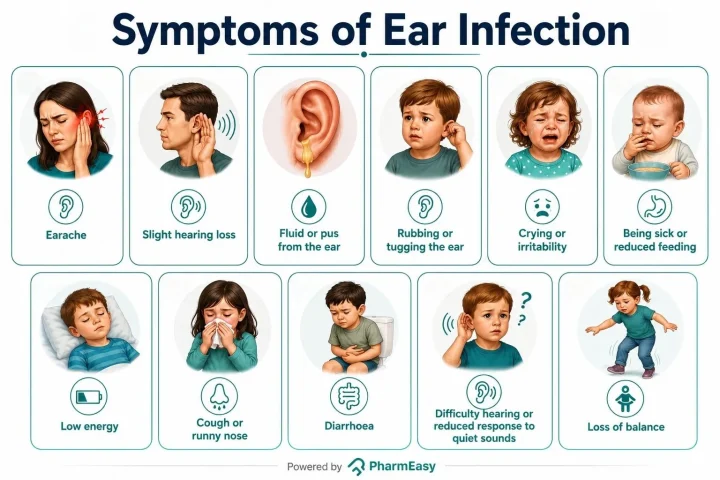
Symptoms of Ear Infection
Middle ear infection symptoms often appear quickly and may improve over a few days. Symptoms can look different in adults, older children, babies, and younger children4.
- Earache: Ear pain is the most common symptom in adults and older children.
- Slight hearing loss: Some people may notice reduced hearing, particularly when the middle ear is filled with fluid.
- Fluid or pus from the ear: A hole may sometimes develop in the eardrum, allowing pus to drain from the ear.
- Rubbing or tugging the ear: Younger children may rub or pull at the affected ear.
- Crying or irritability: Young children may become more irritable or cry more than usual, particularly with a fever.
- Being sick or reduced feeding: Younger children may vomit or feed less than usual.
- Low energy: A child with an ear infection may have less energy than usual.
- Cough or runny nose: These symptoms may occur when the ear infection follows a cold or other respiratory infection.
- Diarrhoea: Diarrhoea can occur in young children with otitis media infection.
- Difficulty hearing or reduced response to quiet sounds: A young child may appear inattentive or not respond to quieter sounds.
- Loss of balance: Some children may experience problems with balance.
Treatment of Ear Infection
Treatment depends on the person’s age, symptoms, general health, and risk of complications. Many middle ear infections improve on their own within a few days, so treatment may focus first on relieving pain and fever. Antibiotics are used when symptoms are severe, when the infection does not improve, or when the person is at higher risk of complications2,5.
- Pain and fever relief: Pain relievers and fever medicines may help reduce discomfort. Use medicines only as directed by a doctor or according to the product label2,5.
- Antibiotics: A doctor may prescribe oral antibiotics for some middle ear infections, especially if the child is very unwell, symptoms are severe, or there is a higher risk of complications. Ear drops may be used in specific situations, such as when there is ear discharge or a perforated eardrum, but they should be used only as advised by a healthcare professional2,5.
- Ear tubes or myringotomy: In some children with repeated infections or fluid that stays in the middle ear for several months, a specialist may recommend a small opening in the eardrum and placement of tiny tubes. These tubes help fluid drain and reduce pressure2.
- Adenoid removal: In selected children with repeated ear infections, a specialist may recommend removing the adenoids if they are contributing to the problem2.
- Antihistamines and decongestants: These medicines are not usually recommended for speeding recovery from middle ear infections. Ask a doctor before using them, especially in children5.
- Observation: For mild infections, a doctor may suggest watching symptoms for 2 to 3 days while using pain relief. If symptoms worsen or do not improve, antibiotics may then be considered2,5.
Home Remedies for Ear Infection
The following home-care steps may help ease earache or pressure while you wait for the infection to improve or while following medical advice6:
Advertisement
- Apply a cold pack: Place a cold pack or cold, wet washcloth on the outer ear for about 20 minutes to help reduce pain.
- Chew: Chewing may help relieve the pain and pressure associated with an ear infection. Gum should not be given to young children because it can be a choking hazard.
- Rest upright: Sitting or resting in an upright position instead of lying down can help reduce pressure in the middle ear.
- Use ear drops only when appropriate: Over-the-counter pain-relieving ear drops may help some people, but they should not be used if fluid is draining from the ear or if the eardrum may be perforated unless a doctor says they are safe.
- Take appropriate pain relievers: Over-the-counter pain medicines can help relieve earache in children and adults. Follow the dose instructions and ask a doctor if you are unsure what is safe.
- Swallow or chew during air travel: For ear pain caused by changes in altitude, swallowing or chewing during the airplane’s descent may help. Infants can suck on a bottle or breastfeed during descent.
Possible Complications of Ear Infection
Most ear infections get better within a few days, and complications of otitis media are uncommon. However, when complications occur, the infection can spread to nearby parts of the ear or head4,7.
- Hearing loss: Ear infections can cause hearing loss, which is usually temporary4.
- Perforated eardrum: A hole can develop in the eardrum, sometimes causing fluid or pus to drain from the ear4.
- Mastoiditis: The infection can spread to the bone behind the ear, known as the mastoid4.
- Labyrinthitis: The infection can spread to the inner ear, referred to as labyrinthitis4.
- Meningitis: In rare cases, the infection can spread to the protective membranes around the brain and spinal cord, known as meninges4.
- Facial nerve problems: An ear infection can sometimes lead to problems involving the facial nerve4.
- Chronic infection or cholesteatoma: Ear infections can sometimes lead to a persistent infection or cholesteatoma, which is an abnormal build-up of skin cells in the ear4.
- Long-term hearing or speech effects: Untreated or repeated ear infections can, in some cases, lead to lasting hearing problems or affect speech and language development in children2.
Prevention Tips for Ear Infections
These steps may help lower the risk of middle ear infections:
For Adults
- Keep vaccinations up to date: Recommended vaccines, such as flu and pneumococcal vaccines, can help lower the risk of some infections that may lead to middle ear infections7.
- Avoid exposure to cigarette smoke: Avoiding smoking and staying away from second-hand smoke exposure can help reduce the risk of developing ear infections4,7.
- Take care while swimming and showering: Use earplugs or a swimming cap while swimming if advised, dry the ears well afterwards, and try to keep shampoo and water out of the ears while bathing8,9.
- Avoid putting cotton buds or fingers in the ear: Do not insert fingers, cotton buds, or other objects into the ear canal9.
For Babies and Children
- Keep vaccinations up to date: Recommended vaccines, such as flu and pneumococcal vaccines, can help lower the risk of some infections that may lead to middle ear infections7.
- Do not wean off your baby too quickly: Breastfeeding may help reduce the risk of infections overall4,7.
- Limit dummy or pacifier use: Limiting or avoiding dummy or pacifier use, especially after 12 months of age, may help reduce risk4,7.
- Keep small objects away from babies: Supervise your baby so they do not put small items in their ears, as this can cause injury or infection7.
- Avoid feeding while lying flat: Try not to feed your baby while they are lying on their back7.
When Should You Consult a Doctor?
Seek medical advice if you or your child has symptoms of an ear infection:
- Symptoms are getting worse or last more than 2 to 3 days8.
- Fever is 39°C (102.2°F) or higher, or continues for more than 5 days10.
- A baby under 3 months has a temperature of 38°C (100.4°F) or higher8.
- Pus, discharge, or fluid is draining from the ear8,10.
- There is new or worsening hearing loss8.
- There is swelling, redness, or increasing pain behind the ear, or the individual develops dizziness or loss of balance4,10.
- You have a medical condition that could increase the risk of complications, including congenital heart disease or cystic fibrosis4,7.
- Your immune system is compromised, for example because of chemotherapy.
- The individual develops a severe headache, neck stiffness, breathing problems, dehydration, a seizure, unusual drowsiness, or a rash that does not disappear when pressed10.
Also Read: Ear Bleeding (Otorrhagia): Causes, Symptoms, Treatment and Prevention
Conclusion
Middle ear infections, or otitis media, are common, particularly in children, and often improve on their own. Recognising symptoms such as ear pain, fever, hearing difficulties, or ear discharge can help you know when medical advice may be needed. Simple preventive measures and appropriate home care can help reduce discomfort and the risk of infection, while timely medical attention can help prevent complications.
Also Read: Natural Home Remedies for Ear Pain
Frequently Asked Questions (FAQs)
Are middle ear infections contagious?Middle ear infections are not contagious. However, the cold or respiratory virus that may lead to an ear infection can spread from person to person8.
Can you lose hearing from otitis media?Yes. Otitis media can cause temporary hearing difficulty, especially when fluid remains in the middle ear. Permanent hearing loss is uncommon but can occur if infections are severe, repeated, or not treated when treatment is needed.
How long will otitis media last?Most cases of otitis media improve within 3 to 5 days. Seek medical advice if symptoms do not improve within 2 to 3 days, get worse, or are accompanied by concerning symptoms such as high fever, ear discharge, or hearing loss7.
How do I know if an ear infection is serious?An ear infection may be serious if there is a high fever, worsening pain, swelling or redness behind the ear, fluid or pus draining from the ear, new hearing loss, dizziness, repeated vomiting, severe headache, neck stiffness, unusual drowsiness, breathing problems, dehydration, a seizure, or a rash that does not fade when pressed. Seek urgent medical help if any of these symptoms occur11.
References
- Ear Infections. Accessed August 13, 2026. https://medlineplus.gov/earinfections.html
- Ear Infection (Otitis Media). October 29, 2024. Accessed August 13, 2026. https://www.hopkinsmedicine.org/health/conditions-and-diseases/otitis-media
- Matz O, Sutton AE, Ashurst JV. Acute Otitis Media. In: StatPearls. StatPearls Publishing; 2026. Accessed August 13, 2026. http://www.ncbi.nlm.nih.gov/books/NBK470332/
- Middle ear infection (otitis media) | nidirect. October 19, 2017. Accessed August 13, 2026. https://www.nidirect.gov.uk/conditions/middle-ear-infection-otitis-media
- Australia H. Otitis media (middle ear infection). June 19, 2025. Accessed August 13, 2026. https://www.healthdirect.gov.au/otitis-media
- Earache: MedlinePlus Medical Encyclopedia. Accessed August 13, 2026. https://medlineplus.gov/ency/article/003046.htm
- Middle ear infection (otitis media). NHS inform. Accessed August 13, 2026. https://www.nhsinform.scot/illnesses-and-conditions/ears-nose-and-throat/middle-ear-infection-otitis-media/
- CDC. Ear Infection Basics. Ear Infection. March 23, 2026. Accessed August 13, 2026. https://www.cdc.gov/ear-infection/about/index.html
- Ear infections. nhs.uk. January 25, 2018. Accessed August 17, 2026. https://www.nhs.uk/conditions/ear-infections/
- NHS_STW_Otitis_Media_Advice_Sheet.pdf. Accessed August 13, 2026. https://stw-healthiertogether.nhs.uk/application/files/5916/7404/6879/NHS_STW_Otitis_Media_Advice_Sheet.pdf
- Ear infections. nhs.uk. January 25, 2018. Accessed August 13, 2026. https://www.nhs.uk/conditions/ear-infections/
Disclaimer: The information provided here is for educational/awareness purposes only and is not intended to be a substitute for medical treatment by a healthcare professional and should not be relied upon to diagnose or treat any medical condition. The reader should consult a registered medical practitioner to determine the appropriateness of the information and before consuming any medication. PharmEasy does not provide any guarantee or warranty (express or implied) regarding the accuracy, adequacy, completeness, legality, reliability or usefulness of the information; and disclaims any liability arising thereof.
Links and product recommendations in the information provided here are advertisements of third-party products available on the website. PharmEasy does not make any representation on the accuracy or suitability of such products/services. Advertisements do not influence the editorial decisions or content. The information in this blog is subject to change without notice. The authors and administrators reserve the right to modify, add, or remove content without notification. It is your responsibility to review this disclaimer regularly for any changes.









































Comments