




How to Trim Dog Nails Safely at Home
By Dr. Ramani Jairam +2 more

Medically reviewed by Dr. Ramani Jairam
Last updated: Sep 9, 2026 Published on: Jul 31, 2026


Get,

to manage your symptom
Get your,

4 Cr+ families
benefitted

OTP sent to 9988776655



You’ve successfully subscribed to receive
doctor-approved tips on
Whatsapp

Get ready to feel your best.


Register to Avail the Offer
Send OTPBy continuing, you agree with our Privacy Policy and Terms and Conditions
Hi There,
Sign up on PharmEasy now!!


Trusted by 4 crore+ families

OTP sent to 9988776655
You have unlocked 25% off on medicines


Code: NU25

By Dr. Ramani Jairam +2 more
Table of Contents
If you have ever held a pair of nail clippers while your dog pulls away, squirms, or gives you those worried eyes, you are not alone. Many pet parents feel anxious about trimming their dog’s nails, fearing they might cut too deep, cause pain, or make their dog afraid of future nail trims. As a result, nail trimming is often delayed until the nails become too long and uncomfortable.
The good news is that with the right tools, proper technique, and a little patience, trimming your dog’s nails at home can be safe, stress-free, and even become part of your regular grooming routine. In this blog, you will learn why regular nail trimming is important, how to cut dog’s nails at home, what to do if you accidentally cut too deep, and share some practical tips on help to keep your dog calm throughout the process.
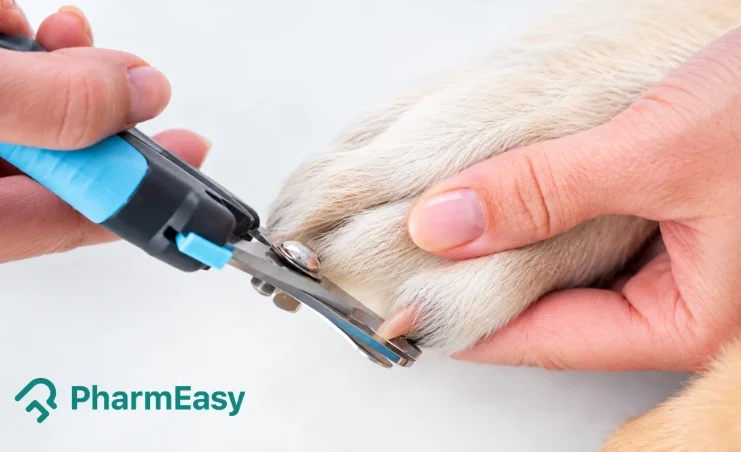
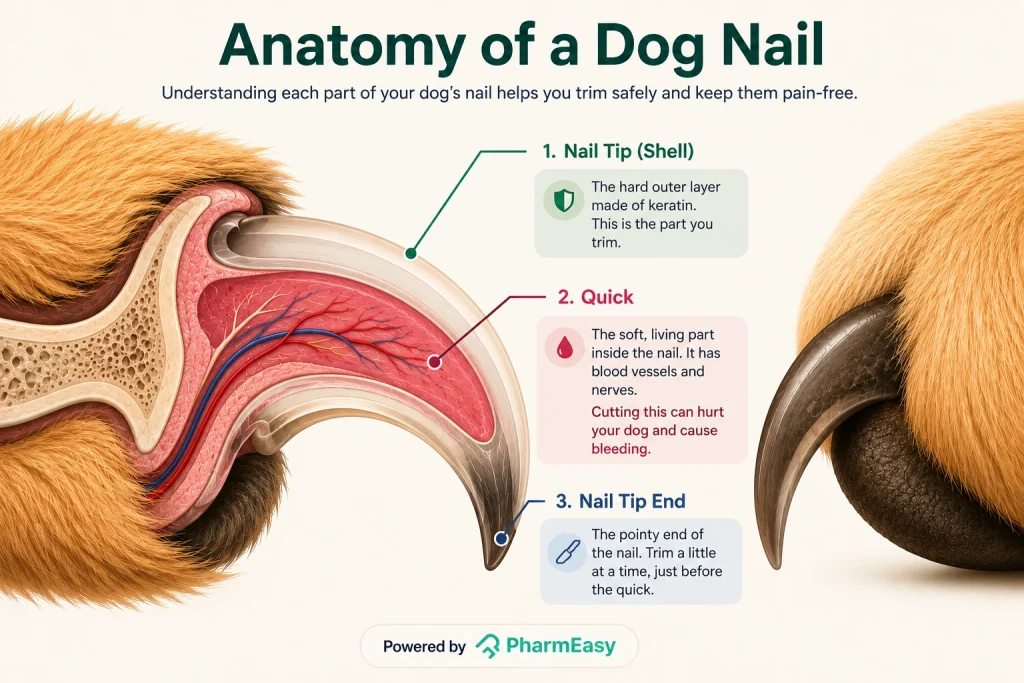
If you understand the basic structure of your dog’s nail, it can help you trim it more safely and avoid injury. A dog nail has the following parts:
Note: Dogs also have a dewclaw. This is an extra claw located on the inner side of the front legs (and sometimes the hind legs). Since it does not wear down naturally, it may require more frequent trimming3,4.
Regular nail trimming is more than just a cosmetic grooming task. It is essential for your dog’s health and comfort.
Trimming the nails regularly helps the quick gradually recede, making future nail trims easier and reducing the risk of cutting into it. If nails become too long, they can affect the way your dog stands and walks. Overgrown nails may cause the paws to splay, reduce traction, and place extra pressure on the feet and legs with every step. Over time, this can contribute to changes in foot structure and strain on the tendons. While some active dogs naturally wear their nails down through regular activity, many dogs still require routine nail trimming to maintain a healthy nail length3,5.
Most dogs need their nails trimmed every 3 to 4 weeks, although the ideal frequency varies depending on several factors3.
Factors such as your dog’s activity level, the surfaces they walk on, age, and how quickly their nails grow can all influence how often trimming is needed. Dogs that regularly walk or run on hard surfaces may naturally wear down their nails and require less frequent trims, while indoor or less active dogs may need more regular nail care6.
Note: If you are unsure how often your dog’s nails should be trimmed or notice the nails becoming overgrown despite regular care, consult your veterinarian.7 They can recommend a nail trimming schedule based on your dog’s individual needs.
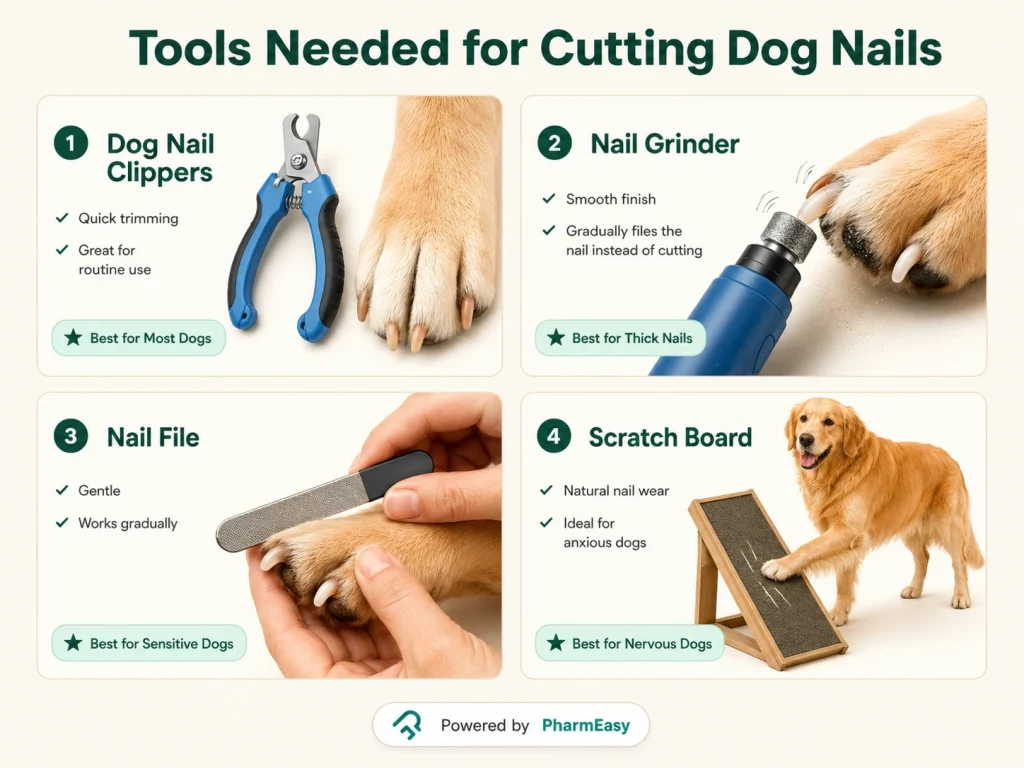
The best tool depends on your dog’s size, temperament, and what they are most comfortable with. Common tools used for trimming dog nails include1,3:
Note: There is no single tool that works best for every dog. Some dogs prefer clippers, while others are more comfortable with a grinder, file, or scratch board. So, choose the option that your dog tolerates best and that you can use confidently.
Follow these steps to trim your dog’s nails safely at home3:
Follow these tips to make nail trimming safer and more comfortable for your dog3:
Accidentally cutting into the quick can happen, especially if your dog has dark nails or moves suddenly during trimming. Since the quick contains blood vessels and nerves, it can cause pain and bleeding, but it is usually not a medical emergency.
If you accidentally cut too deep:
Important: If the bleeding does not stop after several minutes, the nail appears severely injured, or your dog continues to show significant pain, contact your veterinarian for advice.
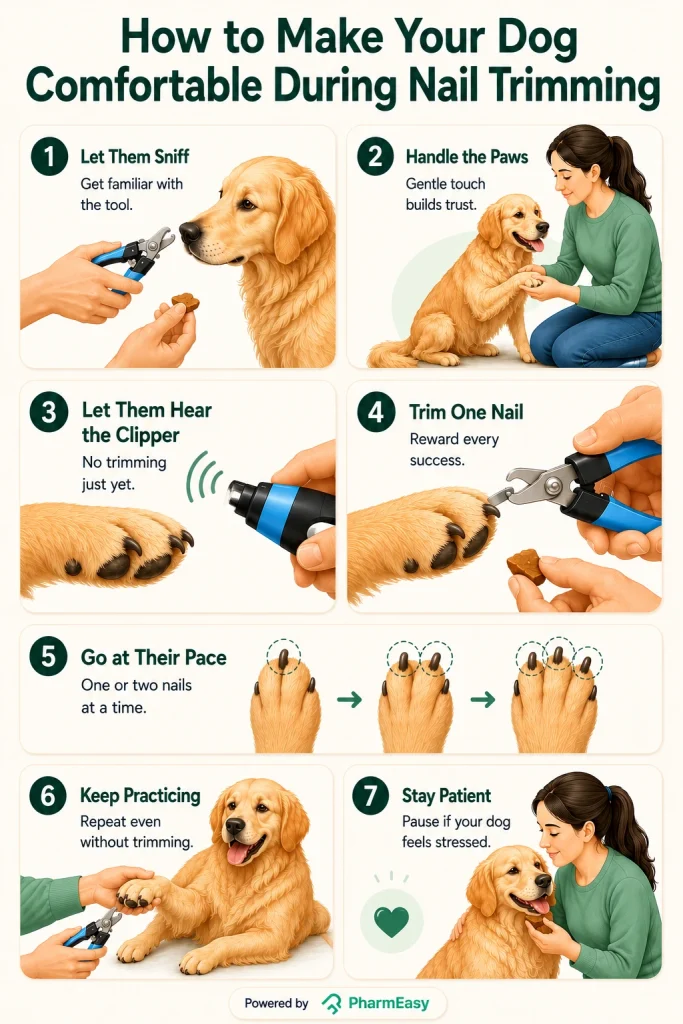
Help your dog associate nail trimming with positive experiences by introducing the process gradually. Some dogs may feel comfortable within a week, while others may need more time. Be patient and move at your dog’s pace. Here is what you can do to make them comfortable3:
Avoid these common mistakes to make nail trimming a safer and less stressful experience for your dog1:
While many dogs can have their nails trimmed safely at home, some situations require the help of a veterinarian or professional groomer. Consult a vet if8,9:
Also Read: Dog Deworming: What Is It, Types, Symptoms & Prevention Tips
Regular nail trimming is an important part of your dog’s overall health and grooming routine. Most dogs can learn to tolerate nail trimming at home with the right tools, a gradual approach, and plenty of patience. So, always trim small amounts at a time, avoid cutting the quick, and reward your dog throughout the process.
If you are unsure about trimming your dog’s nails or your dog becomes distressed, don’t hesitate to seek help from a veterinarian or professional groomer to ensure the experience is safe and comfortable.
Overgrown nails can change the way a dog places its paws on the ground. This may reduce traction, put extra pressure on the feet and legs, and make walking or running uncomfortable or painfu3,6.
If left untrimmed, nails can become overgrown, affecting your dog’s posture and movement6. They may also be more likely to crack, break, or cause discomfort over time.
The quick is difficult to see in black nails, so trim only a small amount at a time. After each cut, inspect the cut surface. If you notice a small black dot in the centre of the nail, you are getting close to the quick and should stop trimming to avoid pain and bleeding6.
No, it is best to use nail clippers or grinders designed specifically for dogs, as they are made to safely trim a dog’s thicker, curved nails10.
1. Good Grooming – Improving Your Dog’s Nail-Care Routine. American Kennel Club. Accessed July 27, 2026. https://www.akc.org/expert-advice/family-dog/dog-nail-care-routine/
2. Structure of the nails. InformedHealth; 2024. Accessed July 27, 2026. https://www.ncbi.nlm.nih.gov/books/NBK513133/
3. How to Trim Your Dog’s Nails Safely. American Kennel Club. Accessed July 27, 2026. https://www.akc.org/expert-advice/health/how-to-trim-dogs-nails-safely/
4. What Are Dewclaws on Dogs and Do They Serve a Purpose? American Kennel Club. Accessed July 27, 2026. https://www.akc.org/expert-advice/health/what-are-dog-dewclaws/
5. How to Groom a Dog at Home. American Kennel Club. Accessed July 27, 2026. https://www.akc.org/expert-advice/health/how-to-groom-a-dog/
6. Häusler K, Söhnel K. Trimming of nails in healthy dogs does not change gait parameters when comparing pre- and post-nail trim. Front Vet Sci. 13:1728382. doi:10.3389/fvets.2026.1728382 https://pubmed.ncbi.nlm.nih.gov/41728131/
7. Ahmed LA, Somarriba M, Brodbelt DC, Church DB, O’Neill DG. Epidemiology and clinical management of nail clipping in dogs under UK primary veterinary care. J Small Anim Pract. 2025;66(12):925-933. doi:10.1111/jsap.70002 https://onlinelibrary.wiley.com/doi/10.1111/jsap.70002
8. When Should I Call the Vet? American Kennel Club. Accessed July 27, 2026. https://www.akc.org/expert-advice/health/should-i-call-my-dogs-vet/
9. Chen A, Hall E, Bennington LN, McGowan C, Quain A. “One of the Hardest Things I Have to Do in the Clinic”: A Survey of Veterinary Team Members’ Knowledge, Attitudes, and Practices Regarding Nail Clipping. Vet Sci. 2026;13(2):115. doi:10.3390/vetsci13020115 https://www.mdpi.com/2306-7381/13/2/115
10. McDonald SE, Doherty C, Sweeney J, et al. Barriers to and facilitators of pet grooming among clients served by a subsidized grooming service program. Front Vet Sci. 2022;9:1021707. doi:10.3389/fvets.2022.1021707 https://www.frontiersin.org/journals/veterinary-science/articles/10.3389/fvets.2022.1021707/full
Disclaimer: The information provided here is for educational/awareness purposes only and is not intended to be a substitute for medical treatment by a healthcare professional and should not be relied upon to diagnose or treat any medical condition. The reader should consult a registered medical practitioner to determine the appropriateness of the information and before consuming any medication. PharmEasy does not provide any guarantee or warranty (express or implied) regarding the accuracy, adequacy, completeness, legality, reliability or usefulness of the information; and disclaims any liability arising thereof.
Links and product recommendations in the information provided here are advertisements of third-party products available on the website. PharmEasy does not make any representation on the accuracy or suitability of such products/services. Advertisements do not influence the editorial decisions or content. The information in this blog is subject to change without notice. The authors and administrators reserve the right to modify, add, or remove content without notification. It is your responsibility to review this disclaimer regularly for any changes.


Comments

Leave your comment...
You may also like
























Comments