




Is It Dangerous to Have Fluid in the Knee? Causes, Home Remedies & Treatment
By Dr. Parth Mehta +2 more

Medically reviewed by Dr. Parth Mehta
Last updated: Sep 11, 2026 Published on: Jul 31, 2026


Get,

to manage your symptom
Get your,

4 Cr+ families
benefitted

OTP sent to 9988776655



You’ve successfully subscribed to receive
doctor-approved tips on
Whatsapp

Get ready to feel your best.


Register to Avail the Offer
Send OTPBy continuing, you agree with our Privacy Policy and Terms and Conditions
Hi There,
Sign up on PharmEasy now!!


Trusted by 4 crore+ families

OTP sent to 9988776655
You have unlocked 25% off on medicines


Code: NU25

By Dr. Parth Mehta +2 more
Table of Contents
Knee pain and swelling are common and can affect people of all ages. They can make everyday activities, such as walking, climbing stairs, or getting up from a chair, more difficult. One possible cause is knee effusion, which means extra fluid has collected in or around the knee joint. This can happen after an injury, repeated strain, or due to a medical condition1. This article explains the causes, symptoms, home care tips, and treatment options for knee effusion, and when to seek medical care.
Fluid in the knee, also called knee effusion, happens when extra fluid collects in or around the knee joint and causes swelling. A small amount of joint fluid, called synovial fluid, is normally present in the knee. It helps the joint move smoothly. When the knee is injured, irritated, inflamed, or affected by certain health conditions, the body may produce more fluid than usual, leading to swelling1.
Fluid in the knee is not always dangerous, but it should not be ignored. Mild swelling after overuse or a minor injury may improve with rest and simple home care. However, swelling can also be a sign of infection, a serious injury, or a condition such as arthritis or gout. In these cases, medical treatment may be needed1.
Symptoms can vary depending on the cause. Common symptoms include:
Seek medical help promptly if you notice any of the following:
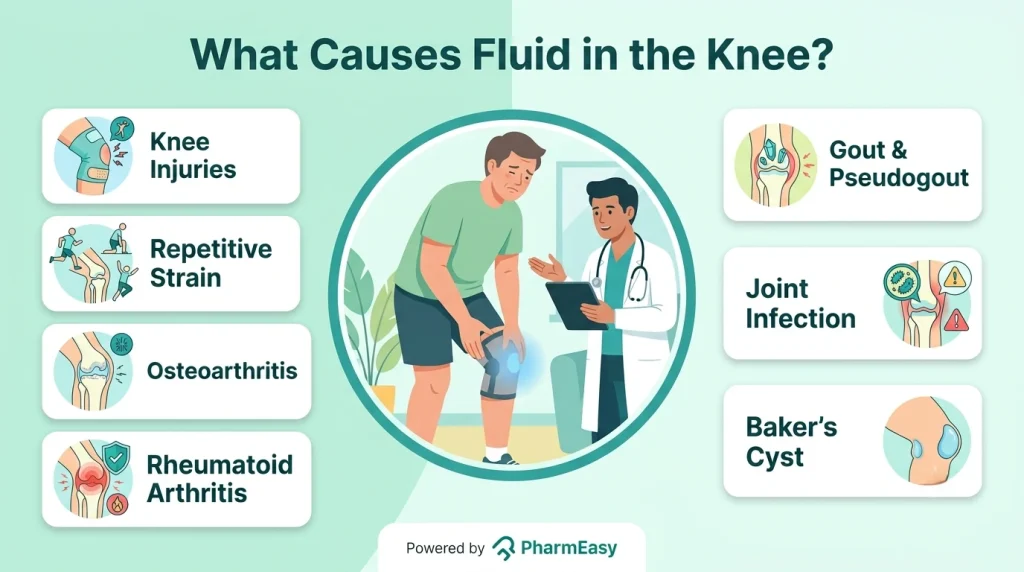
Fluid in the knee can have many causes. Some common causes include:
Note: The causes listed above are some of the most common reasons for fluid in the knee, but they are not the only ones. A doctor can find the exact cause through a physical examination and other diagnostic procedures, if needed.
Diagnosis is important because treatment depends on the cause of the swelling. A doctor will usually examine the knee and may recommend tests if needed.
The doctor may recommend one or more of the following tests:
Treatment depends on what is causing the fluid build-up, how severe the swelling is, and the person’s overall health. Resting the knee and avoiding activities that make symptoms worse may help while waiting for medical advice. A doctor may recommend one or more of the following:
Note: Take medicines only as advised by a doctor or pharmacist. Some medicines can cause side effects or may not be suitable for everyone.
Note: The proper treatment for knee effusion depends on its underlying cause, severity, and overall health. Always consult a doctor for an accurate diagnosis and a personalised treatment plan. Do not self-medicate or delay medical care, especially if symptoms are getting worse.
Home care may help reduce pain and swelling, especially after mild strain or overuse. These steps should not replace medical care if symptoms are severe or getting worse:
Note: Home care tips might help relieve or reduce the symptoms, but they cannot treat the cause. It is important to consult a doctor if the symptoms get worse even after following these tips.
Consult a doctor if knee swelling or pain is severe, does not improve, or makes it hard to walk or put weight on the affected leg. Seek urgent medical care if the knee is very swollen, red, warm, or painful, if you have a fever, if the swelling follows a significant injury, or if the knee looks deformed1,2. People with conditions such as arthritis or gout should also seek medical advice if symptoms are worsening or becoming difficult to manage1,3,4,5. Early assessment can help identify the cause and guide the right treatment.
Also Read: Home Remedies For Knee Joint Pain By Dr. Siddharth Gupta
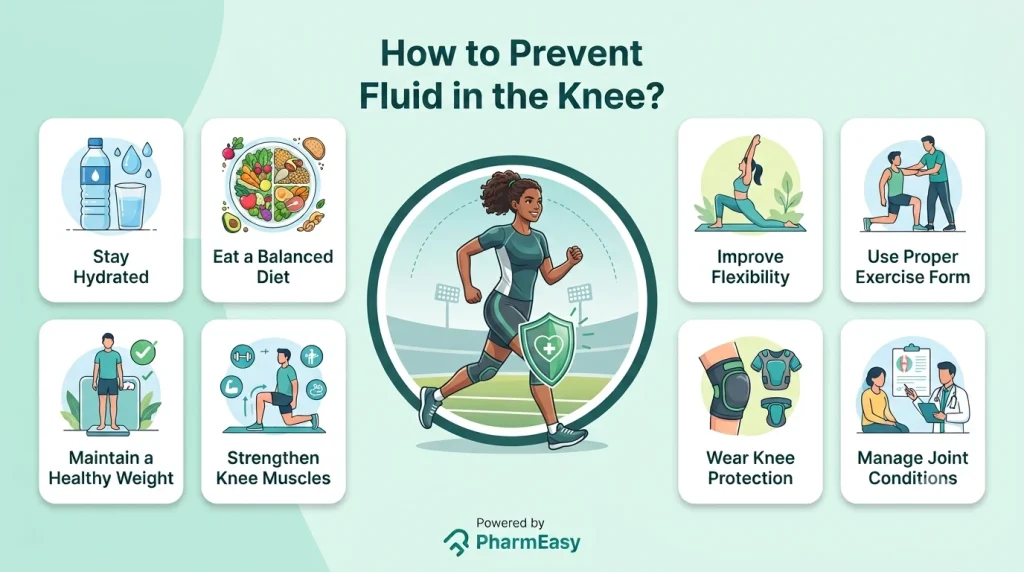
While not all cases of knee effusion can be prevented, adopting healthy habits and protecting the knee joint can help reduce the risk. The following are some helpful preventive tips:
Note: These measures may help reduce the risk of fluid on the knee but cannot prevent all causes. Regular medical follow-up is important for people with underlying joint conditions or recurrent knee problems.
Also Read: Calf Strain: What It Is, Causes, Symptoms, and Recovery Tips
Fluid on the knee, or knee effusion, is swelling caused by extra fluid in or around the knee joint. It can happen after an injury, repeated strain, arthritis, gout, infection, or other health problems. Mild swelling may improve with rest, ice, elevation, and avoiding activities that make symptoms worse. However, swelling with fever, warmth, redness, severe pain, difficulty walking, or a recent injury should be checked by a doctor. Finding and treating the cause can help relieve symptoms and reduce the risk of complications.
Gentle walking may be helpful for some people once pain and swelling are improving, but it is not suitable for everyone. If walking increases pain, swelling, or instability, stop and seek medical advice. People with an injury, arthritis, or another knee condition should follow a doctor’s or physiotherapist’s guidance11.
Heat may help ease stiffness or long-term aching in some knee conditions. However, heat may not be the best choice for a newly swollen, red, warm, or injured knee. In those situations, medical advice is recommended, and ice is often used first for swelling12.
Yes, applying an ice pack may help reduce swelling, inflammation, pain, and discomfort caused by several knee problems1.
Yes, arthritis can cause fluid buildup in the knee by triggering inflammation inside the joint. Conditions such as osteoarthritis and rheumatoid arthritis may lead to swelling, pain, and stiffness due to excess fluid accumulation1,3,4.
Yes, gout can cause fluid buildup in the knee due to the accumulation of uric acid crystals inside the joint, which triggers inflammation. This can lead to sudden pain, swelling, redness, and stiffness1,5.
Yes. Fluid in the knee can be related to an infection in the joint, called septic arthritis. This can cause severe pain, swelling, redness, warmth, and fever, and it needs urgent medical attention1.
1. Gerena LA, Ahmed Mabrouk, DeCastro A. Knee Effusion. 2024. Available from: https://www.ncbi.nlm.nih.gov/books/NBK532279/
2. Acute Knee Effusions: A Systematic Approach to Diagnosis. 2026. Available from: https://www.aafp.org/afp/2000/0415/p2391
3. Osteoarthritis. 2024. Available from: https://medlineplus.gov/osteoarthritis.html
4. Rheumatoid Arthritis. 2025. Available from: https://medlineplus.gov/rheumatoidarthritis.html
5. Gout. 2024. Available from: https://medlineplus.gov/gout.html
6. Department of Radiology, Valleywise Health Medical Centre, Phoenix, USA, Pandya S, Melville DM, Department of Radiology, Mayo Clinic Arizona, Phoenix, USA. Evaluation of the knee joint with ultrasound and magnetic resonance imaging. J Ultrason. 2023;23(95):237-248. doi:10.15557/JoU.2023.0032 Available from: https://pubmed.ncbi.nlm.nih.gov/38020509/
7. Akbarnia H, Smith T, Saber AY, Zahn E. Knee Arthrocentesis. 2024. Available from: https://www.ncbi.nlm.nih.gov/books/NBK470229/
8. Comparing pain meds for osteoarthritis. Available from: https://www.arthritis.org/health-wellness/healthy-living/managing-pain/pain-relief-solutions/comparing-pain-meds-for-osteoarthritis
9. Rönn K, Reischl N, Gautier E, Jacobi M. Current Surgical Treatment of Knee Osteoarthritis. Arthritis. 2011;2011:1-9. doi:10.1155/2011/454873 Available from: https://pubmed.ncbi.nlm.nih.gov/22046517/
10. Living with rheumatoid arthritis. 2023. Available from: https://www.nhs.uk/conditions/rheumatoid-arthritis/living-with/
11. Coelho JM, Fernandes TT, Alves SM, Nunes RG, Nogueira L, Oliveira A. Impact of walking on knee articular cartilage T2 values estimated with a dictionary-based approach – A pilot study. Radiography. 2025;31(1):66-74. doi:10.1016/j.radi.2024.10.018 Available from: https://pubmed.ncbi.nlm.nih.gov/39541875/
12. Rossi R. Heat therapy for different knee diseases: expert opinion. Front Rehabil Sci. 2024;5:1390416. doi:10.3389/fresc.2024.1390416 Available from: https://pubmed.ncbi.nlm.nih.gov/39055174/
Disclaimer: The information provided here is for educational/awareness purposes only and is not intended to be a substitute for medical treatment by a healthcare professional and should not be relied upon to diagnose or treat any medical condition. The reader should consult a registered medical practitioner to determine the appropriateness of the information and before consuming any medication. PharmEasy does not provide any guarantee or warranty (express or implied) regarding the accuracy, adequacy, completeness, legality, reliability or usefulness of the information; and disclaims any liability arising thereof.
Links and product recommendations in the information provided here are advertisements of third-party products available on the website. PharmEasy does not make any representation on the accuracy or suitability of such products/services. Advertisements do not influence the editorial decisions or content. The information in this blog is subject to change without notice. The authors and administrators reserve the right to modify, add, or remove content without notification. It is your responsibility to review this disclaimer regularly for any changes.


Comments

Leave your comment...
You may also like

















Comments