




Croup Cough in Kids: Causes, Symptoms, Treatment & When to Worry
By Dr. Sarthak Soni +2 more

Medically reviewed by Dr. Sarthak Soni
Last updated: Sep 11, 2026 Published on: Jul 29, 2026


Get,

to manage your symptom
Get your,

4 Cr+ families
benefitted

OTP sent to 9988776655



You’ve successfully subscribed to receive
doctor-approved tips on
Whatsapp

Get ready to feel your best.


Register to Avail the Offer
Send OTPBy continuing, you agree with our Privacy Policy and Terms and Conditions
Hi There,
Sign up on PharmEasy now!!


Trusted by 4 crore+ families

OTP sent to 9988776655
You have unlocked 25% off on medicines


Code: NU25

By Dr. Sarthak Soni +2 more
Table of Contents
Hearing your baby or child wake up in the middle of the night with a loud, barking cough can be frightening. This can often be a sign of croup cough, which is an inflammation of the windpipe. This blog will cover interesting facts, causes, symptoms, types, diagnosis, treatment, home remedies, and prevention of croup cough1.
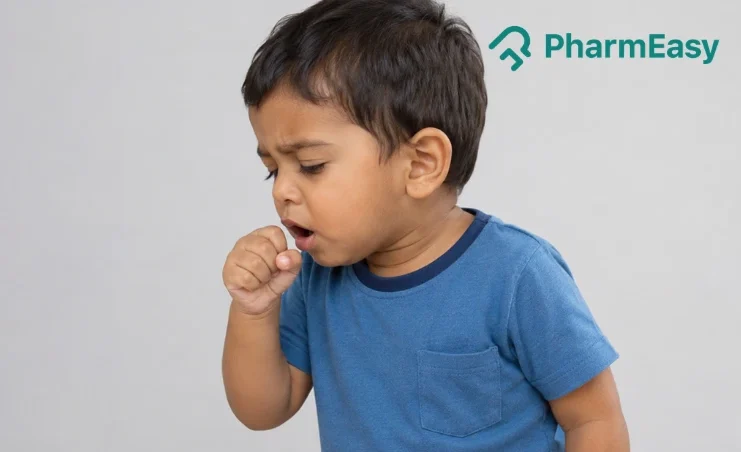
Croup is an upper airway infection that is characterised by hoarseness and coughing that sounds like a seal barking. It is usually caused by viruses such as parainfluenza and RSV but can also be caused by bacteria. It is common in children under the age of 6. Most children with croup exhibit mild symptoms and can be treated at home, but in a few severe cases, hospitalisation is required1,2.
Croup is caused by viruses such as1,2:
Croup can also be caused by a bacterium, usually Staphylococcus aureus. In this case, it is called bacterial tracheitis.
The common types of croup that may occur in babies and kids include2:
Croup is diagnosed with the following examinations and laboratory tests1:
The options for croup treatment in babies and children include2:
Home remedies that may help soothe the symptoms of croup include3:
You may be able to avoid croup cough in your child by ensuring that they1,2:
Also Read: Home Remedies for Cold in Infants and Babies
It is important to consult a doctor if your child has croup and is not responding to any home remedies. If your child has trouble breathing, a high-pitched sound with every breath, extreme drowsiness, decreased consciousness, and bluish coloured lips and face, you should contact your doctor immediately3.
Also Read: Runny Nose in Children: Causes, How to Manage It & Prevention Tips
Although croup cases are usually mild and improve with care at home, some children may require hospitalisation. If your child develops breathing problems, extreme fatigue, and trouble swallowing, ensure that you go to the doctor as soon as possible. Recognising and diagnosing croup early, timely treatment, and appropriate care can help prevent complications. It is important to ensure hygiene and timely vaccinations for your child to avoid viral and bacterial infections in general.
If your child has a barking cough and hoarseness, it is likely that it is croup cough. Further tests, like a chest exam, may be needed to confirm the diagnosis1,3.
Yes, but it is important that you keep constantly checking with them at night. Make sure your child is not crying as it can worsen the symptoms. If your child is older than 1 year, it is advisable to use a pillow to keep their head up while sleeping1,3.
Antibiotics are administered to children only when a primary or secondary bacterial infection is suspected2.
Yes, the most severe symptoms of croup usually appear on day 3 or 42.
Sometimes, conditions such as acute epiglottitis (epiglottis infection), deep neck space abscesses (a condition characterised by fever, drooling, and neck stiffness), presence of a foreign body in the throat, and allergic reactions may be mistaken for croup as they all have similar symptoms2.
Yes, complications such as pneumonia may occur as a result of croup2.
1. Croup: MedlinePlus Medical Encyclopedia. Accessed July 3, 2026. Available from: https://medlineplus.gov/ency/article/000959.htm
2. Kadam S, Daley S, Carr B. Croup. StatPearls. Published online June 2, 2025. Accessed July 3, 2026. Available from: https://app-statpearls-legacy-prod.azurewebsites.net/point-of-care/20142
3. Croup – discharge: MedlinePlus Medical Encyclopedia. Accessed July 3, 2026. Available from: https://medlineplus.gov/ency/patientinstructions/000994.htm
4. Tracheitis: MedlinePlus Medical Encyclopedia. Accessed July 3, 2026. Available from: https://medlineplus.gov/ency/article/000988.htm
5. Content – Health Encyclopedia – URochester Medicine. Accessed July 16, 2026. Available from: https://www.urmc.rochester.edu/encyclopedia/content?contenttypeid=90&contentid=p02942
6. Treating Your Child’s “Barking Cough” at Home | University of Utah Health. January 2, 2023. Accessed July 16, 2026. Available from: https://healthcare.utah.edu/the-scope/kids-zone/all/2026/04/treating-your-childs-barking-cough-home
7. The-PEARL-No.-33_-Croup. Accessed July 20, 2026. Available from: https://flemsc.emergency.med.jax.ufl.edu/wordpress/files/2024/02/The-PEARL-No.-33_-Croup.pdf
Disclaimer: The information provided here is for educational/awareness purposes only and is not intended to be a substitute for medical treatment by a healthcare professional and should not be relied upon to diagnose or treat any medical condition. The reader should consult a registered medical practitioner to determine the appropriateness of the information and before consuming any medication. PharmEasy does not provide any guarantee or warranty (express or implied) regarding the accuracy, adequacy, completeness, legality, reliability or usefulness of the information; and disclaims any liability arising thereof.
Links and product recommendations in the information provided here are advertisements of third-party products available on the website. PharmEasy does not make any representation on the accuracy or suitability of such products/services. Advertisements do not influence the editorial decisions or content. The information in this blog is subject to change without notice. The authors and administrators reserve the right to modify, add, or remove content without notification. It is your responsibility to review this disclaimer regularly for any changes.


Comments

Leave your comment...
You may also like
























Comments