




Generic vs Non-Generic (Branded vs Non-Branded): What’s the Difference and Which May Be Right for You?
By Dr. Jagriti Jha +2 more

Medically reviewed by Dr. Jagriti Jha
Last updated: Jul 17, 2026 Published on: Jul 17, 2026


Get,

to manage your symptom
Get your,

4 Cr+ families
benefitted

OTP sent to 9988776655



You’ve successfully subscribed to receive
doctor-approved tips on
Whatsapp

Get ready to feel your best.


Register to Avail the Offer
Send OTPBy continuing, you agree with our Privacy Policy and Terms and Conditions
Hi There,
Sign up on PharmEasy now!!


Trusted by 4 crore+ families

OTP sent to 9988776655
You have unlocked 25% off on medicines


Code: NU25

By Dr. Jagriti Jha +2 more
Table of Contents
When your doctor prescribes a medicine, you may notice that the same active ingredient is available under different brand names and at very different prices. Your pharmacist may also suggest a lower-cost alternative.
This can make the choice confusing and leave you wondering: What is the difference between a generic medicine, a branded generic, and an original brand-name medicine? Are generics as effective? Why do prices vary so much? And when should you ask your doctor or pharmacist before switching?
The key point is that approved generic medicines are designed to provide the same therapeutic effect as the corresponding brand-name medicine, although they may differ in name, appearance, inactive ingredients, manufacturer, and price1.
This article explains the differences and similarities, discusses effectiveness, safety, cost, and access, and outlines when a generic or brand-name option may be more appropriate for you.
Generic medicines contain the same active ingredient as a corresponding brand-name medicine. The active ingredient is the substance that produces the intended effect in the body, so approved generics are used to manage the same medical conditions as the original medicine1,2.
In India, many generics are sold as branded generics: medicines made after the original patent expires but marketed under a manufacturer’s trade name. Some medicines are sold by their generic, non-proprietary name without a separate brand name; these are often called unbranded or generic-name medicines and are stocked at Jan Aushadhi Kendras. Both types must meet applicable quality, safety, and bioequivalence standards, but their prices can differ substantially3.
Brand-name medicines, also called innovator medicines, are the original versions developed by a pharmaceutical company after extensive research, testing, and clinical trials. They are marketed under a unique brand name and are usually the first version of a medicine to receive regulatory approval4.
Note: In this article, brand-name medicine refers to the original innovator product, not to a branded generic. A branded generic has a trade name, but it is still a generic medicine rather than the original innovator brand3,4.
Generic and brand-name medicines can have the same intended therapeutic use, but they differ in several practical ways. Below are some differences between generic and branded medicines3,4,5
| Feature | Generic Medicines | Non-Generic Medicines |
| Name | Sold under the generic (non-proprietary) name, or under the manufacturer’s own trade name if it is a branded generic: the most common type of generic sold in India. | Sold under a unique brand name by the manufacturer. |
| Manufacturer | Produced by one or more manufacturers after patent or exclusivity expires. | Produced by the company that initially developed the medicine. |
| Price | Usually less expensive. | Usually more expensive. |
| Appearance | May differ in colour, shape, size, or packaging. | Has the original appearance and packaging. |
| Inactive ingredients | May contain different fillers, binders, or colouring agents. | Contains the manufacturer’s original inactive ingredients. |
| Patent status | Available after patent or exclusivity protection ends (unless otherwise permitted by law). | Initially protected by patents or regulatory exclusivity. |
| Availability | Often available from multiple manufacturers. | Available under the original brand name. |
Although generic and branded medicines may look different or have different names, they have many important similarities, such a4,5:
| Feature | How They Are Similar |
| Active ingredient | Contain the same active ingredient. |
| Medical use | Treat the same disease or condition. |
| Strength | Available in the same strength (e.g., 500 mg). |
| Dosage form | Available in the same dosage forms (e.g., tablet, capsule, syrup). |
| Route of administration | Taken the same way (e.g., oral, topical, injectable). |
| Effectiveness | Expected to provide the same therapeutic effect. |
| Safety and quality | Must meet the same regulatory standards for quality, safety, and effectiveness. |
Approved generic medicines are expected to work as effectively as their corresponding brand-name medicines. They contain the same active ingredient and must show that they work in the body in a comparable way2,5.
To be approved, a generic medicine generally needs to match the brand-name medicine in strength, dosage form, route of administration, and intended use, and it must meet the required quality standards. Labelling may differ only where regulations allow5.
Important: Do not switch between medicines on your own. If you are unsure about the difference between brand name and generic name, ask your doctor or pharmacist whether the generic, branded generic, or brand-name option is appropriate for your condition, especially if you take long-term medicines or medicines that require close monitoring.
Before any medicine reaches patients, it must undergo a rigorous regulatory review to ensure it meets established standards for quality, safety, and effectiveness.
Brand-name medicines are first evaluated based on extensive laboratory research, preclinical studies, and clinical trials before they receive marketing approval6. Once the patent or exclusivity period of this brand-name medicine expires, manufacturers of generic medicines can apply for approval2,7. Rather than repeating the original clinical trials, they are required to demonstrate that their generic version of the medicine is equivalent to the approved brand-name medicine and is expected to provide the same clinical benefit when used as directed2.
To do this, they must show that the generic medicine2:
Cost is one of the most important practical differences between generic medicine and branded medicine. Generics are often less expensive, but the extent of the saving depends on the medicine, manufacturer, pharmacy, and country5.
Generic medicines are usually much cheaper (sometimes even up to 80%)3,8 because manufacturers do not need to repeat the full research and large clinical trial programmes completed for the original brand-name medicine. Instead, they must show that their version meets regulatory requirements and is bioequivalent to the brand-name medicine5,8.
In India, savings can vary. How much you actually save depends on which type of generic you choose. Branded generics, sold under a manufacturer’s own trade name, and the most common type available at retail pharmacies, are often priced only modestly below the innovator brand because marketing, packaging, and distribution costs may still be included. Generic-name or (unbranded) medicines, including those sold through the Government of India’s Jan Aushadhi Kendras, typically offer the deepest discounts, although savings may sometimes be even less than the branded equivalent. However, prices can still vary by product and location3.
Because the lowest-priced option can differ from one medicine to another, it is useful to compare the prescribed brand, available branded generics, and any approved generic-name options before purchase. Your pharmacist can help identify the active ingredient and compare available alternatives3. For example, one medicine may cost ₹1.38 per tablet as the lowest-priced branded medicine, ₹0.575 per tablet as a branded generic, and ₹0.66 per tablet under the Jan Aushadhi (unbranded generic) scheme, making the branded generic the least expensive option. In contrast, another medicine may cost 1.34 per tablet as the lowest-priced branded medicine, ₹0.82 per tablet as a branded generic, and ₹0.53 per tablet under the Jan Aushadhi scheme, making the Jan Aushadhi version the most affordable. These examples highlight that the lowest-priced option may differ depending on the medicine, making price comparison an important step before purchase3.
Note: Price should not be the only factor. The right choice should also consider your diagnosis, dose, treatment history, allergies, and your doctor’s or pharmacist’s advice.
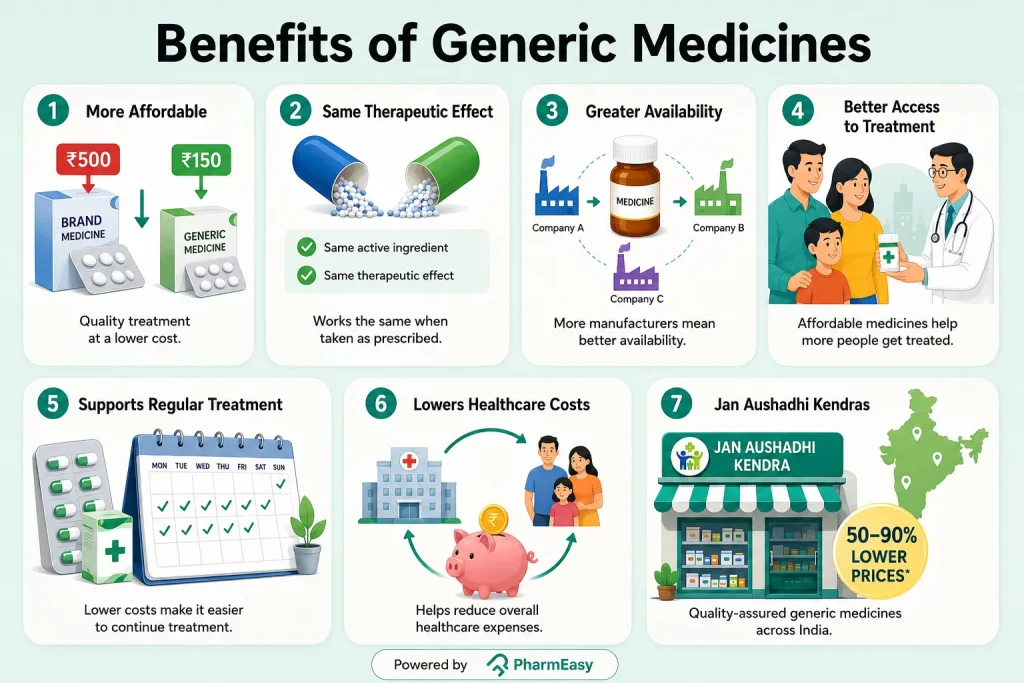
Generic medicines offer several advantages for both patients and healthcare systems. When approved by regulatory authorities, they provide an effective and more affordable alternative to brand-name medicines.
Note: If you are unsure how to identify generic and branded medicines, check the medicine label for the active ingredient, brand name, and manufacturer, or ask your doctor or pharmacist for guidance.
Approved generic medicines are suitable for many people, but the best option depends on the medicine, your condition, and whether consistent monitoring is needed. Use the points below as a guide for discussion with your doctor or pharmacist.
Generic medicines are suitable for most patients and are commonly recommended when1:
Also Read: Generic Medicines And How Safe Are They?
In some situations, your doctor may advise using a brand-name medicine, such as when1,8:
Generic, branded generic, and brand-name medicines can all play important roles in treatment. Approved generics contain the same active ingredient as the corresponding brand-name medicine and are expected to provide the same therapeutic effect, while differences may exist in name, appearance, inactive ingredients, manufacturer, and price.
For many patients, generics can improve affordability and access without compromising expected treatment benefit. However, a brand-name medicine or a consistent manufacturer may be preferred in specific situations, such as when no approved generic is available, when inactive ingredients are a concern, or when a medicine requires careful monitoring.
If you are deciding between a generic vs branded medicine, speak with your doctor or pharmacist. They can help you compare options safely and choose the medicine that best fits your health needs and budget.
Neither is better than the other. For most people, approved generic medicines are just as effective as brand-name medicines because they contain the same active ingredient and are expected to provide the same therapeutic effect. However, in certain situations, such as when no generic version is available or for specific medical conditions, your doctor may recommend a brand-name medicine1,2.
Generic medicines are generally less expensive because manufacturers do not have to repeat the extensive research, development, and clinical trials that were originally conducted for the brand-name medicine. Once the patent or exclusivity period expires, multiple manufacturers can produce generic versions at lower prices5,8.
Before they can be marketed, generic medicines must be approved by the relevant regulatory authority in each country – in India, this is the Central Drugs Standard Control Organisation (CDSCO), which reviews generic drug approvals and bioavailability/bioequivalence studies under the New Drugs and Clinical Trials Rules, 2019. To receive approval, they must demonstrate that they contain the same active ingredient, have the same strength, dosage form, and route of administration, meet the same quality standards, and are bioequivalent to the corresponding brand-name medicine2,13.
Generic medicines are designed to work in the same way as their brand-name counterparts and are expected to have the same clinical effect and safety profile. However, they may contain different inactive ingredients, such as fillers, binders, or colouring agents. Although these differences do not affect how the medicine works for most people, a small number of individuals may sometimes experience sensitivity or reactions to certain inactive ingredients5. If you notice any new or unusual side effects after taking a generic or brand-name medicine, consult your doctor.
No, not all prescription medicines have a generic version. Some brand-name medicines may still be protected by patents or regulatory exclusivity, while others may not yet have an approved generic equivalent1,2,5. If you are unsure whether a generic version of your prescribed medicine is available, speak with your doctor or pharmacist. They can advise you on the most appropriate medicine option for your condition.
In India, most generic medicines are “branded generics” – made by a company after the original patent expires but sold under that company’s own trade name rather than the medicine’s generic (non-proprietary) name. A smaller share are sold purely under the generic name itself, with no brand attached; these “unbranded” or generic-name medicines, including those available through Jan Aushadhi Kendras, are usually the least expensive option. Both types must meet the same CDSCO quality, safety, and bioequivalence requirements – the difference is mainly in naming, marketing, and price, not in clinical effectiveness3,12,13.
1. What are generic medicines? Healthdirect. Accessed July 11, 2026. https://www.healthdirect.gov.au/what-are-generic-medicines
2. Generic Drug Facts. FDA. June 2, 2026. Accessed July 11, 2026. https://www.fda.gov/drugs/generic-drugs/generic-drug-facts
3. Sovani V, Ghooi R, Kale V. Cost of medicines in India – branded, generics and branded generics. Indian J Pharm Pharmacol. 2025;12:18-26. doi:10.18231/j.ijpp.2025.004 https://www.researchgate.net/publication/390949116_Cost_of_medicines_in_India_-_branded_generics_and_branded_generics
4. Proteesh R, Gupta R. Generics versus branded generics: A case of Confusion. Indian J Commun Fam Med. doi:10.4103/ijcfm.ijcfm_33_23 https://www.researchgate.net/publication/392868275_Generics_versus_branded_generics_A_case_of_confusion
5. Generic Drugs: Questions & Answers. FDA. June 8, 2026. Accessed July 11, 2026. https://www.fda.gov/drugs/generic-drugs/generic-drugs-questions-answers
6. Chen J, Luo X, Qiu H, Mackey V, Sun L, Ouyang X. Drug discovery and drug marketing with the critical roles of modern administration. Am J Transl Res. 2018;10(12):4302-4312. Accessed July 11, 2026. https://pmc.ncbi.nlm.nih.gov/articles/PMC6325519/
7. Joshi SS, Shetty YC, Karande S. Generic drugs – The Indian scenario. J Postgrad Med. 2019;65(2):67-69. doi:10.4103/jpgm https://pubmed.ncbi.nlm.nih.gov/31036775/
8. Dunne S, Shannon B, Dunne C, Cullen W. A review of the differences and similarities between generic drugs and their originator counterparts, including economic benefits associated with usage of generic medicines, using Ireland as a case study. BMC Pharmacol Toxicol. 2013;14:1. doi:10.1186/2050-6511-14-1 https://pubmed.ncbi.nlm.nih.gov/23289757/
9. Miller S. Generic Drugs: A Treatment for High-Cost Health Care. Mo Med. 2020;117(1):12-13. Accessed July 11, 2026. https://pmc.ncbi.nlm.nih.gov/articles/PMC7023936/
10. Aremu TO, Oluwole OE, Adeyinka KO, Schommer JC. Medication Adherence and Compliance: Recipe for Improving Patient Outcomes. Pharm J Pharm Educ Pract. 2022;10(5):106. doi:10.3390/pharmacy10050106 https://www.researchgate.net/publication/363101227_Medication_Adherence_and_Compliance_Recipe_for_Improving_Patient_Outcomes
11. Godman B, Shrank W, Wettermark B, et al. Use of Generics—A Critical Cost Containment Measure for All Healthcare Professionals in Europe? Pharmaceuticals. 2010;3(8):2470-2494. doi:10.3390/ph3082470 https://pubmed.ncbi.nlm.nih.gov/27713363/
12. About PMBJP. Pradhan Mantri Bhartiya Janaushadhi Pariyojana, Department of Pharmaceuticals, Government of India. Accessed July 15, 2026. https://janaushadhi.gov.in/about-pmbjb
13. New Drugs and Clinical Trials Rules, 2019. Central Drugs Standard Control Organization. Accessed July 16, 2026. https://cdsco.gov.in/opencms/resources/UploadCDSCOWeb/2022/new_DC_rules/NEW%20DRUGS%20ANDctrS%20RULE,%202019.pdf
Disclaimer: The information provided here is for educational/awareness purposes only and is not intended to be a substitute for medical treatment by a healthcare professional and should not be relied upon to diagnose or treat any medical condition. The reader should consult a registered medical practitioner to determine the appropriateness of the information and before consuming any medication. PharmEasy does not provide any guarantee or warranty (express or implied) regarding the accuracy, adequacy, completeness, legality, reliability or usefulness of the information; and disclaims any liability arising thereof.
Links and product recommendations in the information provided here are advertisements of third-party products available on the website. PharmEasy does not make any representation on the accuracy or suitability of such products/services. Advertisements do not influence the editorial decisions or content. The information in this blog is subject to change without notice. The authors and administrators reserve the right to modify, add, or remove content without notification. It is your responsibility to review this disclaimer regularly for any changes.


Comments

Leave your comment...
You may also like





















Comments