




Polydipsia (Excessive Thirst): Causes, Symptoms, Treatment & More
By Dr. Akash N. Shah +2 more

Medically reviewed by Dr. Akash N. Shah
Last updated: Sep 8, 2026 Published on: Jul 13, 2026


Get,

to manage your symptom
Get your,

4 Cr+ families
benefitted

OTP sent to 9988776655



You’ve successfully subscribed to receive
doctor-approved tips on
Whatsapp

Get ready to feel your best.


Register to Avail the Offer
Send OTPBy continuing, you agree with our Privacy Policy and Terms and Conditions
Hi There,
Sign up on PharmEasy now!!


Trusted by 4 crore+ families

OTP sent to 9988776655
You have unlocked 25% off on medicines


Code: NU25

By Dr. Akash N. Shah +2 more
Table of Contents
If you constantly find yourself reaching for a glass of water and still feeling thirsty, this is for you! Persistent or excessive thirst, medically known as polydipsia, can be frustrating, uncomfortable, and sometimes a sign that something more serious is going on in the body. While it can often occur due to lifestyle habits, medications, or dehydration, certain underlying health issues may also be associated with this condition1.
In this blog, we’ll explore polydipsia’s meaning, its common causes and symptoms, when to seek medical attention, available treatment options, and simple ways to manage excessive thirst effectively.
To define polydipsia simply, we can say that it is a condition characterised by excessive or persistent thirst that continues even after drinking fluids. Unlike normal thirst, which typically resolves after drinking, polydipsia causes a person to feel the need to drink water frequently throughout the day.1,2 This is different from normal thirst, which improves after drinking water.
Recognising the difference between normal thirst and persistent excessive thirst matters because ongoing polydipsia can sometimes be an early warning sign of a more serious health issue that requires medical attention2.
Note: Clinically, drinking more than around 3 litres of fluid daily without an obvious reason may be considered excessive for an adult. However, there are factors, such as exposure to hot environment and a lot of perspiration, that need to be taken into consideration3. It is also important to understand that polydipsia is not a disease itself but a symptom that may point to an underlying condition such as diabetes, dehydration, hormonal imbalance, or certain medications1.
When thirst becomes persistent and begins to affect daily life, it may indicate an underlying medical condition that needs attention. Polydipsia symptoms and signs include:
If these polydipsia symptoms persist for more than 2 days without an obvious cause, consult a doctor for proper evaluation.
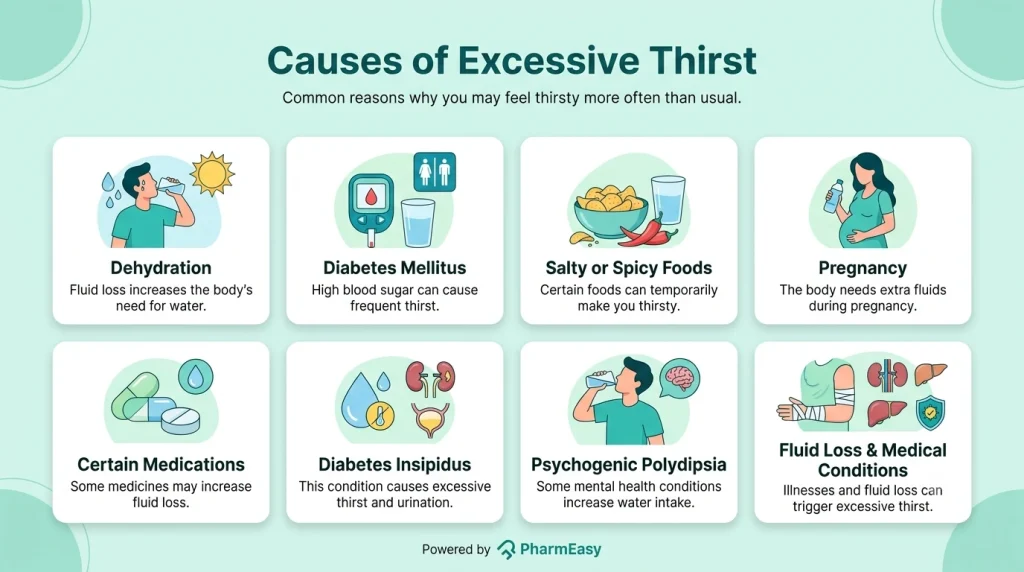
Excessive thirst can occur for many reasons, ranging from temporary dehydration to underlying medical conditions. Common reasons for excessive thirst include:
You may be more likely to experience excessive thirst if you2,4:
If excessive water intake is not properly managed, it may lead to hyponatremia, a condition in which sodium levels in the blood become too low. This can disturb normal brain and nerve function. Possible complications may include1:
In rare but serious situations, severe cases may cause permanent neurological damage or become life-threatening if left unaddressed.
To identify the cause of excessive thirst, doctors may use the following tests and evaluations:
Note: Diagnosis focuses on identifying and managing the underlying cause of excessive thirst, not just the symptom itself.
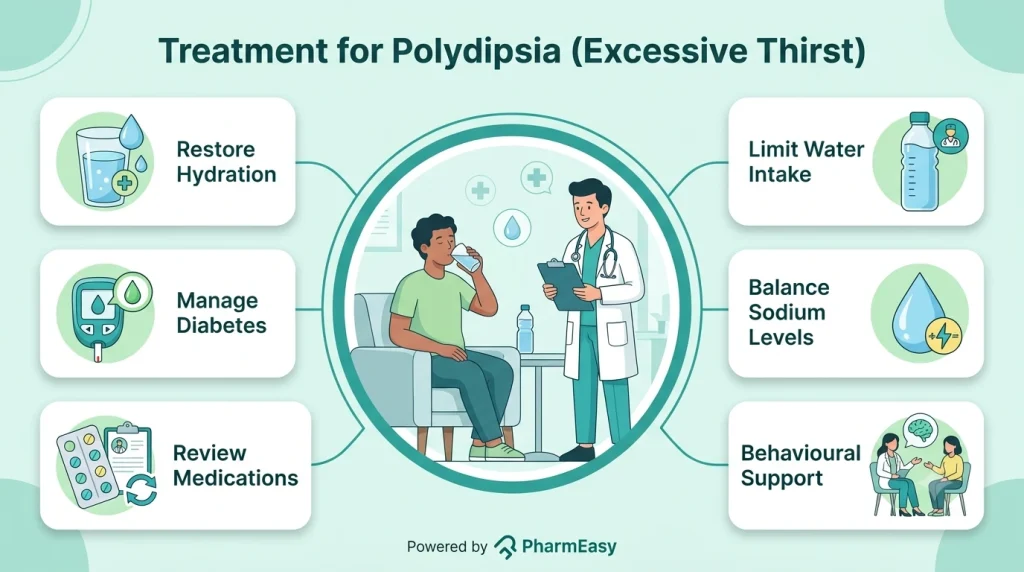
Treatment for polydipsia depends on the underlying issue. In many cases, managing the excessive thirst cause helps improve symptoms. Common polydipsia treatment/management options include:
Transient polydipsia due to environmental factors or acute illnesses may not need urgent medical attention if behaviour is adjusted to prevent dehydration, as follows2,4,5:
You should consult a doctor if2,4:
A doctor can help identify reasons for excessive thirst, which may be linked to conditions such as diabetes, dehydration, medication side effects, or other medical problems. This will help guide their treatment decision based on the underlying excessive thirst causes.
Also Read: Dysuria (Painful Urination): Meaning, Symptoms, Causes, Treatment & Home Remedies
Polydipsia is a symptom, not a diagnosis, which is why persistent excessive thirst should never be ignored. While it may sometimes result from dehydration or dietary habits, it can also be an early sign of underlying conditions such as diabetes or fluid balance disorders. Therefore, identifying the cause early, following healthy hydration habits, and keeping up with regular medical checkups can help avoid complications.
If you continue to feel unusually thirsty despite drinking enough fluids, consult a doctor for proper evaluation and management.
Polydipsia itself is a symptom, but if left unaddressed, the underlying cause may lead to complications (depending on the underlying cause). In severe cases, excessive water intake can also cause electrolyte imbalance such as hyponatremia (low sodium levels)1.
In some cases, liver disease or cirrhosis may contribute to fluid and electrolyte imbalance14. This might increase thirst. However, polydipsia is not considered a primary symptom of liver cirrhosis.
Polydipsia can often improve once the underlying cause is identified and addressed1. The outcome depends on whether the cause is temporary, medical, or psychological.
Anxiety and certain mental health conditions may lead to psychogenic polydipsia. This is a condition where a person drinks excessive amounts of water without a physical need13.
Hypothyroidism is not a common cause of polydipsia. However, in some cases, it may contribute indirectly through changes in metabolism or associated health conditions1.
A urinary tract infection (UTI) may increase thirst in some people. This could be more common if it is associated with fever, dehydration, or frequent urination15.
1. Kotagiri R, Kutti Sridharan G. Primary Polydipsia. In: StatPearls. StatPearls Publishing; 2026. Accessed May 28, 2026. Available from: http://www.ncbi.nlm.nih.gov/books/NBK562251/
2. Thirst – excessive: MedlinePlus Medical Encyclopedia. Accessed May 28, 2026. Available from: https://medlineplus.gov/ency/article/003085.htm
3. Ramawat RB, Afroz O, Patil V, Yadav S, Sood M. Polydipsia: The forgotten thirst in psychiatry – a narrative review from India. Ind Psychiatry J. 10.4103/ipj.ipj_296_25. doi:10.4103/ipj.ipj_296_25 Available from:https://www.researchgate.net/publication/401197008_Polydipsia_The_forgotten_thirst_in_psychiatry_-_a_narrative_review_from_India
4. Excessive thirst. nhs.uk. October 18, 2017. Accessed May 28, 2026. Available from: https://www.nhs.uk/symptoms/thirst/
5. Thirst. NHS inform. Accessed May 28, 2026. Available from: https://www.nhsinform.scot/illnesses-and-conditions/nutritional/thirst/
6. Montgomery KS. Nutrition Column An Update on Water Needs during Pregnancy and Beyond. J Perinat Educ. 2002;11(3):40-42. doi:10.1624/105812402X88830 Available from: https://pmc.ncbi.nlm.nih.gov/articles/PMC1595116/
7. CDC. Diabetes Testing. Diabetes. November 13, 2025. Accessed May 28, 2026. Available from: https://www.cdc.gov/diabetes/diabetes-testing/index.html
8. Kidney Tests. Accessed May 28, 2026. Available from: https://medlineplus.gov/kidneytests.html
9. Liver Function Tests: MedlinePlus Medical Test. Accessed May 28, 2026. Available from: https://medlineplus.gov/lab-tests/liver-function-tests/
10. Electrolyte Panel: MedlinePlus Medical Test. Accessed May 28, 2026. Available from: https://medlineplus.gov/lab-tests/electrolyte-panel/
11. Gubbi S, Shahid M, Koch CA, Verbalis JG. Diagnostic Tests for Diabetes Insipidus. In: Feingold KR, Adler RA, Ahmed SF, et al., eds. Endotext. MDText.com, Inc.; 2000. Accessed May 28, 2026. Available from: http://www.ncbi.nlm.nih.gov/books/NBK537591/
12. The prevention and control the type-2 diabetes by changing lifestyle and dietary pattern – PMC. Accessed May 28, 2026. Available from: https://pmc.ncbi.nlm.nih.gov/articles/PMC3977406/
13. BHATIA* MS, GOYAL A, SAHA R, DOVAL N. Psychogenic Polydipsia – Management Challenges. Shanghai Arch Psychiatry. 29(3):180-183. doi:10.11919/j.issn.1002-0829.216106 Available from: https://pubmed.ncbi.nlm.nih.gov/28904515/
14. Lalama MA, Saloum Y. Nutrition, fluid, and electrolytes in chronic liver disease. Clin Liver Dis. 2016;7(1):18-20. doi:10.1002/cld.526 Available from: https://pmc.ncbi.nlm.nih.gov/articles/PMC6490252/
15. Lee LC, Noronha M. When plenty is too much: water intoxication in a patient with a simple urinary tract infection. BMJ Case Rep. 2016;2016:bcr2016216882. doi:10.1136/bcr-2016-216882 Available from: https://pmc.ncbi.nlm.nih.gov/articles/PMC5129180/
Disclaimer: The information provided here is for educational/awareness purposes only and is not intended to be a substitute for medical treatment by a healthcare professional and should not be relied upon to diagnose or treat any medical condition. The reader should consult a registered medical practitioner to determine the appropriateness of the information and before consuming any medication. PharmEasy does not provide any guarantee or warranty (express or implied) regarding the accuracy, adequacy, completeness, legality, reliability or usefulness of the information; and disclaims any liability arising thereof.
Links and product recommendations in the information provided here are advertisements of third-party products available on the website. PharmEasy does not make any representation on the accuracy or suitability of such products/services. Advertisements do not influence the editorial decisions or content. The information in this blog is subject to change without notice. The authors and administrators reserve the right to modify, add, or remove content without notification. It is your responsibility to review this disclaimer regularly for any changes.


Comments

Leave your comment...
You may also like























Comments