




Gluten Allergy: What It Is, Causes, Symptoms, Diagnosis & More
By Dr. Vishesh Bharucha +2 more

Medically reviewed by Dr. Vishesh Bharucha
Last updated: Sep 10, 2026 Published on: Jun 4, 2026


Get,

to manage your symptom
Get your,

4 Cr+ families
benefitted

OTP sent to 9988776655



You’ve successfully subscribed to receive
doctor-approved tips on
Whatsapp

Get ready to feel your best.


Register to Avail the Offer
Send OTPBy continuing, you agree with our Privacy Policy and Terms and Conditions
Hi There,
Sign up on PharmEasy now!!


Trusted by 4 crore+ families

OTP sent to 9988776655
You have unlocked 25% off on medicines


Code: NU25

By Dr. Vishesh Bharucha +2 more
Table of Contents
You may often come across the term “gluten-free” on restaurant menus, food packaging, health blogs, and social media. But what does it really mean, and should you be worried about it?
Gluten, originating from the Latin word that means glue, is a group of proteins that is composed of a mix of prolamins and glutelins. It is found in grains such as rye, barley, and wheat and is responsible for elasticity of the dough and chewy texture of the bread1,2.

After eating wheat or gluten-containing foods, some individuals may develop disorders such as wheat allergy, celiac disease (an autoimmune condition), or non-celiac gluten sensitivity (gastrointestinal or non-gastrointestinal symptoms triggered by gluten consumption). Globally, the estimated prevalence of celiac disease is approximately 1.4%, non-celiac gluten sensitivity affects around 0.63–6.0% of the population, and wheat allergy is reported in nearly 0.2–1.0% of individuals2,3.
This article walks you through what a gluten allergy is, what causes it, the gluten allergy symptoms to look out for, how it is diagnosed, and how it can be managed.
Still wondering what is a gluten allergy? The term ‘gluten allergy’ is used loosely in everyday language to refer mostly to wheat allergy, although it may sometimes be used to describe celiac disease or non-celiac gluten sensitivity4,5.
Understanding how these conditions differ is essential, as each condition has a different underlying mechanism and requires a separate management approach1,2
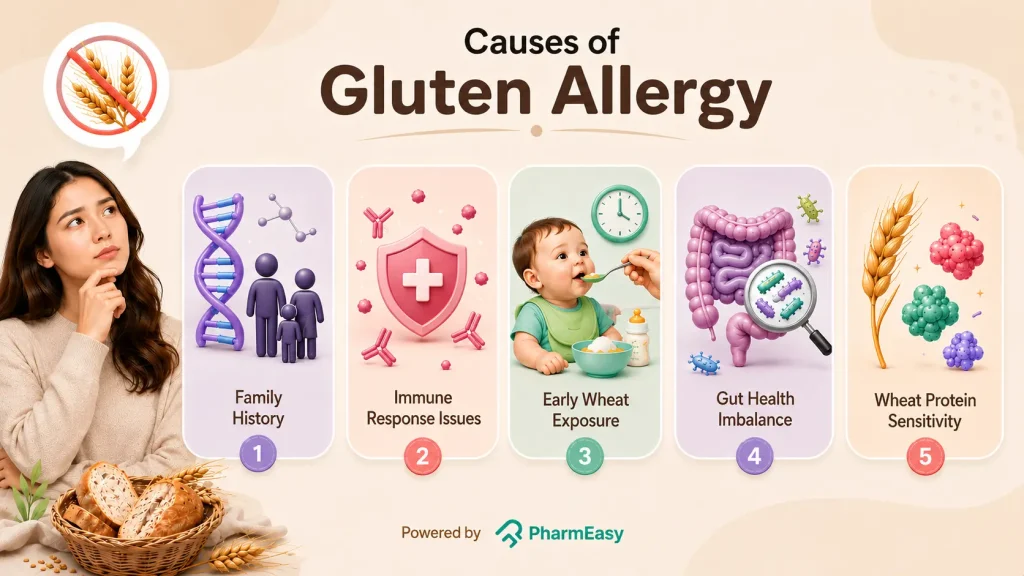
Wheat allergy can occur at different ages. There are many underlying mechanisms and influences that may contribute to its development, such as:
Gluten allergy symptoms usually vary from person to person. Some individuals may have mild discomfort, while others may have a severe reaction. Symptoms typically appear after eating food that contains wheat or other gluten-containing grains4 and include:
Some people experience a phenomenon called wheat-dependent exercise-induced anaphylaxis (WDEIA), in which gluten allergy symptoms appear only when physical activity follows wheat consumption. WDEIA is a rare but potentially serious food allergy with symptoms ranging from hives and swelling to breathing difficulty and severe anaphylaxis13.
The terms gluten allergy and gluten intolerance are often used interchangeably, but they describe different conditions with different underlying mechanisms.
Gluten allergy, which usually refers to wheat allergy, is a true allergy that occurs when the body recognises wheat proteins as harmful substances and produces IgE antibodies against them. Symptoms include hives, itching, swelling, abdominal pain, and troubled breathing. People who experience wheat allergy should avoid wheat10.
Gluten intolerance, also referred to as non-celiac gluten sensitivity, may not involve an immune response. The symptoms may take hours or even days after the ingestion of gluten to show up and range from bloating and abdominal pain to brain fog, very similar to those of celiac disease. Diagnosis is confirmed when a screening test is negative for celiac disease. A good way to manage this is to remove gluten from the diet10.
Celiac disease is an autoimmune condition in which eating gluten-containing foods causes the immune system to attack and damage the lining of the small intestine. Unlike a wheat allergy, it is not an allergic reaction, although some of the symptoms may appear similar1.
Not everyone who consumes wheat or gluten develops an allergy. However, certain factors can increase the likelihood of developing a wheat allergy. These risk factors are often linked to genetics, existing allergic conditions, and repeated exposure to wheat proteins.
In case the gluten allergy is not recognised or is not managed properly, it can sometimes lead to several health and lifestyle-related complications, which include:
Wondering how to find out if you have a gluten allergy? To diagnose a gluten allergy, it is important for the doctor to carefully assess the person’s symptoms, medical history, and dietary habits. A physical examination, followed by diagnostic tests, will help assess whether the individual has an allergy. Diagnostic tests include:
In this test, the skin on the arm or back is gently pricked with a small amount of wheat protein extract. If a raised, itchy bump appears soon after, it may indicate a wheat allergy. Mild redness or itching at the site is common and usually temporary4.
If a skin prick test is not possible due to certain medications or skin conditions, then a blood test is advisable. The blood test may be positive for allergy-related antibodies that react specifically to wheat proteins1,4.
This test is performed under strict medical supervision after the skin prick or blood test for diagnosing food allergies. The person is given small amounts of the suspected food allergen, and the quantity is gradually increased while doctors observe for any allergic reactions1.
The doctor may advise keeping a daily record of food habits. This is helpful for identifying foods that may cause an allergy15.
Certain suspected foods are removed from the diet for a period of time under medical guidance. These foods are gradually reintroduced, one at a time, to check whether symptoms return. This can help in the diagnosis of non-celiac gluten sensitivity16.
Tests like IgA tissue transglutaminase or IgA endomysial assay are used for the diagnosis of celiac disease, followed by biopsy of the duodenum for confirmation1.
It is important to avoid self-diagnosing a gluten allergy. Instead, work with a qualified healthcare professional who can perform appropriate tests to rule out celiac disease or other conditions.
Although it may not always be possible to avoid gluten-related conditions from developing, avoiding gluten-containing foods is the most effective way to reduce the risk of allergic reactions and manage symptoms after diagnosis. Proper care, dietary changes, and lifestyle modifications can also help avoid complications and improve quality of life. Here are a few more ways to avoid gluten allergies:
Also Read: Super Healthy Gluten Free Foods and Its Health Benefits
1. Myth: Gluten allergy is very common.
Fact: True gluten allergy is relatively rare, affecting less than 1% of the population. It is often confused with celiac disease or gluten intolerance, both of which are more prevalent2.
2. Myth: Gluten-free diets are always healthier.
Fact: A gluten-free diet is medically necessary only for those with a confirmed diagnosis. For everyone else, cutting out gluten without guidance may lead to nutritional deficiencies12.
3. Myth: You can grow out of a gluten allergy.
Fact: While wheat allergy is more common in children and some do outgrow it, adults can also develop it, and not everyone grows out of it8.
4. Myth: If a product is labelled ‘gluten-free’, it is completely safe for someone with a wheat allergy.
Fact: Not necessarily. Gluten-free refers to the absence of gluten-containing grains, but a product may still contain wheat-derived ingredients that have been processed to remove gluten. Always read labels carefully11.
You should seek medical advice promptly if:
Living with a gluten or wheat allergy can feel overwhelming at first, particularly when navigating food choices and social situations. But with the right information, medical support, and a few practical habits, it is entirely possible to live well. The key is to get a proper diagnosis rather than self-diagnosing, work with healthcare professionals who understand your needs, and build a diet that keeps you safe without leaving you nutritionally short-changed.
Also Read: Food Allergy Rash: Symptoms, Causes, Treatment & Home Remedies
Not exactly. A wheat allergy is an immune reaction specifically to proteins in wheat, while the term ‘gluten allergy’ is sometimes used more broadly. Wheat allergy is the closest equivalent to what most people mean by gluten allergy, but celiac disease and non-celiac gluten sensitivity are separate conditions5.
No. Celiac disease is an autoimmune disorder, in which eating gluten triggers an immune response that damages the lining of the small intestine10.
Yes. Doctors can use skin prick tests, specific IgE blood tests, and oral food challenges to diagnose a wheat allergy. If celiac disease is also being considered, a blood test for antibodies and a duodenal biopsy may be done15.
No. Soy is a separate food allergen and does not contain gluten. However, some individuals with food allergies may react to both soy and wheat. If you have concerns about multiple food sensitivities, speak with your doctor or allergist17.
Genetics may play a role in its development. If close family members have food allergies, asthma, or eczema, your chances of developing a wheat allergy are higher. However, genetics alone do not determine whether someone will develop the condition4.
The main approach to management involves strict avoidance of wheat and being prepared for accidental exposure. Some children may outgrow wheat allergy over time, but this is not a guaranteed outcome11.
Yes, it is possible. While wheat allergy is more commonly diagnosed in childhood, adults can develop it too, sometimes as a result of occupational exposure or following a period of illness. If you develop new symptoms in adulthood, it is advisable to consult your doctor7.
1. Akhondi H, Ross AB. Gluten-Associated Medical Problems. In: StatPearls [Internet]. StatPearls Publishing; 2025. Accessed May 26, 2026. https://www.ncbi.nlm.nih.gov/books/NBK538505/
2. Sharma N, Bhatia S, Chunduri V, et al. Pathogenesis of Celiac Disease and Other Gluten Related Disorders in Wheat and Strategies for Mitigating Them. Front Nutr. 2020;7:507080. doi:10.3389/fnut.2020.00006 https://www.frontiersin.org/journals/nutrition/articles/10.3389/fnut.2020.00006/full
3. Global Prevalence of Celiac Disease: Systematic Review and Meta-analysis – Clinical Gastroenterology and Hepatology. Accessed May 26, 2026. https://www.cghjournal.org/article/S1542-3565(17)30783-8/fulltext
4. Wheat & Gluten Allergy | Symptoms & Treatment | ACAAI Public Website. ACAAI Patient. Accessed May 26, 2026. https://acaai.org/allergies/allergic-conditions/food/wheat-gluten/
5. Patel N, Samant H. Wheat Allergy. In: StatPearls [Internet]. StatPearls Publishing; 2023. Accessed May 26, 2026. https://www.ncbi.nlm.nih.gov/books/NBK536992/
6. Cianferoni A. Wheat allergy: diagnosis and management. JAA. 2016;9:13-25. doi:10.2147/JAA.S81550 https://pubmed.ncbi.nlm.nih.gov/26889090/
7. Poole JA, Barriga K, Leung DYM, et al. Timing of Initial Exposure to Cereal Grains and the Risk of Wheat Allergy. Journal of Allergy and Clinical Immunology. 2006;117(2):S42. doi:10.1016/j.jaci.2005.12.174 https://www.jacionline.org/article/S0091-6749(05)02896-4/fulltext
8. The Roles and Mechanisms of Gut Microbiota in Food Allergy – Cheng – 2023 – Advanced Gut & Microbiome Research – Wiley Online Library. Accessed May 26, 2026. https://onlinelibrary.wiley.com/doi/10.1155/2023/9575410
9. Food allergy to wheat: differences in immunoglobulin E-binding proteins as a function of age or symptoms. Journal of Cereal Science. 2005;42(1):109-117. doi:10.1016/j.jcs.2005.01.004 https://www.researchgate.net/publication/313149563_Food_allergy_to_wheat_Differences_in_immunogloglin_E-binding_proteins_as_a_function_of_age_or_symptoms
10. Celiac Disease, Gluten Intolerance and Gluten Allergy: What’s the Difference? | 700 Children’s. Accessed May 26, 2026. https://www.nationwidechildrens.org/family-resources-education/700childrens/2013/10/should-your-children-avoid-gluten
11. Food Allergy. Allergy UK | National Charity. Accessed May 26, 2026.https://www.allergyuk.org/about-allergy/types-of-allergies/food-allergy/
12. G S, S Q, A DP. Wheat allergens associated with Baker’s asthma. Journal of investigational allergology & clinical immunology. 2011;21(2). Accessed May 27, 2026. https://pubmed.ncbi.nlm.nih.gov/21462797/
13. Faihs V, Kugler C, Schmalhofer V, et al. Wheat‐dependent exercise‐induced anaphylaxis: subtypes, diagnosis, and management. doi:10.1111/ddg.15162 https://pubmed.ncbi.nlm.nih.gov/37462335/
14. Gluten: A Benefit or Harm to the Body? • The Nutrition Source. May 23, 2017. Accessed May 26, 2026. https://nutritionsource.hsph.harvard.edu/gluten/
15. Wolf RL, Lebwohl B, Lee AR, et al. Hypervigilance to a Gluten-Free Diet and Decreased Quality of Life in Teenagers and Adults with Celiac Disease. Dig Dis Sci. 2018;63(6):1438-1448. doi:10.1007/s10620-018-4936-4 https://pubmed.ncbi.nlm.nih.gov/29387990/
16. Leonard MM, Cureton P, Fasano A. Indications and Use of the Gluten Contamination Elimination Diet for Patients with Non-Responsive Celiac Disease. Nutrients. 2017;9(10):1129. doi:10.3390/nu9101129 https://pubmed.ncbi.nlm.nih.gov/29057833/
17. MEd KM, RDN, LDN. Are soy products ok? National Celiac Association. Accessed May 26, 2026. https://nationalceliac.org/celiac-disease-questions/are-soy-products-ok-to-eat-when-you-have-celiac-disease/
Disclaimer: The information provided here is for educational/awareness purposes only and is not intended to be a substitute for medical treatment by a healthcare professional and should not be relied upon to diagnose or treat any medical condition. The reader should consult a registered medical practitioner to determine the appropriateness of the information and before consuming any medication. PharmEasy does not provide any guarantee or warranty (express or implied) regarding the accuracy, adequacy, completeness, legality, reliability or usefulness of the information; and disclaims any liability arising thereof.
Links and product recommendations in the information provided here are advertisements of third-party products available on the website. PharmEasy does not make any representation on the accuracy or suitability of such products/services. Advertisements do not influence the editorial decisions or content. The information in this blog is subject to change without notice. The authors and administrators reserve the right to modify, add, or remove content without notification. It is your responsibility to review this disclaimer regularly for any changes.


Comments

Leave your comment...
You may also like
























Comments