
Introduction
This article delves into the world of cholera, an abrupt illness caused by consuming contaminated food or water harbouring Vibrio cholerae bacteria. Harmful organisms in the small intestine produce a toxin called choleragen that sticks to the intestine. This toxin triggers the release of a substance that leads to a significant release of electrolytes and water2. This faeco-oral transmitted disease triggers severe diarrhoea and dehydration, and can even be fatal. Join us as we explore the impact of this bacterial infection, often affecting regions lacking modern sanitation and clean water system1. Undeveloped nations and refugee camps, in addition to parts of the Middle East, Asia, South America, and Africa are some examples1.
Did You Know?
- In 2020, a total of 323,369 cases and 857 deaths were reported from 24 countries9.
- Millions across the world get cholera infection every year1.
- Cholera outbreaks are commonly seen in warmer climates1.
- Salty rivers and coastal area water is the habitat for cholera-causing bacteria1.
- With well-timed rehydration therapy, more than 99% affected will recover. That is why rehydration is the most vital treatment for cholera5.
Advertisement
Causes of Cholera
A person who has developed profuse diarrhoea implies that the amount of an infectious agent called Vibrio cholerae has reached greater numbers inside the patient’s body. This has the potential to infect others3.
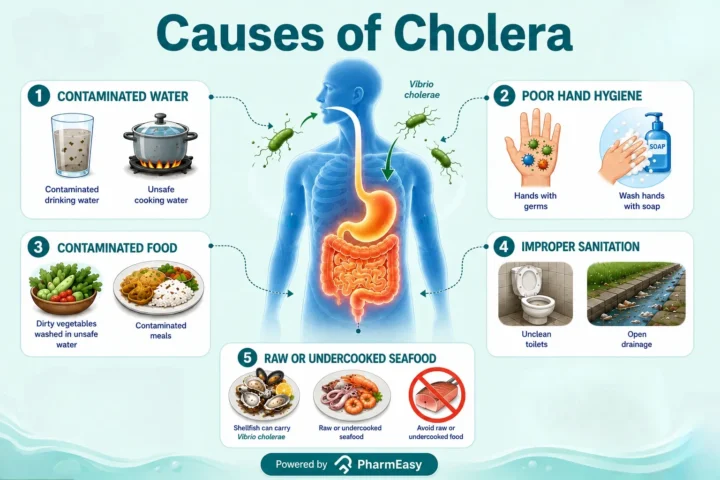
The main causative agent of cholera is Vibrio cholerae (V. cholerae) bacteria, which is responsible for the infection and its transmission through contaminated water and food sources.
- The infection spreads when contaminated faeces enter the water system.
- Improperly sanitized water puts people at risk when using it for drinking, cooking, and washing.
- Consumption of food or water contaminated with V. cholerae leads to bacterial multiplication in the small intestines and causes fluid secretion, resulting in diarrhoea.
- Cholera usually does not spread directly from person to person, but there can be occasional cases of transmission.
- Practising good hand hygiene is important to prevent infection.
- V. cholerae bacteria can also be found in salty rivers and coastal waters.
- Rare cases of cholera have been associated with consuming raw or undercooked shellfish1.
Vibrio cholerae bacteria, being the causal microbe for cholera, are transferred from infected to healthy individuals through their faeces. V. cholerae grows within people when they consume food, water, or both that is infected with the bacteria. The small intestines then may release fluid as a result of the bacteria, which results in diarrhoea1.
Dr. Rajeev Singh, BAMS
Signs and Symptoms of Cholera
Most people infected with cholera do not develop symptoms or experience only mild illness. However, a small proportion can develop severe symptoms that may include
- Watery Diarrhoea (Rice-Water stools): Large amounts of pale, hazy, watery stool that resembles rice-washing water are a typical sign of cholera. Dehydration is more likely as a result of the rapid loss of fluids and electrolytes caused by this acute diarrhea10,2.
- Cramps in the leg muscles
- Feeling weakness or fatigue
- Feeling dehydrated
- Nausea3
- Passing very less amount of urine1
When there is a case of profuse water-like diarrhoea, then additional signs are examined in such individuals:
- Rapid heart beat (tachycardia)
- Reduced skin elasticity
- mouth and dry mucous membrane.
- Low Blood pressure
- Sunken eyes3
Signs of Dehydration
- Mild dehydration: Thirst, Dry mouth, reduced urine output
- Moderate dehydration: Sunken eyes, dizziness, rapid heartbeat, decreased urination
- Severe dehydration: Very low blood pressure, extreme weakness, confusion, minimal or no urine output, shock
Risk Factors for Cholera
Exploring the factors that increase susceptibility to cholera:
Advertisement
- People who are much more likely to be exposed to cholera include healthcare employees treating cholera patients, and tourists in a place of active cholera transmission who cannot or do not always comply with secure meals and water precautions and private hygiene measures4.
- A person who has profuse diarrhoea has the potential to infect nearby people if the faecal matter of such a patient is not discarded carefully and other things are contaminated with it3.
You may have come across news pieces that in the rural areas of economically poor countries, cholera is a common disease. The reason for this may be the lack of proper water sanitation, compromised sewage disposal and hygiene issues. In such places, the food and water are usually infected with Vibrio cholerae bacteria, consumption of which leads to diarrhoea and other symptoms. They typically take 2–3 days to manifest.
Dr. Siddharth Gupta, B.A.M.S, M.D (Ayu)
Diagnosis of Cholera
After examining the patient for several signs and symptoms, a confirmatory test is required to declare and outline the degree of cholera infection.
- Stool sample examination: The patient would be asked to collect their stools into a cup/bag which can be sent into the laboratory for checking the presence of V. cholerae1.
- Rapid test: In many areas, there are no labs to perform stool examination. Hence, there are rapid dipstick tests which can indicate a cholera case instantly1.
Treatment of Cholera
When someone contracts cholera their focus should be on preventing dehydration. Since the body fluids are constantly being lost, the water intake must compensate for the loss.
- Therapy of rehydration: Drink Oral Rehydration Solution at regular intervals. Also, if dehydration is at a severe stage go to the doctor for instant administration of I.V fluids5.
- When are IV fluids needed: Intravenous (IV) fluids may be required in cases of severe dehydration, especially if the patient is unable to drink enough fluids, has persistent vomiting, shows signs of shock, or has very low blood pressure11.
- Antibiotic treatment: Since 1964, antibiotics are prescribed in conjunction with rehydration therapy.
- A study6 found that antibiotics can reduce stool volume, shorten the duration of diarrhoea, and decrease the duration of positive bacterial culture.
- Antibiotics are prescription medicines and should be taken according to the doctor’s instructions6.
- Treatment with zinc: Administering zinc supplements is found to lessen the severity of diarrhoea in children.
- Children who were given zinc supplements experienced 8 hours less of diarrhoea and had 10% less diarrhoea stool compared to those who did not receive the supplementation7.
Complications of Cholera
Cholera can cause excessive diarrhoea and vomiting, resulting in the loss of important substances in the body.
- Electrolytes
- Fluids
- Sodium
- Potassium
Insufficient levels of these substances can lead to dehydration and various symptoms:
- Dryness in eyes, nose, and mouth
- Increased heart rate
- Potassium levels falls (hypokalaemia)
- Low blood pressure (hypotension)
- Reduced elasticity of the skin
If left untreated, severe dehydration caused by cholera can lead to serious complications:
- Kidney failure
- Shock
- Coma
- Death1,3.
Disclaimer: The information included on this site is for educational purposes only and is not intended to be a substitute for medical treatment by a healthcare professional. Because of unique individual needs, the reader should consult their physician to determine the appropriateness of the information for the reader’s situation.
Cholera Risk in India
Cholera Hotspots in India
Cholera outbreaks in India are more common during the monsoon season and in areas with poor sanitation or unsafe drinking water. States that have reported recurrent outbreaks include12:
- West Bengal
- Odisha
- Maharashtra
- Assam
- Bihar
- Uttar Pradesh
Cholera Vaccination for Travellers
Travellers visiting areas with active cholera transmission may consider vaccination after consulting a healthcare professional.
- Shanchol is an oral cholera vaccine that may be available in India depending on local availability and public health programmes.
- It provides protection against Vibrio cholerae O1 and O139 strains.
- Recommended for travellers, humanitarian workers, and people staying in high-risk areas.
- Cholera vaccines reduce the risk of cholera but do not provide complete protection. Vaccination should be combined with safe food, water, and hygiene practices.
Prevention of Cholera
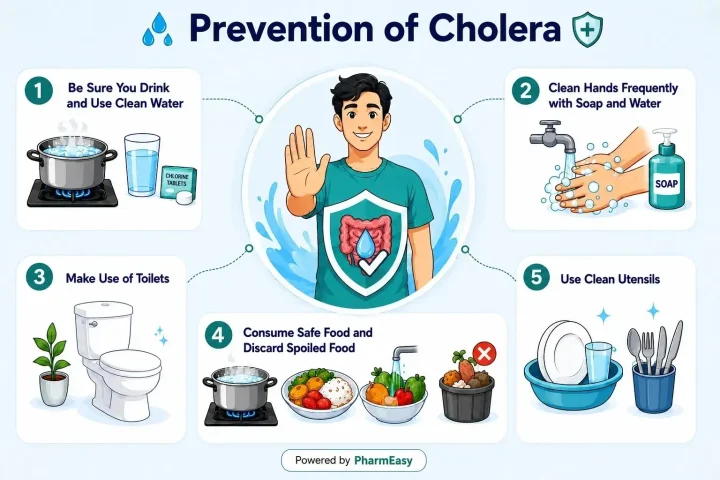
Bacteria causing cholera are not contagious, however, preventive measures can be undertaken to avoid contracting the infection from another person1. There are 5 fundamental cholera preventive steps as per Centres for Disease Control and Prevention (CDC)8:
- Be Sure You Drink and Use Clean Water: Always use clean, boiled water for drinking and cooking purposes. Water used for brushing teeth, for cooking food must be at least boiled for a minute or it must be treated using chlorine tablets.
- Clean Hands Frequently with Soap and Water: Hand-washing hygiene should be followed and children should be supervised by an adult. It is very important to thoroughly clean hands using soap and water before having food and post visiting the washroom.
- Make Use of Toilets: Toilet hygiene must be followed and they should be sanitized regularly.
- Simmer It, Make It, Remove the Peel, or Discard It: Food that is taken from the sea should be cooked properly after fruits and vegetables are brought, clean them. Consume only freshly made home-cooked meals.
- Keep it Clean: Utensils used for preparing food and toilets after use should be kept clean by deploying soap and water. The bathroom area and washing clothes area should be 100 feet away from each other. After all the cleaning has been done, discard the dirty water and wash your hands properly.
Also Read: Food Allergies: Symptoms, Types, Diagnosis & Home Remedies
When to See a Doctor?
It is observed that after consumption of contaminated food, a person takes 12 hours to even upto 5 days to develop severe symptoms.
Therefore, anyone who experiences any of the above mentioned symptoms should immediately visit the doctor. Some early symptoms might fade within a few days. Early diagnosis and onset of administering medications can prevent a patient’s life1.
Conclusion
Cholera is a serious but preventable bacterial infection caused by Vibrio cholerae, primarily spreading through contaminated food and water in regions with poor sanitation. While it can be life-threatening due to severe dehydration, timely rehydration therapy oral or intravenous leads to recovery in over 99% of cases. Antibiotics and zinc supplementation further aid treatment. Prevention through clean water, proper hand hygiene, safe food practices, and good sanitation remains the most effective defense against this disease. Early medical attention is crucial upon onset of symptoms.
Also Read: Viral Fever: Causes, Symptoms, and Treatment Options
Frequently Asked Questions (FAQs)
Which animal is the host for spreading cholera disease? There are no specific animal hosts for Vibrio cholerae bacteria4.
Is there any vaccine for cholera?There is one vaccine for cholera which has been approved by FDA1.
Which types of bacteria causes cholera outbreaks?There are many serogroups of V. cholerae, however, two types – O1 and O139 – are the reasons for cholera outbreaks9.
How did this disease spread in India? During the 19th century, cholera unfolded across the world from its unique reservoir inside the Ganges delta in India9.
In cholera which bacteria attacks which organ of the body?Vibrio cholerae bacteria infects the intestine and causes diarrhoea3.
References
- Cholera: Symptoms, Causes, Treatment & Prevention [Internet]. Available from: https://my.clevelandclinic.org/health/diseases/16636-cholera
- Cholera, Vibrio cholerae O1 and O139, and Other Pathogenic Vibrios – Medical Microbiology – NCBI Bookshelf [Internet]. Available from: https://www.ncbi.nlm.nih.gov/books/NBK8407/
- Cholera [Internet]. Available from: https://www.who.int/news-room/fact-sheets/detail/cholera
- Mohamed MG, Dabou EAA, Abdelsamad S, Elsalous SH. Cholera outbreaks: Public health implications, economic burden, and preventive strategies. AIMS Public Health. 2025 Aug 5;12(3):767-795. doi: 10.3934/publichealth.2025039. PMID: 41127425; PMCID: PMC12538245. Available from: https://pmc.ncbi.nlm.nih.gov/articles/PMC12538245/
- Aghsaeifard Z, Heidari G, Alizadeh R. Understanding the use of oral rehydration therapy: A narrative review from clinical practice to main recommendations. Health Sci Rep. 2022 Sep 11;5(5):e827. doi: 10.1002/hsr2.827. PMID: 36110343; PMCID: PMC9464461. Available from: https://pmc.ncbi.nlm.nih.gov/articles/PMC9464461/
- Rogawski ET, Westreich DJ, Becker-Dreps S, Adair LS, Sandler RS, Sarkar R, Kattula D, Ward HD, Meshnick SR, Kang G. Antibiotic treatment of diarrhoea is associated with decreased time to the next diarrhoea episode among young children in Vellore, India. Int J Epidemiol. 2015 Jun;44(3):978-87. doi: 10.1093/ije/dyv040. Epub 2015 Apr 29. PMID: 25929259; PMCID: PMC4607743. Available from: https://pmc.ncbi.nlm.nih.gov/articles/PMC4607743/
- Boran P, Tokuc G, Vagas E, Oktem S, Gokduman MK. Impact of zinc supplementation in children with acute diarrhoea in Turkey. Arch Dis Child. 2006 Apr;91(4):296-9. doi: 10.1136/adc.2005.079939. Epub 2005 Dec 14. PMID: 16354711; PMCID: PMC2065989. Available from: https://pmc.ncbi.nlm.nih.gov/articles/PMC2065989/
- Centers for Disease Control and Prevention. How to prevent cholera [Internet]. Atlanta (GA): CDC; 2025 Jul 23 [cited 2026 May 21]. Available from: https://www.cdc.gov/cholera/prevention/index.html
- Ahmed SH, Nashwan AJ. Cholera outbreak amid civil war: A public health crisis in Syria. J Infect Public Health. 2022 Dec;15(12):1484-1485. doi:10.1016/j.jiph.2022.11.013. Available from: https://www.researchgate.net/publication/365368063_Cholera_outbreak_amid_civil_war_A_public_health_crisis_in_Syria
- Sack DA, Sack RB, Nair GB, Siddique AK. Cholera. Lancet. 2004 Jan 17;363(9404):223-33. doi: 10.1016/s0140-6736(03)15328-7. PMID: 14738797. Available from: https://pubmed.ncbi.nlm.nih.gov/14738797/
- Harris JB, LaRocque RC, Qadri F, Ryan ET, Calderwood SB. Cholera. Lancet. 2012 Jun 30;379(9835):2466-2476. doi: 10.1016/S0140-6736(12)60436-X. PMID: 22748592; PMCID: PMC3761070. Available from: https://pmc.ncbi.nlm.nih.gov/articles/PMC3761070/
- Ali M, Sen Gupta S, Arora N, Khasnobis P, Venkatesh S, Sur D, Nair GB, Sack DA, Ganguly NK. Identification of burden hotspots and risk factors for cholera in India: An observational study. PLoS One. 2017 Aug 24;12(8):e0183100. doi: 10.1371/journal.pone.0183100. PMID: 28837645; PMCID: PMC5570499. Available from: https://pmc.ncbi.nlm.nih.gov/articles/PMC5570499/
Disclaimer: The information provided here is for educational/awareness purposes only and is not intended to be a substitute for medical treatment by a healthcare professional and should not be relied upon to diagnose or treat any medical condition. The reader should consult a registered medical practitioner to determine the appropriateness of the information and before consuming any medication. PharmEasy does not provide any guarantee or warranty (express or implied) regarding the accuracy, adequacy, completeness, legality, reliability or usefulness of the information; and disclaims any liability arising thereof.
Links and product recommendations in the information provided here are advertisements of third-party products available on the website. PharmEasy does not make any representation on the accuracy or suitability of such products/services. Advertisements do not influence the editorial decisions or content. The information in this blog is subject to change without notice. The authors and administrators reserve the right to modify, add, or remove content without notification. It is your responsibility to review this disclaimer regularly for any changes.
 0
0
 0
0 





































Comments