Last updated: Aug 28, 2026Published on: Aug 28, 2026
Table of Contents
Introduction
Noticing fluid, pus, blood or any substance coming out of the ear can make anyone anxious. This type of ear discharge, which is medically known as otorrhea, can result from pathologic factors like ear wax or certain pathologic causes1. Understanding the causes of otorrhea can help in taking appropriate decisions regarding the severity of the condition and whether a medical intervention is needed. In this blog, we will cover what otorrhea is, its types, causes, symptoms, treatment and preventive measures that could be taken.
What Is Ear Discharge (Otorrhea)?
Any fluid or substance draining from the ear is termed as ear discharge or otorrhea. Mostly ear discharge is considered a sign of some underlying conditions rather than being a disease itself. It can result following certain infections, injuries, and some tissue growths1. The symptoms can vary based on the underlying condition that led to discharge, and can include pain, fever, dizziness, ringing in the ears etc. However, untreated discharge cases can lead to several complications, including hearing loss and spread of the infection to surrounding structures2.
Advertisement
Did You Know?
Acute otitis media is considered the second most common diagnosis in the emergency department of children and can show symptoms of pain along with discharge3.
15-20% of affected children with acute middle ear infections (acute otitis media) develop ear discharge due to the perforation of the eardrum4.
External ear infection (otitis externa), which is a major cause of discharge, is found to be affecting 10% of people at some point during their lifetime3.
The most commonly isolated organism in otitis externa is Pseudomonas aeruginosa, in chronic otitis media is Staphylococcus aureus and in acute otitis media is Streptococcus pneumoniae4.
Types of Ear Discharge
Based on the consistency, colour and appearance, ear discharges can be of five types4. Recognising the different types can help in reaching the diagnosis promptly and initiating appropriate interventions.
Clear: A clear, transparent discharge might point towards any injuries to the head. It is caused by the leakage of cerebrospinal fluid (CSF) through the ear4.
Bloody: It can be a discharge with blood appearing red or pink and can occur as a result of any injuries or trauma to the ear or head4.
Serous: Thin, watery, non-pus-containing discharge is seen in certain kinds of middle ear infection with effusion (otitis media with effusion-OME)5. It can result following a sudden decrease in ear pressure compared to the air pressure6.
Mucoid: Thicker, sticky fluid (mucous) discharges can be seen in mucoid type OME5. This condition is also termed “glue ear” occurs due to the accumulation of certain kinds of mucins6.
Purulent: Thick discharge containing pus, which is seen in external ear infections and suppurative middle ear infections5. It can be thick, opaque or white or yellowish in colour and may bear an unpleasant smell in some cases.
Causes of Ear Discharge
Ear discharge causes are mainly pointing towards any underlying infections, past injuries or procedures done in the ear.
Ear Wax: In most cases, the discharge would be ear wax7. It is considered a normal protective mechanism of the ear from dust particles. However, overaccumulation might lead to some difficulties.
Ruptured Eardrum: White, yellow or bloody discharges are commonly associated with a ruptured eardrum. Causes of rupturing can include:
Any foreign objects in the ear: This usually happens in children when they put any toys or foreign objects into the ear. The discharge might contain pus and blood1,7.
Pushing an object into the ear: Pushing cotton buds or any objects might lead to the rupture of the eardrum1,7.
Injuries, sudden changes in air pressure such as during air travel and exposure to very loud sounds might cause rupture7.
Middle Ear Infection: Infection can increase the risk of fluid buildup in the ear, which induces increased pressure and can lead to the eardrum rupturing. Though middle ear infections commonly occur in children, people of any age can face this condition. It is often associated with severe pain and a thick yellowish discharge. When a ruptured eardrum takes time to heal, discharge can be seen continuously without any pain1.
Outer Ear Infection: It is also termed swimmer’s ear. Skin inside the ear canal can swell and cause discharge1. In addition, the ear canal can be reddish and moist, itchy, with pain that increases during the movement of the earlobe7. Sometimes fungal infections can also give rise to sticky ear discharge along with ear pain8.
Eczema: A type of skin allergy or irritation which can lead to clear discharge1.
Abnormal skin cells: An abnormal collection of skin cells, called cholesteatoma, can induce a foul-smelling discharge1.
Head injury: A serious injury can lead to the leakage of brain fluid (cerebrospinal fluid) through the ear, which can be clear or with blood. It is an emergency situation, and immediate medical attention is needed1.
Following an ear tube insertion: A tube (grommet) inserted through the eardrum might produce ear discharge after the procedure8.
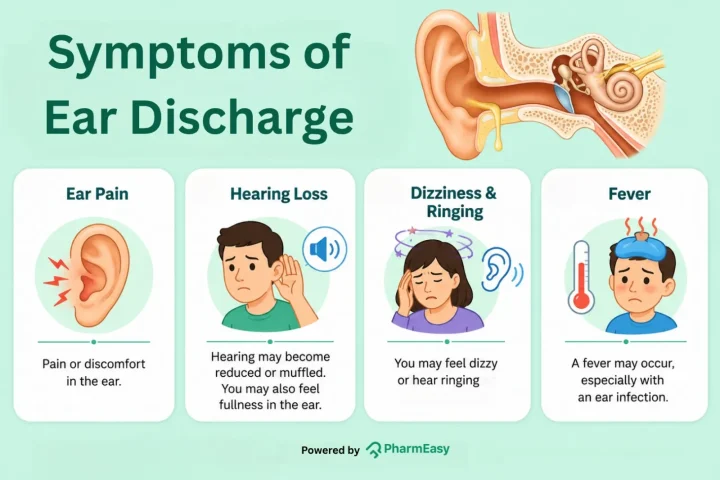
Symptoms of Ear Discharge
Ear discharge symptoms can vary based on the causes of discharge and include:
Pain:Ear pain (otalgia) is considered the indicator of acute cases of middle ear infection3.
Hearing Loss: Hearing loss is mostly seen in middle ear infection with discharge cases along with a sensation of fullness6. It can also be seen in cases of cholesteatomas9.
Dizziness and Ringing in the ears: Dizziness and ringing in the ears are pronounced in cases of cholesteatomas along with foul-smelling discharges9.
Fever: Fever is marked in the acute cases of middle ear infection10.
Ear Discharge in Children vs Adults
Ear discharge in adults
Ear discharge in children
In adults, external ear infection is more common compared to children, along with acute middle ear infection and perforation of the eardrum3.
In children, the most common cause of discharge is middle ear infection, most commonly in the age group of 6 to 24 months3.
In adults, symptoms of an infection can include itchiness, irritation, a sense of fullness in the ear, pain and ear discharge11.
Children might show signs of any infection by rubbing or pulling the ear, being irritable, avoiding foods and losing their balance11.
Ear discharge in adults resolves based on the underlying causes. In cases of middle ear infections, oral antibiotics only provide a slight reduction of symptoms. In most cases, ear drops are preferred, provided there is no history of any other underlying diseases8.
In most cases of ear discharge in children, spontaneous resolution can be seen within one week12. Oral antibiotics are most beneficial in children having middle ear infection in both ears and who are aged more than 2 years8.
For treatment of ear discharge in adults with chronic suppurative otitis media (CSOM), topical antibiotics alone or along with other topical steroids are recommended. Ear cleansing can also be beneficial13.
For treatment in children with CSOM, topical antibiotics are preferred over antiseptics. Limited evidence is present regarding the benefits of ear cleansing, though it is usually recommended for children13.
How Is Ear Discharge Diagnosed?
Diagnostic procedures mainly focus on a detailed history and examination to determine the underlying cause. Other tests are done if there is uncertainty in cause or more serious conditions are suspected.
Medical history: History of any associated pain, hearing loss, duration and frequency, colour and consistency of discharge can help in identifying the cause of the discharge. History of any trauma or surgeries or grommet insertion can also be beneficial in identifying the cause8.
Otoscopy: It is an instrument used by doctors to look into the ear, and they can find what is causing the discharge1. This is helpful in examining the external auditory canal and eardrum. Also, the middle ear can be examined in case of an ear drum perforation. It can help in finding whether the discharge is due to any foreign bodies, infection of the outer or middle ear, trauma or any perforations of the eardrum14.
Hearing Test: It can help determine whether the discharge and the underlying cause is affecting hearing1.
Culturing of the discharge: If fungal infections are suspected based on the itchiness (pruritus) or fungal parts (hyphae) during the examination, a swab is taken for culturing of the organism and identifying the effective medicine (sensitivity). In case of a bacterial infection which is not resolving with antibiotic treatment, culture and sensitivity from ear discharge can provide important information about the infection and further management8.
Imaging Tests: Imaging tests such as Computed Tomography (CT) and Magnetic Resonance Imaging (MRI) are helpful in diagnosing the cause of ear discharge1. CT is helpful in assessing middle ear diseases such as cholesteatoma, or any abnormalities related to the skull. MRIs are helpful in finding any abnormalities in the structures present inside the skull or soft tissue masses6.
Treatment of Ear Discharge
Ear discharge treatment can vary based on the underlying cause, and it can be8:
Advertisement
Treatment for outer ear infection
Topical medicines: Antimicrobials containing steroids are effective in the treatment. However, if any fungal infection is suspected, preparations which target both bacteria and fungi can be given.
Oral antibiotics: If there are no signs of any underlying systemic infections, oral antibiotics are not needed. However, if the infection has spread to the skull base, systemic antibiotics might be needed to control the spread of infection.
Suctioning of debris from the ear: If no improvement in symptoms is noted, referring to an ENT specialist is recommended for aural microsuction. Here, any discharge or debris is removed by suction under magnification.
Treatment for middle ear infection: Middle ear infections may resolve spontaneously within 24 hours.
Medicines: Children who are older than 2 years are put under observation for 2-3 days to check whether symptoms are resolving, and during this period only pain-relieving medicines are needed. Oral antibiotics are advised for children aged <2 years who have middle ear infections in both ears with ear discharge.
Antibiotic eardrops: If the patient has no underlying diseases and the only concern is discharge through the perforated eardrum, topical antibiotics are preferred over systemic ones.
Intravenous antibiotics: Persistent pain even after the oral antibiotic therapy needs to be assessed, and it might indicate infection of a bone behind the ear (mastoiditis). In these cases, intravenous antibiotics might need to be considered to prevent the infection from developing into infections affecting bone (osteomyelitis) and abscess formation.
Treatment for grommet-associated discharge: Ear drops containing antibiotics and microsuction are generally used in grommet-associated discharge. However, there is less evidence regarding the most effective treatment for this.
Treatment for cholesteatoma: Surgery is preferred in this condition to remove the abnormal tissue from the ear.
Treatment for cerebrospinal discharge: CSF ear discharge often precedes a history of any injuries. This should be managed following an urgent investigation.
Keeping the ears dry and avoiding inserting foreign objects such as cotton tips are also part of the otorrhea treatment, as they can help in preventing the further progression of the condition. A persistent, foul-smelling discharges needed to be assessed by a medical practitioner. Also, use of eardrops without proper medical attention might do danger to your health.
Home Care Tips for Ear Discharge
Home care tips that can help for ear discharge depend on the cause and symptoms of the discharge8:
Keep the ears dry: Avoiding any instances that might wet the ears can help in minimising further irritation.
Avoid inserting any objects into the ear: Poking any objects into the ear might complicate the condition and needs to be avoided.
Avoid swimming: Swimming might lead to deterioration of the condition by wetting the ears. Also, if there is any chance of splashing water into the ear, petroleum jelly-coated cotton wool can be used.
Clean ear with a wick: A soft and strong tissue paper can be made into a wick and can be inserted into the ear canal. Placing it in there for one minute can absorb the excess discharge, and then it should be removed. Another fresh wick is inserted, and the procedure is repeated till it becomes dry2.
Possible Complications of Untreated Ear Discharge
Untreated ear infections along with the discharge can lead to complications, including2:
The following general preventive measures can be taken to avoid ear discharge:
Maintaining ear hygiene along with drying ears after a water bath are most helpful in preventing discharge associated with ear infections. Try to keep the ears as dry as possible by using towels or tilting the head back and forth to naturally allow the draining.
Keeping ears dry while and after swimming is important to avoid frequent ear infections. Use custom earplugs or tight fit shower caps to protect ears while swimming.
Exclusive breastfeeding for 6 months and continuing at least for 12 months can help in preventing some ear infections and the associated discharge15. Keep the baby in slanting position while breastfeeding to avoid ear discharge16.
Avoiding smoking can prevent infections and related discharge15.
Avoiding putting any external objects into the ear and forcefully removing the earwax is important17. If you feel any discomfort because of the accumulation of earwax, contacting your healthcare professional is advised.
Flu and pneumococcal vaccines are advised as a preventive measure against middle ear infections. Since a bacterium named Streptococcus pneumoniae is the most common cause of middle ear infection, vaccination against this may help in the prevention of the infections15.
Fungal infections can result following wounds caused by continuous rubbing or insertion of any wooden sticks or metal wax picks into the ear to remove earwax. Coconut oil application is also found to be a predisposing factor to fungal infection. These practices should be avoided to prevent the discharge related to fungal infections18.
If the ear discharge is associated with severe pain.
Fever or headaches are seen along with the discharge.
White, yellow, clear or bloody ear discharge.
Any previous history of trauma prior to the discharge.
If the discharge persists for more than five days.
In doubtful cases of hearing loss.
Any signs of swelling or redness from the ear.
Immediate medical attention is required if external ear infections are associated with weakness of nerves of the brain (cranial nerve palsy) as this might indicate bone involvement. Additionally, in individuals having compromised immunity such as diabetics, ENT consultation is important if there is presence of small, red, easily bleeding tissues (granulation tissue) that formed in the ear canal, along with redness and swelling of the outer ear or deteriorating symptoms8.
Conclusion
Ear discharge or otorrhea is the drainage of fluid or any substance from the ear. Causes of otorrhea mostly involve ear infections, inserting any foreign objects into the ear, injuries or a previous history of any procedures or surgeries related to the ear. Otorrhea symptoms can vary based on the underlying causes and can include pain, sensation of fullness, hearing loss, fever, along with discharge. Though most cases can be managed effectively, understanding about otorrhea can help in avoiding unnecessary concerns and taking appropriate measures.
Diagnosis of ear discharge is mainly based on a detailed medical history and physical examination. Any past history of injuries, swimming, surgeries, or hearing changes is noted. An otoscope is used to check the ear canals and eardrum. Hearing tests or imaging tests such as CT and MRI are needed based on the findings1.
What causes yellow or green discharge from the ear?
Yellow or green discharge might contain pus and is usually associated with underlying ear infections. In purulent middle ear infections, the discharge can be yellow with pus11. In cases of rupture of the eardrum, white, yellow or bloody discharges can be seen7. However, the colour of the discharge might not point towards a particular condition. A medical evaluation is required to find the exact cause.
Can earwax be mistaken for ear discharge?
Yes. Earwax can sometimes be mistaken for discharge, especially when it is darker, soft and excessive. Earwax is a normal substance that is produced by the ear to protect the ear from dust particles7. However, if the earwax accumulation causes any discomfort and foul smelling medical attention is needed.
Is ear discharge contagious?
Ear discharge is not contagious. Discharges associated with external ear infection or middle ear infection don’t spread from person to person3,10.
Can ear discharge go away on its own?
Remission of the ear discharges are depended on the underlying causes. In most cases of middle ear infections, spontaneous remission happens within one day. And in the absence of any underlying systemic diseases, only ear drops are needed in most cases. Children under 2 years of age and those having infections in both ears benefit more from oral antibiotics8.
Can swimming cause ear discharge?
Swimming put at an increased risk for ear discharge due to more chances for external ear infection. Keeping the ears dry after swimming or using any cotton plugs to avoid splashing of water into the ear can be followed as a preventive measure against ear discharge caused by this8.
Can a ruptured eardrum cause ear discharge?
Yes. Rupturing of the eardrum caused by injuries due to any foreign objects that are inserted into the ear, pushing materials into the ear, sudden pressure changes as during air travel and middle ear infections can all cause ear discharge7.
Dannatt P, Jassar P. Management of patients presenting with otorrhoea: diagnostic and treatment factors. Br J Gen Pract. 2013;63(607):e168-e170. doi:10.3399/bjgp13x663253. https://pubmed.ncbi.nlm.nih.gov/23561697/
Avital A, Donchin M, Springer C, Cohen S, Danino E. Feeding young infants with their head in upright position reduces respiratory and ear morbidity. Sci Rep. 2018;8:6588. doi:10.1038/s41598-018-24636-0. https://pubmed.ncbi.nlm.nih.gov/29700412/
Prasad SC, Kotigadde S, Shekhar M, et al. Primary Otomycosis in the Indian Subcontinent: Predisposing Factors, Microbiology, and Classification. Int J Microbiol. 2014;2014:636493. doi:10.1155/2014/636493. https://pubmed.ncbi.nlm.nih.gov/24949016/
Disclaimer: The information provided here is for educational/awareness purposes only and is not intended to be a substitute for medical treatment by a healthcare professional and should not be relied upon to diagnose or treat any medical condition. The reader should consult a registered medical practitioner to determine the appropriateness of the information and before consuming any medication. PharmEasy does not provide any guarantee or warranty (express or implied) regarding the accuracy, adequacy, completeness, legality, reliability or usefulness of the information; and disclaims any liability arising thereof.
Links and product recommendations in the informationprovided here are advertisements of third-party products available on the website. PharmEasy does not make any representation on the accuracy or suitability of such products/services. Advertisements do not influence the editorial decisions or content. The information in this blog is subject to change without notice. The authors and administrators reserve the right to modify, add, or remove content without notification. It is your responsibility to review this disclaimer regularly for any changes.








































Comments