
Introduction
Have you ever noticed blood on a cotton bud, pillow, or your finger after cleaning your ear? It can be worrying, especially if you are not sure what caused it.
Ear bleeding, also called otorrhagia, can happen for several reasons. Some causes are minor, such as irritation or a small scratch in the ear canal, while others, such as an infection, eardrum injury, or head injury, may need medical care1. This article explains the common causes of ear bleeding, symptoms that may occur with it, treatment options, when to seek medical help, and simple steps that may reduce the risk of ear injury.
What Is Ear Bleeding?
Ear bleeding means that blood is coming from the ear canal or another part of the ear. It may appear as a small spot of blood, blood mixed with discharge, or more noticeable bleeding.
Advertisement
Ear bleeding is a symptom, not a condition by itself. It can occur because of minor injuries, infections, pressure-related injury, or other problems affecting the ear1,2. The cause determines whether simple care is enough or whether a doctor should examine the ear.
Did You Know?
- Cotton buds can injure the ear: In the United States, an estimated 263,338 children were treated in emergency departments for ear injuries related to cotton-tip applicators between 1990 and 2010. Bleeding was recorded in more than a third of these cases3.
- Many traumatic eardrum tears heal without surgery: In one study, 89% of traumatic eardrum perforations closed on their own, within about a month4.
- Small eardrum tears often heal faster: One study reported an overall healing rate of 97%, with small perforations commonly closing within a month5.
- Bleeding does not always mean poor healing: In a study of 188 traumatic eardrum perforations, 96.2% of perforations with bleeding healed within three months6.
Causes of Ear Bleeding
Ear bleeding can have many causes. Some are minor, while others need prompt medical attention. Common causes include:
- Ear injury: Scratches from cotton buds, fingernails, or other objects can injure the delicate skin of the ear canal and cause bleeding7.
- Ear infections: Infections can inflame or irritate the ear canal or middle ear. This may lead to pain, discharge, and sometimes bleeding or blood-stained fluid8.
- Ruptured eardrum: A tear or hole in the eardrum may occur after an infection, a sudden change in pressure, or an injury9.
- Head injury: Bleeding from the ear after a significant blow to the head can be a warning sign of a serious injury and needs urgent medical assessment10.
- Pressure changes: Sudden pressure changes during air travel, scuba diving, or exposure to a blast can injure the eardrum and may cause bleeding11.
Symptoms of Ear Bleeding
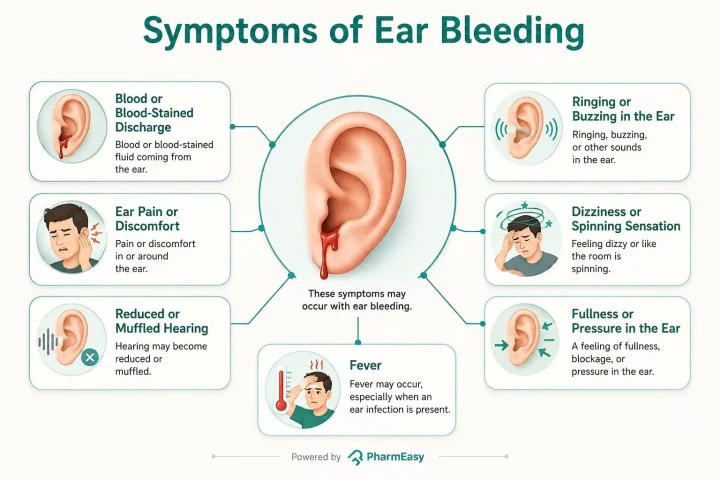
Ear bleeding may happen on its own or with other symptoms, depending on the cause. Symptoms that can occur with ear bleeding include8,9,11:
- Blood or blood-stained discharge from the ear
- Ear pain or discomfort
- Reduced or muffled hearing
- Ringing or buzzing in the ear (tinnitus)
- Dizziness or a spinning sensation (vertigo)
- A feeling of fullness or pressure in the ear
- Fever, especially when an ear infection is present
Treatment of Ear Bleeding
Treatment depends on the cause of the bleeding. A doctor may look inside the ear to find where the blood is coming from and to check whether the ear canal, eardrum, or middle ear is involved. Treatment or care may include:
- Minor injuries: Small scratches in the ear canal often heal on their own. Avoid putting cotton buds, fingers, or other objects into the ear while it heals5.
- Ear infections: Treatment depends on the type and severity of the infection. A doctor may prescribe ear drops, painkillers, antibiotics, or other medicines when needed8,9.
- Ruptured eardrum: Many ruptured eardrums heal naturally within a few weeks. A doctor may prescribe antibiotics if there is an infection or a risk of infection9.
- Eardrum perforation that does not heal: If a hole in the eardrum does not close on its own, an ear, nose, and throat specialist may recommend a patch procedure or surgery, such as tympanoplasty, to repair it12.
- Bleeding after a significant head injury: This needs urgent medical assessment because bleeding from the ear after head trauma can be linked with serious injury10.
Important: Do not put ear drops, oils, or other medicines into a bleeding ear unless a doctor has recommended them.
Advertisement
What Should You Do If Your Ear Starts Bleeding?
If your ear starts bleeding, stay calm and do not try to clean deep inside the ear. To reduce the chance of further injury, follow these steps8,9,11:
- If blood or discharge is present, gently wipe the outer ear without putting anything inside the ear canal.
- Avoid cotton buds, fingers, tissues, or other objects, as they may worsen an injury.
- Avoid swimming and prevent water from entering the ear until the cause is assessed or the ear has healed.
- Some ear drops are not safe if the eardrum is torn. Do not use ear drops unless a doctor has advised you to do so.
- Contact a doctor for an assessment, especially if bleeding occurs with pain, hearing loss, dizziness, fever, or discharge.
- Seek urgent medical care if ear bleeding occurs after a significant head injury, as this can be a sign of a serious injury.
Possible Complications of Untreated Ear Bleeding
Ear bleeding is a symptom, so the risks depend on the cause. If the cause is not found and treated when needed, possible complications may include11:
- Temporary or long-term hearing loss
- Repeated ear infections
- Ongoing ear discharge
- Eardrum perforation that does not heal
Note: If ear bleeding occurs following a head injury, it may indicate a skull-base fracture. If this is left untreated, it could result in a cerebrospinal fluid (CSF) leak, which may increase the risk of meningitis13.
Prevention Tips for Ear Bleeding
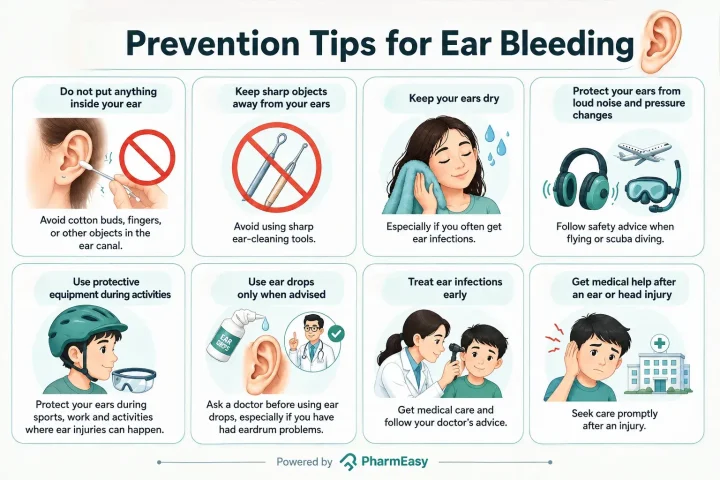
A few simple habits can help protect your ears and lower the risk of bleeding. These include14,15:
- Avoid putting cotton buds, fingers, or other objects into the ear canal.
- Keep sharp objects and ear-cleaning tools away from the ear canal.
- Keep your ears dry, especially if you are prone to ear infections.
- Use ear protection around loud noise and follow safety advice for activities with sudden pressure changes, such as flying or scuba diving.
- Use suitable protective equipment during sports, work, or other activities that could injure the ear.
- Do not use ear drops unless recommended by a doctor, especially if you have a history of eardrum problems.
- Treat ear infections promptly and follow your doctor’s advice.
- Seek medical care promptly after an ear injury or head injury.
Also Read: Ear Discharge (Otorrhea): Common Causes, Warning Signs and Treatment
When Should You Consult a Doctor?
Contact a doctor if you have any of the following symptoms8,9:
- Severe or persistent ear pain
- Dizziness or vertigo
- Hearing loss
- Loud or persistent ringing in the ear
- Fever or feeling generally unwell
- Bloody or other unusual ear discharge
- Ear discharge that persists for several days
- An object stuck in the ear
- Redness or swelling around or inside the ear canal
- New facial weakness or an uneven facial appearance
- Ear bleeding or discharge after an ear injury or head injury
Also Read: Hearing Loss: Symptoms, Causes, Types, Diagnosis, Treatment and Prevention
Conclusion
Ear bleeding can be alarming, but knowing the possible causes and warning signs can help you respond safely. Avoid putting objects into the ear, keep the ear dry when advised, and follow safe ear-care practices to reduce the risk of injury. If bleeding continues, comes back, or occurs with other symptoms, see a doctor for further evaluation.
Also Read: Natural Home Remedies for Ear Pain
Frequently Asked Questions (FAQs)
Is ear bleeding an emergency?Minor bleeding may come from a small scratch or irritation. However, bleeding after a head injury, heavy bleeding, or bleeding with severe pain, dizziness, or hearing loss needs urgent medical attention.1,10
Can high BP cause ear bleeding?High blood pressure is not a common direct cause of bleeding from the ear canal. However, very high blood pressure can affect blood vessels and has been linked with inner-ear bleeding and hearing problems in rare cases16. Ear bleeding should not automatically be blamed on high blood pressure; a doctor should check for the actual cause.
Can ears bleed due to stress?Stress does not usually cause ear bleeding. Rare medical conditions may involve bleeding from unusual sites, but these are uncommon17. If the ear is bleeding, it is safer to have the ear examined rather than assuming stress is the cause.
Can headphones cause ear bleeding?Headphones do not usually cause ear bleeding. However, poorly fitting earbuds or forceful insertion can irritate or scratch the ear canal18. This may cause mild bleeding in some cases.
References
- Rivera G, Lajud S, Gonzalez L, Garratón M, Labat E. Management of life‐threatening post‐traumatic otorrhagia. Clin Case Rep. 2020;9(1):5-7. doi:10.1002/ccr3.3340 Available from: https://pmc.ncbi.nlm.nih.gov/articles/PMC7813099/
- Kim CH, Shin JE. Hemorrhage within the tympanic membrane without perforation. J Otolaryngol – Head Neck Surg. 2018;47:66. doi:10.1186/s40463-018-0300-0. Available from: https://www.researchgate.net/publication/328771100_Hemorrhage_within_the_tympanic_membrane_without_perforation
- Ameen ZS, Chounthirath T, Smith GA, Jatana KR. Pediatric Cotton-Tip Applicator-Related Ear Injury Treated in United States Emergency Departments, 1990-2010. J Pediatr. 2017;186:124-130. doi:10.1016/j.jpeds.2017.03.049. Available from: https://pubmed.ncbi.nlm.nih.gov/28473166/
- Lou ZC, Lou ZH, Zhang QP. Traumatic tympanic membrane perforations: a study of etiology and factors affecting outcome. Am J Otolaryngol. 2012;33(5):549-555. doi:10.1016/j.amjoto.2012.01.010. Available from: https://pubmed.ncbi.nlm.nih.gov/22365389/
- Jellinge ME, Kristensen S, Larsen K. Spontaneous closure of traumatic tympanic membrane perforations: observational study. J Laryngol Otol. 2015;129(10):950-954. doi:10.1017/S0022215115002303. Availabe from: https://pubmed.ncbi.nlm.nih.gov/26344019/
- Jin ZH, Lou ZH, Lou ZC. Assessment and spontaneous healing outcomes of traumatic eardrum perforation with bleeding. Am J Otolaryngol. 2017;38(4):479-483. doi:10.1016/j.amjoto.2017.04.014. Available from: https://pubmed.ncbi.nlm.nih.gov/28479299/
- Hobson JC, Lavy JA. Use and abuse of cotton buds. J R Soc Med. 2005;98(8):360-361. doi:10.1258/jrsm.98.8.360. Available from: https://pmc.ncbi.nlm.nih.gov/articles/PMC1181836/
- Ear discharge. MedlinePlus. Accessed August 12, 2026. https://medlineplus.gov/ency/article/003042.htm
- Ruptured eardrum. MedlinePlus. Accessed August 12, 2026. https://medlineplus.gov/ency/article/001038.htm
- Severe head injury symptoms and treatments. NHS. Accessed August 12, 2026. https://www.nhsinform.scot/illnesses-and-conditions/injuries/head-and-neck-injuries/severe-head-injury/
- ONeill OJ, Brett K, Frank AJ. Ear Barotrauma. StatPearls Publishing. Accessed August 12, 2026. http://www.ncbi.nlm.nih.gov/books/NBK499851/
- Ryan MA, Kaylie DM. What Is the Optimal Age to Repair Tympanic Membrane Perforations in Pediatric Patients? The Laryngoscope. 2016;126(10):2201-2202. doi:10.1002/lary.26052. Available from: https://pubmed.ncbi.nlm.nih.gov/27107159/
- Feldman JS, Farnoosh S, Kellman RM, Tatum SA. Skull Base Trauma: Clinical Considerations in Evaluation and Diagnosis and Review of Management Techniques and Surgical Approaches. Semin Plast Surg. 2017;31(4):177-188. doi:10.1055/s-0037-1607275. Available from: https://pubmed.ncbi.nlm.nih.gov/29075156/
- Ear infections. NHS. January 25, 2018. Accessed August 12, 2026. Available from: https://www.nhs.uk/conditions/ear-infections/
- Deafness and hearing loss. World Health Organization. Accessed August 12, 2026. https://www.who.int/news-room/questions-and-answers/item/deafness-and-hearing-loss-ear-care
- Agarwal S, Mishra A, Jagade M, Kasbekar V, Nagle SK. Effects of Hypertension on Hearing. Indian J Otolaryngol Head Neck Surg. 2013;65(Suppl 3):614-618. doi:10.1007/s12070-013-0630-1. Available from: https://pubmed.ncbi.nlm.nih.gov/24427724/
- Nasir A, Chong Sian N, Abdullah A. Hematohidrosis: A Rare Case of Bleeding Ears. Cureus. 16(6):e63113. doi:10.7759/cureus.63113. Available from: https://pubmed.ncbi.nlm.nih.gov/39055449/
- Mazlan R, Saim L, Thomas A, Said R, Liyab B. Ear infection and hearing loss amongst headphone users. Malays J Med Sci. 2002;9(2):17-22. Accessed August 12, 2026. https://pmc.ncbi.nlm.nih.gov/articles/PMC3406203/
Disclaimer: The information provided here is for educational/awareness purposes only and is not intended to be a substitute for medical treatment by a healthcare professional and should not be relied upon to diagnose or treat any medical condition. The reader should consult a registered medical practitioner to determine the appropriateness of the information and before consuming any medication. PharmEasy does not provide any guarantee or warranty (express or implied) regarding the accuracy, adequacy, completeness, legality, reliability or usefulness of the information; and disclaims any liability arising thereof.
Links and product recommendations in the information provided here are advertisements of third-party products available on the website. PharmEasy does not make any representation on the accuracy or suitability of such products/services. Advertisements do not influence the editorial decisions or content. The information in this blog is subject to change without notice. The authors and administrators reserve the right to modify, add, or remove content without notification. It is your responsibility to review this disclaimer regularly for any changes.







































Comments