




Cough Syrup for Kids: What to Give, What to Avoid & Safe Dosage
By Dr. Sarthak Soni +2 more

Medically reviewed by Dr. Sarthak Soni
Last updated: Aug 19, 2026 Published on: Jul 2, 2026


Get,

to manage your symptom
Get your,

4 Cr+ families
benefitted

OTP sent to 9988776655



You’ve successfully subscribed to receive
doctor-approved tips on
Whatsapp

Get ready to feel your best.


Register to Avail the Offer
Send OTPBy continuing, you agree with our Privacy Policy and Terms and Conditions
Hi There,
Sign up on PharmEasy now!!


Trusted by 4 crore+ families

OTP sent to 9988776655
You have unlocked 25% off on medicines


Code: NU25

By Dr. Sarthak Soni +2 more
Table of Contents
Cough and cold are very common in children, especially during weather changes or when they catch infections from others1. Most of the time, these coughs are mild and easily manageable at home. However, many people use cough syrups as the primary approach to manage cough in children. Though they can help relieve symptoms such as dry cough and mucus buildup, they are not always essential2. This article explores different types of cough syrup for children, when they should be used, their side effects, recommended dose, easy ways to make cough syrups at home, and when to avoid them.
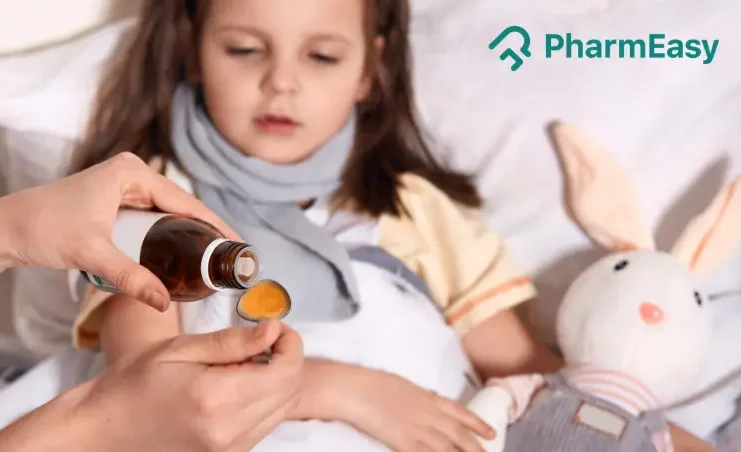
Cough syrup is a liquid medicine that is often used to treat coughs. It acts differently depending on the ingredients; some cough syrups block the cough reflex, particularly in dry or unpleasant coughs, while others loosen and thin heavy mucus, allowing it to be coughed up more easily. This helps clean the airways and makes breathing easier3.
Cough syrups can enhance sleep and overall comfort by lowering coughing or by helping in the removal of mucus in children. However, it is important to note that cough syrup does not cure the underlying sickness; rather, it relieves symptoms while the body heals4.
Note: Persistent night coughing in children may sometimes indicate an underlying health condition such as asthma5. In such cases, the child should be evaluated by a doctor.
Different types of cough syrups are available to help manage different kinds of coughs in children. The following are some of the most common types of cough syrups for kids:
These are known as central cough suppressants. They work by acting on cough receptors in the brain and reducing the cough reflex. They are mainly used to treat dry, irritating coughs that do not produce mucus. They are especially helpful for frequent coughing. However, they are not routinely prescribed in children under the age of 26.
These are widely used to treat allergy symptoms caused by dust or pollen. They work by lowering the body’s allergic response, thereby alleviating symptoms such as sneezing, runny nose, and post-nasal drip. However, these are not recommended in children who have a general cough without a clear cause7.
These are known as the wet cough syrups. They are used to treat coughs that produce mucus or phlegm. They work by loosening the mucus in the lungs and making it easier to cough it out8. By clearing the airways, these syrups help improve breathing and provide relief from chest congestion.
These are the cough syrups that help relieve a blocked or stuffy nose by shrinking the swollen blood vessels inside the nose. Thus, by lowering swelling inside the nose, they help open the nasal passages and make breathing easier9.
Note: Cough syrups are not recommended for children under 2 years of age unless specifically prescribed by a doctor. For older children, cough syrup should only be used as advised by the doctor. Not all cough syrups are suitable for every child, as the right type depends on the cause of the cough. Therefore, avoid buying them over-the-counter. Also, avoid giving more than one cough or cold medicine at the same time unless a paediatrician recommends it.
Mild cases of cough and cold can be managed at home using several home-care approaches. The following are some homemade cough syrups for kids:


Note: Honey should not be given to children younger than one year old due to the risk of botulism (muscle weakness and paralysis from a type of bacterial infection).



Note: The information provided is for general educational purposes and should not be used as a substitute for medical advice or treatment. Always consult a paediatrician before administering any homemade or herbal approach to children, particularly infants and toddlers. Also, if the child’s cough persists, worsens, or is accompanied by fever, difficulty breathing, wheezing, or chest pain, seek medical assistance right away.
There is no single standard dosage for cough syrup in children, as it depends on their age, weight, the type of medicine, and its concentration15. Most importantly, cough syrups should only be administered in the exact dose suggested by a doctor, since giving too little or too much may not be effective and can cause side effects16.
Caretakers should never assume the dosage or give children adult formulations. To ensure exact dosing and prevent overdose, the FDA recommends using professional measuring equipment such as a medication cup, oral syringe, or dropper rather than household spoons17.
Note: Following the prescription dosage recommended by a doctor is very important to avoid adverse events that can be caused by overdose. For any doubts, immediately reach out to a paediatrician.
Cough syrups for kids may sometimes cause side effects that affect different body systems, including the brain and digestive system and, in rare cases, more serious reactions.
According to the FDA and other health authorities, cough syrups are not recommended for children under the age of two, as they can cause several adverse effects in them16. They are also usually not necessary for mild or short-term coughs caused by common viral infections, which often resolve on their own without the need for medication1. In many cases, giving syrup without first determining the actual reason for the cough (such as a cold, allergy, or asthma) might have no benefits over it7 and can even delay accurate diagnosis and treatment.
These medicines should also be avoided when a child shows symptoms like wheezing, chest tightness, or difficulty breathing, as these may indicate more serious conditions that need medical attention rather than just cough relief. Using cough syrup in such situations may only mask the symptoms instead of treating the underlying problem5.
Another important reason to be cautious is the risk of side effects and overdose of the over-the-counter syrups. These may cause sleepiness, dizziness, nausea, and sometimes more serious reactions18. Taking more than the recommended dose or using multiple cold and cough syrups together can lead to repeated ingredients, which increases the risk of overdose and toxicity16.
Also Read: Home Remedies for Cold in Infants and Babies
Consulting a doctor is important in the following cases:
Also Read: Croup Cough in Kids: Causes, Symptoms, Treatment & When to Worry
Cough in children is usually harmless and improves with time and simple care. Cough syrups can help ease symptoms, but they should be used carefully and only when necessary. Understanding the type of cough, selecting the appropriate medicine, and maintaining proper dosage is critical for a child’s safety.
In many cases, basic home medicines and supportive care are sufficient to assist them in recovering peacefully. However, parents should avoid self-medication and always seek a paediatrician’s advice, especially for young children.
To relieve a cough in children fast, keep them hydrated; make them drink warm fluids like soup or honey (for children over one year old); and get them lots of rest2. Consult a doctor if the cough is severe, persistent, and accompanied by fever or difficulty in breathing1.
Keep the kid hydrated and use a cool-mist humidifier to reduce throat discomfort and loosen mucus2. Raising the child’s head slightly while sleeping can also assist to alleviate nighttime coughing. For persistent nighttime cough, it’s best to consult a paediatrician as it may be linked to wheezing (which is a sign of underlying airway disease like asthma).
There is no single fast cure for cough, as it depends on the cause. Most coughs improve with rest, fluids, and treating the underlying infection or irritation.
Coughing is often worse at night because mucus from the nose and sinuses can gather in the back of the throat. This postnasal drip may irritate the throat and cause coughing. Sometimes the mucus enters the airways, resulting in a wet cough with sputum that is particularly prominent while sleeping19.
To reduce cough in kids naturally, offer warm fluids like water or soup; give honey (for children above 1 year) and use saline water nasal sprays to loosen mucus. Keeping the child well-hydrated and rested also helps recovery2.
1. Coughs and colds in children. 2025. Available from: https://www.healthdirect.gov.au/coughs-and-colds-in-children
2. Coughs and Colds: Medicines or Home Remedies? 2022. Available from: https://www.healthychildren.org/English/health-issues/conditions/chest-lungs/Pages/Coughs-and-Colds-Medicines-or-Home-Remedies.aspx
3. Schroeder K. Systematic review of randomised controlled trials of over-the-counter cough medicines for acute cough in adults. BMJ. 2002;324(7333):329-329. doi:10.1136/bmj.324.7333.329. Available from: https://pmc.ncbi.nlm.nih.gov/articles/PMC65295/
4. Cuzzocrea S, Catania M. Pharmacological and clinical overview of cloperastine in treatment of cough. TCRM. Published online March 2011:83. doi:10.2147/TCRM.S16643. Available from: https://pubmed.ncbi.nlm.nih.gov/21445282/
5. Cough or difficulty in breathing. Available from: https://www.ncbi.nlm.nih.gov/books/NBK154448/
6. Lam SHF, Homme J, Avarello J, et al. Use of antitussive medications in acute cough in young children. JACEP Open. 2021;2(3):e12467. doi:10.1002/emp2.12467. Available from: https://pubmed.ncbi.nlm.nih.gov/34179887/
7. Chang AB, Peake J, McElrea MS. Anti-histamines for prolonged non-specific cough in children. Cochrane Airways Group, ed. Cochrane Database of Systematic Reviews. 2008;2010(2). doi:10.1002/14651858.CD005604.pub3. Available from: https://pmc.ncbi.nlm.nih.gov/articles/PMC8896440/
8. Cold and Cough Medicines. 2025. Available from: https://medlineplus.gov/coldandcoughmedicines.html
9. Summerlin J, Eiland LS. The Use and Safety of Cough and Cold Medications in the Pediatric Population. The Journal of Pediatric Pharmacology and Therapeutics. 2025;30(1):17-26. doi:10.5863/1551-6776-30.1.17. Available from: https://pubmed.ncbi.nlm.nih.gov/39935563/
10. Goldman RD. Honey for treatment of cough in children. Can Fam Physician. 2014;60(12):1107-1108, 1110. Available from: https://pubmed.ncbi.nlm.nih.gov/25642485/
11. Townsend EA, Siviski ME, Zhang Y, Xu C, Hoonjan B, Emala CW. Effects of Ginger and Its Constituents on Airway Smooth Muscle Relaxation and Calcium Regulation. American Journal of Respiratory Cell and Molecular Biology. 2013;48(2):157-163. doi:10.1165/rcmb.2012-0231OC. Available from: https://pubmed.ncbi.nlm.nih.gov/23065130/
12. Gudi SK, Ramesh T B, P P. “Tulsi” – the Wonder Herb (Pharmacological Activities of Ocimum Sanctum). Published online 2014. Available from: https://www.researchgate.net/publication/314363747_Tulsi_-_the_Wonder_Herb_Pharmacological_Activities_of_Ocimum_Sanctum
13. Shahnaz Sultana, Khan A, Mohammed M Safhi, Alhazmi HA. Cough Suppressant Herbal Drugs: A Review. International Journal of Pharmaceutical Science Invention. 2016;5(5):15-28. Cough Suppressant Herbal Drugs: A Review. Available from: https://www.researchgate.net/publication/308369657_Cough_Suppressant_Herbal_Drugs_A_Review
14. Beigoli S, Behrouz S, Memarzia A, et al. Effects of Allium cepa and Its Constituents on Respiratory and Allergic Disorders: A Comprehensive Review of Experimental and Clinical Evidence. Rather MA, ed. Evidence-Based Complementary and Alternative Medicine. 2021;2021:1-22. doi:10.1155/2021/5554259. Available from: https://pmc.ncbi.nlm.nih.gov/articles/PMC8452398/
15. Illustrative drug requirement for on spot management during screening. Available from: https://www.nhm.gov.in/images/pdf/programmes/RBSK/RBSK-ORDERS/Communicated_Essential_Drug_List_for_Mobile_Health_%20Team_under_RBSK.pdf
16. Use Caution When Giving Cough and Cold Products to Kids. 2018. Available from: https://www.fda.gov/drugs/safe-use-over-counter-otc-medicines-children/use-caution-when-giving-cough-and-cold-products-kids
17. Should You Give Kids Medicine for Coughs and Colds? 2024. Available from: https://www.fda.gov/consumers/consumer-updates/should-you-give-kids-medicine-coughs-and-colds
18. Dolansky G, Rieder M. What is the evidence for the safety and efficacy of over-the-counter cough and cold preparations for children younger than six years of age? Paediatrics & Child Health. 2008;13(2):125-127. doi:10.1093/pch/13.2.125. Available from: https://pmc.ncbi.nlm.nih.gov/articles/PMC2528730/
19. Why are you coughing at night? 2026. Available from: https://www.health.harvard.edu/respiratory-health/why-are-you-coughing-at-night
Disclaimer: The information provided here is for educational/awareness purposes only and is not intended to be a substitute for medical treatment by a healthcare professional and should not be relied upon to diagnose or treat any medical condition. The reader should consult a registered medical practitioner to determine the appropriateness of the information and before consuming any medication. PharmEasy does not provide any guarantee or warranty (express or implied) regarding the accuracy, adequacy, completeness, legality, reliability or usefulness of the information; and disclaims any liability arising thereof.
Links and product recommendations in the information provided here are advertisements of third-party products available on the website. PharmEasy does not make any representation on the accuracy or suitability of such products/services. Advertisements do not influence the editorial decisions or content. The information in this blog is subject to change without notice. The authors and administrators reserve the right to modify, add, or remove content without notification. It is your responsibility to review this disclaimer regularly for any changes.


Comments

Leave your comment...
You may also like
























Comments