
Introduction
Dealing with hair loss, or alopecia, is a major concern for anyone experiencing it. Alopecia simply means losing hair, either completely or just partially, it affects both sexes of any age group, and it usually develops slowly over time. While it’s natural to feel uneasy finding hair on your pillow, hairbrush, or in the shower drain, try not to panic because it’s completely normal to shed about 100 hair daily from the roughly 100,000 strands covering your head1. However, it is crucial to monitor the pattern if you notice abnormal hair fall, that is something more than usual or in a patchy distribution. Early observation is the best way to get a timely diagnosis and start effective treatment.
There are different types of alopecia, and the most common one is known as androgenetic alopecia. It can affect about 80% of males and 50% females and its incidence increases with age2.
Figuring out the cause is confusing right? This blog will guide through everything about hair loss, the main reasons why it happens (from your genes to high stress), the important tests doctors use to diagnose, the different treatments options available, and simple tips to help stop it before it starts.
Advertisement
What Causes Hair Loss?
There can be several causes that lead to hair loss. These include:
- Genetic Factor: Although it’s common for our hair to get thinner as we age, hair loss can be influenced by our genes. One common example of hereditary conditions associated with hair loss is androgenetic alopecia (pattern baldness). It is hair loss that runs in the family and happens because your hair follicles are too sensitive to male hormones called androgens3. Pattern baldness is more common in men than women and can start in men right after puberty1.
- Stress: Hair loss can be caused by emotional or physical stress also. You may lose large amounts of hair when distressed, but the loss usually stops on its own after 6 to 8 months. This condition is usually short-term, but it can be long-term or chronic under following conditions:
- Any major infections in the body
- After childbirth
- Intense emotional distress
- Diet that does not contain protein
- Illness including severe blood loss or any major surgery
- Medications such as retinoids, birth control pills, blood pressure drugs and certain antidepressants, and pain relievers like NSAIDs1.
- Nutritional Deficiencies: Iron, zinc and certain vitamins like B12, biotin, D and C are essential nutrients whose deficiencies can cause hair loss4.
- Hormonal Changes: Significant shifts in hormone levels can trigger temporary or permanent hair loss.
- Thyroid Disorders: Both an overactive (hyperthyroidism) and underactive (hypothyroidism) thyroid can disrupt the balance needed for hair growth5.
- Childbirth or Menopause: The fluctuation and subsequent drop in oestrogen levels after these events can cause excessive temporary shedding of hai1,5.
- Medical Conditions
- Autoimmune issues like alopecia areata (patchy baldness) or Lupus.
- Infections like syphilis or fungal infections.
- Post-radiation or chemotherapy1.
- Other Factors
- Trauma or injury caused by burns.
- Overuse of heat or chemicals like excessive shampooing and blow-drying.
- Nervous habits such as continuous hair pulling or scalp rubbing1.
Blood Tests for Diagnosing Hair Loss
A simple blood test can often reveal underlying medical problems, such as nutritional deficiencies or hormonal imbalances, that impact hair growth.
The test checks for Thyroxine (T4) Triiodothyronine (T3) and Thyroid stimulation hormone (TSH). Thyroid hormones are strongly linked to hair loss because they control the growth of body cells, including those in the skin. Thyroid Hormones are essential for growth and maintenance of hair follicle; hair loss can signal underlying thyroid dysfunction. Hair loss affects roughly 50% of people with hyperthyroidism and 33% of those with hypothyroidism. Thus, one of the most important tests that is linked to hair loss is Thyroid function test6,7.
2. Sex Hormone Test
As mentioned above hair follicle are sensitive to male sex hormones or androgens. Dehydroepiandrosterone sulphate (DHEAS) and Testosterone are types of androgens found in both male and female, high level of these 2 hormones can lead to hair loss. Thus, DHEAS and Testosterone testing is important8,9.
CBC test checks for different components like red blood cells, white blood cells, platelets, haemoglobin, haematocrit and MCV (Mean corpuscular volume). Here CBC is performed to rule out anaemia or infection. Unusual levels of red blood cells, haemoglobin, or haematocrit can signal conditions like anaemia or insufficient iron. High level of WBC (white blood cell) could be a sign of infection6,10.
High C-reactive protein (CRP) levels suggest inflammation, which can be a sign of autoimmune disease. An example for autoimmune condition is Alopecia areata (sudden unpredictable hair loss)11.
Advertisement
5. Iron and Ferritin level
Ferritin is a protein that stores iron. Low serum ferritin levels are significantly associated with alopecia specially in pre-menopausal women, making it crucial to test and manage ferritin levels during hair loss. Studies indicates that low iron stores are an independent factor contributing to this type of hair loss in women who haven’t reached menopause6,12.
6. Vitamin and Mineral test
Studies4 have shown a low level of vitamin in people with alopecia which means alopecia can be due to deficiency of vitamins. Thus, Vitamin B12, biotin, D, C and zinc test are some essential blood tests to rule out alopecia13.
Other Tests to Determine the Cause of Hair Loss
- Medical History and Scalp Examination: This is the most basic step to rule out alopecia where a physician takes detailed history on how you take care of your hair and scalp, your diet pattern, level of stress, medical and family history. Scalp is examined to see texture of hair, pattern of hair loss and to see any signs of infection like redness or inflammation1.
- Hair Pull Test: Hair pull test offers a rough assessment of active hair shedding. It is performed by gently pulling a small bundle of hair from three different areas of the scalp. If fewer than three hairs are extracted during the test, the result is considered negative (normal shedding) and if more than six strands of hair are extracted, it suggests excessive or active hair loss, resulting in a positive test14.
- Scalp Biopsy: A scalp biopsy is a critical diagnostic tool for hair loss, to see the living tissue. It involves taking a small sample of the scalp to examine under a microscope, which helps the doctor identify the cause of alopecia. Biopsy gives clues about the patient’s prognosis specifically, if the hair loss is due to inflammation, it can be reversed or slowed down in some cases by proper treatment. To get the best result, the biopsy should typically be taken from the leading edge of the affected area, where hair loss is actively occurring. Area with complete, long-term baldness is usually avoided, as there is little active tissue left to study14.
- Trichoscopy: Also known as scalp dermoscopy, it is a non-invasive method for evaluating hair loss. This technique uses magnification to visualize the hair shafts and scalp skin in detail using a handheld dermoscope or a videodermoscope15.
Hair Loss Treatment Options
Treating hair loss is highly personalized and depends on the specific cause. Treatment can range from non-invasive topical applications to surgical procedures. Commonly used options are:
1. For Management of Common Underlying Conditions
- Antifungals: If hair fall is linked to ringworm of any fungus, it is usually treated by antifungal shampoos or oral medicine for the same1.
- Corticosteroids: Topical corticosteroids are used for autoimmune conditions like alopecia areata16.
- Vitamin and Mineral Supplements: Supplements are recommended if a specific deficiency is identified as contributing factor of hair loss e.g. deficient specific vitamins, biotin, zinc supplements)1
2. Alopecia Medications
- Topical: These are applied directly on the scalp to stimulate hair growth. For example, Minoxidil. It is used to promote hair growth and slow the progression of balding, and it is effective mainly for recent hair loss in people younger than 40. It comes in the form of liquid which is applied directly on the scalp17.
- Oral Medications: These include drugs like Finasteride that control male pattern hair loss by inhibiting the production (Testosterone to Dihydrotestosterone) of a specific male hormone in the scalp that is responsible for halting hair growth18. It comes in form of a tablet to take orally.
- Hair Transplant: It is a surgical procedure that improves baldness by moving hair from areas of thick growth to the bald areas. This procedure cannot produce new hair; it can only transplant the hair you currently have to the areas of baldness19.
- Low Level Laser Therapy (LLLT) and Platelet Rich Plasma therapy (PRP): It helps in promoting hair growth by stimulating the cells within the hair follicle. Platelet rich plasma encourages hair growth by utilizing patients own blood platelets. For an effective outcome combination of LLLT and PRP is given together20.
How to Prevent Hair Loss?
By focusing on certain factors, you can effectively minimize hair loss to some extent.
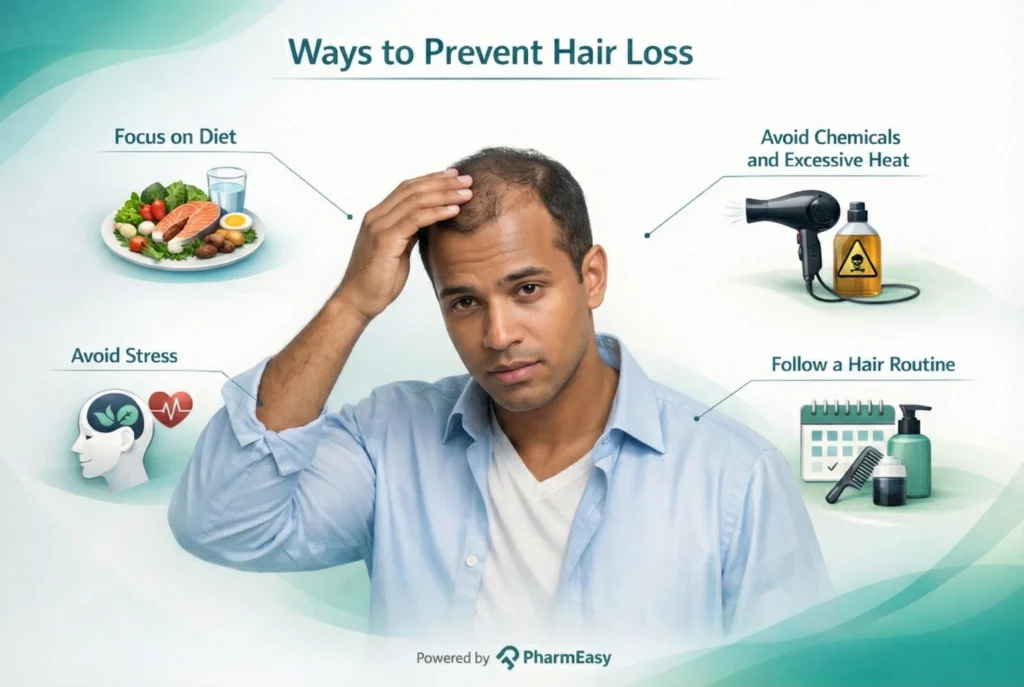
- Focus on Diet: Nutrient deficiency is one major factor that can lead to hair loss. Focus on a diet rich in iron, protein, zinc, biotin, omega-3 fatty acids, and vitamin C, which are found in foods like eggs, green leafy vegetables, nuts, meat, salmon and citrus fruits4.
- Avoid Chemicals and Excessive Heat: Chemicals used for straightening and colouring hairs can cause certain side effects like allergy, chemical burns on scalp, breakage of hair further leading to alopecia. Hair styling like curling and straightening also worsens the hair condition21.
- Avoid Stress: Stress hormones damage the stem cell required for hair growth. You can effectively manage stress by practicing relaxation techniques like yoga and meditation22.
Some routine hair care tips to follow23:
- Wash your hair regularly.
- Choose a shampoo and conditioner that suits your hair type.
- Use a scalp exfoliator to remove dead skin build-up.
- Avoid sharing personal items like hairbrushes and combs.
- Brush your hair often to prevent tangles.
By practicing these above steps, you can significantly minimize hair loss and promote healthier hair growth. If you still face hair fall even after taking all preventive measures, consult a doctor for regular blood tests to avoid issues that can lead to further hair loss.
Also Read: How to Get Rid of Static Hair Naturally: Home Remedies and Tips
When to See a Doctor?
You need to consult your doctor if you see any of the following symptoms1
- Hair loss more than usual or in a typical pattern.
- Experiencing rapid hair loss at an early age (teen or in twenties)
- If you see any redness, scaly texture or if you have pain on the area of hair loss.
- Woman with a male pattern baldness.
- Developing bald spots on eyebrows or beard.
- Any signs of infection on the scalp.
Early diagnosis can help to rule out the condition and prevent further hair loss.
Also Read: Fenugreek for Hair Growth: Reviewed and Confirmed by Effective Studies
Conclusion
Hair loss is a condition that is quite frustrating at the same time can often be managed effectively once the root cause is identified. Diagnostic tools, especially blood tests, play an indispensable role by finding out internal imbalances like thyroid issues, hormonal changes, or nutritional gaps. Early, accurate diagnosis guides the selection of the most effective treatment, whether it’s a simple dietary supplement, a topical medication, or a more evolved procedure. If you notice rapid or unusual changes in your hair volume, consulting a doctor for comprehensive testing is the most constructive step you can take to understand and properly manage your condition.
Frequently Asked Questions (FAQs)
Do dermatologists take blood tests for hair loss? Yes, dermatologists routinely advice blood tests as these help in evaluating the main reason behind hair loss, or alopecia. This step is essential because effective treatment depends entirely on identifying the root cause of hair fall25.
How can I check what’s causing hair loss? It is always better to take doctors opinion on what’s exactly causing your hair loss, there are several invasive and non-invasive procedure that is conducted by the doctor, which will tell the exact cause of your hair fall.
Can over supplementation of vitamins cause hair loss? Yes, over supplementation of vitamins also known as hypervitaminosis specifically vitamin A and E can hamper your hair growth and further lead to hair loss. Thus, it is always important to check your vitamin levels to prevent from toxicity4,24.
Why is sharing comb or hairbrush risky? It is always wise to keep your comb to yourself as a precaution. Since fungal infections on the scalp, like ringworm, are easily transferable, it is best not to share, especially with people you don’t know personally23.
Is it possible for my hair to regrow after experiencing hair loss? Yes, in cases where hair loss is triggered by a temporary medical condition such as fever, chemotherapy or by a stress factors, the hair typically grows back once the underlying condition is resolved1.
References
- Hair loss: MedlinePlus Medical Encyclopedia [Internet]. medlineplus.gov. Available from: https://medlineplus.gov/ency/article/003246.htm
- Nestor MS, Ablon G, Gade A, Han H, Fischer DL. Treatment options for androgenetic alopecia: Efficacy, side effects, compliance, financial considerations, and ethics. Journal of Cosmetic Dermatology. 2021 Nov 6;20(12). Available from: https://pmc.ncbi.nlm.nih.gov/articles/PMC9298335/
- Ho CH, Zito PM. Androgenetic Alopecia [Internet]. Nih.gov. StatPearls Publishing; 2019. Available from: https://www.ncbi.nlm.nih.gov/books/NBK430924/
- Guo EL, Katta R. Diet and hair loss: effects of nutrient deficiency and supplement use. Dermatol Pract Concept [Internet]. 2017;7(1):1–10. Available from: https://pmc.ncbi.nlm.nih.gov/articles/PMC5315033/
- Owecka B, Agata Tomaszewska, Dobrzeniecki K, Maciej Owecki. The Hormonal Background of Hair Loss in Non-Scarring Alopecias. Biomedicines. 2024 Feb 24;12(3):513–3. Available from: https://pmc.ncbi.nlm.nih.gov/articles/PMC10968111/
- Jackson AJ, Price VH. How to Diagnose Hair Loss. Dermatologic Clinics. 2013 Jan;31(1):21–8. Available from: https://pubmed.ncbi.nlm.nih.gov/23159173/
- Hussein RS, Atia T, Dayel SB, Hussein RS, Atia T, Dayel SB. Impact of Thyroid Dysfunction on Hair Disorders. Cureus [Internet]. 2023 Aug 10;15(8). Available from: https://pmc.ncbi.nlm.nih.gov/articles/PMC10492440/
- Testosterone Levels Test: MedlinePlus Lab Test Information [Internet]. Medlineplus.gov. 2018. Available from: https://medlineplus.gov/lab-tests/testosterone-levels-test/
- DHEA Sulfate Test: MedlinePlus Medical Test [Internet]. medlineplus.gov. Available from: https://medlineplus.gov/lab-tests/dhea-sulfate-test/
- National Library of Medicine. Complete Blood Count (CBC): MedlinePlus Lab Test Information [Internet]. Medline plus. 2022. Available from: https://medlineplus.gov/lab-tests/complete-blood-count-cbc/
- Ahmed Ibrahim AbdElneam, Mohammed Saleh Al‐Dhubaibi, Saleh Salem Bahaj, Ghada Farouk Mohammed, Ahmed Kaid Alantry, Lina Mohamed Atef. C‐reactive protein as a novel biomarker for vitamin D deficiency in alopecia areata. Skin research and technology. 2024 Mar 1;30(3). Available from: https://pmc.ncbi.nlm.nih.gov/articles/PMC10963905/
- Aslam MF, Khalid M, Amad Aslam M. The Association of Serum Ferritin Levels With Non-scarring Alopecia in Women. Cureus. 2022 Dec 2; Available from: https://pmc.ncbi.nlm.nih.gov/articles/PMC9805541/
- Nayak K, Garg A, Mithra P, Manjrekar P. Serum Vitamin D3 Levels and Diffuse Hair Fall among the Student Population in South India: A Case-Control Study. International journal of trichology [Internet]. 2016;8(4):160–4. Available from: https://www.ncbi.nlm.nih.gov/pubmed/28442870
- Vidal CI. Overview of Alopecia: A Dermatopathologist’s Perspective. Missouri Medicine [Internet]. 2015 Jul;112(4):308. Available from: https://pmc.ncbi.nlm.nih.gov/articles/PMC6170065/
- Lacarrubba F, Micali G, Tosti A. Scalp Dermoscopy or Trichoscopy. Alopecias – Practical Evaluation and Management. 2015;21–32. Available from: https://pubmed.ncbi.nlm.nih.gov/26370641/
- Gregoire S, McIntosh B, Sanchez K, Biba U, Arash Mostaghimi. Local Corticosteroids for Alopecia Areata: A Narrative Review. Dermatology and Therapy. 2025 May 5; Available from: https://pubmed.ncbi.nlm.nih.gov/40323545/
- Minoxidil topical [Internet]. Medlineplus.gov. [cited 2025 Nov 25]. Available from: https://medlineplus.gov/druginfo/meds/a689003.html
- Finasteride [Internet]. Medlineplus.gov. [cited 2025 Nov 25]. Available from: https://medlineplus.gov/druginfo/meds/a698016.html
- Hair transplant [Internet]. Medlineplus.gov. [cited 2025 Nov 25]. Available from: https://medlineplus.gov/ency/article/007205.htm
- Clinicaltrials.gov [Internet]. Clinicaltrials.gov. [cited 2025 Nov 25]. Available from: https://www.clinicaltrials.gov/study/NCT07048626
- Nayak BS, Ann CY, Azhar AB, Ling ECS, Yen WH, Aithal PA. A study on scalp hair health and hair care practices among Malaysian medical students. Int J Trichology [Internet]. 2017;9(2):58–62. Available from: https://pmc.ncbi.nlm.nih.gov/articles/PMC5551307/
- How stress causes hair loss [Internet]. National Institutes of Health (NIH). [cited 2025 Nov 25]. Available from: https://www.nih.gov/news-events/nih-research-matters/how-stress-causes-hair-loss
- CDC. Healthy habits: Hair and scalp hygiene [Internet]. Water, Sanitation, and Environmentally Related Hygiene (WASH). 2025 [cited 2025 Nov 25]. Available from: https://www.cdc.gov/hygiene/about/hair-and-scalp-hygiene.html
- Almohanna HM, Ahmed AA, Tsatalis JP, Tosti A. The role of vitamins and minerals in hair loss: A review. Dermatol Ther (Heidelb) [Internet]. 2019;9(1):51–70. Available from: https://pmc.ncbi.nlm.nih.gov/articles/PMC6380979/#Sec10
- Al Aboud AM, Syed HA, Zito PM. Alopecia. In: StatPearls. Treasure Island (FL): StatPearls Publishing; 2025. Available from: https://www.ncbi.nlm.nih.gov/books/NBK538178/
Disclaimer: The information provided here is for educational/awareness purposes only and is not intended to be a substitute for medical treatment by a healthcare professional and should not be relied upon to diagnose or treat any medical condition. The reader should consult a registered medical practitioner to determine the appropriateness of the information and before consuming any medication. PharmEasy does not provide any guarantee or warranty (express or implied) regarding the accuracy, adequacy, completeness, legality, reliability or usefulness of the information; and disclaims any liability arising thereof.
Links and product recommendations in the information provided here are advertisements of third-party products available on the website. PharmEasy does not make any representation on the accuracy or suitability of such products/services. Advertisements do not influence the editorial decisions or content. The information in this blog is subject to change without notice. The authors and administrators reserve the right to modify, add, or remove content without notification. It is your responsibility to review this disclaimer regularly for any changes.






































Comments