




Common Insulin Mistakes to Avoid: Safe Use, Storage, Dosing & Management Tips
By Dr. Amruta Prabhu +2 more

Medically reviewed by Dr. Amruta Prabhu
Last updated: Sep 10, 2026 Published on: Jun 26, 2026


Get,

to manage your symptom
Get your,

4 Cr+ families
benefitted

OTP sent to 9988776655



You’ve successfully subscribed to receive
doctor-approved tips on
Whatsapp

Get ready to feel your best.


Register to Avail the Offer
Send OTPBy continuing, you agree with our Privacy Policy and Terms and Conditions
Hi There,
Sign up on PharmEasy now!!


Trusted by 4 crore+ families

OTP sent to 9988776655
You have unlocked 25% off on medicines


Code: NU25

By Dr. Amruta Prabhu +2 more
Table of Contents
Many people who use insulin every day follow their routine with confidence, yet small, unnoticed mistakes can sometimes make it harder to keep blood sugar levels under control. It could be something as simple as incorrect storage, using the wrong injection technique, or missing the right dose timing that can affect how well insulin works1,2.
The good news is that these mistakes are common and often easy to correct. In this article, we’ll explore the most common insulin injection mistakes, why they matter, and practical tips to help you use insulin safely and effectively.

Insulin is a life-saving medicine for people with type 1 diabetes and for many people with type 2 diabetes1. It helps keep blood sugar levels within the target range, thereby reducing both high and low blood sugar cases.
However, insulin can only work effectively when it is used correctly. Below are the reasons why proper usage matters.
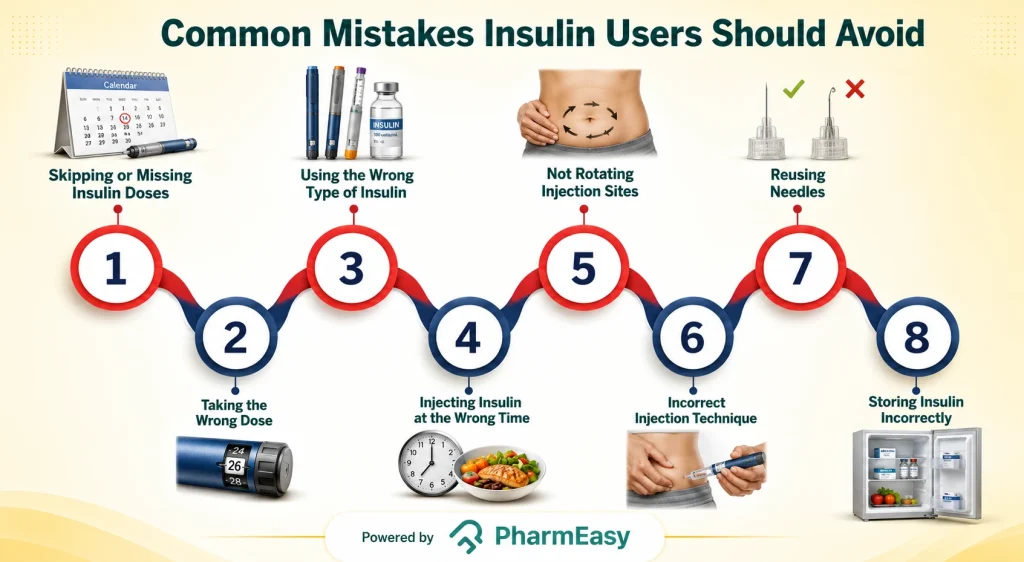
Even experienced insulin injection users can make small mistakes that could affect blood sugar control. Therefore, being aware of these common errors can help you get the most benefit from your insulin and reduce the risk of complications. Some common mistakes include:
Proper storage helps insulin remain effective and safe to use. Follow these practical tips to avoid common storage mistakes1,6:
Using an insulin injection can sometimes be challenging, but a few practical steps can help you manage common issues and improve blood sugar control. Here’s what you can do:

Along with taking insulin correctly, healthy daily habits can also help improve blood sugar control and overall diabetes management. Here are some to follow:
Missing an insulin dose may happen accidentally. What you should do next depends on the type of insulin you use, when the missed dose is noticed, and your current blood sugar level.
If you miss or forget an insulin dose11,13:
Tip: Set reminders using alarms, smartphone apps, or pill and medication reminder tools to help avoid missed doses in the future.
Also Read: What Are Endorphins? Understanding the Body’s Natural Pain-Relieving Hormone
If your insulin is not working as expected, your blood sugar levels may become difficult to control. Some signs may include:
Like all medicines, insulin may cause side effects, although not everyone experiences them. Common insulin side effects include14:
Important: Severe allergic reactions, including rash, swelling, or difficulty breathing, may rarely occur. These require immediate medical attention.
Contact your doctor if you experience any of the following:
Note: Whenever you have concerns about your insulin therapy or blood sugar control, never stop or adjust your insulin without consulting your doctor.
Also Read: Insulin Resistance: What You Need To Know
Insulin works best when it is used correctly and consistently. Try to follow simple steps, such as storing insulin properly, using the correct injection technique, rotating injection sites, monitoring your blood sugar, and following your prescribed dose, which can help insulin work effectively and improve blood sugar control.
Also, you should learn to recognise the signs of low and high blood sugar and never hesitate to contact your doctor if you have concerns or notice persistent changes in your blood sugar levels.
No, it is recommended to use a new needle for every injection. Reusing needles can make injections more painful, increase the risk of infection, damage the needle tip, and contribute to thickened skin, which could affect insulin absorption16.
Unopened insulin should be stored according to the manufacturer’s instructions, usually in a refrigerator (2°C to 8°C) until its expiry date. Once in use, most insulin products can be kept at room temperature (generally below 30°C) for a limited period, which varies by product1,6. Always follow the storage instructions provided with your specific insulin.
Insulin may not work properly if it is expired, stored incorrectly, frozen, exposed to excessive heat, injected into thickened or damaged skin, administered using poor injection technique, or if the wrong dose or type of insulin is used1,2.
Rotating injection sites helps prevent lumps or thickened skin, promotes more consistent insulin absorption, and improves blood sugar control. The recommended injection sites include the abdomen, thighs, upper arms, and buttocks. You should also avoid injecting into the same spot repeatedly6.
1. Tulsan SK, Laila R, Patel H, et al. Errors in diabetic insulin therapy and the vitality of proper precautions in Bangladesh: Real-life insights from the developing world. J Fam Med Prim Care. 2024;13(1):292-297. doi:10.4103/jfmpc.jfmpc_484_23. https://pubmed.ncbi.nlm.nih.gov/38482322/
2. Trief PM, Cibula D, Rodriguez E, Akel B, Weinstock RS. Incorrect Insulin Administration: A Problem That Warrants Attention. Clin Diabetes Publ Am Diabetes Assoc. 2016;34(1):25-33. doi:10.2337/diaclin.34.1.25. https://pubmed.ncbi.nlm.nih.gov/26807006/
3. Services D of H& H. Diabetes and insulin. Accessed June 25, 2026. http://www.betterhealth.vic.gov.au/health/conditionsandtreatments/diabetes-and-insulin
4. Home P, Riddle M, Cefalu WT, et al. Insulin Therapy in People With Type 2 Diabetes: Opportunities and Challenges? Diabetes Care. 2014;37(6):1499-1508. doi:10.2337/dc13-2743. https://pubmed.ncbi.nlm.nih.gov/24855154/
5. Rahman MS, Hossain KS, Das S, et al. Role of Insulin in Health and Disease: An Update. Int J Mol Sci. 2021;22(12):6403. doi:10.3390/ijms22126403. https://pubmed.ncbi.nlm.nih.gov/34203830/
6. Tandon N, Kalra S, Balhara YPS, et al. Forum for Injection Technique (FIT), India: The Indian recommendations 2.0, for best practice in Insulin Injection Technique, 2015. Indian J Endocrinol Metab. 2015;19(3):317-331. doi:10.4103/2230-8210.152762. https://pmc.ncbi.nlm.nih.gov/articles/PMC4366768/
7. Signs, Symptoms, and Treatment for Hypoglycemia (Low Blood Glucose) | American Diabetes Association. Accessed June 25, 2026. https://diabetes.org/living-with-diabetes/hypoglycemia-low-blood-glucose/symptoms-treatment
8. Hyperglycemia (High Blood Glucose) | American Diabetes Association. Accessed June 25, 2026. https://diabetes.org/living-with-diabetes/treatment-care/hyperglycemia
9. Apr 4 LR, 2024. Living Healthy with Diabetes. www.heart.org. Accessed June 25, 2026. https://www.heart.org/en/health-topics/diabetes/prevention–treatment-of-diabetes/living-healthy-with-diabetes
10. Chacko E, Signore C. Five Evidence-Based Lifestyle Habits People With Diabetes Can Use. Clin Diabetes Publ Am Diabetes Assoc. 2020;38(3):273-284. doi:10.2337/cd19-0078. https://pmc.ncbi.nlm.nih.gov/articles/PMC7364446/
11. How and when to take long-acting insulin. nhs.uk. July 11, 2023. Accessed June 25, 2026. https://www.nhs.uk/medicines/insulin/long-acting-insulin/how-and-when-to-take-long-acting-insulin/
12. How and when to take short-acting insulin. nhs.uk. July 11, 2023. Accessed June 25, 2026. https://www.nhs.uk/medicines/insulin/short-acting-insulin/how-and-when-to-take-short-acting-insulin/
13. How and when to take intermediate-acting insulin. nhs.uk. July 11, 2023. Accessed June 25, 2026. https://www.nhs.uk/medicines/insulin/intermediate-acting-insulin/how-and-when-to-take-intermediate-acting-insulin/
14. Side effects of long-acting insulin. nhs.uk. July 11, 2023. Accessed June 25, 2026. https://www.nhs.uk/medicines/insulin/long-acting-insulin/side-effects-of-long-acting-insulin/
15. Diabetes and being ill | Managing when you’re sick | Diabetes UK. Accessed June 25, 2026. https://www.diabetes.org.uk/living-with-diabetes/life-with-diabetes/illness
16. Impact of Insulin Injection and Infusion Routines on Lipohypertrophy and Glycemic Control in Children and Adults with Diabetes – PMC. Accessed June 25, 2026. https://pmc.ncbi.nlm.nih.gov/articles/PMC6349294/
Disclaimer: The information provided here is for educational/awareness purposes only and is not intended to be a substitute for medical treatment by a healthcare professional and should not be relied upon to diagnose or treat any medical condition. The reader should consult a registered medical practitioner to determine the appropriateness of the information and before consuming any medication. PharmEasy does not provide any guarantee or warranty (express or implied) regarding the accuracy, adequacy, completeness, legality, reliability or usefulness of the information; and disclaims any liability arising thereof.
Links and product recommendations in the information provided here are advertisements of third-party products available on the website. PharmEasy does not make any representation on the accuracy or suitability of such products/services. Advertisements do not influence the editorial decisions or content. The information in this blog is subject to change without notice. The authors and administrators reserve the right to modify, add, or remove content without notification. It is your responsibility to review this disclaimer regularly for any changes.


Comments

Leave your comment...
You may also like

























Comments