




Khadiradi Vati: Uses, Benefits, Side Effects & More
By Dr Rajeev Singh +2 more

Last updated: Sep 15, 2026 Published on: Mar 15, 2022


Get,

to manage your symptom
Get your,

4 Cr+ families
benefitted

OTP sent to 9988776655



You’ve successfully subscribed to receive
doctor-approved tips on
Whatsapp

Get ready to feel your best.


Register to Avail the Offer
Send OTPBy continuing, you agree with our Privacy Policy and Terms and Conditions
Hi There,
Sign up on PharmEasy now!!


Trusted by 4 crore+ families

OTP sent to 9988776655
You have unlocked 25% off on medicines


Code: NU25

By Dr Rajeev Singh +2 more
Table of Contents
Khadiradi Vati is an ayurvedic formulation made from multiple herbs. Khadira (Acacia catechu) is the major ingredient in the formulation, along with Bhimseni kapoor (Cinnamomum camphora), Kankol (Piper cubeba), Supari (Areca nut), and Javitri (Myristica fragrans)1. The main ingredient Khadira is responsible for most of its therapeutic benefits. Acacia catechu is an important medicinal plant and an economically significant forest tree2.
There are various phytochemicals present in Khadiradi Vati like flavonoids, glycosides, saponins, tannins, alkaloids, and volatile oils1.
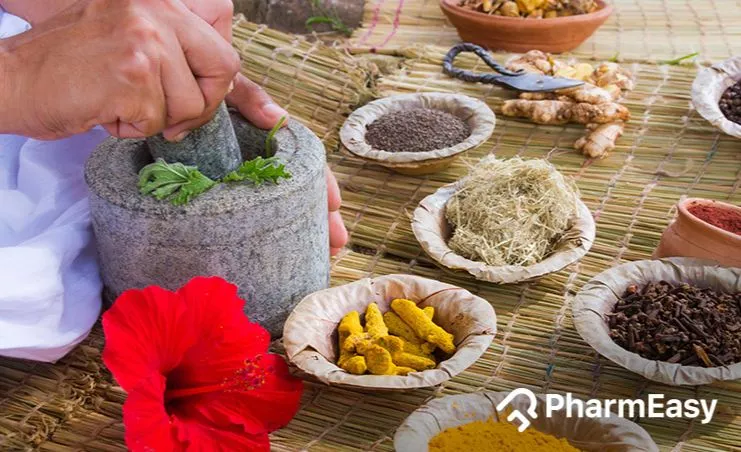
Phytochemical screening of Khadiradi Vati shows the presence of carbohydrates and proteins aside from phytochemicals1.
Khadiradi Vati is used for pharyngitis (sore throat), mouth ulcers, and other diseases of teeth, gums, tongue, and sore throat1. It has the following activities that make it a potentially beneficial medicinal formulation:
The major ingredient of Khadiradi Vati, Acacia catechu, is helpful in cough, eruptions on the body and ulcers2.
Khadiradi Vati is beneficial in sore throat, tonsillitis, and pharyngitis.

As per the Ayurvedic Formulary of India11, Khaidradi Vati is useful in Mukha daurgandhya (Halitosis), Mukha Paka (Stomatitis), Danta Roga (Disease of the tooth), Dantasausirya (Dental caries), Gala Roga (Diseases of the throat), Aruci (Tastelessness), Caladanta (Loose tooth), Mukhajadya (Restricted movement of the jaw), and Asya Roga (Diseases of the buccal cavity)3 and cough with expectoration4.
Over the years, I have learned that Khadiradi Vati, along with other Ayurvedic medicines, may potentially provide relief in cases of Lichen Planus. Khadiradi Vati is known for its anti-inflammatory and immunomodulatory properties, which can help alleviate the symptoms associated with Lichen Planus, such as skin lesions and itching10.
Dr. Siddharth Gupta, B.A.M.S, M.D (Ayu)
Also Read: Nirgundi: Benefits, Uses, Side Effects & More!



As per the National Health Portal of India, sucking on Khadiradi Vati might be beneficial in cough with bringing up and spitting out sputum4.
I would advise considering the use of Khadiradi Vati, an Ayurvedic herbal formulation that contains Acacia as a major ingredient, for its potential hepatoprotective activity. Acacia is believed to possess properties that can protect the liver from damage and promote its well-being9.
Dr. Rajeev Singh, BAMS
Khadiradi Vati is available as pills.
The dose of khadiradi Vati pills, to be sucked or swallowed, with water or honey8 should be decided by a qualified ayurvedic doctor. The ayurvedic doctor will prescribe you the dose, based on your diagnosis.
Also Read: Sesame Seeds: Benefits, Uses, Side Effects and More!
Khadiradi Vati has no reported side effects5.
Also Read: Sarpagandha (Indian Snakeroot): Uses, Benefits, Side Effects, Precautions & More!
Khadiradi Vati is a trusted Ayurvedic polyherbal formulation with a wide range of benefits for oral and respiratory health. Its antiseptic, anti-inflammatory, astringent, and expectorant properties make it effective in managing conditions like periodontitis, stomatitis, sore throat, and cough. With no reported side effects and recognition in the Ayurvedic Formulary of India, it remains a reliable traditional remedy. However, it is always advisable to consult a qualified Ayurvedic doctor before use, particularly for pregnant women, breastfeeding mothers, and children.
Also Read: Chironji (Charoli): Uses, Benefits, Precautions, Side Effects & More!
Khadiradi Vati is an ayurvedic polyherbal formulation. Khadira (Acacia catechu) is the major ingredient in the formulation, along with Bhimseni kapoor (Cinnamomum camphora), Kankol (Piper cubeba), Supari (Areca nut), and Javitri (Myristica fragrans)1.
Khadiradi Vati is used for pharyngitis or sore throat, mouth ulcers, and other diseases of teeth, gums, tongue, and sore throat1. Khadiradi vati is used as an oral antiseptic, astringent, anti-inflammatory, and expectorant. Therefore, it is beneficial, especially in sore throat and tonsillitis and pharyngitis1.
Khadiradi Vati has benefits in periodontitis, stomatitis, pharyngitis, and cough.
Khadiradi Vati has no reported side effects5.
There are no safety studies about its usage in children. Consult with a doctor before giving to children.
The chief ingredient of Khadiradi Vati, Acacia catechu, is an excellent antimicrobial and anti-inflammatory agent. It increases the concentration of vitamin C in the cells. It eliminates free radicals and prevents destruction of collagen in tissues. The effect of Khadiradi Vati was found to be superior to chlorhexidine and comparable to Dashansanskar churana in the treatment of chronic Periodontitis5.
Mukhapaka is a commonly occurring disease of the oral cavity. It can occur anywhere in the oral cavity (mouth), gums, lips, pallet and inside of the cheeks. Khadiradi Vati is used in mouth ulcers as it has anti-inflammatory, antiseptic and astringent properties. Khadiradi Vati was found to be highly effective in the management of stomatitis6.
There are no safety studies about its usage in pregnant and breastfeeding women. Therefore, it should be used with the doctor’s advice and supervision.
1. BP A, MC R, SM P, Murthy Dr N. Formulation and standardization of khadiradi vati and comparative study with marketed formulation. Journal of Pharmacognosy and Phytochemistry [Internet]. 2019 [cited 2022 Feb 18];8(3):2299–301. Available from: https://www.phytojournal.com/archives/2019.v8.i3.8353/formulation-and-standardization-of-khadiradi-vati-and-comparative-study-with-marketed-formulation
2. Negi BS, Dave BP. In Vitro Antimicrobial Activity of Acacia catechu and Its Phytochemical Analysis. Indian Journal of Microbiology 2011 50:4 [Internet]. 2011 Feb 2 [cited 2022 Feb 18];50(4):369–74. Available from: https://link.springer.com/article/10.1007/s12088-011-0061-1
3. Pharmacopoeia Commission For Indian Medicine & Homoeopathy. The Ayurvedic Pharmacopoeia Of India Part-I Volume-Ix Government Of India Ministry Of Ayush 2016. 2016. https://www.ayurveda.hu/api/API-Vol-1.pdf
4. Ardra-Kasa(Cough with expectoration) | National Health Portal of India [Internet]. [cited 2022 Feb 18]. Available from: https://jaims.in/jaims/article/view/4207
5. Mittal N, Joshi V, Srivastava R, Singh S. Efficacy of Ayurvedic drugs as compared to chlorhexidine in management of chronic periodontitis: A randomized controlled clinical study. Journal of Indian Society of Periodontology [Internet]. 2018 Jan 1 [cited 2022 Feb 18];22(1):28. Available from: https://pubmed.ncbi.nlm.nih.gov/29568169/
6. Deshmukh R D, Dhakate VG, Pawar N S, Ingle A M, Barde R R. A CLINICAL CASE STUDY-ROLE OF TRIPHALA CHURNA PRATISARANA AND KHADIRADI VATI IN THE MANAGMENT OF MUKHAPAKA WITH SPECIAL REFERENCE TO STOMATITIS. Deshmukh et al World Journal of Pharmaceutical Research [Internet]. 2020;9:1201. https://wjpr.s3.ap-south-1.amazonaws.com/article_issue/1599122413.pdf
7. N V Vidya BEVD. Ayurveda Treatment Protocol in the Management of Galagraha (Pharyngitis)-A Case Study. Journal of Ayurvedic and Herbal Medicine [Internet]. 2020;6(2):63–5. Available from: https://www.researchgate.net/publication/352410387_Ayurveda_Treatment_Protocol_in_the_Management_of_Galagraha_Pharyngitis-A_Case_Study
8. Department of Ayush M of H and FWG of I. Essential Drugs List(EDL)_Ayurveda. http://namayush.gov.in/sites/all/themes/webcms/images/essential_drugs/Ayurveda_EDL_list_final.pdf
9. Lakshmi T, Sri Renukadevi B, Senthilkumar S, Haribalan P, Parameshwari R, Vijayaraghavan R, Rajeshkumar S. Seed and bark extracts of Acacia catechu protects liver from acetaminophen induced hepatotoxicity by modulating oxidative stress, antioxidant enzymes and liver function enzymes in Wistar rat model. Biomed Pharmacother. 2018;108:838-844. doi:10.1016/j.biopha.2018.08.077. https://www.sciencedirect.com/science/article/pii/S0753332218345773
10. Srinivas T, Rashmika K, Rani GS, Rao SB, Laxmi V. A critical review on Khadiradi Vati – an Ayurvedic formulation. J Ayurveda Integr Med Sci. 2024;9(8):146-156. doi:10.21760/jaims.9.8.22. https://jaims.in/index.php/jaims/article/view/3737
11. India. Ayurvedic Pharmacopoeia Committee. The Ayurvedic Formulary of India. 2nd rev ed. New Delhi: Controller of Publications; 2003 https://openlibrary.org/works/OL6053604W/The_Ayurvedic_formulary_of_India
Disclaimer: The information provided here is for educational/awareness purposes only and is not intended to be a substitute for medical treatment by a healthcare professional and should not be relied upon to diagnose or treat any medical condition. The reader should consult a registered medical practitioner to determine the appropriateness of the information and before consuming any medication. PharmEasy does not provide any guarantee or warranty (express or implied) regarding the accuracy, adequacy, completeness, legality, reliability or usefulness of the information; and disclaims any liability arising thereof.
Links and product recommendations in the information provided here are advertisements of third-party products available on the website. PharmEasy does not make any representation on the accuracy or suitability of such products/services. Advertisements do not influence the editorial decisions or content. The information in this blog is subject to change without notice. The authors and administrators reserve the right to modify, add, or remove content without notification. It is your responsibility to review this disclaimer regularly for any changes.
 9
9  2
2Comments

Leave your comment...
You may also like






















Comments