
Persistent indigestion, stomach discomfort, or unintentional weight loss can be a cause for concern, especially if the symptoms persist or recur. In many cases, these symptoms may be caused by common digestive problems1. However, when such symptoms continue or become worse, they should not be ignored, as they can sometimes be linked to stomach cancer. In this blog, we will discuss stomach cancer, its stages, symptoms, causes, treatment options, and when to seek medical attention.
The stomach is a muscular organ in the upper abdomen that helps break food down during digestion. Stomach cancer, also known as gastric cancer, is a type of cancer that begins when cells in the stomach start growing abnormally and uncontrollably. The most common type of stomach cancer is adenocarcinoma, which develops from the mucus-forming cells in the innermost lining of the stomach2,3. Over time, abnormal cells from this lining can grow deeper into the stomach wall and may eventually spread to other organs2.
In the early stages, stomach cancer may have mild to no symptoms, making it difficult to notice1. This is why ongoing or unusual digestive symptoms should be evaluated by a doctor rather than being treated as simple indigestion that occurs repeatedly4.
Stomach cancer symptoms may change as the disease progresses. The table below compares symptoms that may occur in the early and advanced stages of stomach cancer.
| Early Symptoms | Advanced Symptoms |
| Unexplained indigestion | Vomiting (often with blood) |
| Nausea (mild) | Blood in the stool (rarely) |
| Stomach discomfort | Unexplained weight loss |
| Lack of appetite | Difficulty swallowing |
| Heartburn | Abdominal pain or bloating |
| Yellowing of skin and eyes (jaundice) | |
| Fluid build-up in the abdomen (ascites) | |
| Anaemia accompanied by easy fatigability/generalised weakness |
Stomach cancer does not usually have a single cause. It develops when changes in the cells of the stomach cause them to grow and multiply abnormally. Factors that may increase the chance of these changes include:
Certain factors can make a person more likely to develop stomach cancer. These include:
Note: Having any of these risk factors does not mean that a person will develop stomach cancer. These factors only indicate that the likelihood of stomach cancer may be higher. If you have concerns about your risk or experience persistent digestive symptoms, speak with your doctor for appropriate advice and evaluation.
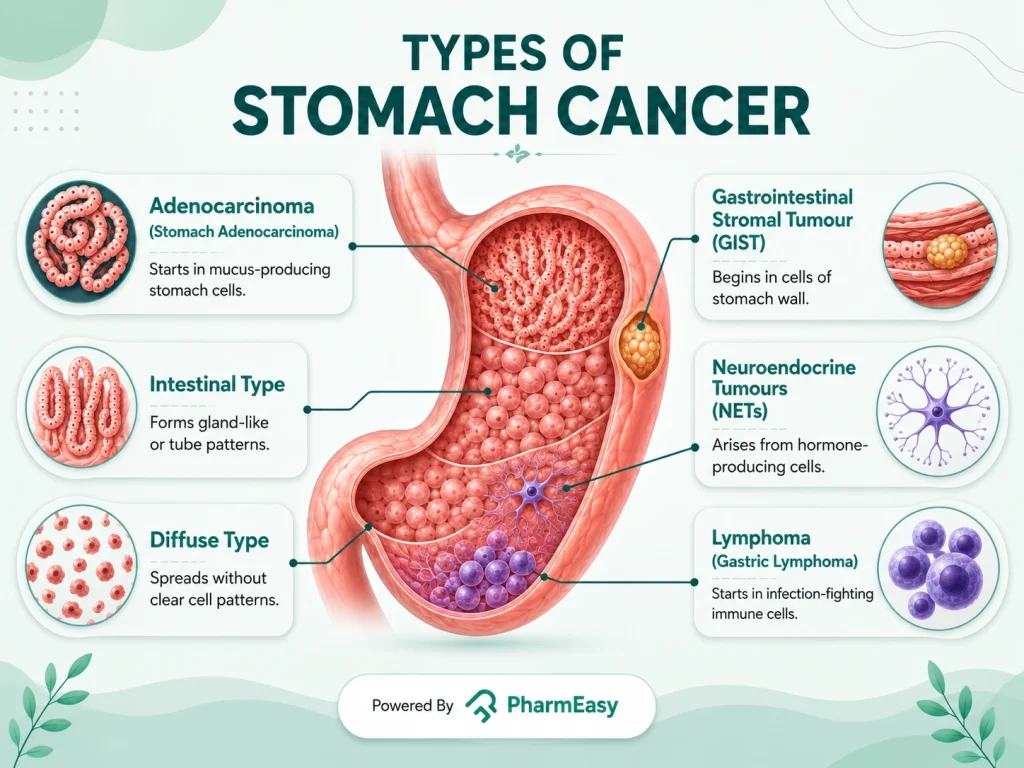
There are different types of stomach cancer based on the type of cells they originate in.
Note: There are certain other types of cancers, such as squamous cell carcinoma, small cell carcinoma, and leiomyosarcoma, that can develop in the stomach. However, these forms are uncommon.
Stomach cancer can be divided into different stages:
During this stage, abnormal or cancerous cells are limited to the innermost layer of the stomach lining (mucosa) and have not invaded deeper tissues but can spread to nearby parts. This is also called carcinoma in situ.
Stage I stomach cancer is divided into Stage IA and Stage IB, depending on the spread of the cancer and whether nearby lymph nodes are affected.
Stage II stomach cancer is divided into Stage IIA and Stage IIB based on how deeply the cancer has grown into the stomach wall and how many nearby lymph nodes are affected.
Stage III stomach cancer is divided into Stages IIIA, IIIB and IIIC. At this stage, the cancer has grown deeper into the stomach wall and may have spread to several nearby lymph nodes or surrounding organs.
The cancer at this stage has spread from the stomach to other distant parts of the body, such as the liver, lungs, distant lymph nodes or the lining of the abdomen. This stage is also known as metastatic stomach cancer. The cancer that has spread to other organs is the same type as the original tumour. For example, stomach cancer that spreads to the lungs will still have stomach cancer cells and it will be called metastatic stomach cancer8.
If stomach cancer is suspected, doctors may use a combination of tests to confirm the diagnosis, determine the extent of the disease and choose the most appropriate treatment. The common diagnostic tests include:
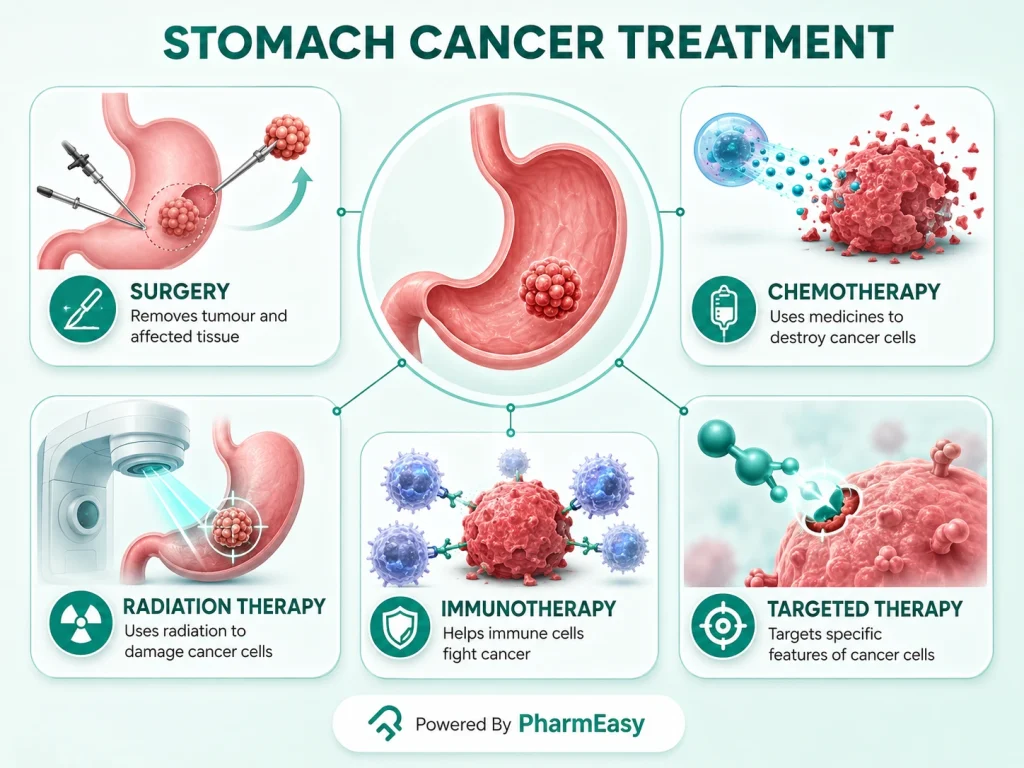
Stomach cancer treatment depends on factors such as the cancer stage, its location, the individual’s overall health, and whether the cancer has spread to other parts of the body. Doctors may use one treatment or combine several approaches as needed.
Also Read: Bowel Cancer (Colorectal Cancer): Meaning, Symptoms, Diagnosis & Treatment
Not every case of stomach cancer can be prevented. However, certain measures may help reduce its risk:
Note: These steps may help lower the risk of stomach cancer; however, they may not be able to prevent every case. Your risk can also be influenced by factors such as family history and other health conditions. Speak with a doctor for personalised advice if you have concerns about your risk factors.
See a doctor if digestive problems persist, keep coming back or worsen over time. Seek medical advice for symptoms such as unexplained weight loss, ongoing indigestion, repeated vomiting, difficulty swallowing, loss of appetite, feeling full quickly, blood in vomit or black (or red) stools, unusual tiredness, swelling or persistent abdominal pain. These symptoms can occur with many common digestive problems and do not necessarily mean stomach cancer. However, it is important to consult your doctor for persistent symptoms as this may help find the cause early and ensure appropriate treatment1.
Also Read: Is Bowel Leakage a Sign of Cancer?
Being aware of changes in digestion and other unusual stomach symptoms can help encourage early medical evaluation. Knowing your personal risk factors and following healthy habits may help lower the chances of developing stomach cancer. If symptoms do not settle or become more severe, seeing a doctor promptly can help identify the cause and guide you to the right treatment.
Stomach cancer is often discovered when persistent digestive symptoms lead a person to seek medical advice and undergo tests such as an upper endoscopy and biopsy. In some cases, it may be found during tests performed for another stomach-related problem1,9.
Stomach cancer can be serious and may become life-threatening, especially when diagnosed at an advanced stage. However, early detection and appropriate treatment can improve the chances of recovery14.
Yes, stomach cancer can cause unintentional weight loss1,4, often due to reduced appetite, feeling full quickly, or the effects of the cancer on the body.
The rate at which stomach cancer develops depends on multiple factors, such as the type of cancer. It can also differ based on the characteristics and stage of the tumour, with some cancers progressing gradually while others may advance more quickly15.
Yes, smoking is linked to a higher risk of developing stomach cancer, as harmful chemicals in tobacco can damage cells in the stomach lining. Quitting smoking can help reduce this risk and improve overall health6,13.
Early stomach cancer may cause few or no noticeable symptoms, so it cannot be confirmed based on symptoms alone. Persistent indigestion, stomach discomfort, loss of appetite or unexplained weight loss should be checked by a doctor. They may recommend tests such as an upper endoscopy or biopsy1,9.
1. Stomach cancer symptoms. NCI. 2024. Available from: https://www.cancer.gov/types/stomach/symptoms
2. Stomach cancer. Cancer Research UK. Available from: https://www.cancerresearchuk.org/about-cancer/stomach-cancer
3. What is stomach cancer? NCI. Available from: https://www.cancer.gov/types/stomach
4. Menon G, El-Nakeep S, Babiker HM. Gastric cancer. In: StatPearls. StatPearls Publishing; 2024. Available from: http://www.ncbi.nlm.nih.gov/books/NBK459142/
5. Causes of stomach cancer – NCI. 2025.Available from: https://www.cancer.gov/types/stomach/causes-risk-factors
6. Stomach cancer risk factors. American Cancer Society. 2026. Available from: https://www.cancer.org/cancer/types/stomach-cancer/causes-risks-prevention/risk-factors.html
7. Stomach cancer. American Cancer Society. 2026. Available from: https://www.cancer.org/cancer/types/stomach-cancer.html
8. Stages of stomach cancer. NCI. 2023. Available from: https://www.cancer.gov/types/stomach/stages#stage-0-carcinoma-in-situ-of-the-stomach
9. Stomach cancer diagnosis. NCI. 2023. Available from: https://www.cancer.gov/types/stomach/diagnosis
10. Tests for stomach cancer. Cancer Research UK. 2025. Available from: https://www.cancerresearchuk.org/about-cancer/stomach-cancer/getting-diagnosed/tests-stomach-cancer
11. Stomach cancer treatment. NCI. 2025. Available from: https://www.cancer.gov/types/stomach/treatment
12. Stomach cancer treatment by stage. NCI. 2025. Available from: https://www.cancer.gov/types/stomach/treatment/by-stage
13. Stomach cancer causes, risk factors, and prevention. American Cancer Society. 2026.Available from: https://www.cancer.org/cancer/types/stomach-cancer/causes-risks-prevention.html
14. Stomach cancer survival rates and statistics. NCI. 2023. Available from: https://www.cancer.gov/types/stomach/survival
15. Murakami K, Matsubara H. Chronology of gastrointestinal cancer. Surg Today. 2017;48(4):365-370. doi:10.1007/s00595-017-1574-y https://pubmed.ncbi.nlm.nih.gov/28795270/
Disclaimer: The information provided here is for educational/awareness purposes only and is not intended to be a substitute for medical treatment by a healthcare professional and should not be relied upon to diagnose or treat any medical condition. The reader should consult a registered medical practitioner to determine the appropriateness of the information and before consuming any medication. PharmEasy does not provide any guarantee or warranty (express or implied) regarding the accuracy, adequacy, completeness, legality, reliability or usefulness of the information and disclaims any liability arising thereof.
Links and product recommendations in the information provided here are advertisements of third-party products available on the website. PharmEasy does not make any representation on the accuracy or suitability of such products/services. Advertisements do not influence the editorial decisions or content. The information in this blog is subject to change without notice. The authors and administrators reserve the right to modify, add, or remove content without notification. It is your responsibility to review this disclaimer regularly for any changes.


