




Types of Bone Fracture: Symptoms, Treatment and Prevention
By Dr. Parth Mehta +2 more

Medically reviewed by Dr. Parth Mehta
Last updated: Sep 16, 2026 Published on: May 7, 2026


Get,

to manage your symptom
Get your,

4 Cr+ families
benefitted

OTP sent to 9988776655



You’ve successfully subscribed to receive
doctor-approved tips on
Whatsapp

Get ready to feel your best.


Register to Avail the Offer
Send OTPBy continuing, you agree with our Privacy Policy and Terms and Conditions
Hi There,
Sign up on PharmEasy now!!


Trusted by 4 crore+ families

OTP sent to 9988776655
You have unlocked 25% off on medicines


Code: NU25

By Dr. Parth Mehta +2 more
Table of Contents
A fall or accident can instantly cause a broken bone, affecting your mobility and daily life. Bone fractures are the most common orthopaedic injuries, occurring when a bone cracks or breaks due to sudden impact, trauma, or weak bone structure1. Early recognition of fractures is important because timely treatment might help avoid severe complications like deformity or long-term pain.
Fractures can occur irrespective of age, and they can vary from a simple hairline fracture to complete breaks. The major causes of bone fractures are falls, sports injuries, road accidents, osteoporosis, and repetitive stress on the bone. Maintaining bone strength through a proper diet and understanding other preventive measures might reduce the risk of bone fractures and promote long-term skeletal health1.

In this article, we will discuss bone fractures, their types, symptoms, treatment options, etc.
As mentioned earlier, a bone fracture is a condition in which a bone cracks or breaks completely1. This may occur due to conditions like falls, road accidents, or sports injuries when the bone is subjected to pressure that it cannot withstand, causing it to split or break2. In some cases, bones weakened by conditions like osteoporosis or repeated stress are more likely to fracture, even with minor pressure. Bone fractures can range from a thin crack to a full break where the bone splits into multiple pieces depending on the force it is subjected to. For example, in high impact situations, such as in a car accident or gunshot injury, the bone can break into multiple pieces1.
Although bones are strong, they may fracture under certain conditions, such as:
A fracture is called a closed fracture when the bone breaks but does not pierce the skin, making it less exposed to infection. Open fracture occurs when the broken bone breaks through the skin, creating a wound, making it prone to infection3. Open fractures require immediate medical attention due to high chances of complications.
The symptoms of bone fracture usually depend on the type of fracture and severity. Some common bone fracture symptoms include:
There are various types of bone fractures based on the affected part of the body and their cause. All fractures require immediate medical attention; avoid relying solely on home remedies. Provide only quick first aid if needed and take the patient to the nearest hospital as soon as possible. The types of bone fractures, their causes, and basic first aid measures are as follows.
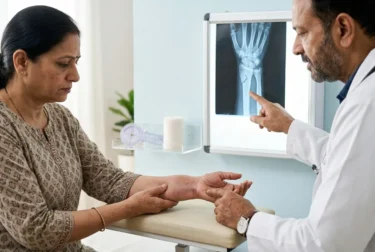
This is a fracture where the bone breaks but does not pierce the skin3. The injury is internal, and the risk of infection is lower compared to open fractures. Can occur from falls, minor accidents, or direct impact where the force is enough to break the bone but not the skin.
First aid for the fracture:
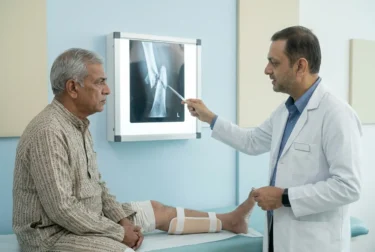
In this type of fracture, the broken bone sticks out through the skin or creates a wound that reaches the bone. The risk of bleeding and infection is very high3. It is commonly caused by severe trauma such as road accidents, falls from height, or high-impact injuries4.
First aid for the fracture:
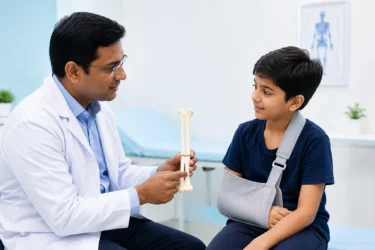
Greenstick fractures usually occur in children as their bones are more flexible than adults. This is a partial thickness fracture, in which the bone partially breaks on one side while the other side stays intact. It can occur after a fall and from accidents, sports injuries, or being hit. Malnutrition, in particular, vitamin D deficiency, increases the likelihood of Greenstick fractures5.
First aid for the fracture:
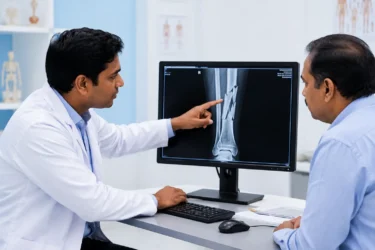
In this type of fracture, the bone breaks into three or more number of pieces1,3. The bone fracture healing time for a comminuted fracture is more. Comminuted fractures can occur from high-impact trauma like car accidents or heavy falls1.
First aid for the fracture:
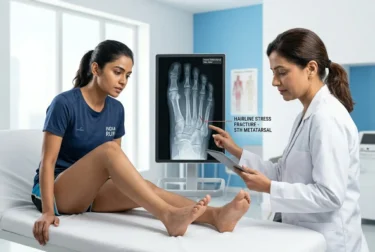
This type of fracture is a small crack in the bone that develops due to repeated stress on the bone over time, which may weaken the bone and reduce its ability to withstand force. Hairline fractures commonly occur in the foot or lower leg due to repeated activities such as jogging or running1,3,6.
First aid for the fracture:
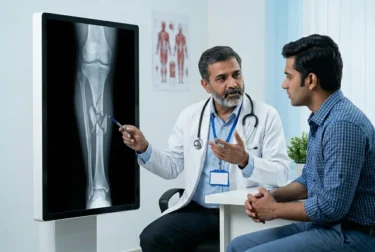
This type of fracture causes injury to the surrounding structures, such as muscles, nerves, blood vessels, arteries, and even the lining of the bone (periosteum). Can result from accidents, crushing injuries, or falls3.
First aid for the fracture:
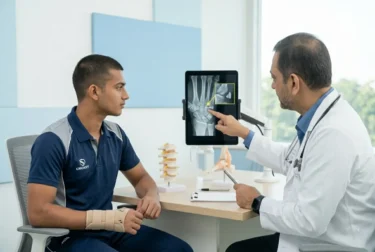
In this type of fracture, a small piece of bone is pulled away from the main bone by a tendon or ligament attached to it. It usually occurs due to a sudden strong pull, such as during sports activities or from repeated stress over time. In rare cases, it can also happen after surgery or due to diseases that weaken the bone7.
First aid for the fracture:
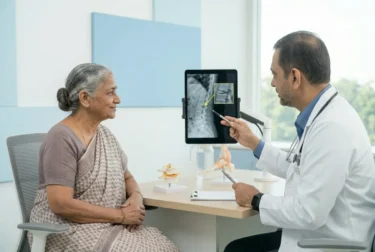
This type of fracture results from pressing of the bones against each other3, where the bone may collapse. Compression fractures usually occur in the spine and may be caused by weakening of the bones due to osteoporosis or cancer3,8.
First aid for the fracture:
Note: The first aid tips provided are only for initial management and should never replace proper treatment. It is recommended to take the patient to the hospital as early as possible following an injury.
The most common approaches to diagnosing a bone fracture include:
Bone fracture treatment can be performed using either non-surgical or surgical methods, depending on the severity and type of injury.
Non-surgical treatment approaches include:
Surgical approaches for fracture are needed when nonsurgical options are not suitable and include:
Note: Treatment approaches are selected based on the types of bone fractures. Non-surgical methods should only be followed under the guidance of a doctor.
If surgical options are required, they should be performed by a qualified specialist. After surgery, adequate rest and proper care are important, and the patient should follow the doctor’s instructions to support safe and timely recovery.
The healing time for a bone fracture varies depending on the type and severity of the injury. While some fractures (e.g., fractures in the fingers) take 3 to 4 weeks to heal, others may need 6 to 8 weeks, 3 to 6 months, or even longer1. In children, the healing may be faster, while it might take more time in adults14 . More complex fractures, such as comminuted or complicated fractures, may require several months for complete recovery, especially if surgery is involved.
Several factors can affect the recovery process. These include the patient’s age, the type and location of the fracture, overall health, and the treatment method used1,3. Good nutrition (especially calcium and vitamin D supplementation), proper rest, and regular medical follow-up also play an important role in the healing process1,15.
Physiotherapy is an essential part of treatment and recovery after a fracture. Once the bones start healing, physiotherapy under expert guidance might help restore muscle strength, flexibility, and range of motion of the affected area4. It might help reduce stiffness and muscle weakness caused by extended periods of immobilisation. Normal activities can be resumed gradually, once the bones have healed and attained strength; however, it is important to follow medical guidance to avoid re-injury.
Also Read: How High Heels Affect the Body?
Here are some ways to help reduce the occurrence of bone fractures.
Also Read: Joint Pain During the Monsoon: Causes, Symptoms, Exercises & Relief Tips
The following signs and symptoms indicate the patient requires immediate medical attention:
Also Read: Sprained Ankle: What Is It, Causes, Symptoms & More
Bone fractures are common injuries that might vary in severity, but require timely medical attention for proper healing. Early diagnosis, an appropriate medical approach, and guided rehabilitation play an important role in recovery. By maintaining bone health and taking protective measures, the risk of fractures can be reduced, supporting overall mobility and quality of life.
Bone fractures can occur from trauma from accidents or sports injuries, due to low bone density (osteoporosis), repetitive usage of particular bones, such as from jogging or running1.
The initial approaches that can be employed following a fracture are managing bleeding, immobilising the injured area using a splint, and restricting the patient from moving3.
After a bone fracture, avoid moving the injured area or trying to straighten it, lifting or driving, and getting your cast wet3.
For a faster recovery from fracture, getting proper rest, taking a nutrient-rich diet, avoiding smoking and alcohol consumption, and having regular check-ups and follow-ups can help1,3.
The signs of a healing fracture may include a slow reduction in pain, reduced swelling and fading of bruises.
1. Fractures (Broken Bones). doi: https://orthoinfo.aaos.org/en/diseases–conditions/fractures-broken-bones/
2. Broken Bone. 2024. doi: https://medlineplus.gov/ency/article/000001.htm
3. Bone Fractures. 2022. doi: https://www.betterhealth.vic.gov.au/health/conditionsandtreatments/bone-fractures
4. Open Fractures. doi: https://orthoinfo.aaos.org/en/diseases–conditions/open-fractures/
5. Atanelov Z, Bentley TP. Greenstick Fracture. 2023. doi: https://www.ncbi.nlm.nih.gov/books/NBK513279/
6. Fractures. 2024. doi: https://www.healthdirect.gov.au/fractures
7. McCoy JS, Nelson R. Avulsion Fractures. In: StatPearls. StatPearls Publishing; 2026. Accessed March 17, 2026. http://www.ncbi.nlm.nih.gov/books/NBK559168/
8. Compression Fracture. doi:https://www.cancer.gov/publications/dictionaries/cancer-terms/def/compression-fracture
9. Diagnosis of Fracture. doi:https://www.ncbi.nlm.nih.gov/books/NBK174863/
10. Sadineni RT. Imaging Patterns in MRI in Recent Bone Injuries Following Negative or Inconclusive Plain Radiographs. JCDR. Published online 2015. doi:10.7860/JCDR/2015/15451.6685 Available from: https://europepmc.org/article/pmc/4625309
11. Computer Tomography. 2025. doi: https://www.nibib.nih.gov/science-education/science-topics/computed-tomography-ct
12. Bone Graft. doi: https://medlineplus.gov/bonegrafts.html
13. Seidlitz C, Kip M. Chapter 1: Introduction to the Indications and Procedures. doi: https://www.ncbi.nlm.nih.gov/books/NBK546138/
14. Lindaman LM. Bone healing in children. Clin Podiatr Med Surg. 2001;18(1):97-108. doi: https://pubmed.ncbi.nlm.nih.gov/11344982/
15. Institute of Orthopaedic Research and Biomechanics, University of Ulm, Helmholtzstraße 14, 89081 Ulm, Germany, Fischer V, Haffner-Luntzer M, Amling M, Ignatius A. Calcium and vitamin D in bone fracture healing and post-traumatic bone turnover. eCM. 2018;35:365-385. doi:10.22203/eCM.v035a25. Available from: https://pubmed.ncbi.nlm.nih.gov/29931664/
Disclaimer: The information provided here is for educational/awareness purposes only and is not intended to be a substitute for medical treatment by a healthcare professional and should not be relied upon to diagnose or treat any medical condition. The reader should consult a registered medical practitioner to determine the appropriateness of the information and before consuming any medication. PharmEasy does not provide any guarantee or warranty (express or implied) regarding the accuracy, adequacy, completeness, legality, reliability or usefulness of the information; and disclaims any liability arising thereof.
Links and product recommendations in the information provided here are advertisements of third-party products available on the website. PharmEasy does not make any representation on the accuracy or suitability of such products/services. Advertisements do not influence the editorial decisions or content. The information in this blog is subject to change without notice. The authors and administrators reserve the right to modify, add, or remove content without notification. It is your responsibility to review this disclaimer regularly for any changes.


Comments

Leave your comment...
You may also like

























Comments